morocco

Moroccan cuisine (Arabic: المطبخ المغربي) is the cuisine of Morocco, fueled by interactions and exchanges with many cultures and nations over the centuries.[1] Moroccan cuisine is usually a mix of Arab, Berber, Andalusi, and Mediterranean cuisines, with minimal European (French and Spanish) and sub-Saharan influences.[2] Like the rest of the Maghrebi cuisine, Moroccan cuisine has more in common with Middle Eastern cuisine than with the rest of Africa.[3]

According to Moroccan chef and cuisine researcher Hossin Houari, the oldest traces of Moroccan cuisine that can still be observed today go back to the 7th century BC.[4]

Pork consumption is forbidden to Muslims in Morocco, in accordance with Islamic dietary laws.

Ingredients[edit]

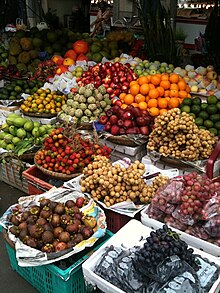
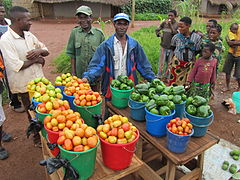
Morocco produces a large range of Mediterranean fruits and vegetables, as well as tropical products like snails. Common meats include beef, goat, mutton and lamb, which, together with chicken and seafood, serve as a base for the cuisine. Characteristic flavorings include lemon pickle, argan oil, preserved butter (smen), olive oil, and dried fruits.

The staple grains today are rice and wheat, used for bread and couscous, though until the mid-20th century, barley was an important staple, especially in the south.[5] Grapes are mostly eaten fresh, as a dessert; wine consumption is only about 1 liter per capita per year.[6][7][8] The traditional cooking fats are butter and animal fat, though olive oil is now replacing them.[9] Butter is used both fresh, zebeda, and preserved, smen.[10]

Flavorings[edit]

Spices and ras el hanout are used extensively in Moroccan food.[11][12][13] Although some spices have been imported to Morocco through the Arabs, introducing Persian and Arabic cooking influences, many ingredients—like saffron from Talaouine, mint and olives from Meknes, and oranges and lemons from Fes—are home-grown, and are being exported. After the Idrissids established Fes in 789, predominant in Arab culture, many spices were brought from the east.[14] Common spices include cinnamon, cumin, turmeric, ginger, paprika, coriander, saffron, mace, cloves, fennel, anise, nutmeg, cayenne pepper, fenugreek, caraway, black pepper and sesame seeds. Twenty-seven spices are combined for the Moroccan spice mixture ras el hanout.[15]

Common herbs in Moroccan cuisine include mint, parsley, coriander, oregano, peppermint, marjoram, verbena, sage and bay laurel.

Structure of meals[edit]

Khudenjal, an herbal tea based on Alpinia officinarum, and two types of sellou at Jemaa el-Fnaa in Marrakesh.

A typical lunch begins with a series of hot and cold salads, followed by a tagine or dwaz. Often, for a formal meal, a lamb or chicken dish is next, or couscous topped with meat and vegetables. Traditionally, Moroccans eat with their hands and use bread.[16] The consumption of pork and alcohol is uncommon due to religious restrictions.[17]

Main dishes[edit]

See also: List of Moroccan dishes

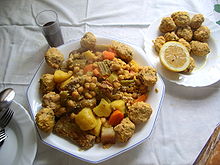
Couscous with vegetables, meat, and tfaya, a confection of caramelized onions, raisins, sugar, butter, and cinnamon.

The main Moroccan dish people are most familiar with is couscous;[18] lamb is the most commonly eaten meat in Morocco, usually eaten in a tagine with a wide selection of vegetables. Chicken is also very commonly used in tagines or roasted. They also use additional ingredients such as plums, boiled eggs, and lemon. Like their national food, the tagine has a unique taste of popular spices such as saffron, cumin, cinnamon, ginger, and cilantro, as well as ground red pepper.[19]

Moroccan cuisine has ample seafood dishes. European pilchard is caught in large but declining quantities.[20] Other fish species include mackerel, anchovy, sardinella, and horse mackerel.[21]

Other famous Moroccan dishes are pastilla (also spelled basteeya or bestilla), tanjia, and rfissa.

Tagine-cooked chicken and vegetables with mint tea and khobz el-dâr.

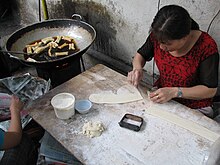
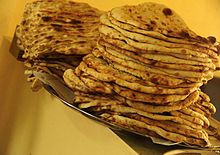
A big part of the daily meal is bread. Bread in Morocco is principally made from durum wheat semolina known as khobz. Bakeries are very common throughout Morocco and fresh bread is a staple in every city, town, and village. The most common is whole-grain coarse ground or white-flour bread or baguettes. There are also a number of flat breads and pulled unleavened pan-fried breads.

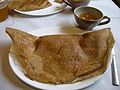
In addition, there are dried salted meats and salted preserved meats such as khlea and g'did (basically sheep bacon), which are used to flavor tagines or used in el rghaif, a folded savory Moroccan pancake.

Soups[edit]

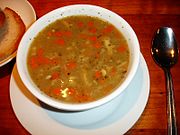
Harira, a typical heavy soup, is eaten during winter to warm up and is usually served for dinner. It is typically eaten with plain bread or with dates during the month of Ramadan. Bissara is a broad bean-based soup that is also consumed during the colder months of the year.[22]

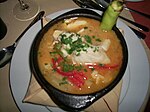
Moroccan snail soup, also known as "Beboush," is a traditional delicacy in Moroccan cuisine.[23] This unique and flavorful dish is a beloved part of Moroccan street food culture and can be found in bustling marketplaces throughout the country. It is made by simmering tender snails in a fragrant broth infused with a medley of aromatic spices, including cumin, coriander, and mint. The result is a savory and slightly spicy soup that offers a true taste of Morocco. Moroccan Snail Soup is a testament to the rich and diverse culinary heritage of the country, enticing locals and adventurous travelers alike with its bold flavors and cultural significance.

Salads[edit]

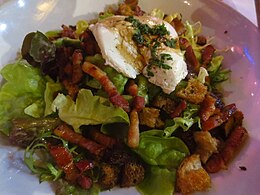
Salad asorti, served in Beni Mellal

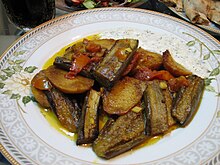
Salads include both raw and cooked vegetables, served either hot or cold.[24] include zaalouk, an aubergine and tomato mixture, and taktouka (a mixture of tomatoes, smoked green peppers, garlic, and spices) characteristic of the cities of Taza and Fes, in the Atlas.[24] Another cold salad is called bakoula, or khoubiza, consisting of braised mallow leaves, but can also be made with spinach or arugula, with parsley, cilantro, lemon, olive oil, and olives.

Desserts[edit]

Moroccan traditional cookies seller in the old Medina in Marrakech

Usually, seasonal fruits rather than cooked desserts are served at the close of a meal. A common dessert is kaab el ghzal (كعب الغزال, gazelle ankles), a pastry stuffed with almond paste and topped with sugar. Another is halwa chebakia, pretzel-shaped dough deep-fried, soaked in honey and sprinkled with sesame seeds; it is eaten during the month of Ramadan. Jowhara is a delicacy typical of Fes, made with fried waraq pastry, cream, and toasted almond slices.[25] Coconut fudge cakes, 'Zucre Coco', are popular also.

Seafood[edit]

See also: Fishing industry in Morocco

Morocco is endowed with over 3000 km of coastline. There is an abundance of fish in these coastal waters with the sardine being commercially significant as Morocco is the world's largest exporter.[26] Sardines were used in the production of garum in Lixus.

At Moroccan fish markets, one can find sole, swordfish, tuna, turbot, mackerel, shrimp, conger eel, skate, red snapper, spider crab, lobster and a variety of mollusks.

In Moroccan cuisine, seafood is incorporated into, among others, tajines, bastilla, briouat, and paella.

Seafood for sale at Casablanca's Central Market

Drinks[edit]

Main article: Maghrebi mint tea

Moroccan mint tea

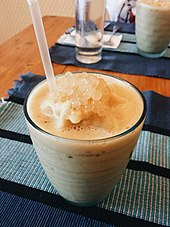
A pistachio croissant served with a nuṣṣ-nuṣṣ (نص-نص "half-half," a Moroccan variant of café crème), served at a café in Casablanca.

The most popular drink is Moroccan mint tea, locally called atay. Traditionally, making good mint tea in Morocco is considered an art form and the drinking of it with friends and family is often a daily tradition. The pouring technique is as crucial as the quality of the tea itself. Moroccan tea pots have long, curved pouring spouts and this allows the tea to be poured evenly into tiny glasses from a height. For the best taste, glasses are filled in two stages. The Moroccans traditionally like tea with bubbles, so while pouring they hold the teapot high above the glasses. Finally, the tea is accompanied with hard sugar cones or lumps.[27] Morocco has an abundance of oranges and tangerines, so fresh orange juice is easily found and inexpensive.

Snacks and fast food[edit]

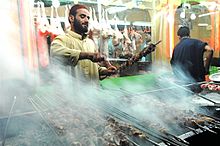
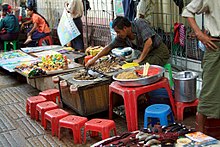
Selling fast food in the street has long been a tradition, and the best example is Djemaa el Fna square in Marrakech. Ma'quda is a potato fritter popular among students and people of modest means, particularly in Fes.[28] Starting in the 1980s, new snack restaurants, primarily in the north, started serving bocadillos (a Spanish word for a sandwich).

Dairy product shops locally called mhlaba (محْلَبة), are very prevalent all around the country. Those dairy stores generally offer all types of dairy products, juices, smoothies, and local fare such as bocadillos, msemmen and harcha.[29]

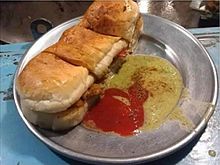
The khanz u-bnīn (خانز وبنين "stinky and delicious") is a cheap and popular street sandwich.[30]

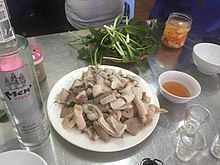
Another popular street food in Morocco[31] is snails, served in their juices in small bowls, and eaten using a toothpick.[32]

In the late 1990s, several multinational fast-food franchises opened restaurants in major cities.[33]

Chefs[edit]

Among those who have brought Moroccan cuisine to a wider audience are TV chef Choumicha and Al-Amīn al-Hajj Mustafa an-Nakīr, chef to the former king of Morocco Hassan II.

poland

Polish cuisine (Polish: kuchnia polska) is a style of food preparation originating in and widely popular in Poland. Due to Poland's history, Polish cuisine has evolved over the centuries to be very eclectic, and shares many similarities with other national cuisines. Polish cooking in other cultures is often referred to as à la polonaise.

Polish cuisine is rich in meat, especially pork, chicken and game, in addition to a wide range of vegetables, spices, fungi and mushrooms, and herbs.[1] It is also characterised by its use of various kinds of pasta, cereals, kasha and pulses.[2] In general, Polish cuisine makes extensive use of butter, cream, eggs, and seasoning. Traditional dishes often demand lengthy preparation. Many Poles take time to serve and enjoy their festive meals, especially Christmas Eve dinner (Wigilia) on December 24, or Easter breakfast, both of which could take several days to prepare.

Among popular Polish national dishes are bigos [ˈbiɡɔs] ⓘ, pierogi [pʲɛˈrɔɡʲi] ⓘ, kiełbasa, kotlet schabowy [ˈkɔtlɛt sxaˈbɔvɨ] ⓘ (pork loin breaded cutlet), gołąbki [ɡɔˈwɔ̃pkʲi] ⓘ (stuffed cabbage leaves), zrazy [ˈzrazɨ] (roulade), zupa ogórkowa [ˈzupa ɔɡurˈkɔva] (sour cucumber soup), zupa grzybowa [ˈzupa ɡʐɨˈbɔva] (mushroom soup), zupa pomidorowa [ˈzupa pɔmidɔˈrɔva] (tomato soup),[3] rosół [ˈrɔsuw] ⓘ (meat broth), żurek [ˈʐurɛk] ⓘ (sour rye soup), flaki [ˈflakʲi] ⓘ (tripe soup), and red beetroot soup barszcz [barʂt͡ʂ] ⓘ.[4]

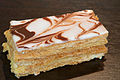
A traditional Polish dinner is composed of three courses, beginning with a soup like the popular rosół broth or tomato soup. In restaurants, soups are followed by an appetizer such as herring (prepared with either cream, oil, or in aspic), or other cured meats and chopped raw vegetable salads. The main course usually includes meat, such as a roast, breaded pork cutlet, or chicken, with a coleslaw-like surówka ([suˈrufka]), shredded root vegetables with lemon and sugar (carrot, celeriac, cooked beetroot), sauerkraut, or mizeria salad. The side dishes are usually boiled potatoes, kasza, or less commonly, rice. Meals often conclude with a dessert of either a fruit compote, makowiec, a poppy seed pastry, napoleonka mille-feuille, or sernik (cheesecake).

Internationally, if a Polish culinary tradition is used in other cuisines, it is referred to as à la polonaise, from the French, meaning 'Polish-style.' In French cuisine, this term is used for techniques like using butter instead of cooking oil; frying vegetables with buttered breadcrumbs; using minced parsley and boiled eggs (Polonaise garnish); and adding horseradish, lemon juice, or sour cream to sauces like velouté.[5][6]

History[edit]

Middle Ages[edit]

Flaki (or flaczki) is tripe soup, known since the Middle Ages and favourite dish of king Jogaila.

Polish cuisine in the Middle Ages was based on dishes made of agricultural produce and cereal crops (millet, rye, wheat), meats of wild and farm animals, fruits, forest fungi, berries and game, honey, herbs, and local spices. It was known above all for abundant use of salt from Wieliczka Salt Mine and permanent presence of groats (kasza). A high calorific value of dishes and drinking beer or mead as a basic drink was typical of Middle Ages Polish cuisine.[citation needed]

During the Middle Ages Polish cuisine was heavy and spicy. Two main ingredients were meat (both game and beef) and cereal. The latter consisted initially of proso millet, but in the Late Middle Ages other types of cereal became widely used. Most country people did not eat bread but consumed cereals in the form of kasza or various types of flatbread. Some of these (for instance kołacz) are considered traditional recipes even in the 21st century. Apart from cereals, a large portion of the daily diet of mediaeval Poles consisted of pulses, mostly broad beans and peas. As the territory of Poland was densely forested, usage of fungi, forest berries, nuts, and wild honey was also widespread. Among the delicacies of the Polish nobility were honey-braised bear paws served with horseradish-flavoured salad, smoked bear tongue, and bear bacon (bears are now protected in Poland)[citation needed].[7][8]

Pierniki (Polish gingerbread) from Toruń, 14th-century recipe

Owing to close trade relations with Turkey and the countries in the Caucasus, the price of spices (such as black pepper and nutmeg) was much lower in Poland than the rest of Europe, hence spicy sauces became popular. The usage of two basic sauces, the jucha czerwoná and jucha szará (meaning "red" and "gray blood" in Old Polish), remained widespread at least until the 18th century.[9]

Daily beverages included milk, whey, buttermilk, and various herbal infusions. The most popular alcoholic beverages were beer and mead; however, in the 16th century, upper classes began to import Hungarian and Silesian wines. Mead was so widespread that in the 13th century Prince Leszek I the White explained to the Pope that Polish knights could not participate in a crusade as there was no mead in the Holy Land.[10] Also, vodka became popular, possibly among the lower classes first. There is written evidence suggesting that vodka originated in Poland. The word "vodka" was recorded for the first time ever in 1405 in Akta Grodzkie,[11] the court documents from the Palatinate of Sandomierz in Poland.[11] At that time, the word wódka (vodka) referred to chemical compounds such as medicines and cosmetic cleansers, while the popular beverage was called gorzałka [ɡɔˈʐawka] (from the Old Polish gorzeć).

Renaissance[edit]

The Italian Queen Bona Sforza (second wife of Sigismund I of Poland), brought Italian cooks with her court to Poland after 1518. Although native vegetable foods were an ancient and intrinsic part of Polish cuisine, there began a period in which vegetables like lettuce, leeks, celeriac, cabbage, carrots, onions (cipolla/cebula) and especially, tomatoes (pomo d'oro/pomidory), were introduced. Even today, some of those vegetables are referred to in Polish as włoszczyzna, a word derived from Włochy, the Polish name of Italy. During this period, the use of spices — which arrived in Poland via Western Asian trade routes was common among those who could afford them, and dishes considered elegant could be very spicy. However, the idea that Queen Bona was the first to introduce vegetables to Poland is false. While her southern cooks may have helped elevate and expand the role of various vegetables in royal Polish cuisine, records show that the court of king Jogaila (Polish: Władysław II Jagiełło, who died in 1434, over 80 years before her reign) enjoyed a variety of vegetables including lettuce, beets, cabbage, turnip, carrots, peas, and cauliflower.

Ogórki kiszone (brine-pickled cucumbers)

Polish-style pickled cucumber (ogórek kiszony) is a variety developed in the northern part of Central Europe. It was exported worldwide and is found in the cuisines of many countries. It is usually preserved in wooden barrels. A cucumber only pickled for a few days is different in taste (less sour) than one pickled for a longer time and is called ogórek małosolny (lit. 'lightly salted gherkin'). Another kind of pickled gherkin popular in Poland is ogórek konserwowy (lit. 'preserved gherkin'), which is preserved with vinegar rather than pickled and uses different spices creating a sweet and sour taste, and well-known in Jewish cuisine.

The court of Queen Bona was followed the Italian fashion, because she exclusively employed Italian chefs, some of whom were originally hired to prepare parties for aristocratic families but who were soon serving typical Italian dishes as part of the court's daily menu. Court records show that Queen Bona imported large volumes of southern European, American, and Western Asian fruits (oranges, lemons, pomegranates, olives, figs, tomatoes), vegetables (potatoes and corn), nuts (chestnuts, raisins, and almonds, including marzipan), along with grains (such as rice), cane sugar, and Italian olive oil. The court also imported various herbs and spices including black pepper, fennel, saffron, ginger, nutmeg, cloves, and cinnamon.[12]

The Polish–Lithuanian Commonwealth[edit]

Compendium ferculorum, albo Zebranie potraw ("Collection of Dishes") is the oldest extant Polish cookbook, from 1682.

Until the Partitions perpetrated by the neighboring empires, Poland was one of the largest countries in the world, and encompassed many regions with its own, distinctive culinary traditions.[12] Two consecutive Polish kings, Władysław IV and John II Casimir (Polish: Jan II Kazimierz Waza) married the same French Duchess, Marie Louise Gonzaga (Polish: Ludwika Maria), daughter of Charles I, Duke of Mantua; she was persecuted by King Louis XIII of France for her affiance to his opponent Gaston, Duke of Orléans. Marie Louise arrived in Warsaw in 1646, was widowed, and married again in 1649.[relevant?] Ludwika brought along with her a court full of Frenchmen including courtiers, secretaries, army officers, physicians, merchants, craftsmen, as well as many cooks.[13]

Records show that her visiting guests were entertained with game, fowl (waxwings, fieldfares, snow bunting, hazel grouse, partridges, black grouse, capercaillies), fish and mollusks (loach, various trout, grayling, fresh and smoked salmon, flounder, salted herring, lampreys in vinegar, oysters, snails), and Genoese pâté, not to mention fresh fruit and chestnuts. French and Italian wines were served, as well as mead and local beers. These dishes were made only according to French recipes. The royal court, with all its innovations, exerted a broad influence over the rest of aristocratic residences and noble palaces across Poland. French cuisine was in fashion and many families willingly employed French cooks and patissiers. In the mid-18th century, French champagne appeared on Polish tables.[12]

Among the most influential regional cuisines under the Polish–Lithuanian Commonwealth were Lithuanian, Jewish, German, and Hungarian cuisine, as well as Armenian cuisine, which arrived in Poland before the 17th century along with many settlers, especially in the south-eastern part of the Commonwealth.[12] Signature dishes of the Western Asia reached Polish tables thanks to the Armenian trade and cultural exchange with Poland's neighbor: the Ottoman Empire. Rare delicacies were brought to royal court as gifts from sultans and royal envoys. The strongest influences were noted in the cities of Lwów, Kraków, Kamieniec Podolski, and Zamość due to many Armenians living there permanently.[12] Also, because of the close contact with the Ottoman Empire, coffee (kawa) and boza became popular.

With the subsequent decline of Poland, and the grain crisis that followed The Swedish Deluge, potatoes began to replace the traditional use of cereals. The oldest surviving Polish cookbook, Compendium ferculorum, albo Zebranie potraw ("Collection of Dishes") by Stanisław Czerniecki was published in Kraków in 1682.[14][15] Under the Partitions, the cuisine of Poland became heavily influenced by cuisines of surrounding empires. This included Russian and German cuisines, but also the culinary traditions of most nations of the Austro-Hungarian empire. The 19th century also saw the creation of many Polish cookbooks, by Jan Szyttler, Anna Ciundziewicka, Wincenta Zawadzka, Lucyna Ćwierczakiewiczowa, and others.[16][17]

After World War II[edit]

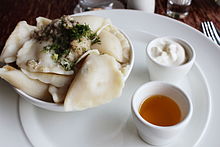
Most enduring of Polish culinary traditions are pierogi, a national dish of Poland, originating in the ancient culinary traditions of Poland's former eastern territories (Kresy).[18]

After the end of World War II, Poland became a communist country which joined the Warsaw Pact. Some restaurants were nationalized. The communists envisioned a net of lunch rooms called "bufet" for the workers at various companies, and milk bars for the public. The majority of restaurants that survived the 1940s and 1950s were state-owned. Workplace canteens promoted mostly inexpensive meals, including soups, meatballs and pork chops, and staples such as placki ziemniaczane / kartoflane (potato pancakes), placki z jablkami (apple pancakes), kopytka (potato gnocchi), leniwe (farmer's cheese gnocchi served as a sweet), and pierogi. A typical second course consisted of meat cutlet served with potatoes or buckwheat and surówka (raw, julienned vegetables). The popular Polish kotlet schabowy is a breaded cutlet similar to the Austrian Wiener schnitzel and the Italian and Spanish Milanesa.[19][20]

With time, the shortage economy led to scarcity of meat, coffee, tea, and other basic ingredients. Many products like chocolate, sugar, and meat were rationed, with a specific limit depending on social class and health requirements. Physical workers and pregnant women were generally entitled to more food products. Imports were restricted, so much of the food supply was domestic. Cuisine became homogeneous, to be a chef was no longer a prestigious profession, and for decades the country became basically disconnected from any foreign cuisine.[21] Tropical fruits (such as citrus, banana, and pineapple) were available during holidays, while local fruits and vegetables were mostly seasonal but were available at private stands. For most of the year, people had to get by with only domestic winter fruit and vegetables: apples, plums, currants, onions, potatoes, cabbage, root vegetables, and frozen products. Other food products (of foreign origins) were seldom available at markets at high prices.

This situation led in turn to gradual replacement of traditional Polish cuisine with food prepared from anything available at the time. Among popular dishes introduced by public restaurants were kotlet mielony (meatballs), a sort of hamburger often served with beetroot puree and raw carrots. The traditional recipes were mostly observed during the Wigilia feast (Christmas Eve), for which many families tried to prepare 12 traditional courses.[22]

A popular form of fish dish was, and still is, the paprikash (paprykarz szczeciński) from the port city of Szczecin, usually added to sandwiches as a spread.[23]

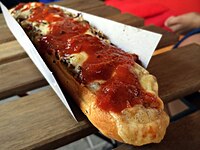
Zapiekanka, a long loaf sandwich with melted cheese, meat, mushrooms, onions, and ketchup. A popular street food to this day which originated in the 1970s.

Modern era[edit]

With the fall of communism in Poland in 1989, a wave of new restaurants opened, and basic foodstuffs were once again readily obtainable. This led to a gradual return of the rich traditional Polish cuisine, both in home cooking and in restaurants. At the same time, restaurants and supermarkets promoted the use of ingredients typical of other cuisines of the world. Among the most notable foods to become commonplace in Poland were cucurbits, zucchini, and many kinds of fish. During communist times, fresh fish was available essentially only in the seaside towns.

Recent years have seen the advent of the slow food movement, and a number of TV programmes devoted to cooking, both traditional and modern, have gained in popularity. In 2011, a nostalgic cookbook (written in English) combining a child's memories growing up in the Gierek era with traditional Polish recipes was published in London.[24][25]

American fast food in Poland, often McDonald's, KFC, and Pizza Hut, are in decline as Polish people prefer their own cuisine, including fast food.[citation needed] Meanwhile, doner kebabs are gaining popularity. Nonetheless, in most of Poland one can still get traditional and very popular Polish street food such as the zapiekanka, a pizza-like baguette with cheese, mushrooms, onion, ketchup, and sometimes meat. There are also many small-scale, quick-service restaurants which serve kebabs, hamburgers, hot dogs, and Polish kiełbasa (sausage). In the southern mountainous region, oscypek served with cranberry jam is a popular street food.

In a 2023 survey on "100 Best Cuisines in the World" conducted by TasteAtlas, Polish cuisine was ranked 13th.[26]

Holiday meals[edit]

Christmas dishes[edit]

See also: Wigilia

Barszcz z uszkami, one of the traditional Wigilia dishes

Traditional Christmas Eve dinner called Wigilia is meat free, though with fish and usually consists of barszcz (borscht) with uszka (small dumplings)—a classic Polish Christmas Eve starter—followed by dishes such as fried carp or cod with apple, leeks and raw salads. Traditionally, carp (fried or Jewish style) provides a main component of the Christmas Eve meal across Poland. Other popular dishes, eaten on ensuing days, include pickled matjas herring, rollmops, pierogi with sauerkraut and forest mushrooms, fish soup, kielbasa, hams, bigos (savory stew of cabbage and meat), and vegetable salads. Among popular desserts are gingerbread, cheesecake, various fruits such as oranges, poppy seed cake, makowiec (makówki in Silesia), fruit kompot, and kluski with poppyseed and gingerbread. Regional dishes include żurek, siemieniotka (in Silesia), and kołduny, stuffed dumplings with mushrooms or meat from the eastern regions.[27]

Fat Thursday[edit]

Pączki or kreple, filled doughnut

Tłusty Czwartek, or "Fat Thursday", is a Polish culinary custom on the last Thursday before Lent, equivalent to Pancake Day. Traditionally, it is an occasion to enjoy sweets and cakes before the forty days of abstinence expected of Catholics until Easter Day.[28]

The most popular sweetmeats on 'Fat Thursday' are pączki, Polish doughnuts, and faworki (sometimes called chrust), equivalent to the French beignets. Traditional Polish doughnuts are filled with rose petal jam, plum jam, or stewed apple and covered with icing with orange peel or powdered with icing sugar. Fat Thursday used to mark the beginning of a "Fat Week", a period of great gluttony during which Polish ancestors consumed dishes served with smalec (lard), bacon, and all kinds of meat.[citation needed]

The original doughnuts, popular until the 16th century, were made of the same dough as bread, and would be filled with pork and fried on smalec. Only later were they made as patisserie.[citation needed]

Easter breakfast[edit]

See also: Święconka

A typical Easter breakfast often consists of cold-cuts served with horseradish sauce and beetroot salads, breads, bigos, żurek, kiełbasa, smoked salmon or herring, marinated vegetable salads, Easter salad (chopped boiled eggs, green peas, ćwikła, carrot, apple, potato, parsley, and mayonnaise), coffee, tea and cakes (such as chocolate cake), makowiec, mazurek, and sernik.

Regional cuisines[edit]

Poland has a number of unique regional cuisines with differences in preparation and ingredients. For an extensive list of the dishes typical of Galicia, Kresy, Podlaskie, Masovia (including Warsaw), Masuria, Pomerania, Silesia, Lesser Poland, the Tatra mountains, and Greater Poland, see the List of Polish cuisine dishes.

Greater Poland[edit]

Typical for Greater Poland are various dishes using potatoes – especially pyry z gzikiem (potatoes with quark cheese mixed with sour cream, onions and chieves). Popular are also poultry dishes like kaczka po poznańsku (duck meat with red cabbage and steam-cooked dumplings), czernina (duck blood soup) and goose meat eaten on the Saint Martin's Day.

Other famous specialities include rogale świętomarcińskie (croissants filled with white poppy seeds), fried cheese and a beer Grodziskie/Grätzer (made from oak-smoked wheat malt and with a low alcohol content).

Lesser Poland[edit]

The city of Kraków is famous for its sausage kiełbasa krakowska and meat sandwich maczanka krakowska. Typical are also some Austrian influences due to the fact, that the city belonged in the second half of the 19th century and at the beginning of the 20th century to Austria-Hungary. They include Pischinger cake and pork cutlet kotlet schabowy (today popular in the whole Poland). Popular street foods are bagels obwarzanki and baked sandwiches zapiekanki sold on the Plac Nowy square.

The area near Nowy Sącz and Limanowa is rich in quality plums; popular are prunes called suska sechlońska and plum brandy slivovitz.

The mountain areas of Lesser Poland, especially Podhale, are famous for its sheep milk cheeses like bundz, creamy bryndza or smoked oscypek. Other popular dishes include a milk drink żętyca, a sauerkraut soup kwaśnica, placek po zbójnicku (potato pancakes with goulash on top) and a góral tea (tea with alcohol).

Lubelszczyzna[edit]

Many dishes in Lublin cuisine have Jewish roots, like cebularz (flatbread topped with onion and poppy seeds) and forszmak (soup with various types of meat).

Important local ingredient is groat – typical dish consisting of it is a pie called pieróg biłgorajski.

Kashubia and Pomerania[edit]

Because of the proximity to the sea, typical for the region are various forms of fish dishes like śledź po kaszubsku (herring in tomato marinade with onion) and fried cod or flounder.

Other famous specialties include kashubian strawberry (kaszëbskô malëna), gingerbreads from Toruń and alcohol beverages from Gdańsk: Goldwasser (herbal liqueur with flakes of gold leaf) and machandel (juniper vodka).

In Szczecin, typical regional products are paszteciki (pastries with meat or vegetarian filling) and fish spread paprykarz szczeciński. Besides, in the resort towns along the westpomeranian Baltic coast, popular street foods are sandwiches with herring, similar to German Fischbrötchen.

Masovia[edit]

Modern Warsaw, as a capital, has a very cosmopolitan cuisine combining various international foods. However, there are also some typical traditional dishes like Warsaw tripe, pyzy z mięsem (potato dumpling with meat) and pork knuckles in jelly (popular as a vodka chaser).

Famous are many desserts of Warsaw origin, like chocolate cream cake wuzetka (probably named after the Warsaw W-Z Route), ptasie mleczko (chocolate covered marshmallows) and pańska skórka (candies sold traditionally at cemeteries during the All Saints' Day).

Out of Warsaw, typical regional products include apples from Grójec and piwo kozicowe from Kurpie region (low-alcohol juniper beverage).

Podlaskie[edit]

Podlaskie cuisine has many Lithuanian, Belarusian and Tatar influences. Popular dishes, also known from the aforementioned cuisines, include kartacze (potato dumplings with meat), babka ziemniaczana (potato pie) and pierekaczewnik (meat pie).

In addition, famous are the cold beetroot or cucumber soup chłodnik, cheese koryciński and desserts: sękacz (simnal cake) and marcinek [pl] (layered cake with cream).

Podlaskie is also known from high-quality alcoholic beverages like vodka with bison grass żubrówka and home-made strong vodka duch puszczy.

Silesia[edit]

Silesian cuisine combines Polish, German, Czech and Austrian influences. The most iconic dish is rolada – rolled beef patty usually served with silesian dumplings and red cabbage. Other popular foods are sourdough soup żur śląski, meatballs karminadle and blood sausage krupniok.

Typical desserts are cakes like the kołocz śląski, candies kopalnioki and wafers oblaty śląskie.

Traditional dishes from Lower Silesia include śląskie niebo (pork with dried fruits and spices), gingerbread cake legnicka bomba, herbal liqueur Echt Stonsdorfer (today produced in Germany, but similar product known as Likier Karkonoski is produced in Poland) and modern fast-food from Wrocław – knysza.

Warmia–Masuria[edit]

The cuisine of Warmia–Masuria connects German and Eastern influences (especially from the former Eastern Borderlands; thus it has some similarities to the Podlaskie cuisine). Due to many lakes and forests, it is also rich in fishes, mushrooms, and honey. Typical traditional dishes include kartacze (potato dumplings with meat), dzyndzałki (dumplings filled with buckwheat groats), klopsy królewieckie (meatballs with caper sauce), sękacz (spit cake) and a honey liqueur niedźwiedziówka.

Soups[edit]

All soups have fresh stock—made from chicken, beef, pork ribs, vegetables, or a combination of several root vegetables. Meat is either chopped and eaten with soup, used to make the next dish, or eaten with bread. It is common to eat two dishes during dinner: (1) a soup, and (2) a side (potato, rice, groats, pasta) with meat, stews, or sweet dishes. Although cream or purée soups are not common or traditional in Poland, they are still prepared because of the influence of other countries' cuisine. Often soups are whitened by adding a splash of sour or double cream.

Zupa pomidorowa (tomato soup) with rice or pasta is a popular dish as part of a Polish dinner.

Botwinka young beetroot leaf soup with hard-boiled egg, popular in late spring season.

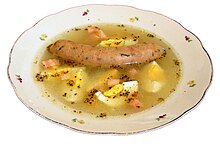
Żurek, a sour rye soup with biała kiełbasa and egg

Dried apples, pears and plums – a traditional product of Poland, used, for example, to prepare Christmas compote.

  • Zupa pomidorowa – Thin tomato soup made with tomato purée, root vegetables, and stock, usually served with pasta or rice; sour cream is often added.
  • Kartoflanka – Potato soup with root vegetables.
  • Czarnina (or czernina) – Duck soup made with duck broth or duck blood, the latter giving the soup a dark, almost black, colour. Recipes vary widely, but often sweet and sour ingredients are added, typically vinegar and often sugar, fruit juice, or fruit such as prunes or pears. It is usually served with the duck meat and Kluski-style noodles. Nowadays, it is not commonly eaten.
  • Chłodnik litewski – Cold soup made of soured milk or sour cream, young beet leaves, cucumbers, and chopped fresh dill. Sometimes chives and radishes are added.
  • Botwinka – Beet leaves soup with potatoes and root vegetables, served hot.
  • Barszcz czerwony (red borscht) – Clear beetroot soup made out of stock, beetroots, and beetroot sourdough; served with uszka, krokiet made from naleśniki, pasztecik, pierogi, and rarely with white beans, red kidney beans, or mashed potatoes. It is a very important dish during Christmas Eve.
  • Zupa buraczkowa – Beetroot soup with grated beetroots, cubed potatoes, and root vegetables. Sometimes it is called "red borscht", like the one cooked during Christmas Eve, even though it does not contain beetroot sourdough. It is slightly sweet but not sour.
  • Barszcz ukraiński (Ukrainian borscht) – Beetroot soup with addition of sliced white cabbage, white or red kidney beans, and diced or puréed tomatoes. In Ukraine, beans are not used in this dish.
  • Zupa szczawiowa – Sorrel soup made of sorrel leaves and rice, served with hard-boiled egg.
  • Flaki (or flaczki) – Beef or pork tripe stew with marjoram and spices. Vegetarians make this soup with oyster mushrooms.
  • Rosół – Clear chicken soup served with noodles, usually short vermicelli. The stock is made of root vegetables and whole chicken, beef, or both.
  • Zupa grzybowa / pieczarkowa – Mushroom soup made of white or wild mushrooms with potatoes or pasta. During Christmas Eve it is instead served with łazanki pasta or uszka.
  • Zupa ogórkowa – A sour cucumber soup made of sour, salted cucumbers.
  • Żur – Fermented cereal soup made of wholemeal rye sourdough, although oat sourdough is used in Lesser Poland and Podlachia, and buckwheat sourdough is used in Lublin Voivodeship.[29] Like żurek and zalewajka, it is served with mashed potatoes, hard-boiled eggs, cooked and smoked bacon, and biała kiełbasa (white kielbasa).
  • Żurek – Fermented cereal soup, more delicate than żur because it is made of wheat flour sourdough. Colloquially (but improperly) it is often called barszcz biały (white bortscht).[29]
  • Zalewajka (rye soup) – Fermented cereal soup made with sour rye. Served with sliced smoked pork sausage, cooked and smoked bacon, and separately cooked and diced potatoes.
  • Barszcz biały – Fermented cereal soup made with wheat flour. Traditionally, cabbage sourdough (sauerkraut juice) or cucumber sourdough (sour pickled cucumbers juice) is used. Still, they can be replaced by using citric acid.[29]
  • Grochówka – Pea soup with split peas, potato, carrot, parsley root, kielbasa or fried bacon, and marjoram.
  • Kapuśniak – Sauerkraut soup with potatoes, root vegetables (parsley root, carrots, celery root), bacon, and pork ribs.[30]
  • Kwaśnica – Sauerkraut soup with potatoes and ribs. Similar to kapuśniak, but omits other vegetables and tastes sourer.[30]
  • Forszmak lubelski – Pork or beef, smoked bacon, white mushrooms, sour pickled cucumbers, red bell pepper, tomato puree, spices, onion, and garlic.
  • Chłodnik – Cold soup made of raw, partially blended, or cooked and chilled vegetables with yoghurt or sour cream (such as cucumber chłodnik or tomato chłodnik). Often served with cooked potatoes, hard-boiled eggs, or both.
  • Zupa fasolowa (bean soup) – Made with white beans, root vegetables, smoked sausage (kielbasa), fried bacon, and marjoram.
  • Zupa kapuściana (cabbage soup) – Made with stock, chopped white cabbage, root vegetables, tomato puree and potatoes.
  • Zupa jarzynowa (vegetable soup) – Made with potatoes, green beans, root vegetables, cauliflower, peas, and sometimes brussels sprouts.
  • Zupa ryżowa (rice soup) – Made with rice, potatoes, and root vegetables with chicken.
  • Zupa koperkowa (dill soup) – Made with chicken stock, root vegetables, a big amount of dill, spring onion, potatoes or baby potatoes, and sometimes with sour or double cream.
  • Zupa chrzanowa (horseradish soup) – Made with white kielbasa, smoked bacon or pork ribs, sour cream, horseradish, garlic, potatoes, and root vegetables for stock; can be served with hard-boiled eggs.
  • Zupa gołąbkowa – Soup with minced meat, cabbage, tomato puree, tomatoes, rice, and spices.
  • Zupa kalafiorowa (cauliflower soup) – Made with stock, potatoes, cauliflower florets, and root vegetables.
  • Zupa brokułowa (broccoli soup) – Made with stock, potatoes, broccoli florets, and root vegetables.
  • Zupa gulaszowa (goulash soup) – Made with pork, beef, potatoes, onion or leek, passata, tomato puree, paprika, and red bell pepper. It is similar to Hungarian goulash, whilst Polish goulash is similar to pörkölt.
  • Zupa soczewicowa (or soczewicy) (lentil soup) – Made with green or red lentils, garlic, tomatoes, tomato puree, onion, and double or sour cream. May be served with pasta or potatoes.
  • Zupa owocowa (fruit soup) – Served cold with different fruits and pasta during hot summer.

Meat and fish[edit]

A typical Polish meal: kotlety mielone (minced pork cutlet), potatoes, beets and tea with lemon

Rolmopsy (rollmops), rolled pickled herring fillets, served during Christmas. Traditional to Polish, German and Jewish cuisines.

  • Baranina – Roasted, stewed, or grilled mutton.
  • Bigos – Stew of mainly sauerkraut, cabbage, and meats such as smoked kielbasa and bacon. Also contains mushrooms, onions, and sometimes tomato puree. It is known as a "hunter's stew" due to the addition of game and scraps of other meats.
  • Bitki wołowe z pieczarkami / grzybami – Thin slices of beef braised with mushrooms.
  • Bitki wieprzowe w sosie własnym – Thin slices of pork in gravy, braised with onions.
  • Golonka – Stewed pork knuckle or hock.
  • Gołąbki – Cabbage rolls with ground meat and rice or groats, served with mushroom, dill, or tomato sauce. For Christmas Eve, meat may be substituted with mushrooms. A variety with mushroom and potato filling is mostly found in Eastern Poland due to influence from Ukraine. Cabbage leaves used are from savoy cabbage or white cabbage. Rarely, it can be made with red cabbage or sauerkraut leaves. Modern versions include use of chinese cabbage or filling wrapped in zucchini slices. This dish is either cooked or baked.
  • Gołąbki bez zawijania (gołąbki without wrapping) – Large meatballs filled with chopped cabbage, onion and rice.
  • Gulasz – Meat stew originated from Hungarian pörkölt with onions, tomatoes, red bell peppers, and paprika.
  • Karkówka – Pork neck, roasted, grilled, or braised with onions.
  • Kiełbasa – Sausage, smoked or boiled, usually made with pork. It is a staple of Polish cuisine and comes in dozens of varieties.
  • Kotlet mielony – Minced meat (pork, pork-beef, or turkey) patty made with egg, breadcrumbs, chopped onions, wet bread, and spices, often rolled in breadcrumbs. Sometimes filled with cheese, mushrooms, or both.
  • Kotlet schabowy – Thinly pounded pork loin cutlet coated in breadcrumbs. It is a variation of schnitzel.
  • Kurczak Pieczony – Roasted chicken.
  • Pieczeń cielęca – Roasted veal.
  • Pieczeń wieprzowa z winem – Roasted pork in wine gravy.
  • Polędwiczki wołowe – Braised beef sirloin slices.
  • Pulpety or Klopsiki w sosie – Polish style meatballs in tomato, mushroom, or dill sauce.
  • Rolada z mięsa mielonego z pieczarkami – Minced meat roulade with mushrooms.
  • Schab Faszerowany – Stuffed pork loin.
  • Wołowina Pieczona – Roasted beef.
  • Zrazy zawijane – Thin beef fillets rolled and filled with bacon, mushrooms, mustard, gherkins, and onions.
  • Roladki schabowe/z kurczaka – Thin pork/chicken fillets rolled with filling including version with cheese.
  • Żeberka wędzone – Smoked spare ribs.
  • Filet z dorsza – Cod fillet with or without batter. Can be steam cooked or baked.
  • Łosoś – Steamed or baked salmon fillet.
  • Pstrąg – Poached or baked trout.
  • Rolmopsy – Rolled pickled herring fillets stuffed with pickled onion or cucumbers.
  • Ryba Smażona – Fried breaded fish fillet.
  • Śledzie – Herring marinated in oil or vinegar with onions.
  • Śledzie w śmietanie – Herring marinated in sour cream with onions. Sour pickled cucumbers, apples, and mushrooms can also be added.
  • Zimne nogi – Polish savoury jelly based on bone broth made from pork legs and served with chopped meat and vegetables, like peas or carrots. Served with a drizzle of vinegar or lemon juice. Dish originates from Jewish cuisine. If using meat other than pork leg, it is called galareta.

Flour or potato-based[edit]

  • Pierogi – Half-moon-shaped dumplings with various fillings. Savoury pierogi may be filled with sauerkraut and mushrooms, potato, quark and fried onion (pierogi ruskie, Ruthenian pierogi), minced meat, or buckwheat groats and quark or mushrooms. Sweet pierogi can be made with sweet quark or with fruits such as blueberries, strawberries, cherries, plums, raspberries, apples, or even chocolate.[31]
  • Uszka – Tiny dumplings traditionally filled only with mushrooms and onions. Other fillings used are mushrooms with sauerkraut or rarely cooked[clarification needed] and minced meat with onions. When filled with meat, they are served with clear borscht, clear mushroom soup, or broth.
  • Kołduny – Stuffed dumplings with raw minced beef and mutton, beef dripping, fried onions, and spices. Potato kalduny is a different dish from Subcarpathia made from potato dough filled with twaróg (quark), potatoes, and onions.
  • Placki ziemniaczane / kartoflane – Potato pancakes with grated potatoes, onions, eggs, wheat flour, and marjoram.
  • Pyzy – Potato dumplings made with raw, grated potatoes, egg, flour, and sometimes filled with minced meat; then cooked.
  • Knedle – Potato dumplings made with cooked potatoes and starch. Usually filled with fruits, most popular being plums and strawberries.
  • Kopytka – Hoof-shaped potato dumplings made of cooked potatoes, egg, and flour. Often served with breadcrumbs, sugar, and melted butter or fried bacon.
  • Pierogi / kluski leniwe – Hoof-shaped dumplings made of flour or potatoes, eggs, and quark.
  • Kluski śląskie – Dumplings in small donut-like shape made with boiled potatoes and potato starch. Often served with gravy or meat stew.
  • Czarne / szare kluski – Dumplings black or gray in colour, made of raw grated potatoes and potato starch.
  • Pampuchy / kluski na parze / pyzy drozdżowe – Steamed yeast wheat flour dumplings served with fruit yoghurt or jam. They can be also served savoury with gravy or filled with chocolate.
  • Kluski kładzione (laid dumplings) – Dumplings made of thick batter with flour and eggs laid in boiling water.
  • Lane Kluski (poured dumplings) – Dumplings made of thin batter with flour, milk, and eggs, usually poured straight into soup.
  • Zacierki (grated dumplings) – Grated or chopped dough into tiny balls and cooked.
  • Naleśniki – Thicker and plumper version of crêpes, served with sweet or savoury filling.
  • Krokiety (croquettes) – In Poland, they are made of naleśniki, often filled with either sauerkraut and mushrooms or ham and cheese, then folded like a burrito, breaded, and fried. Commonly served with clear borscht.
  • Racuchy – Yeast pancakes often stuffed with apples and served with powdered sugar or jam.
  • Łazanki – Pasta shaped like small squares. This Polish version is served with sauerkraut, onion, and fried kielbasa or fried bacon.
  • Zapiekanka – Open faced sandwich made from a veka roll sliced in half and topped with tomato sauce, mushrooms, and cheese. Zapiekanka can also be anything baked in casserole dish with added egg and cream mixture, so it holds together when removed. It usually involves meats, vegetables with potatoes or pasta, and melted cheese on top. A baked Polish fast food.
  • Knysza – Polish fast food with yeast bread roll filled with red and white cabbage, tomato, cucumber, pickled cucumber, onion, fried onion, corn, and sometimes fried chicken with garlic mayonnaise sauce. It originated in Wrocław.
  • Smażone ziemniaki / bratkartofle – Fried slices of potatoes (often previously cooked) usually (1) eaten with a fried egg, (2) mixed in scrambled eggs, onions, and grilled, or (3) mixed with fried, sliced kielbasa. Whole dish and serving with eggs (German: bratkartoffeln mit ei) or sausage (bratkartoffeln mit wurst) comes from Germany. In Poland, it is often eaten with a glass of sour buttermilk or kefir.
  • Makaron z jajkiem – Fried (cooked) pasta with fried onions, scrambled eggs, and butter; sometimes cheese, bacon, or ham can be added. It is a version of Italian spaghetti carbonara (Italian: spaghetti con uova e cipolla).

Side dishes and salads[edit]

  • Kasza – Cooked groats; most popular are groats of buckwheat, barley, millet, and wheat.
  • Mizeria – Traditional Polish salad made with sliced cucumbers, sour cream, and spices; served as a side.
  • Surówka z jabłka i marchewki – Carrot salad made with peeled and grated carrots, apples, oil, and lemon juice.
  • Surówka z ogórków i pomidorów – Salad made with cucumbers, tomatoes, onions, and oil or sour cream.
  • Ziemniaki gotowane – Simple boiled potatoes sprinkled with dill.
  • Tłuczone ziemniaki – Mashed potatoes.
  • Surówka z białej kapusty – Salad with shredded cabbage, carrots, and spices, often with grated apples.
  • Surówka z kiszonej kapusty – Salad with sauerkraut, carrots, parsley, apples, and lemon juice.
  • Sałatka warzywna or Jarzynowa – Salad of cooked vegetables such as parsley root, carrot, potatoes, celery root, pickled cucumbers in brine, and hard-cooked eggs in mayonnaise and mustard. Also often contains corn, peas, apple, onion, leek, or even red kidney beans. A traditional Polish side dish.
  • Kapusta zasmażana – Sauerkraut or white cabbage pan-fried with onions and spices, often with fried bacon.
  • Kapusta na gęsto – Braised white cabbage with onions, dill, and double cream.
  • Surówka – Any salad made of raw vegetables with drizzle of vinegar, oil, sour cream, or yoghurt.
  • Sałatka – Any salad made of cooked vegetables, usually with mayonnaise.
  • Sałatka burakowa / buraczki tarte – Cooked and grated beetroot salad; can be made warm or cold.
  • Ćwikła – Cooked and grated beetroots with horseradish paste and lemon juice.
  • Fasolka szparagowa z czosnkiem – Green beans with garlic and butter or oil; originated in Italy.
  • Kalafior / fasolka szparagowa / brukselka z bułką tartą – Cooked cauliflower, green beans, or Brussels sprouts with a polonaise sauce made of fried breadcrumbs in butter.
  • Brokuł / kalafior z sosem czosnkowym – Cooked broccoli or cauliflower with a garlic sauce.
  • Ogórek kiszony – Polish pickled cucumber, fermented in brine consisting of dill and dill flower, garlic, salt, and spices.
  • Ogórek konserwowy – Pickled cucumber in vinegar, which is rather sweet and vinegary in taste.
  • Grzyby marynowane – Marinated mushrooms.
  • Sałatka szwedzka – Preserved salad made with cucumbers, onions, carrots, vinegar, and spices.
  • Sałatka ziemniaczana – Potato salad made with cooked potatoes, onions, pickled cucumbers, dill, and mayonnaise; sometimes with added smoked bacon or herring fillets marinated in oil or vinegar. Originally from Germany.
  • Sałatka śledziowa – Marinated herring salad with pickled cucumbers, onions, and sour cream; sometimes eggs and apples are added.

Bread[edit]

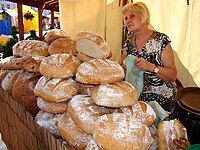
Bread stand in Sanok, Poland

Bread (chleb) and bread rolls (bułka (bread roll), bajgiel, rogal, bułka paryska) have been an essential part of Polish cuisine and tradition for centuries. Today, bread remains one of the most important foods in the Polish cuisine. The main ingredient for Polish bread is rye or wheat. Traditional bread has a crunchy crust, a soft interior, and an unforgettable aroma. Such bread is made with sourdough, which lends it a distinctive taste. It can be stored for a week or so without getting too hard and is not crumbly when cut.

In Poland, welcoming with bread and salt ("chlebem i solą") is often associated with the traditional hospitality ("staropolska gościnność") of the Polish nobility (szlachta), who prided themselves on their hospitality. A 17th-century Polish poet, Wespazjan Kochowski, wrote in 1674: "O good bread, when it is given to guests with salt and good will!" Another poet, Wacław Potocki, mentioned this custom. The custom was, however, not limited to the nobility, as Polish people of all classes observed this tradition, reflected in old Polish proverbs.[32] Nowadays, the tradition is mainly observed on wedding days, when newlyweds are greeted with bread and salt by their parents on returning from the church wedding.

Desserts and sweets[edit]

Main article: List of Polish desserts

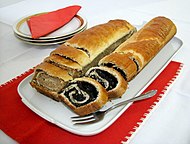
Makowiec (poppy seed roll)

Sernik (cheesecake)

  • Beza – Type of sweet meringue in biscuit form, occasionally with topping.
  • Makowiec – Sweet poppy-seed swiss roll, with raisins, dried fruits, and walnuts.
  • Pączek – Closed donuts filled with rose petal jam, other fruit conserves, custard, chocolate, or quark with sugar.
  • Pierniki – Soft gingerbread biscuit forms of pryanik, unfilled or filled with marmalade of different fruit flavours, and sometimes covered with chocolate.
  • Sernik (cheesecake) – One of the most popular desserts in Poland. It is a cake made primarily of twaróg, a type of fresh cheese similar to quark. It can be baked or refrigerated. It might be flavoured with vanilla, lemon peel, or orange peel. Sometimes raisins or various fresh fruits are added. Commonly topped with a chocolate topping or sprinkled with coconut-flakes or nuts. It is very popular to garnish it with a sweet jelly topping with a variety of fresh fruits when it is unbaked.
  • Mazurek – Pie baked particularly at Christmas Eve and Easter, made with shortcrust pastry. There are variations with different fillings, such as walnut paste, dulce de leche or ganache with dried fruits, candied fruit, and nuts.
  • Chałka – Sweet white wheat bread of Jewish origin (challah).
  • Kogel mogel (eggnog) – Made from egg yolks, sugar, and flavourings such as honey, vanilla, or cocoa. Traditional for Polish Jews.
  • Krówki – Polish fudge; soft milk toffee candies.
  • Napoleonka – Polish type of cream pie made of two layers of puff pastry, filled with vanilla pastry cream, usually sprinkled with powdered sugar. A close relative of the French millefeuille. An alternative but less popular version is kremówka, often filled with whipped cream instead of custard cream.
  • Keks – Cake with candied and dried fruit.
  • Babka – Polish version of a pound cake, made with or without yeast. It is served with powdered sugar or icing. Can be made as a marble cake.
  • Miodownik – Layered honey cake filled with vanilla pastry cream and ganache on top.
  • Orzechowiec – Layered nut cake filled with vanilla pastry cream and kajmak, topped with chopped nuts.
  • Ciasto marchewkowe – Carrot cake with added nuts and honey, sometimes layered with whipped cream.
  • Ciasto bez pieczenia / na zimno – Various types of unbaked and refrigerated cakes made of biscuits, ladyfingers, crackers, or sponge cake with vanilla, whipped cream, coconut, jelly, mascarpone, semolina, or poppy seed filling. Often topped with ganache.
  • Karpatka – Cream pie made of two layers of choux pastry filled with vanilla pastry cream.
  • Wuzetka – Layered chocolate sponge cake filled with jam and whipped cream, associated with Warsaw.
  • Ptasie mleczko – Chocolate-covered candy filled with soft meringue (or milk soufflé).
  • Kisiel – Clear, jelly-like sweet fruit liquid, made with starch, sugar, and fruits or fruit juice.
  • Budyń – Pudding that usually comes in many different flavours, such as sweet cream, vanilla, chocolate, cherry, and more.
  • Faworki – Light fried pastry covered with powdered sugar.
  • Pańska Skórka, Miodek – Hard taffy sold at cemeteries during Zaduszki and at Stare Miasto (Old Town) in Warsaw.
  • Kutia – Grain dish made with wheat, poppy seeds, nuts, raisins, and honey. Not traditionally Polish, but served during Christmas in the eastern regions like Białystok and Podlachia.
  • Prince Polo - Polish chocolate bar.
  • Mieszanka Wedlowska – Assorted chocolate covered candy.
  • Torcik Wedlowski – Large, circular, chocolate covered wafer with hand-made decorations.
  • Pawełek – Chocolate bar with a flavoured filling, most popular contains advocaat.
  • Śliwka w czekoladzie – Chocolate-covered prune.
  • Ryż z jabłkami – Type of a rice pudding baked or cooked with apples and cinnamon.

Beverages[edit]

See also: Beer in Poland and Polmos

Alcohol[edit]

Żywiec Brewery Baltic porter beer. Poland is Europe's third largest beer producer, producing 36.9 million hectolitres.

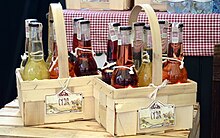
Mead Półtorak, made from natural honey and grape fruit, 16% alc. 750 ml (26 imp fl oz; 25 US fl oz).

Traditional Polish alcoholic beverages include mead, beer, vodka (Old Polish: okowita, gorzała), and to a lesser extent, wine. In recent decades, beer has become very common: popular are both traditional Polish beer styles like Baltic porter and oak-smoked Grodziskie and also many other styles brewed by many small craft breweries. Wine is less frequently drunk, however, in recent years, the consumption of wine has risen along with increasing production of local grape wines in small vineyards in Lesser Poland, Subcarpathia, Silesia, and West Pomerania regions.

Among alcoholic beverages, Polish vodka—traditionally prepared from grain or potatoes—has essentially displaced the formerly widespread mead.[33]

Polish cider

Some sources suggest that the first production of vodka took place in Poland as early as the 8th century, becoming more widespread in the 11th century.[34] The world's first written mention of the drink and of the word "vodka" was in 1405 from Akta Grodzkie recorder of deeds,[11][clarification needed] the court documents from the Palatinate of Sandomierz in Poland.[11]

Vodka production on a much larger scale began in Poland at the end of the 16th century. By the 17th and 18th centuries, Polish vodka was known in the Netherlands, Denmark, England, Russia, Germany, Austria, Hungary, Romania, Ukraine, Bulgaria, and the Black Sea basin.[35] Vodka was the most popular alcoholic drink in Poland until 1998, when it was surpassed by beer.[33]

Beside clear vodkas, flavoured vodka (known as nalewka) and liqueurs are also popular. The most important are Żubrówka (vodka with bison grass from Podlaskie), herbal Żołądkowa Gorzka, aged starka, plum brandy śliwowica (especially from Łącko), honey liqueur krupnik, as well as Goldwasser (herbal liqueur with flakes of gold leaf) and juniper vodka machandel, both originating from Gdańsk.

Non-alcoholic drinks[edit]

See also: Kvass § Poland, and Kefir

Traditionally, kvass (kwas chlebowy) was a fermented beverage first popular among the peasantry, but it later spread to the szlachta and became a universal Polish drink by the 14th-15th centuries.[36] It is typically made from rye bread, usually known as black bread, and is not classified as an alcoholic beverage in Poland, as its alcohol content usually ranges from 0% to 2%.[36] There are many commercial and family variations of the beverage; however, traditional Polish recipes still exist.[37][38] Despite its production on an industrial scale in Poland during the interbellum,[39] it began to lose popularity to mass-produced soft drinks and carbonated water in the 20th century.[40] It remained known primarily in rural areas of eastern Poland.[41] However, kvass started making a comeback in the 21st century, with many new Polish brands being started.[42]

Since the turn of the century, tea is perhaps the most popular beverage, usually served with a slice of lemon and sweetened with either sugar or honey. Tea came to Poland from England shortly after its appearance in Western Europe, mainly due to the Dutch merchants. However, its prevalence is attributed to the Russians in the 19th century – at this time samovars imported from Russia become commonplace in Polish homes. Tea with milk is called bawarka (lit. 'Bavarian style').[43]

Coffee has been widely drunk since the 18th century, when Poland bordered the Ottoman Empire.

Other frequently consumed beverages include buttermilk, kefir, soured milk, instant coffee, various mineral waters, juices, and numerous brands of soft drinks. A considerable number of Poles enjoy carbonated water, and customers in restaurants are always offered both still and sparkling (carbonated) water to drink.[44]

Lists of common Polish dishes found on a national level[edit]

  • List of common Polish soups
  • Common main courses
  • Common desserts
  • Common beverages
  • Common folk medicine

iraq

Iraqi cuisine is a Middle Eastern cuisine that has its origins in the ancient Near East culture of the fertile crescent.[1][2][3] Tablets found in ancient ruins in Iraq show recipes prepared in the temples during religious festivals—the first cookbooks in the world.[3][4] Ancient Mesopotamia was home to a sophisticated and highly advanced civilization, in all fields of knowledge, including the culinary arts.[3]

The Iraqi kitchen reached its zenith in the Islamic Golden Age when Baghdad was the capital of the Abbasid Caliphate (750–1258 AD).

The cuisine varies across the country. The cooking of Northern Iraq is known for adding pomegranate to the dolma juice prominently to give it a unique taste. In Southern Iraq, fish is used extensively, while the middle region, including Baghdad and the surrounding cities, is known for its variety of rice dishes and sweets.

Contemporary Iraq reflects the same natural division as ancient Mesopotamia,[5][6][7][8] which consisted of Assyria in the arid northern uplands and Babylonia in the alluvial plain.[8] Upper Mesopotamia grows wheat and crops requiring winter chill such as apples and stone fruits.[8] Lower Mesopotamia grows rice and barley, citrus fruits, and is responsible for Iraq's position as one of the world's largest producer of dates.

Pork consumption is forbidden to Muslims in Iraq, in accordance with Sharia, the Islamic law.

Dates, apricots, figs, and prunes are processed to make dried fruits

History[edit]

See also: History of Mesopotamia and History of Iraq

Archaeologists have found evidence from excavations at Jarmo, in northeastern Iraq, that pistachio nuts were a common food as early as 6750 BC.[9] Among the ancient texts discovered in Mesopotamia is a Sumerian-Akkadian bilingual dictionary,[10] recorded in cuneiform script on 24 stone tablets about 1900 BC.[10] It lists terms in the two ancient Iraqi languages for over 800 different items of food and drink.[10] Included are 20 different kinds of cheese, over 100 varieties of soup and 300 types of bread, each with different ingredients, filling, shape or size.[10]

The world's oldest recipes are found in Mesopotamia of modern-day ancient Iraq, written in cuneiform tablets.[11][4] One of three excavated cuneiform clay tablets written in 1700 BC in Babylon,[12][11] 50 miles south of present-day Baghdad, contains 24 recipes for stew cooked with meat and vegetables,[12] enhanced and seasoned with leeks, onion, garlic, and spices and herbs like cassia, cumin, coriander, mint, and dill.[12] Stew has remained a mainstay in the cuisine.[12] Extant medieval Iraqi recipes and modern Iraqi cuisine attest to this.[12]

Ingredients[edit]

Kleicha is sometimes considered the national cookie of Iraq and is served during religious holidays.

Some characteristic ingredients of Iraqi cuisine include:

  • Vegetables such as eggplant, tomato, turnips, beans, shallots, okra, onion, lentils, cress, potato, cabbage, courgette (zucchini), spinach, lettuce, leeks, artichokes, garlic, peppers and chilli peppers.
  • Cereals including rice, bulghur wheat and barley.
  • Pulses and legumes such as lentils, chickpeas, green beans, green grams, and cannellini beans.
  • Fruits including olives, dates, raisins, apricots, plums, figs, grapes, melons, pomegranates, apples, cherries, quinces, and citrus fruits—oranges, lemons and limes.
  • Cheeses such as baladi, feta and halloumi.
  • Herbs and spices including cinnamon, cardamom, coriander, fenugreek, cumin, oregano, mint, tarragon, thyme, saffron, dried lime, cassia, dill, turmeric, baharat, advieh, sumac and za'atar.
  • Nuts and seeds such as sesame, pistachios, almonds, walnuts, hazelnuts and pine nuts.

Other Iraqi culinary essentials include olive oil, sesame oil, tamarind, vermicelli, tahini, honey, date syrup, yogurt and rose water.

Lamb is the favorite meat, but chicken, beef, goat and fish are also eaten. Most dishes are served with rice—usually timman anbar, a yellowish, very aromatic, long-grain rice grown in the Middle Euphrates region.[13]

Bulghur wheat is used in many dishes, having been a staple in the country since the days of the ancient Assyrians.[3] Flatbread is a staple that is served with a variety of dips, cheeses, olives, and jams, at every meal.

Common dishes[edit]

Mêzzä[edit]

Meals begin with appetizers and salads, known as mezza. Mezza is a selection of appetizers or small dishes often served with a beverage, like anise-flavored liqueurs such as arak, ouzo, rakı, sambuca, pastis, or various wines, similar to the tapas of Spain, or finger food.

Mezza may include:

Samoon, type of Iraqi bread.

  • Iraqi sumac salad, a typical Iraqi salad with the addition of sumac berries.[14]
  • Baytinijan maqli, a dish often served cold, consisting of fried aubergine (eggplant) with tahini, lettuce, parsley and tomatoes, garnished with sumac and served on pita bread or sliced bread, often grilled or toasted. Variations include bell peppers, or a garlic-lemon vinaigrette.
  • Fattoush, a salad made from several garden vegetables and toasted or fried pieces of pita bread.
  • Tabbouleh, a salad dish, often used as part of a mezze. Its primary ingredients are finely chopped parsley, bulgur, mint, tomato, scallion, and other herbs with lemon juice, olive oil and various seasonings, generally including black pepper and sometimes cinnamon and allspice.
  • Turshi, pickled vegetables in the cuisine of many Balkan and Middle East countries. It is a traditional appetizer, mezze for rakı, ouzo, tsipouro and rakia.

Dips[edit]

  • Baba ghanoush, a dish of baked aubergine (eggplant) mashed and mixed with various seasonings.
  • Hummus, a dip or spread made from cooked, mashed chickpeas, blended with tahini, olive oil, lemon juice, salt and garlic.
  • Jajik, an appetizer, also used as a sauce for shish and döner kebab. Jajik is made of strained yogurt (usually sheep's milk or goat's milk in Greece and Turkey) with cucumbers, garlic, salt, usually olive oil, pepper, dill, sometimes lemon juice and parsley, or mint added. The cucumbers are either puréed and strained, or seeded and finely diced. Olive oil, olives, and herbs are often used as garnishes.

Soups and stews[edit]

Various stews served over rice form a major part of Iraqi cuisine.

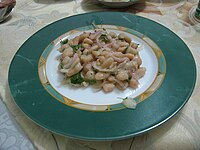
  • Fasolia yabsa (Iraqi white bean stew), made up of tender lamb or veal, white kidney beans (also called cannellini beans), tomato sauce and served over rice.[15]
  • Fasoulia, a soup of dry white beans, olive oil, and vegetables.
  • Harissa, similar to keşkek, a porridge made of stewed and boned chicken and coarsely ground soaked wheat.
  • Kebabs, a dish consisting of grilled or broiled meats on a skewer or stick.[16] The most common kebabs include lamb and beef, although others use chicken or fish.
  • Lentil soup, may be vegetarian or include meat, and may use brown, red, yellow or black lentils, with or without the husk.
  • Maqluba, an upside-down rice and aubergine (eggplant) casserole, hence the name which means "upside-down". It is sometimes made with fried cauliflower instead of aubergine and usually includes meat—often braised lamb.[17]
  • Margat bamia or simply bamia, a stew made with okra and lamb or beef cubes in a tomato sauce.[18]
  • Margat baytinijan, an aubergine-based dish of the Balkans and the Middle East. All versions are based primarily on sautéed aubergine (eggplant) and tomato, usually with minced meat.

A prepared masgouf

Iraqi kebab, usually served with khubz or samoon

  • Masgouf, a traditional Mesopotamian dish made with fish from the Tigris.[16][19] It is an open-cut freshwater fish roasted for hours after being marinated with olive oil, salt, curcuma and tamarind while keeping the skin on. Traditional garnishes for the masgouf include lemon, chopped onions and tomatoes, as well as the clay-oven flatbreads common to Iraq and much of the Middle East.
  • Pomegranate soup, called shorbat rumman in Iraq. It is made from pomegranate juice and seeds, yellow split peas, ground beef, mint leaves, spices, and other ingredients.[20]
  • Qeema, a minced meat, tomato and chickpea stew, served with rice. Traditionally prepared at the annual Ashura commemorations in southern Iraq. The name qeema is an ancient Akkadian word meaning "finely chopped".[21]

Quzi

  • Quzi, stuffed roasted lamb.[16][19]
  • Hikakeh is a thin crust of slightly browned rice at the bottom of the cooking pot.

A plate of Parda blaw

  • Tashrib, a soup made with either lamb or chicken with or without tomatoes eaten with Iraqi nan; the bread is broken into pieces and the soup is poured over in a big bowl.

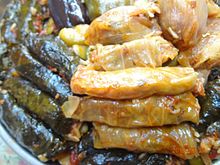
Iraqi dolma

Tepsi baytinijan

  • Tepsi baytinijan, an Iraqi casserole. The main ingredient of the dish is aubergine (eggplant), which is sliced and fried before placing in a baking dish, accompanied with chunks of lamb/beef/veal and/or meatballs, plus tomatoes, onions and garlic.

Potato slices are placed on top of the mixture, and the dish is baked. Like many other Iraqi dishes it is usually served with rice, along with salad and pickles.

Dumplings and meatballs[edit]

  • Dolma (sarma), a family of stuffed vegetable dishes. The grape-leaf dolma is common. Courgette (zucchini), aubergine (eggplant), tomato and pepper are commonly used as fillings. The stuffing may or may not include meat.[22]
  • Falafel, a fried ball or patty made from spiced chickpeas or fava beans. Originally from Egypt, falafel is a form of common fast food in the Middle East, where it is also served as a kind of mezze and more commonly eaten with samoon with a salad and usually Amba (condiment) as dressing
  • Kofta, a family of meatball or meatloaf dishes in Middle Eastern, Indian, and Balkan cuisines. In the simplest form, koftas consist of balls of minced or ground meat—usually beef or lamb—mixed with spices or onions.

Vegetarian varieties include lauki kofta,[23] shahi aloo kofta,[24] and malai kofta.[25]

  • Kubba, a dish made of rice or burghul, chopped meat, and spices. There are many varieties and variations of kubba. One of the best-known varieties is a torpedo-shaped burghul shell stuffed with chopped meat and fried. Other varieties are baked, poached, or even served raw. They may be shaped into balls, patties, or flat.[20] [1][2]
  • Samosa, a small fried or baked pasty, which may be either half-moon shaped or triangular.

Processed meat[edit]

  • Pastırma, a highly seasoned, air-dried cured beef in the cuisines of the former Ottoman countries.
  • Sujuk, a dry, spicy sausage eaten from the Balkans to the Middle East and Central Asia.

Rice dishes[edit]

Long-grain rice is a staple in Iraqi cuisine.[16][19]

Iraqi rice cooking is a multistep process intended to produce just-tender, fluffy grains.[13] A prominent aspect of Iraqi rice cooking is the hikakeh, a crisp bottom crust.[13] Before serving, the hikakeh is broken into pieces so that everyone is provided with some along with the fluffy rice.[13]

  • Dolma, vine leaves stuffed with a mixture of ground lamb or beef with rice cooked with many fillings in the same pot, with pomegranate juice prominently added by North Iraqis to give it a unique taste.

The Assyrians of Iraq may either call it dolma or yaprekh which is the Syriac term for stuffed grape leaves.

Iraqis usually serve dolma without yoghurt. Often chicken or beef ribs are added to the cooking pot, and sometimes served with the dolma instead of masta or khalwah. Iraqi dolma is usually cooked and served in a tomato-based sauce.

Dolma is very popular in Iraq. In Mosul they include courgettes (zucchini), tomatoes, onions, peppers, eggplant, and grape leaves. They are occasionally steamed.

  • Biryani, several rice-based foods made with spices, rice usually basmati and أرز عنبر and meat/vegetable, collectively popular in Iraq, Iran, Afghanistan, Pakistan, Bangladesh, India and among Muslims in Sri Lanka.
  • Mutabbaq samak (Arabic: مطبق سمك), fried fish served over stocked rice.[26][27]
  • Pilaf, similar to that of Iran.
  • Quzi, a rice-based dish served with very slow-cooked lamb and roasted nuts and raisins.
  • Tibeat, a Jewish-Iraqi dish made for Shabbat, slow-cooked chicken stuffed with rice, tomatoes, dried apricots and raisins, with a strong cardamom flavor.[28]

Sandwiches and wraps[edit]

  • Shawarma, a Middle-Eastern Arabic-style sandwich-like wrap[16] usually composed of shaved lamb, goat, chicken, turkey, beef, or a mixture of meats. Shawarma is a popular dish and fast-food staple across the Middle East and North Africa.

Dairy[edit]

  • Baladi cheese, a soft, white cheese originating from the Middle East, with a mild yet rich flavor.
  • Geimar, a creamy dairy product, similar to clotted cream, made in the Balkans, Turkey, Iran and Central Asia. It is made from water buffalo's milk in the East, or cow's milk in the West.
  • Jameed, hard dry labneh (strained yogurt) made from sheep's milk.
  • Jibneh Arabieh, a simple cheese found all over the Middle East, particularly popular in the Persian Gulf area, with an open texture and a mild taste similar to feta, but less salty.
  • Labneh, yogurt which has been strained in a cloth or paper bag or filter, traditionally made of muslin, to remove the whey, giving a consistency between that of yogurt and cheese, while preserving yogurt's distinctive sour taste.[20]

Breads and pastries[edit]

Lahm b'ajeen, garnished with parsley, tomato, red onion, and a wedge of lemon

  • Burek, a type of baked or fried filled pastry. It is made of a thin flaky dough known as phyllo dough (or yufka dough), and are filled with salty cheese (often feta), minced meat, potatoes or other vegetables.
  • Ka'ak, refer to several different types of baked goods produced throughout the Arab world and the Near East.
  • Kadaif, a very fine vermicelli-like pastry used to make sweet pastries and desserts.
  • Kahy, layers of thin dough phyllo usually consumed warm for breakfast by adding creamy kaymak and light sugar syrup. This pastry is mostly spread in the Southern region of Iraq.
  • Khubz Iraqi, an Arabic flatbread that is part of the local diet in many countries of Western Asia.
  • Laffa (an Iraqi pita or naan bread).
  • Lahmacun, a thin pizza topped with minced meat and herbs.
  • Lavash, a soft, thin flatbread.
  • Manakish, a pizza consisting of dough topped with thyme, cheese, or ground meat.
  • Markook, a type of flatbread common in the countries of the Levant. It is baked on a domed or convex metal griddle, known as saj. It is usually sizable, about 2 feet, thin, almost transparent.
  • Pita, a family of yeast-leavened round flatbreads baked from wheat flour.
  • Samoon, a flat and round bread.[19]
  • Sfiha, a pizza-like dish traditionally made with ground mutton rather than the more modern addition of lamb or beef in Brazil. They are open-faced meat pies with no top dough.

Sfiha are much like dolma, ground lamb, lightly spiced, wrapped in brined grape leaves.

Condiments, sauces and spices[edit]

  • Amba, a tangy mango pickle condiment from Pakistan and India. Commonly eaten as a side dish and sometimes as a sandwich topping.
  • Baharat, a spice mixture. Typical ingredients include allspice, black pepper corns, cardamom seeds, cassia bark, cloves, coriander seeds, cumin seeds, nutmeg, dried red chili peppers or paprika.
  • Dibis, a thick, very sweet date syrup. Often mixed with tahini to create a dip.
  • Jallab, a type of syrup popular in the Middle East made from dates, grape molasses and rose water.
  • Mahleb, an aromatic spice made from the seeds of the St Lucie Cherry (Prunus mahaleb).
  • Rose water (Mayy wared), used in various Middle-Eastern dishes, especially in sweets.
  • Tahini (t'heena), a paste of ground sesame seeds used in cooking. Middle-Eastern tahini is made of hulled, lightly roasted seeds.
  • Za'atar, a mixture of herbs and spices used as a condiment.

Sweets[edit]

The earliest known recipe for cake comes from ancient Mesopotamia. Believed to be primarily for consumption at the palace or temple, the cake was made from fat, white cheese, dates and raisins. Another recipe dating to the reign of Hammurabi (1792 BCE–1750 BCE) includes similar basic ingredients with the addition of grape syrup, figs and apples.[29]

The traditional Iraqi kleicha cookies are believed to have their roots in Mesopotamian qullupu—date filled pastries baked in a wood-fired oven called tannour. In modern times, other types of cookies (biskit) and cakes (ka'ak) are made at home, usually flavored with cardamom or rose water. Some variations include the disc-shaped khfefiyyat, half-moon shaped kleichat joz made with nuts, and date-filled kleichat tamur.[29]

"White baklava", osh el bulbul (bird's nests) and other traditional sweets in Iraq

Cookbooks dating to the Abbasid Caliphate between the 10th and 13th centuries include recipes for hundreds of desserts. The tradition continues into the modern day, but the rich, syrupy desserts like baklava are usually prepared for special occasions or religious celebrations, as most daily meals are usually followed by a simple course of seasonal fruit, especially dates, figs, cantaloupes, nectarines, apricots, pomegranates, peaches, mulberries, grapes or watermelons.[29]

Though not as recognizable as baklava, the fried pastry called lauzeenaj, flavored with mastic and rose water, was a specialty in imperial Baghdad.

Rosette-shaped fritters called zalabia are a local specialty, believed to take their name from Ziryab, a well-known Iraqi musician in the Caliphate of Cordoba.

Baklava and zalabia are typical offerings during the Eid al-Fitr celebrations that follow Ramadan. Halqoum (commonly known as Turkish delight) are traditionally given as gifts during the holiday.[29]

Others include:

  • Halva, popular in the Balkans, Poland, Middle East, and other areas surrounding the Mediterranean Sea. The primary ingredients in this confection are sesame butter or paste (tahini), and sugar, glucose or honey.
  • Kanafeh, a pastry made with layers of semolina, white cheese and a sugary syrup sprinkled with rose water.
  • Luzina, a candy similar to Turkish lukum, made from ground fruits.
  • Mann al-sama, an Iranian nougat that originated in Isfahan.
  • Qatayef, an Arab dessert reserved for the Muslim holiday of Ramadan, a sort of sweet crêpe filled with cheese or nuts. It was traditionally prepared by street vendors as well as households in the Levant and more recently has spread to Egypt.

Beverages[edit]

Iraqi tea served at the Shabandar Café, Baghdad

Alcoholic beverages[edit]

On February 20, 2023, a law was published banning the import, production and sale of all types of alcoholic beverages, punishable by fines of up to IQD 25 million. There is currently no further information available regarding the enforcement of the law, which is currently being litigated.

  • Arak, a clear, colourless, unsweetened anise-flavoured distilled alcoholic drink. Arak is usually not consumed straight, but is mixed in approximately ⅓︎ arak to ⅔︎ water, and ice is then added.[30][31]
  • Beer, a drink that originated in ancient Assyria and Babylon over 6,000 years ago.
  • Cusa Masqool, an alcoholic drink which is made from fermented goats milk. It is mostly only found in the Kurdistan region and dates back to antiquity.

Non-alcoholic beverages[edit]

  • Coffee, a drink that has a strong and bitter taste, a popular beverage in Iraq.
  • Sharbat, a chilled, sweet drink prepared from fruit juice or flower petals.
  • Laban, a cold beverage of yogurt mixed with cold water, sometimes with a pinch of salt or dried mint added.
  • Tea, also known as chai, is widely consumed throughout the day, especially in the mornings, after meals, and during social settings. It is prepared in a special way involving boiling tea in hot water, then placing it over a second tea pot with boiling water to let the tea infuse.

Related cuisines[edit]

  • Arab cuisine
  • Armenian cuisine
  • Assyrian cuisine
  • Azerbaijani cuisine
  • Caucasian cuisine
  • Central Asian cuisine
  • Iranian cuisine
  • Levantine cuisine
  • Mediterranean cuisine
  • Middle Eastern cuisine
  • Turkish cuisine

spain

Spanish cuisine (Spanish: Cocina española) consists of the traditions and practices of Spanish cooking. It features considerable regional diversity, with important differences between the traditions of each of Spain's regional cuisines.

Olive oil (of which Spain is the world's largest producer) is extensively used in Spanish cuisine.[1][2] It forms the base of many vegetable sauces (known in Spanish as sofritos).[3] Herbs most commonly used include parsley, oregano, rosemary and thyme.[4] The use of garlic has been noted as common in Spanish cooking.[5] The most used meats in Spanish cuisine include chicken, pork, lamb and veal.[6] Fish and seafood are also consumed on a regular basis.[6] Tapas and pinchos are snacks and appetizers commonly served in bars and cafes.

History[edit]

See also: History of Spain

Antiquity[edit]

Growing of the Mediterranean triad in the province of Huelva

Authors such as Strabo wrote about the aboriginal people of Spain using nuts and acorns as staple foods.[7] The extension of vineyards along the Mediterranean seemed to be due to the colonization of Greeks and Phoenicians, who also introduced the production of olive oil. Spain became the largest producer of olive oil in the world. The growing of crops of the so-called tríada mediterránea (the "Mediterranean triad": wheat, the grapevine, and olives) underpinned the staple meal products for the inhabitants of the south of the Iberian Peninsula during the Roman Era (bread, wine and oil).[8]

Middle Ages[edit]

The Visigoths' limited but lasting contributions to Spanish cuisine included the spread of consumption of fermented milk and the preference for avoiding the mix of water and wine.[9]

Rice was possibly introduced for the first time by Byzantines in the Iberian Peninsula by the 6th century. After the Muslim conquest of the Iberian peninsula in the 8th century, Arabs expanded rice cultivation,[10] bringing new irrigation techniques originally from the Indian subcontinent that also allowed for the cultivation of crops such as sugar cane, watermelon, lemon and oranges.[11] Other ingredients possibly introduced in the Iberian Peninsula during the Hispano-Muslim period include sorghum, spinach, eggplant, peach, apricot and saffron.[12] The most famous Spanish dish, paella, used two ingredients that were probably popularized during the Al-Andalus period: rice and saffron.[13]

Illustration of the "supper of Tarragona" of James I of Aragon in an edition of the Llibre dels fets published in 1343.

Moors also developed the basis for the art of pastry-making and introduced escabeche,[14] a food preservation technique relying on vinegar. Dishes like ajo blanco, alboronía,[15] alajú,[16] hallulla,[17] albóndigas,[18] mojama,[19] arrope,[20] were some of the many legacies of Moorish cuisine.[21][13][22] Although Muslim religion did not allow alcoholic drinks, the consumption of wine was widespread as the Qur'anic precepts never got to overrule the preexisting traditions.[23] There are many accounts of the "drinking chats" of Abd al-Rahman II, Abd al-Rahman III and Almanzor.[24] Almodrote (a formerly popular sauce preparation out of vogue since the late 17th century) was a Sephardic recipe in origin.[25] Observing the kashrut regulations, Jews and judaizantes opted for blood-drained meat without fat, outright rejecting bacon.[26] Potajes were an important part of the Jewish cuisine in the Middle Ages, most notably adafina, a local name for a ḥamin dish,[27] along with other Jewish culinary legacies in Spain.[28][29][30] The cookbook history in the country could be traced back to works such as the Llibre de Sent Soví (1324) and Ruperto de Nola's Llibre de Coch (1520),[31] both written in the Catalan language.

Modern era[edit]

See also: Columbian exchange

Old Woman Frying Eggs (The Old Cook) (c. 1618) by Diego Velázquez. Scottish National Gallery.

Still-life painting by Luis Egidio Meléndez (1774) featuring cucumbers and tomatoes.

The kitchen of the Asylum of San Bernardino in Madrid (c. 1908).

The arrival of Europeans to the Americas in 1492 initiated the advent of new culinary elements, such as tomatoes, potatoes, maize, bell peppers, spicy peppers, paprika, vanilla and cocoa, or chocolate. Spain was where chocolate was first mixed with sugar to temper its natural bitterness. Other ingredients traveled to the Americas, such as rice, grapes, olives and many types of cereals.[32]

Influenced by Arabic harisa, grain-based soups such as farinetes (along the Mediterranean coast) and, similarly, gachas (in the Central Plateau) were customary in Early Modern Spain.[33]

Foreign visitors noted with disdain the Spaniards' use of olive oil and (pig's) lard for cooking rather than their preferred (cow's) butter. The latter was barely available and, according to the 17th-century account of Madame d'Aulnoy, on the rare occasions that it was, would come "from afar, preserved in pig's tripes and full of worms". Butter was only produced locally in places such as Galicia, Asturias and Soria, or was imported, preserved in potassium nitrate, (the so-called "Flanders' butter").[34]

By the 18th century, many American ingredients, such as peppers and tomatoes, had been fully incorporated to the Spanish cuisine. Contemporary foreign visitors such as French ambassador Jean-François de Bourgoing, judged negatively this change happening in Spain by the late part of the century: "Spanish cooking, which they have inherited, is not generally pleasing to foreigners. Spaniards like strong condiments such as pepper, tomato sauce, hot peppers and saffron, which color or infect nearly all their dishes".[35]

Spain was the bridge for the Columbian exchange between the rest of Europe and the New World.[36] Many traditional Spanish dishes such as tortilla de patata (an omelette made with potatoes), would not be possible without the Columbian exchange. Gazpacho, salmorejo, and pan con tomate are made with tomatoes, which traveled from the New World to the Old World.[citation needed]

For most of the 19th century, the aristocracy consumed a set of dishes that was largely an imitation of French cuisine. That was the available cuisine at the time, together with the degeneration of regional cuisines.[37] A positive foreign take on the Spanish dishes opposing the largely negative views from foreign commentators was that of Richard Ford, who was fond of Spanish specialties such as Sherry and ham.[37]

Modern Spanish cuisine was gestated in the late 19th to early 20th century, with gastronomes and writers such as Mariano Pardo de Figueroa (Dr. Thebussem), José Castro y Serrano, Ángel Muro, Emilia Pardo Bazán and Dionisio Pérez, some of whom put effort into developing the idea of a "national cuisine" recognisable by Spaniards as their own.[38]

Keen on participating in the Spanish nation-building process, Dr. Thebussem, in an autochthonous example of culinary nationalism, proposed to the King's Chef that the olla podrida (a rustic stew typically made of meat, legumes and other vegetables) should be served at official banquets as a national dish.[39] This could be considered an important step in the process of straying away from the French cooking paradigm,[40] which was dominant in the 19th century in Europe. Olla podrida had been previously ridiculed in foreign (most notably French) satires.[41]

Although the new foodscape built in opposition to the French centralist culinary model accounted for the awareness of the distinctive regional singularities, subsequent food writers in the country would continue to cope with the tension between the Spanish peripheral and centralist foodscapes.[42]

The influential cooking book 1080 recetas de cocina by Simone Ortega (first published in 1972) became a hit in Spain, remaining as of 2019 the third best-selling book ever in the history of the country after Don Quixote and the Bible.[43] This was not a book exclusively of Spanish traditional recipes, but also included French recipes, bringing an exotic penchant to Spanish homes.[43]

Televised cooking shows started in the country in 1984 with Con las manos en la masa.[44]

Meal routines[edit]

This section needs additional citations for verification. Please help improve this article by adding citations to reliable sources in this section. Unsourced material may be challenged and removed. (July 2021) (Learn how and when to remove this template message)

Chocolate con churros, a popular meal served for breakfast

A continental-style breakfast (desayuno) may be taken just after waking up, or before entering the workplace. Common products taken during breakfast include coffee, milk, chocolate drink, biscuits (most notably Marie biscuits), magdalenas, toasts (featuring ingredients such as oil, tomato and butter) or churros.[45]

Due to the large time span between breakfast and lunch, it is not uncommon to halt the working schedule to take a mid-morning snack.

Lunch (el almuerzo or la comida, meaning "the food"), the large midday meal in Spain, contains several courses, especially in restaurants. In some regions of Spain, the word almuerzo refers to the mid-morning snack, instead of lunch. Lunch usually starts between 2:00 p.m. or 2:30 p.m. finishing around 3:00 p.m. to 3:30 p.m., and is usually followed by sobremesa, which refers to the table talk that Spanish people undertake. Menus are organized according to these courses and include five or six choices in each course. At home, Spanish meals contain one to two courses and a dessert. The content of this meal is usually a soup dish, salad, a meat or a fish dish and a dessert such as fruit, yoghurt or something sweet. Tapas may also be typically served before or during lunch.

In recent years,[clarification needed] the Spanish government took action to shorten the lunch break, in order to end the working day earlier. Most businesses shut down for two or three hours for lunch, then resume the working day until dinner time in the evening.[46][47]

La cena, meaning both dinner or supper, is taken between 8:30 p.m. and 11:00 p.m. It typically consists of one course and dessert. Due to the large time span between lunch and dinner, an afternoon snack, la merienda, equivalent to afternoon tea, may take place at about 6:00 p.m. At merienda, people typically drink coffee, eat something sweet, or eat a sandwich or a piece of fruit.

Some country-wide staple dishes common throughout Spain include croquetas (croquettes), paella (a rice dish from the Valencian Community), ensaladilla rusa (the local name for the Olivier salad), gazpacho (a vegetable cold soup), and tortilla de patatas (Spanish omelette).[48] There is a disagreement in Spanish society when it comes to preferring onion as an ingredient in the Spanish omelette, often accompanied by exclusionary and vehement takes by either side.[49]

  • Boquerones en vinagre

    Boquerones en vinagre

  • Croquetas

    Croquetas

  • Processed gazpacho carton packages

    Processed gazpacho carton packages

  • Pincho de tortilla

    Pincho de tortilla

  • Mejillones en escabeche

    Mejillones en escabeche

Tapas (appetizers), taken before lunch or dinner, or during them, are common. It is also common for tapas to be provided as a complimentary appetizer in bars and cafes when ordering a drink.[50] Aside from some of the aforementioned specialties, other signature tapas include: mejillones en escabeche (marinated mussels), gildas, albóndigas (meatballs), callos, torreznos or raxo de cerdo.[51]

Regional cuisines[edit]

This section needs additional citations for verification. Please help improve this article by adding citations to reliable sources in this section. Unsourced material may be challenged and removed. (July 2021) (Learn how and when to remove this template message)

Andalusia[edit]

Main article: Andalusian cuisine

Gazpacho

Boquerones fritos (deep-fried anchovies)

Andalusian cuisine is twofold: rural and coastal. Of all the Spanish regions, this region uses the most olive oil in its cuisine. The Andalusian dish that has possibly achieved the most international fame is gazpacho, a cold soup made with chopped vegetables, such as tomatoes and green peppers, vinegar, water, salt, olive oil, and bread (crumbs). Other cold soups include poleá, zoque and salmorejo.

Eating olives as a snack is common. Meat dishes include flamenquín, pringá, oxtail stew, and menudo gitano (also called Andalusian tripe). Hot soups include sopa de gato (made with bread), caldillo de perro (fish soup with orange juice) and migas canas. Fish dishes include pescaíto frito, soldaditos de Pavía, and parpandúa. The traditional Andalusian breakfast[clarification needed] is typically eaten by laborers throughout Spain.

Cured meats include Serrano ham and Iberico ham. Typical drinks in the area include anise, wine (such as Malaga, Jerez, and Pedro Ximénez), and sherry brandy.

Aragon[edit]

Main article: Aragonese cuisine

Aragonese cuisine has a rural origin. One of its most famous dishes is roast lamb, or asado de ternasco. The lamb is cooked with garlic, salt, olive oil, laurel leaves, thyme and parsley.[52] Pork dishes are also very popular, among them, magras con tomate [es]. Popular Aragonese recipes made with bread are migas de Pastor, migas con chocolate [es], regañaos [es], and goguera [es].

Legumes are very important to Aragonese dishes, but the most popular vegetables are borage and thistle, as well as the famed tomate rosa de Barbastro [es]. In terms of cured meats, jamón de Teruel [es] and ham from Huesca are used often. Among the cheeses, queso de Tronchón [es] is notable. Fruit-based cuisine includes the very popular frutas de Aragón [es] (English: fruits of Aragon, which are candied fruits covered in chocolate) and maraschino cherries. Also to note is the Melocotón con vino, consisting on melocotón de Calanda [es], a regional peach variant, infused in red wine with sugar and cinnamon.[53]

Another sweet Aragonese specialities are the trenza de Almudevar, the tortas de alma, guirlache [es] (a type of nougat), adoquín del Pilar [es] and Españoletas (a kind of local cookie).[54]

The presence of peaches in Aragonese cuisine can be seen in its drinks. Sopeta is a traditional beverage emerging from sliced peach, white wine and sugar. The best-known wines of Aragon are those from Cariñena, Somontano (Huesca), Calatayud and Campo de Borja.

Asturias[edit]

Main article: Asturian cuisine

Asturian fabada (bean stew)

Cabrales blue cheese

Asturian cuisine has a long and rich history, deeply rooted in Celtic traditions of Atlantic Europe.[citation needed] One of its most famous dishes is fabada asturiana. Fabada is the traditional stew of the region, made with white beans, sausages (such as chorizo and morcilla [es]), and pork. A well-known recipe is fabes con almejas (beans with clams). Asturian beans (fabes) can also be cooked with hare, partridge, prawns, or octopus. Another known recipe is pote asturiano [es] (made with white beans, kale, potatoes and a variety of sausages and bacon) and potaje de vigilia [es].

Pork-based foods, such as chosco [ast], callos a l'asturiana [ast] and bollu preñáu [ast] (chorizo-stuffed bread rolls), are popular. Common meat dishes include carne gobernada [es] (roasted veal), cachopo (a crunchy, crumb-coated veal steak stuffed with ham and cheese), and caldereta [es]. Fish and seafood play an important role in Asturian cuisine. The Cantabrian Sea provides a rich variety of species, including tuna, hake and sardines.

Asturian cheeses are very popular in the rest of Spain. Among them, the most representative is Cabrales cheese, a pungent, blue cheese developed in the regions near the Picos de Europa. Other popular cheese types are gamonéu afuega'l pitu, and queso de Pría [es]. These are usually enjoyed with the local cider, a low-alcohol drink made of Asturian apples with a distinctive sourness.

Asturian cider, Sidra de Asturias [es], made of a special type of apple, is traditionally poured escanciada from a certain height, usually over the head of the waiter/server. When the cider falls into the glass from above, the drink "breaks", becoming aerated and bubbly. It is consumed immediately after being served, in consecutive, tiny shots.

Notable desserts are frisuelos [es] (similar to crêpes, usually filled with cream or apple jam), rice pudding (white rice cooked with milk, lemon zest and sugar), and carbayón (dulce) [ast] (puff pastry cakes filled with almond mash and covered with sugar glaze).

Balearic Islands[edit]

Main articles: Balearic cuisine and Cuisine of Menorca

Balearic cuisine has purely Mediterranean characteristics due to its location. The islands have been conquered several times throughout their history by the French and the English, which left some culinary influences. Some well-known food items are the sobrassada, arroz brut [es], mahón cheese, gin de Menorca (pelota), and mayonnaise. Among the dishes are tumbet, frito mallorquín [es], and roasted suckling pig. Popular desserts include ensaïmada, tambor d'ametlla, and suspiros de Manacor.

Basque Country[edit]

Main article: Basque cuisine

Kokotxas al pilpil, traditionally made of hake or cod throats.

The cuisine of the Basque Country has a wide and varied range of ingredients and preparations. The culture of eating is strong among the inhabitants of this region.[clarification needed] Highlights include meat and fish dishes. Among fish, cod (bacalao) is produced in various preparations: bacalao al pil pil [es], bacalao a la vizcaína [es], etc. Also popular are anchovies, bream, and bonito. Among the most famous dishes is changurro [es]. Common meat dishes include beef steaks, pork loin with milk, fig leaf quail, and marinated goose.

Txakoli or chacolí (a white wine characterised by its high acidity and a lesser-than-average alcohol content) is a staple drink from the Basque Country, produced in Álava and Biscay.[55] Basque cider is popular to drink following the apple harvest and is served in cider houses and bars.[56]

Canary Islands[edit]

Main article: Canarian cuisine

Dish of puchero canario [es].

Canarian wrinkly potatoes with red mojo sauce.

The Canary Islands have a unique cuisine due to its geographical location in the Atlantic ocean. The Canary Islands were part of the trading routes to the Americas, hence creating a melting pot of different culinary traditions. Fish (fresh or salted) and potatoes are among the most common staple foods in the islands. The consumption of cheese, fruits, and pork meat also characterizes Canarian cuisine. The close proximity to Africa[dubious – discuss] influences the climate and creates a range of warm temperatures that in modern times have fostered the agriculture of tropical and semitropical crops: bananas, yams, mangoes, avocados, and persimmons. There crops are heavily used in Canarian cuisine.

The aboriginal people, Guanches, based their diet on gofio (a type of flour made of different toasted grains), shellfish, and goat and pork products. Gofio is still consumed in the islands and has become part of the traditional cuisine.

A sauce called mojo is very common throughout the islands. It has been adapted and developed in many ways, so that it may complement various main dishes. Fish dishes usually require a "green mojo" made from coriander or parsley, while roasted meats require a red variety made from chilli peppers that are commonly known as mojo picón.

Some classic dishes in the Canary Islands include papas arrugadas, almogrote, frangollo, rabbit in salmorejo sauce, and stewed goat.

Some popular desserts are truchas (pastries filled with sweet potato or pumpkin), roasted gofio (a gofio-based dough with nuts and honey), príncipe Alberto (a mousse-like preparation with almonds, coffee, and chocolate), and quesillo (a variety of flan made with condensed milk).

Wineries are common in the islands. However, only Malvasia wine from Lanzarote has gained international recognition.

Cantabria[edit]

Main article: Cantabrian cuisine

Cantabrian cocido montañés

A popular Cantabrian dish is cocido montañés (highlander stew), a rich stew made with beans, cabbage, and pork. Seafood is widely used and bonito is present in the typical sorropotún or marmita de bonitu [ast] (tuna pot). Recognized quality meats are Tudanca veal and game meat.

Cantabrian pastries include sobaos and quesadas pasiegas. Dairy products include Cantabrian cream cheese, smoked cheeses, picón Bejes-Tresviso, and quesucos de Liébana [es].

As for alcohol, orujo is the Cantabrian pomace brandy. Cider (sidra) and chacoli wine are also favorites.[57][58] Cantabria has two wines labelled denominación de origen calificada (denomination of qualified origin): Costa de Cantabria and Liébana.

Castile-La Mancha[edit]

Main article: Castilian-Manchego cuisine

Gastronomía manchega, Pedro Muñoz, Spain

In Castilla-La Mancha, the culinary habits reflect the origin of foods eaten by shepherds and peasants. Wheat and grains are a dominant product and ingredient. They are used in bread, soups, gazpacho manchego, crumbs,[clarification needed] porridge, etc. One of the most abundant ingredients in Manchego cuisine is garlic, leading to dishes such as ajoarriero [es], ajo puerco, and garlic marinade[clarification needed].

Some traditional recipes are gazpacho manchego, pisto manchego, and migas ruleras [es]. Also popular in this region is morteruelo [es], a kind of foie gras manchego. Manchego cheese is also renowned.

Given the fact that its lands are dry, and thus unable to sustain large amounts of cattle living on grass, an abundance of small animals, such as rabbit, and especially birds (pheasant, quail, partridge, squab), can be found. This has led to game meat being incorporated into traditional dishes, such as conejo al Ajillo (rabbit in garlic sauce), perdiz escabechada [es] (marinated partridge) or huevos de codorniz (quail eggs).

Castile and León[edit]

Main articles: Castilian-Leonese cuisine, Leonese cuisine, and Cuisine of the province of Valladolid

Roast lechazo

In Castile and León, characteristic dishes include morcilla, (a black pudding made with special spices), judión de la Granja [es], sopa de ajo (garlic soup), Cochinillo asado (roast piglet), lechazo (roast lamb), Chuletón de Ávila (Ávila rib steak), botillo del Bierzo, hornazo from Salamanca, jamón de Guijuelo [es] (a cured ham from Guijuelo, Salamanca), salchicha de Zaratán [es], other sausages, Serrada cheese,[clarification needed] queso de Burgos [es], and Ribera del Duero wines.

Major wines in Castilian-Leonese cuisine include the robust wine of Toro, reds from Ribera del Duero, whites from Rueda, and clarets from Cigales.

Catalonia[edit]

Main article: Catalan cuisine

Escalivada

The cuisine of Catalonia is based in a rural culture; it is extensive and has great culinary wealth. It features cuisine from three climates: coastal (seafood), mountains, and the interiors. Some famous dishes include escudella, pa amb tomàquet, bean omelette[clarification needed], coca de recapte [es], samfaina, thyme soup, caragols a la llauna and the bomba de Barceloneta.[59] Notable sauces are romesco sauce, aioli, bouillabaisse of Catalan origin and picada.

Cured pork cuisine includes botifarra (white and black) and the fuet of Vic. Fish dishes include suquet [es] (fish stew), cod stew, and arròs negre. Among the vegetable dishes, the most famous are calçots and escalivada (roasted vegetables). As for desserts, these include Catalan cream, carquinyolis, panellets, tortell, and neules.

Extremadura[edit]

Main article: Extremaduran cuisine

Legs of Iberian ham

The cuisine of Extremadura is strict, with dishes prepared by shepherds. It is very similar to the cuisine of Castilla. Extremaduran cuisine is abundant in pork; it is said that the region is one of the best for breeding pigs in Spain thanks to the acorns that grow in their fields. Iberian pig herds raised in the fields of Montánchez are characterized by dark skin and thin legs. This breed of pig is found exclusively in Southwestern Iberia, both in Spain and Portugal. Iberian pork products such as sausages are common and often added to stews (cocido extremeño [es]), as well as cachuela [es] (pork liver pâté seasoned with paprika, garlic and other spices).

Other meat dishes are lamb stew or goat stew (caldereta de cordero and caldereta de cabrito). Additionally, meat dishes can include game meats, such as wild boar, partridge, pheasant, or venison.

Distinctive cheeses from the region include the so-called quesos de torta (sheep milk cheeses typically curdled with the infusion of thistle).[60] Both the torta of La Serena and the torta of El Casar enjoy a protected designation of origin.[60] Among the desserts are leche frita, perrunilla [es], and pestiños (fritters), as well as many sweets that have their origins in convents.

Cod preparations are well known, and tench is among the most traditional freshwater fish with fish and vegetable dishes such as moje de peces or escarapuche.

Pimentón de la Vera

Soups are often bread-based and are served in both hot and cold forms. Pennyroyal mint is sometimes used to season gazpachos or soups such as sopa de poleo. Extremaduran ajoblanco (ajoblanco extremeño) is a cold soup, which is different from Andalusian ajoblanco since it contains egg yolk in the emulsion and vegetables but no almonds.

The Northeastern comarca of La Vera produces pimentón de la Vera [es], which is smoked paprika highly valued all over Spain and extensively used in Extremaduran cuisine.

The region is also known for its vino de pitarra tradition (homemade wine made in small earthenware vessels).[61]

Galicia[edit]

Main article: Galician cuisine

Mariscada, a plateau de fruits de mer.

Lacón con grelos [es]

Galician cuisine is known in Spanish territory because of the emigration of its inhabitants. Similarly to neighbouring Asturias, Galicia shares some culinary traditions in stews and soups with the Celtic nations of Atlantic Europe.[62] One of the most noted Galician dishes is soup. Also notable in this region is pork with turnip tops, a popular component of the Galician carnival meal laconadas. Another remarkable recipe is caldo de castañas [es] (a chestnut broth), which is commonly consumed during winter. Pork products are also popular.[63] Cattle breeding is very common in Galicia, meaning red meat is consumed often, typically with potatoes.

The simplicity and authenticity of the Galician cooking methods were praised in the early 20th century by popular gastronome Manuel Puga e Parga (aka Picadillo), who praised dishes such as lacón con grelos [es] or caldeiradas (fish stew), opposed to the perceived sophistication of the French cuisine.[64]

The seafood dishes are famous and rich in variety. Among these are the Galician empanadas, octopus, scallops, crab, and barnacles. In the city of Santiago de Compostela, located along an ancient pilgrim trail from the Pyrenees, it was customary for travellers to first eat scallops upon arriving in the city.[65]

Among the many dairy products is queso de tetilla.

The queimadas (a folkloric preparation of orujo) consists of mixing of the alcoholic beverage with peels of orange or lemon, sugar or coffee beans, prepared in a nearly ritual ceremony involving the flambé of the beverage.[66] Sweets that are famous throughout the Iberian Peninsula are the tarta de Santiago and filloas [es] (crêpes).

La Rioja[edit]

La Rioja is recognized by the use of meats such as pork and cold cuts, which are produced after the traditional slaughter. Lamb is perhaps the second most popular meat product in this region (chuletillas al sarmiento [es]). Veal is common in mountainous areas. Another well-known dish is caparrones, Rioja stew. The most famous dish is Rioja style potatoes and fritada. Lesser-known dishes are Holy lunch and ajo huevo (garlic eggs)[clarification needed]. Pimientos asados (roasted peppers) is a notable vegetable dish.

La Rioja is famously known in Spain for its red wine, so most of these dishes are served with wine. Rioja wine has designated origin status.

Madrid[edit]

Main article: Cuisine of the Community of Madrid

The bocadillo de calamares is a popular fast-food preparation in Madrid.[67]

Madrid did not gain its own identity in the Court until 1561[clarification needed] when Philip II moved the capital to Madrid. Since then, due to immigration, many of Madrid's culinary dishes have been made from modifications to dishes from other Spanish regions. Madrid, due to the influx of visitors from the nineteenth century onwards, was one of the first cities to introduce the concept of the restaurant, hosting some of the earliest examples.[citation needed]

Murcia[edit]

Cocido de pelotas.

The cuisine of the region of Murcia has two sides with the influence of Manchego cuisine. The region of Murcia is famous for its varied fruit production. Among the most outstanding dishes are: tortilla murciana, zarangollo, mojete, aubergine a la crème, pipirrana, etc. A typical sauce of this area is ajo cabañil, used to accompany meat dishes.

Regional dishes include michirones (beans cooked with bay leaves, hot peppers and garlic), olla gitana, cocido murciano con pelotas, sopa de mondongo, and others.

Some meat products from Murcia are morcilla (black pudding), which is flavored with oregano, and pastel murciano, made with ground beef. Among fish and seafood are the golden salt,[clarification needed] Mar Menor prawns, and baked octopus. Rice dishes are common and include caldero, arroz empedrado, paella Valenciana (rice with rabbit and snails), arroz de escribano, and arroz viudo.

Confectionery products include exploradores and pastel de Cierva, typical in Murcia gastronomy and found in almost every pastry shop in Murcia. They are both sweet and savoury at the same time. Desserts are abundant; among them are paparajotes, Orchard[clarification needed], stuffed pastries, and others.

This region also has wine appellations of origin, such as the wines from Jumilla, Bullas and Yecla.

Navarra[edit]

Chorizo de Pamplona

The gastronomy of Navarra has many similarities with Basque cuisine. Some of its flag dishes are trucha a la navarra (Navarra-style trout), ajoarriero, cordero en chilindrón, and relleno. There are also recipes such as the Carlists eggs that are commonly used.

Salted products are common and include chorizo de Pamplona, stuffing and sausage. The lamb and beef have, at present, designations of origin. Some dairy products are Roncal cheese, curd, and Idiazabal cheese. Typical alcoholic drinks include claret and pacharán.

Valencia[edit]

Main article: Valencian cuisine

The cuisine of Valencia has two components: the rural and the coastal. A popular Valencia creation is paella, a rice dish cooked in a circular pan and topped with vegetables and meats (originally rabbit and chicken).[68] Dishes such as arroz con costra, arròs negre, fideuá, arròz al horn, and rice with beans and turnips are also common in the city.

Coastal towns supply the region with fish, leading to popular dishes like all i pebre (fish stew), typical of the Albufera.

The desserts in this region include coffee liqueur, chocolate Alicante, arnadí[69] and horchata, the last two being of Muslim origin.[70] Notably, during Christmas, nougat is made in Alicante and Jijona. Another well-known dessert are peladillas (almonds wrapped in a thick layer of caramel).

uganda

Ugandan cuisine consists of traditional and modern cooking styles, practices, foods and dishes in Uganda, with English, Arab, and Asian (especially Indian) influences.

Many dishes include various vegetables, potatoes, yams, bananas and other tropical fruits.

Chicken, pork, fish (usually fresh, but there is also a dried variety, reconstituted for stewing),[1] beef and goat[1] are all commonly eaten, although among the rural poor, meats are consumed less than in other areas, and mostly eaten in the form of bushmeat. Nyama is the Luganda language word for "meat".

Main dishes[edit]

Main dishes are usually centred on a sauce or stew of simsim, groundnuts, beans or meat. The starch traditionally comes from posho (maize meal) or matooke (steamed and mashed green banana) in the central or kalo (an ugali dish[1] made from millet) in the north, east and west. Posho or millet is cooked as a porridge for breakfast.

For main meals, white maize flour is added to the saucepan and stirred into the posho until the consistency is firm. It is then turned out onto a serving plate and cut into individual slices (or served onto individual plates in the kitchen). Cassava, yam,[1] and African sweet potato are also eaten; the more affluent include white (often called "Irish") potato and rice in their diets. Soybeans were promoted as a healthy food staple in the 1970s and this is also eaten, especially for breakfast. Chapati, similar to Asian flatbreads, are also part of Ugandan cuisine.[citation needed]

Fruits and vegetables[edit]

Various leafy greens are grown in Uganda. These may be boiled in the stews, or served as side dishes in fancier homes. Amaranth (dodo), nakati, and borr are examples of regional greens. Fruits such as mangoes, bananas and pineapples[1] are plentiful and commonly consumed, whether cooked in foods or eaten alone as snacks or as a dessert.

Some traditional food names[edit]

Posho or ugali consists of maize flour (cornmeal) cooked with water to a porridge- or dough-like consistency. Pictured on the bottom right of the plate, it is served with beef and sauce.

Some traditional and historic Ugandan foods include:

  • Posho or kawunga—called ugali in Kenya, it is usually made from maize but also other starches, regional names include kwon. Ugandan expatriates make posho from cornmeal, masa harina or grits. Kwon is a type of ugali made from millet (called kalo in western Uganda) but in other regions like eastern Uganda they include cassava flour.
  • Groundnuts (peanuts)—groundnuts are a vital staple and groundnut sauce is probably the most commonly eaten one. They are eaten plain or mixed with smoked fish, smoked meat or mushrooms, and can also be mixed with greens such as borr.
  • Sim-sim (sesame)—a staple particularly in the north, roasted sesame paste is mixed into a stew of beans or greens and served as a side dish, though sesame paste may also be served as a condiment; a candy is made from roasted sesame seeds with sugar or honey.
  • Matooke—(green banana, not plantain) boiled or steamed (mashed) cooked in or served with a sauce of peanuts, beans, fresh fish or meat.
  • Luwombo—a traditional dish from Buganda, in which a stew of chicken, beef, mushrooms or fish is steamed in banana leaves.
  • Malewa—a traditional dish from eastern Uganda (Bugisu), made from bamboo shoots.
  • Kikomando—a chapati that is cut into pieces and served with fried beans.(this is more of a street food than a traditional food)

Snacks[edit]

Roasted peanuts

  • Roasted groundnuts (peanuts)—served in a spill of paper
  • Samusa (samousa, sumbusa, samosa)—Indian samosas are highly assimilated into the local cuisine, as are chapati and curry
  • Mugaati n'amaggi (bread and eggs)—Originally an Arab dish, it consists of wheat dough spread into a thin pancake, filled with minced meat and raw egg, and then folded into a neat parcel, which is fried on a skillet or hotplate.
  • Nsenene—a seasonal delicacy of a type of locust
  • Nswaa—served similarly to nsenene, but made of white ants[1]
  • Rolex—a chapati filled with eggs, onions, cabbage or kale, and tomatoes, minced meat is sometimes added

Mandazi—a common Ugandan doughnut

Desserts[edit]

  • Fresh fruits—a common dessert
  • Simsim—very popular, made with sugar and sesame seeds[1]
  • Mandazi—doughnut, usually spiced with cardamon
  • Kabalagala—banana pancakes, usually made from very ripe ndizi

Additional Ugandan foods[edit]

  • Additional Ugandan foods
  • Nakati, Ethiopian eggplant

    Nakati, Ethiopian eggplant

  • Basic ingredients in a bamboo basket

    Basic ingredients in a bamboo basket

  • Porridge oats, before cooking

    Porridge oats, before cooking

  • Grasshopper dish

    Grasshopper dish

Beverages[edit]

Tea (chai) and coffee (kawa) are popular beverages and important cash crops. These can be served English-style or spiced (chai masala). Coca-Cola, Pepsi and Fanta have all made inroads in the Ugandan market and soft drinks have become very popular. Both traditional and Western beers are probably the most widely available alcoholic beverages across Uganda.

Pombe and lubisi are generic words for locally made fermented beer, usually from banana or millet. Fermented banana wine[1] is also prepared and consumed. Tonto is a traditional fermented drink made from bananas.

Waragi is the generic term for distilled spirits and these also vary, see for example Uganda Waragi, a brand name for clear or yellow gin.

  • Ugandan alcoholic beverages
  • Ugandan Waragi

    Ugandan Waragi

north korea

North Korean cuisine is the traditional culinary practices and dishes of North Korea. Its foundations are laid by the agricultural and nomadic traditions in southern Manchuria and the Korean Peninsula. Some dishes are shared by the two Koreas; however, availability and quality of Northern cuisine is much more significantly affected by sociopolitical class divides.

Historically, Korean cuisine has evolved through centuries of social and political change. Originating from ancient agricultural and nomadic traditions in southern Manchuria and the Korean Peninsula, it has gone through a complex interaction of the natural environment and different cultural trends.[1] Rice dishes and kimchi are staple Korean foods. In a traditional meal, they accompany both side dishes (panch'an) and main courses like chuk (porridge), pulgogi (grilled meat) or myŏn (noodles). Soju liquor is the best-known traditional Korean spirit.[2]

North Korean cuisine[edit]

P'yŏngyang-raengmyŏn (평양랭면/평양냉면) is a cold noodle dish.

Some North Korean dishes and foods are also prepared in South Korea, and many dishes that originated in North Korea were brought to South Korea by migrating families after the Korean War.[3] Many of these imported dishes became staples in the South Korean diet.[3]

The flavors of some North Korean dishes differ from South Korean versions, with some being less spicy and more varied in composition than South Korean preparations.[4][5] North Korean dishes have been described as having a specific tanginess that is derived from using ingredients with flavors of sweet, sour, pungent and spicy, in combinations that create this effect.[6]

Some restaurants, particularly in Pyongyang, have expensive pricing relative to average worker wages in North Korea.[7][8] North Korean citizens typically cannot afford restaurants.[7][8] Per their pricing, upscale restaurants are typically available only to well-paid leaders of the North Korean government, tourists visiting the country, and the emerging affluent middle class of donju in the country.[9][10] Donju means "masters of money", and the donju typically hold positions in the government, positions operating state-owned businesses outside of the country, and positions involving bringing investments and the importation of products into the country.[11][12][13][14]

Some street foods exist in North Korea, such as in Pyongyang, where vendors operate food stalls.[15][16][17] North Korea's first pizzeria opened in 2009.[18] Alcoholic beverages are produced and consumed in North Korea, and the country's legal drinking age is 18.[19]

North Korean dishes and foods[edit]

An example of kajami shik'ae, a fermented and salted food prepared in North Korea using flounder

  • Barley[6]
  • Beef rib soup[20]
  • Bellflower[21]
  • Chapch'ae[22]
  • Chicken[23]
  • Chinese cabbage stew[24]
  • Chokbal – consists of pig's trotters cooked with soy sauce and various spices.[3] Additional ingredients can include onion, leeks, garlic, cinnamon and black pepper.[3]
  • Cookies[17]
  • Corn – it is not uncommon for North Koreans to grind corn, often including the corn cobs and husks to extend the mixture[6]
  • Edible mushrooms – such as wild pine mushrooms[6]

An example of kimbap

  • Herbs and greens – used as an ingredient and in salads[6]
  • Hot pot[21]

An example of chokbal

  • Kajami shik'ae – a fermented and salted food prepared in North Korea using flounder and additional ingredients such as quinoa, garlic, ginger and chili flakes.[3]
  • Kimbap[22]
  • Kimchi – very common in North Korea, it is consumed as both a condiment and as a side dish, and often accompanies every meal.[5][25][22][26][27][6] Kimchi is relied upon by North Koreans during the winter months when fresh vegetables are unavailable.[6]
    • Kkaktuki – diced radish kimchi
  • Kogi bap – a rice dish with artificial meat, it is a popular North Korean street food[16]
    • Injo kogi – sausages prepared using soybeans and other ingredients.[16]
    • Injo kogi bap – cooked rice wrapped in a skin of leftover soybean paste.
  • Korean chestnut[21]
  • Mandu – various dumplings, mandu styles vary in different regions of North Korea[3]
    • P'yŏnsu – square-shaped mandu popular in Kaesong
  • Meats – Pork is the most commonly consumed meat, along with rabbit, goat, beef, and occasionally dog[6]
  • Millet[28]
  • Miyŏk-kuk – a nutritious vegetable soup prepared with seaweed[22]

Raengmyŏn served at Okryu-gwan restaurant in Pyongyang, North Korea

  • Noodles and noodle dishes[29] – in North Korean culture, long noodles represent a long life or a long marriage, and long noodles are served to people at weddings.[27]
    • Beef noodle soup[25]
    • Corn noodles[30][31]
    • Raengmyŏn – referred to as "naengmyeon" in South Korea, it is a traditional Korean cold noodle dish that is prepared using buckwheat noodles in North Korea.[26][32][27] In North Korea, additional ingredients in the dish typically include some slices of meat, dried egg and hot sauce.[27] The noodles are prepared using the flour and starch from ingredients such as buckwheat, potatoes and sweet potatoes.[3] Some variations of the dish in North Korea is to include raw fish, cucumber, radish and Asian pear.[33][6] Some North Koreans state that raengmyŏn originated in North Korea, and that it was introduced to South Korea by North Koreans who emigrated to South Korea after the Korean War occurred.[33]
    • Ramyŏn – referred to as "curly noodles" in North Korea.[30] Shin Ramyun is a brand of instant noodles produced in South Korea that is nicknamed "money ramen" in North Korea, due to its relatively expensive pricing in North Korea at around 800 won per unit.[30] In 2009, boxes of Shin Ramyun that contain twenty packages of ramen per box cost around 30,000 North Korean won, which in North Korea is expensive, and therefore not available to most North Korean citizens at this price.[a]
    • Rice noodles[24]

P'ajŏn: pictured is haemulp'ajŏn, a seafood scallion pancake

  • P'ajǒn[25]
  • Panch'an – side dishes that accompany full meals, panch'an dishes are typically spicy, salty or tangy, and many are fermented, which adds flavor.[5] Restaurants in North Korea typically charge for these accompaniments[25]
  • Pheasant[24][35]
  • Pibimpap – white rice with vegetables and other ingredients[25][22][28]
    • Tolsot pibimpap[25] – hot stone pot pibimpap
  • Pickled cucumber[21]
  • Pindae-ttŏk – a fried green bean pancake prepared using mung beans, green onion and kimchi.[20][22][3] Pindae-ttŏk first appears under the name binjatteok in the Umsik timipang, a cooking encyclopedia written in the 1670s by Chang Kye-hyang, the wife of a public officer.
  • Porridge – a staple food in North Korea[5]
  • Potatoes and potato dishes.[28][6] See also: potato production in North Korea.
  • Pulgogi – marinated and grilled beef[22][28]
  • Quail eggs and quail egg jelly[24]
  • Rice[20][28] – short-grain rice is a staple food in North Korea.[5]
  • Rice cakes[6]
  • Seafood – seafood dishes and raw seafood are a part of the cuisine, and seafood is a staple food in North Korea[5][25]
    • Alaska pollock[36]
    • Clams[5][6]
    • Cod[5]
    • Kimbap sushi[22]
    • Gray mullet fish soup[20]
    • Octopus[24]
    • Salmon and raw salmon[25]
  • Seaweed[6]
  • Shinsŏllo[20]

An example of kangjǒng

  • Snack foods – examples of snack foods produced within North Korea include kangjǒng, cookies, puffy snacks and cotton candy pieces.[17]
  • Sundae – traditional Korean sausages that are a popular street food[16]
  • Sungŏ-kuk
  • Tangogikuk – traditional soup with dog meat as a primary ingredient[22][37][38][27][39][24]
  • Tofu – a staple food in North Korea[5][21][29]
    • Tofu bap – a tofu and rice dish that is a common street food in North Korea.[16]
  • Tot'ori-muk – acorn jelly[6]
  • Ttŏk – sticky rice cakes, sometimes with fillings[22]
  • Turkey[21]
  • Yakpap – a traditional sweet dish prepared using steamed glutinous rice, chestnuts, dates, honey and other ingredients[26]
  • North Korean dishes and foods
  • Tangogikuk

    Tangogikuk

  • Tolsot pibimpap

    Tolsot pibimpap

  • Unseasoned tot'orimuk

    Unseasoned tot'orimuk

  • Mapo tofu originated in China, and is consumed in North Korea

    Mapo tofu originated in China, and is consumed in North Korea

  • Ttŏk in Pyongyang, North Korea

    Ttŏk in Pyongyang, North Korea

  • Yakpap

    Yakpap

  • Some typical foods in North Korea

    Some typical foods in North Korea

  • Street food vendors in Pyongyang, North Korea

    Street food vendors in Pyongyang, North Korea

  • Dried pollock at the Rakwon Paradise Microbrewery. Dried pollock is a typical bar snack in some areas of North Korea.

    Dried pollock at the Rakwon Paradise Microbrewery. Dried pollock is a typical bar snack in some areas of North Korea.

  • Lunch at a restaurant in Pyongyang

    Lunch at a restaurant in Pyongyang

  • Lunch at a restaurant in Kaesong

    Lunch at a restaurant in Kaesong

  • North Korean foods

    North Korean foods

  • Foods at a restaurant in Pyongyang

    Foods at a restaurant in Pyongyang

  • Covered dishes at Tongil restaurant in Kaesong

    Covered dishes at Tongil restaurant in Kaesong

  • Dishes at Tongil restaurant in Kaesong

    Dishes at Tongil restaurant in Kaesong

  • A North Korean propaganda poster stating,

    A North Korean propaganda poster stating, "Breed more rabbits and let our soldiers enjoy plentiful food!"

Condiments[edit]

Koch'ujang is a red chili pepper paste

Some condiments used in North Korea to add flavor to foods are listed below.

  • Bean paste[5]
  • Garlic[5]
  • Ginger[5]
  • Koch'ujang – prepared as a sauce and as a red pepper paste[5][25][21]
  • Pepper flakes[5]
  • Sesame oil[5]
  • Soy sauce[40]

Beverages[edit]

Taech'u-ch'a tea

  • Bottled water is imported from China, and is typically consumed by the donju, "the new affluent middle class" in North Korea.[9] "Shindŏk' Saemmul" is a spring water produced in North Korea, but it is exported to countries in Southeast Asia, and is typically not available in the North Korean market.[9]
  • Coffee[41]
    • Instant coffee – some instant coffee in North Korea is produced within the country[42]
  • Ginseng tea – a common beverage in North Korea[43]
  • Soft drinks – soft drink bottlers exist in North Korea, such as the Wonbong Trading Co. in Pyongyang.[44] Soft drink products produced within North Korea are sometimes labeled as "carbonated sweet water".[17] Sometime in 2017, Air Koryo, North Korea's flagship airline, began offering its own brand of soft drinks on flights to and from Beijing, China.[44][45] Air Koryo soft drinks are also sold at some North Korean grocery stores.[42] Coca-Cola bottled in China is available in upscale grocery stores in Pyongyang, and Pepsi bottled in China is also available, although it is rare compared to Coca-Cola's availability.[44]
  • Ryongjin Cocoa - a North Korean own brand cola made and canned in the country
  • Taech'u-ch'a – a traditional Korean tea prepared with jujube and a pine nut garnish[22][46]
  • Coffee beans and an espresso machine at a coffee shop located next to the Pyongyang Hotel in Pyongyang, North Korea

    Coffee beans and an espresso machine at a coffee shop located next to the Pyongyang Hotel in Pyongyang, North Korea

  • A coffee drink at Helmut Sachers Kaffee in Pyongyang, North Korea

    A coffee drink at Helmut Sachers Kaffee in Pyongyang, North Korea

Alcoholic beverages[edit]

See also: Korean alcoholic beverages and Beer in North Korea

Alcoholic beverages are consumed in North Korea, and drinking is a part of the culture of North Korea.[47] North Korea's legal drinking age is 18, but minors are sometimes allowed to consume alcoholic beverages, and some shop keepers readily sell them alcoholic drinks.[19] Some North Koreans brew and distill alcoholic beverages at home, despite such home alcohol production being forbidden in North Korea, and some sell these beverages to markets, although this is also illegal.[19] Home brewed liquor is made using ingredients such as potatoes and corn.[19] Some North Korean consumers purchase alcoholic beverages directly from alcohol-producing factories in the country, using cash.[19] In recent times, imported Chinese liquor has been allowed to be sold in markets, and a well-known Chinese liquor purveyed in North Korea is Kaoliang Liquor, which has a 46–50% alcohol content.[19]

North Korea has some bars and other drinking establishments, and in recent times, beer halls have become popular in Pyongyang.[48][49][19]

A glass of Taedonggang pilsner beer

  • Beer is produced in North Korea, and craft beer production has increased in recent times.[50] The major breweries in the country are Taedonggang Brewing Company, Paradise Microbrewery and the Yanggakdo Hotel Microbrewery.[51] In August 2016, the Taedonggang Brewing Company held the country's first beer festival, which included several Taedonggang varieties and other local beers.[52][53] Local beers at the festival included rice beer and dark beers.[52]
    • Beer brands produced in North Korea
      • Pohak
      • Ponghak
      • Pyongyang
      • Rakwon ("Paradise")
      • Ryongsong
      • Samgak ("Delta")
      • Taedonggang – brewed by the state-owned Taedonggang Brewing Company based in Pyongyang[22] In 2017, Taedonggang was the most popular beer in North Korea.[27]
  • Makkŏlli – a specialty rice wine with a milky appearance, it is common in the countryside of North Korea[22][27] Makgeolli is produced using the same process used for the production of soju, and typically has a lower alcohol content compared to soju.[27] It is considered by some to be inferior compared to soju.[27]
  • Rice liquor – rice-based liquor is consumed by more North Koreans compared to beer.[54]
  • Rice wine – glutinous rice wine is a specialty alcoholic beverage in North Korea[21]
  • Soju – referred to as nongtaegi in North Korea, soju is a clear specialty spirit prepared from sweet potato or barley in North Korea.[19][25][22] It is similar to sake.[22] In North Korea, soju's alcohol content ranges from 18 to 25 percent.[27]
  • Whisky – in 2019 North Korea created its first batch of homemade whisky. Samilpo Whisky has been designed to resemble Johnnie Walker to aid brand recognition for North Koreans[55]
  • North Korean alcoholic beverages
  • The karaoke room bar in the Masikryong Hotel, located at the Masikryong Ski Resort in North Korea

    The karaoke room bar in the Masikryong Hotel, located at the Masikryong Ski Resort in North Korea

  • Street food vendors selling draft beer at the 10th Pyongyang Autumn International Trade Fair

    Street food vendors selling draft beer at the 10th Pyongyang Autumn International Trade Fair

  • Craft beer at the Taedonggang Microbrewery No. 3 in Pyongyang, North Korea

    Craft beer at the Taedonggang Microbrewery No. 3 in Pyongyang, North Korea

  • An example of makkŏlli

    An example of makkŏlli

kenya

1. Ugali (Cornmeal Staple

The undeniable most common Kenyan food staple is ugali – usually made from cornmeal that is added to boiling water and heated until it turns into a dense block of cornmeal paste. Ugali has the consistency of a grainy dough and the heaviness of a brick.

For many Kenyans, ugali along with a small amount of cooked vegetables or saucy stew is a normal meal.

Irio Kenyan Food

2. Irio (Mashed Peas and Potato Mix)

Irio is one of the most famous dishes in Kenya, a food that originated as a Kikuyu staple and spread throughout the country.

Green peas and potatoes are boiled and then mashed up before whole kernels of maize (corn) are added to give the mash some extra starch and texture. This hearty and heavy Kenyan food is famous to eat with roasted nyama choma meat (nyama na irio) or just some Kenyan style stew.

photo credit kiplagat

Kenyan Githeri

3. Githeri (Beans and Corn)

It’s not too complicated, a Kenyan dish that consists of boiled beans, corn kernels, and possibly mixed in with a little bit of vegetables.

The combination of Githeri is a filling, highly nutritious, and can be quite good when complimented with salt, pepper, chilies, and even a chapati!

photo credit cimmyt

Kenyan Pilau

KENYAN FOOD – PILAU RICE

4. Kenyan Pilau (Spiced Rice)

Pilau is a glorified combination of rice cooked with flavor bursting spices like cumin, cardamon, cinnamon, and cloves. The fragrant rice is fantastic to eat with a form of meat stew and a few slices of fresh tomato and onions.

Biriyani is another form of spiced rice that is a popular Kenyan food on the coast.

Even though it’s in Tanzania, I’ve enjoyed some of the best pilau and biryani I’ve ever eaten on the island of Zanzibar!

5. Wali wa Nazi (Coconut Rice)

Coconut rice is a popular Kenyan food mostly along the Indian Ocean coast. White rice is cooked with grated coconut meat to create a fragrant twist on plain boiled rice. Wali wa nazi is best enjoyed with a serving of fish or chicken curry, some vegetables, or even bean stew.

Kenyan Food

6. Sukuma Wiki (Collard Greens / Kale)

One of the most popular vegetable Kenyan dishes is sukuma wiki (known as collard greens or a form of kale in English).

Get exclusive updates

Enter your email and I’ll send you the best travel food content.

Enter

The nutritious green leafy vegetable is often cooked in oil with a few diced tomatoes, onions, and flavored with a sprinkle of mchuzi mix (Kenyan food secret flavoring salt – MSG) or stock cube flavoring.

Traditional Kenyan Food

KENYAN FOOD – BEEF STEW

7. Kenyan Stew

Kenyan stew can include a number of different meats: beef stew, goat stew, chicken stew or any other animal stew. Kenyan stew dishes might also include a few other base vegetable ingredients such as carrots, peppers, peas, or potatoes. The sauce is usually formed from a light tomato base and accented with onion, salt and pepper, and that essential mchuzi mix!

Kenyan Cuisine

KENYAN FOOD: NYAMA CHOMA MIXED PLATTER

8. Nyama Choma (Roasted Meat) – Pride of Kenyan Food

Any Kenyan food list is not complete without a mention of nyama choma, also known as roasted meat. Goat and beef are the 2 most common forms of nyama choma, but chicken (kuku choma) and fish (samaki choma) are also valid choices.

Fat and the grizzle from the meat is the choice part of the animal, and is often consumed with a quick dip into a pile of salt for extra flavoring! It’s also possible at many places to get the “fry,” – the fried meat variation.

Find the best places to eat nyama choma in Nairobi right here.

Matoke Plantain Bananas

9. Matoke (Plantain Banana Stew)

Matoke is originally a dish from Uganda, though it is widely available and popular in Kenya as well.

Plantain bananas are cooked up in a pot with some oil, tomatoes, onions, garlic, chilies, meat (optional), and lemon juice. The bananas are cooked until they become soft and begin to form a thick sauce with the other ingredients.

The result is a delicious dish that is reminiscent of boiled potatoes in sauce and excellent to eat with rice, ugali, or a chapati.

Kenya Foods

KENYAN FOOD – CHAPATI

10. Chapati (Flatbread)

Chapatis in Kenya can trace their origin from the influence of the Indian population. Kenyan style chapatis are made with a flour dough that is wound into a coil before being rolled into a flat round circle. The dough is then fried on a skillet accompanied by plenty of oil so it becomes crispy on the edges but remains moist and doughy on the interior.

Chapatis can be considered more of a special form of Kenyan food, a treat to eat. Chapatis go well with fried cabbage, beans, or even just rolled up with a cup of tea!

11. Kachumbari (Tomatoes and Onions)

The simple formula of diced tomatoes, onions, chili peppers, cilantro, and sometimes avocado, is a natural power combination of vegetables that cultures all the way from Mexico to Kenya have discovered. Kenyans enjoy kachumbari as a garnish, a side salad that accompanies things like nyama choma or beans.

Bajias from Slush

KENYAN FOOD – BAJIAS

12. Kenyan Bajias

There are multiple forms of what is commonly known as bajias. The Kenyan variety (sort of borrowed from India) is normally what can be described as glorious spruced-up plate of awesome french fries (chips).

Potatoes are sliced up and battered with seasoning, deep fried, and served with a Kenyan tomato salsa that is worth boasting about.

As one of my own personal favorites, I even picked this dish (link here) for an entire (small) article!

Kenyan Masala Chips

13. Masala Chips (French Fries Masala)

The dish starts with a greasy plate of freshly deep fried french fries (chips).

Tomato sauce, chili sauce, herbs, cilantro, and whatever else the chef decides are all added to the fries, coating them in a luscious sauce that will have you licking your fingers and the plate!

Chips Mayai

14. Chips Mayai (French Fries and Egg)

Chips mayai can be described as a French fry Kenyan omelet.

It all begins with a plate of famous Kenyan chips that are placed in a frying pan before being covered in a generous amount of beaten egg and cooked through.

Lather it up with a generous portion of chili tomato sauce and it’s a snack that will provide calories of energy for a few days!

Chips mayai is a one of the Kenyan dishes that is also popular in Tanzania.

photo credit mwilliamrice

Mandazi

15. Mandazi (Kenyan Doughnut)

They can be smelled from a kilometer down the street, that lovely familiar scent of a blob of deep frying dough.

The smell is enough to entice anyone to make a mandatory mandazi stop.

Mandazi’s make a great snack or a light breakfast with a cup of sweet chai.

photo credit pareshjai

Kenyan sausage

ONE OF THE BEST KENYAN STREET FOOD SNACKS

16. Mutura

Mutura is the real Kenyan sausage, a protein rich meaty snack that could be the envy of every beer drinker.

Goat intestine wrappers are stuffed full of the alluring combination of ground meat parts and goat blood. The sausage is boiled until it is almost cooked through and then thrown on the grill to dehydrate the meat and give it that sensational smoky taste.

If you are searching for that truly authentic Kenyan food street meat experience, mutura will go above and beyond your expectation!

Burger in Nairobi Kenya

KENYAN FOOD – BURGER HUT

17. Kenyan Burger

Though it’s not a traditional Kenyan food staple, there’s something about the burgers in Kenya that have the power to make one smile with happiness.

Some restaurants choose to grill their burgers while others choose to deep fry their burgers, adding that extra grease to the meat for super calorie deliciousness.

This particular burger from Burger Hut Nairobi is the double hut, a burger that’s so mouthwatering it could spark a world burger pilgrimage (if it was just a little more famous).

Kenyan Food

KENYAN FOOD – ROASTED MAIZE

18. Grilled Maize

One of the most popular on-the-go snacks in Kenya is a cob of roasted maize. The corn is picked when it has become mature, so it’s a dry starch that is perfect for roasting over hot embers.

As the maize roasts, some kernels pop like popcorn while others blacken to a crunchy crisp. Some street stall vendors will supply a chili lime salt garnish for the grilled maize.

Kenya Samosa

19. Samosas

Another Indian snack turned Kenyan food are samosas – small triangular pockets of spiced meat or vegetables put in a pastry wrapper and deep fried to a golden brown.

Squeeze a sprinkle of lime juice on a samosa for ultimate enjoyment.

These golden snacks are available everywhere from sit down restaurants to Nairobi street food pushcarts.

20. Chai (Kenyan style tea)

Kenyan coffee is one of the more famous varieties on earth, yet it is tea that is the popular hot drink of choice for many locals. Kenyan tea is brewed dark, mixed with plenty of whole fat milk, and sweetened up with a few heaping tablespoons of sugar.

As for myself, give me a kilo of mubuzi choma sliced from the hind leg, a side of kachumbari, and a warm Tusker or bottle of Stoney Tangawizi and I’m a very, very happy man.

italy

Italian cuisine is a Mediterranean cuisine[1] consisting of the ingredients, recipes and cooking techniques developed in Italy since Roman times and later spread around the world together with waves of Italian diaspora.[2][3][4] Some of these foods were imported from other cultures. Significant changes occurred with the colonization of the Americas and the introduction of potatoes, tomatoes, capsicums, maize and sugar beet—the latter introduced in quantity in the 18th century.[5][6] It is one of the best-known and most appreciated gastronomies worldwide.[7]

Italian cuisine includes deeply rooted traditions common to the whole country, as well as all the regional gastronomies, different from each other, especially between the north, the centre and the south of Italy, which are in continuous exchange.[8][9][10] Many dishes that were once regional have proliferated with variations throughout the country.[11][12] Italian cuisine offers an abundance of taste, and is one of the most popular and copied around the world.[13] The cuisine has influenced several other cuisines around the world, chiefly that of the United States in the form of Italian-American cuisine.[14]

One of the main characteristics of Italian cuisine is its simplicity, with many dishes made up of few ingredients, and therefore Italian cooks often rely on the quality of the ingredients, rather than the complexity of preparation.[15][16] Italian cuisine is at the origin of a turnover of more than €200 billion worldwide.[17] The most popular dishes and recipes, over the centuries, have often been created by ordinary people more so than by chefs, which is why many Italian recipes are suitable for home and daily cooking, respecting regional specificities, privileging only raw materials and ingredients from the region of origin of the dish and preserving its seasonality.[18][19][20]

The Mediterranean diet forms the basis of Italian cuisine, rich in pasta, fish, fruits and vegetables.[21] Cheese, cold cuts and wine are central to Italian cuisine, and along with pizza and coffee (especially espresso) form part of Italian gastronomic culture.[22] Desserts have a long tradition of merging local flavours such as citrus fruits, pistachio and almonds with sweet cheeses like mascarpone and ricotta or exotic tastes as cocoa, vanilla and cinnamon. Gelato,[23] tiramisu[24] and cassata are among the most famous examples of Italian desserts, cakes and patisserie. Italian cuisine relies heavily on traditional products; the country has a large number of traditional specialities protected under EU law.[25] Italy is the world's largest producer of wine, as well as the country with the widest variety of indigenous grapevine varieties in the world.[26][27]

History[edit]
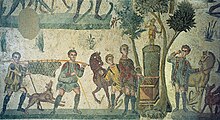
A Roman mosaic depicting a banquet during a hunting trip, from the Late Roman Villa Romana del Casale, Sicily

Italian cuisine has developed over the centuries. Although the country known as Italy did not unite until the 19th century, the cuisine can claim traceable roots as far back as the 4th century BC. Food and culture were very important at that time evident from the cookbook (Apicius) which dates to the first century BC.[28] Through the centuries, neighbouring regions, conquerors, high-profile chefs, political upheaval, and the discovery of the New World have influenced its development. Italian cuisine started to form after the fall of the Roman Empire, when different cities began to separate and form their own traditions. Many different types of bread and pasta were made, and there was a variation in cooking techniques and preparation.
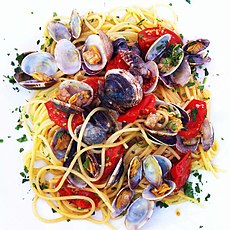
Spaghetti alle vongole

Italian cuisine

show

History

show

Regional cuisines

show

Lists

show

See also

flag Italy portal icon Food portal

  • v
  • t
  • e

The country was then split for a long time and influenced by surrounding countries such as Spain, France and others in Central Europe. Trade and the location on the Silk Road with its routes to Asia also influenced the local development of special dishes. Due to the climatic conditions and the different proximity to the sea, different basic foods and spices were available from region to region. Regional cuisine is represented by some of the major cities in Italy. For example, Milan (in the north of Italy) is known for risottos, Trieste (in the northeast of Italy) is known for multicultural food, Bologna (in the centre of Italy) is known for its tortellini, and Naples (in the south of Italy) is famous for its pizzas.[29] Additionally, spaghetti is believed to have spread across Africa to Sicily and then on to Naples.[30][31]

Antiquity[edit]

See also: Ancient Roman cuisine and Food and dining in the Roman Empire

The first known Italian food writer was a Greek Sicilian named Archestratus from Syracuse in the 4th century BC. He wrote a poem that spoke of using "top quality and seasonal" ingredients. He said that flavours should not be masked by spices, herbs or other seasonings. He placed importance on simple preparation of fish.[32]

Simplicity was abandoned and replaced by a culture of gastronomy as the Roman Empire developed. By the time De re coquinaria was published in the 1st century AD, it contained 470 recipes calling for heavy use of spices and herbs. The Romans employed Greek bakers to produce breads and imported cheeses from Sicily, as the Sicilians had a reputation as the best cheesemakers. The Romans reared goats for butchering, and grew artichokes and leeks.[32]

Some foods now considered traditional were imported to Italy from foreign countries during the Roman era. This includes the jujube (Italian: giuggiole), which is now celebrated as a regional cuisine in Arquà Petrarca.[33] The Romans also imported cherries, apricots, and peaches.[33]

Middle Ages[edit]

See also: Medieval cuisine

A restored medieval kitchen inside Verrucole Castle, Tuscany

Arabs invaded Sicily in the 9th century, introducing spinach, almonds, and rice.[34] They also brought with them foods from foreign lands that are now celebrated as traditional Italian foods: citrus fruit, artichokes, chickpeas, pistachios, sugarcane, eggplants, and durum wheat, which is used to make pasta.[33] During the 12th century, a Norman king surveyed Sicily and saw people making long strings made from flour and water called atriya, which eventually became trii, a term still used for spaghetti in southern Italy.[35] Normans also introduced the casserole, salt cod (Italian: baccalà), and stockfish, all of which remain popular.[36]

Food preservation was either chemical or physical, as refrigeration did not exist. Meats and fish were smoked, dried, or kept on ice. Brine and salt were used to pickle items such as herring, and to cure pork. Root vegetables were preserved in brine after they had been parboiled. Other means of preservation included oil, vinegar, or immersing meat in congealed, rendered fat. For preserving fruits, liquor, honey, and sugar were used.[37]

The oldest Italian book on cuisine is the 13th century Liber de coquina (English: Cookbook) written in Naples. Dishes include "Roman-style" cabbage (ad usum romanorum), ad usum campanie which were "small leaves" prepared in the "Campanian manner", a bean dish from the Marca di Trevisio, a torta, compositum londardicum, dishes similar to dishes the modern day. Two other books from the 14th century include recipes for Roman pastello, Lasagna pie, and call for the use of salt from Sardinia or Chioggia.[38]
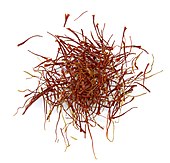
Saffron has been used in Italy for centuries.

In the 15th century, Maestro Martino was chef to the Patriarch of Aquileia at the Vatican. His Libro de arte coquinaria (English: Culinary art book) describes a more refined and elegant cuisine. His book contains a recipe for Maccaroni Siciliani, made by wrapping dough around a thin iron rod to dry in the sun. The macaroni was cooked in capon stock flavoured with saffron, displaying Persian influences. Martino noted the avoidance of excessive spices in favour of fresh herbs.[36] The Roman recipes include coppiette (air-dried salami) and cabbage dishes. His Florentine dishes include eggs with Bolognese torta, Sienese torta and Genoese recipes such as piperata (sweets), macaroni, squash, mushrooms, and spinach pie with onions.[39]

Martino's text was included in a 1475 book by Bartolomeo Platina printed in Venice entitled De honesta voluptate et valetudine (English: On Honest Pleasure and Good Health). Platina puts Martino's "Libro" in a regional context, writing about perch from Lake Maggiore, sardines from Lake Garda, grayling from Adda, hens from Padua, olives from Bologna and Piceno, turbot from Ravenna, rudd from Lake Trasimeno, carrots from Viterbo, bass from the Tiber, roviglioni and shad from Lake Albano, snails from Rieti, figs from Tuscolo, grapes from Narni, oil from Cassino, oranges from Naples and eels from Campania. Grains from Lombardy and Campania are mentioned as is honey from Sicily and Taranto. Wine from the Ligurian coast, Greco from Tuscany and San Severino, and Trebbiano from Tuscany and Piceno are also mentioned in the book.[40]

Early modern era[edit]

The courts of Florence, Rome, Venice, and Ferrara were central to the cuisine. Cristoforo di Messisbugo, steward to Ippolito d'Este, published Banchetti Composizioni di Vivande (English: Banquets Compositions of Food) in 1549. Messisbugo gives recipes for pies and tarts (containing 124 recipes with various fillings). The work emphasizes the use of Eastern spices and sugar.[41]

Bartolomeo Scappi, personal chef to Pope Pius V

In 1570, Bartolomeo Scappi, personal chef to Pope Pius V, wrote his Opera (English: Work) in five volumes, giving a comprehensive view of Italian cooking of that period. It contains over 1,000 recipes, with information on banquets including displays and menus as well as illustrations of kitchen and table utensils. This book differs from most books written for the royal courts in its preference for domestic animals and courtyard birds rather than game.

Recipes include lesser cuts of meats such as tongue, head, and shoulder. The third volume has recipes for fish in Lent. These fish recipes are simple, including poaching, broiling, grilling, and frying after marination.
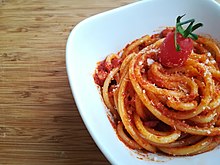
Bucatini allamatriciana

Bucatini with amatriciana sauce, which features the New World food of tomatoes

Particular attention is given to seasons and places where fish should be caught. The final volume includes pies, tarts, fritters, and a recipe for a sweet Neapolitan pizza (not the current savoury version, as tomatoes had not yet been introduced to Italy). However, such items from the New World as corn (maize) and turkey are included.[42] Eventually, through the Columbian exchange, Italian cuisine would also adopt not just tomatoes as a key flavour, but also beans, pumpkins, zucchini, and peppers, all of which came from the Americas during the last few hundred years.[33]

In the first decade of the 17th century, Giacomo Castelvetro wrote Breve Racconto di Tutte le Radici di Tutte l'Herbe et di Tutti i Frutti (English: A Brief Account of All Roots, Herbs, and Fruit), translated into English by Gillian Riley. Originally from Modena, Castelvetro moved to England because he was a Protestant. The book lists Italian vegetables and fruits along with their preparation. He featured vegetables as a central part of the meal, not just as accompaniments.[42] Castelvetro favoured simmering vegetables in salted water and serving them warm or cold with olive oil, salt, fresh ground pepper, lemon juice, verjus, or orange juice. He also suggested roasting vegetables wrapped in damp paper over charcoal or embers with a drizzle of olive oil. Castelvetro's book is separated into seasons with hop shoots in the spring and truffles in the winter, detailing the use of pigs in the search for truffles.[42]

L'arte di Ben Cucinare (English: The Art of Well Cooking), published by Bartolomeo Stefani in 1662

In 1662, Bartolomeo Stefani, chef to the Duchy of Mantua, published L'Arte di Ben Cucinare (English: The Art of Well Cooking). He was the first to offer a section on vitto ordinario (English: ordinary food). The book described a banquet given by Duke Charles for Queen Christina of Sweden, with details of the food and table settings for each guest, including a knife, fork, spoon, glass, a plate (instead of the bowls more often used), and a napkin.[43]

Other books from this time, such as Galatheo (English: Etiquette) by Giovanni della Casa, tell how scalci (English: waiters) should manage themselves while serving their guests. Waiters should not scratch their heads or other parts of themselves, or spit, sniff, cough or sneeze while serving diners. The book also told diners not to use their fingers while eating and not to wipe sweat with their napkin.[43]

Modern era[edit]

Apicius, De re coquinaria (English: On the Subject of Cooking), 1709 edition

At the beginning of the 18th century, Italian culinary books began to emphasize the regionalism of Italian cuisine rather than French cuisine. Books written then were no longer addressed to professional chefs but to bourgeois housewives.[44] Periodicals in booklet form such as La cuoca cremonese (English: The Cook of Cremona) in 1794 give a sequence of ingredients according to season along with chapters on meat, fish, and vegetables. As the century progressed these books increased in size, popularity, and frequency.[45]

In the 18th century, medical texts warned peasants against eating refined foods as it was believed that these were poor for their digestion and their bodies required heavy meals. It was believed that peasants ate poorly because they preferred eating poorly. However, many peasants had to eat rotten food and mouldy bread because that was all they could afford.[46]

In 1779, Antonio Nebbia from Macerata in the Marche region, wrote Il Cuoco Maceratese (English: The Cook of Macerata). Nebbia addressed the importance of local vegetables and pasta, rice, and gnocchi. For stock, he preferred vegetables and chicken over other meats.

In 1773, the Neapolitan Vincenzo Corrado's Il Cuoco Galante (English: The Courteous Cook) gave particular emphasis to vitto pitagorico (English: vegetarian food). "Pythagorean food consists of fresh herbs, roots, flowers, fruits, seeds and all that is produced in the earth for our nourishment. It is so-called because Pythagoras, as is well known, only used such produce. There is no doubt that this kind of food appears to be more natural to man, and the use of meat is noxious." This book was the first to give the tomato a central role with 13 recipes.
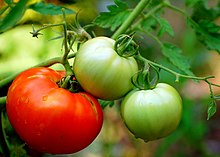
Tomatoes are a typical part of Italian cuisine, but only entered common usage in the late 18th century.[47]

Zuppa al pomodoro (English: "tomato soup") in Corrado's book is a dish similar to today's Tuscan pappa al pomodoro. Corrado's 1798 edition introduced a "Treatise on the Potato" after the French Antoine-Augustin Parmentier's successful promotion of the tuber.[48] In 1790, Francesco Leonardi in his book L'Apicio moderno (English: Modern Apicius) sketches a history of the Italian cuisine from the Roman Age and gives the first recipe of a tomato-based sauce.[49]

In the 19th century, Giovanni Vialardi, chef to King Victor Emmanuel II, wrote Trattato di cucina, Pasticceria moderna, Credenza e relativa Confettureria (English: A Treatise of Modern Cookery and Patisserie) with recipes "suitable for a modest household". Many of his recipes are for regional dishes from Turin, including 12 for potatoes such as Genoese Cappon Magro. In 1829, Il Nuovo Cuoco Milanese Economico (English: The New Economic Milanese Chef) by Giovanni Felice Luraschi featured Milanese dishes such as kidney with anchovies and lemon and gnocchi alla romana. Gian Battista and Giovanni Ratto's La Cucina Genovese (English: Genoese cuisine) in 1871 addressed the cuisine of Liguria. This book contained the first recipe for pesto. La Cucina Teorico-Pratica (English: The Theoretical-Practical Cuisine) written by Ippolito Cavalcanti described the first recipe for pasta with tomatoes.[50]

La scienza in cucina e l'arte di mangiare bene (English: The Science of Cooking and the Art of Eating Well), by Pellegrino Artusi, first published in 1891, is widely regarded as the canon of classic modern Italian cuisine, and it is still in print. Its recipes predominantly originate from Romagna and Tuscany, where he lived. Around 1880, two decades after the Unification of Italy, was the beginning of Italian diaspora, and with it started the spread of Italian cuisine in the world.[51]

Contemporary era[edit]

DOCG and DOC labels on two bottles of Italian wine

Italy has a large number of traditional specialities protected under EU law.[25] From the 1950s onwards, a great variety of typical products of Italian cuisine have been recognized as PDO, PGI, TSG and GI by the Council of the European Union, to which they are added the indicazione geografica tipica (IGT), the regional prodotto agroalimentare tradizionale (PAT) and the municipal denominazione comunale d'origine (De.C.O.).[52][53] In the oenological field, there are specific legal protections: the denominazione di origine controllata (DOC) and the denominazione di origine controllata e garantita (DOCG).[54] protected designation of origin (PDO) and protected geographical indications (PGI) have also been established in olive growing.[55] Some of these are new introductions: the kiwifruit was introduced from New Zealand to Italy in the 1970s, and three decades later, the province of Latina was designated the "Land of the Kiwi" and given protected status as a regional delicacy.[33]

Prosciutto di San Daniele PDO, one of the most imitated Italian products in the world.[56] The marketing phenomenon of imitation of Italian agri-food products that have nothing to do with Italian cuisine is known by the name of Italian Sounding.[57]

Italian cuisine is one of the most popular and copied cultures worldwide.[13] The lack or total unavailability of some of its most characteristic ingredients outside of Italy, leads to the complete de-naturalization of Italian ingredients, and above all else leads to falsifications (or food fraud).[58] This phenomenon, widespread in all continents, is better known as Italian Sounding, consisting in the use of Italian words as well as images, colour combinations (the Italian tricolour), geographical references, and brands evocative of Italy to promote and market agri-food products which in reality have nothing to do with Italian cuisine.[57] Italian Sounding invests in almost every sector of Italian food, from the most famous Italian cheeses, to cured meats, a variety of pastas, regional breads, extra virgin olive oils, and wines.[58] Counterfeit products violate registered trademarks or other distinctive signs protected by law such as the designations of origin (DOC, PDO, DOCG, PGI, TSG, IGT). Therefore, the counterfeiting is legally punishable.[59] However, Italian Sounding cannot be classified as illegal from a strictly legal standpoint, but they still represent "a huge damage to the Italian economy and to the potential resources of Made in Italy".[60] Two out of three Italian agri-food products sold worldwide are not made in Italy.[61] The Italian Sounding phenomenon is estimated to generate €55 billion worldwide annually.[62]

Following the spread of fast food, also in Italy, imported from Anglo-Saxon countries and in particular from the United States in 1986, in Bra, Piedmont, the Slow Food cultural and gastronomic movement was founded, then converted into an institution with the aim of protecting culinary specificities and to safeguard various regional products of Italian cuisine under the control of the Slow Food Presidia.[63] Slow Food also focuses on food quality, rather than quantity.[64] It speaks out against overproduction and food waste,[65] and sees globalization as a process in which small and local farmers and food producers should be simultaneously protected from and included in the global food system.[66][67]

The Italian chef Gualtiero Marchesi (1930–2017) is unanimously considered the founder of the new Italian cuisine[68] and, in the opinion of many, the most famous Italian chef in the world.[69] He contributed mostly to the development of Italian cuisine, placing the Italian culinary culture among the most important around the world, with the creation, thanks to the use of Italian ingredients, dishes and culinary traditions, of the Italian version of the French nouvelle cuisine.[70] Italian nouvelle cuisine is characterized by lighter, more delicate dishes and an increased emphasis on presentation, and it designed for the most expensive restaurants.[71] It is defined as a "cuisine of the head rather than the throat" and it is characterized by the separation of flavours, without ever upsetting the ancient Italian culinary tradition despite the use, in its recipes, of some culinary traditions of other countries.[71][72] He is known for using modern technology and classic cuisine.

Basic foods[edit]
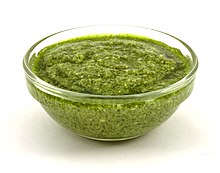
Pesto, a Ligurian sauce made out of basil, olive oil, hard cheese and pine nuts, and which can be eaten with pasta or other dishes such as soup

Italian cuisine has a great variety of different ingredients which are commonly used, ranging from fruits, vegetables, grains, cheeses, meats and fish. In northern Italy, fish (such as cod, or baccalà), potatoes, rice, corn (maize), sausages, pork, and different types of cheese are the most common ingredients. Pasta dishes with tomato are common throughout Italy.[73][74] Italians use ingredients that are fresh and subtly seasoned and spiced.[75]

In northern Italy there are many kinds of stuffed pasta, although polenta and risotto are equally popular if not more so.[76] Ligurian ingredients include several types of fish and seafood dishes. Basil (found in pesto), nuts, and olive oil are very common. In Emilia-Romagna, common ingredients include prosciutto (ham), sausage (Italian: cotechino), different sorts of salami, truffles, grana, Parmesan (Italian: Parmigiano Reggiano), tomatoes (Bolognese sauce or ragù) and balsamic vinegar (Italian: aceto balsamico).
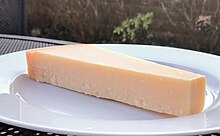
Parmesan cheese

Olive oil

Various types of pasta

Traditional pizza Margherita, whose ingredients, tomato (red), mozzarella (white) and basil (green), are inspired by the colours of the national flag of Italy.[77]

Barrels of aging balsamic vinegar

Traditional central Italian cuisine uses ingredients such as tomatoes, all kinds of meat, fish, and pecorino.[78] In Tuscany, pasta (especially pappardelle) is traditionally served with meat sauce (including game meat).[79] In southern Italy, tomatoes (fresh or cooked into tomato sauce), peppers, olives and olive oil, garlic, artichokes, oranges, ricotta cheese, eggplants, zucchini, certain types of fish (anchovies, sardines and tuna), and capers are important components to the local cuisine.[80]

Many cheeses and dairy products are made in Italy.[81] There are more than 600 distinct types throughout the country,[82][83] of which 490 are protected and marked as PDO (protected designation of origin), PGI (protected geographical indication) and PAT (prodotto agroalimentare tradizionale).[84]

Olive oil is the most commonly used vegetable fat in Italian cooking, and as the basis for sauces, replaced only in some recipes and in some geographical areas by butter or lard.[85] Italy is the largest consumer of olive oil, with 30% of the world total;[86] it also has the largest range of olive cultivars in existence and is the second largest producer and exporter in the world.[87][88] Bread has always been, as it has for other Mediterranean countries, a fundamental food in Italian cuisine.[89] There are numerous regional types of bread.[89]

Italian cuisine has a great variety of sausages and cured meats, many of which are protected and marked as PDO and PGI,[90] and make up 34% of the total of sausages and cured meats consumed in Europe,[91] while others are marked as PAT.[92]

Meat, especially beef, pork and poultry, is very present in Italian cuisine, in a very wide range of preparations and recipes.[93] It is also important as an ingredient in the preparation of sauces for pasta. In addition to the varieties mentioned, albeit less commonly, sheep, goat, horse, rabbit and, even less commonly, game meat are also consumed in Italy.[93]

Since Italy is largely surrounded by the sea, therefore having a great coastal development and being rich in lakes, fish (both marine and freshwater), as well as crustaceans, molluscs and other seafood, enjoy a prominent place in Italian cuisine, as in general in the Mediterranean cuisine.[94] Fish is the second course in meals and is also an ingredient in the preparation of seasonings for types of pasta.[95] It is also widely used in appetizers.[96]

Italian cuisine is also well known (and well regarded) for its use of a diverse variety of pasta. Pasta include noodles in various lengths, widths, and shapes.[97] Most pastas may be distinguished by the shapes for which they are named—penne, maccheroni, spaghetti, linguine, fusilli, lasagne. Many more varieties are filled with other ingredients, like ravioli and tortellini.[97]

The word pasta is also used to refer to dishes in which pasta products are a primary ingredient.[98] It is usually served with sauce. There are hundreds of different shapes of pasta with at least locally recognized names. Examples include spaghetti ('thin rods'), rigatoni ('tubes' or 'cylinders'), fusilli ('swirls'), and lasagne ('sheets'). Dumplings, like gnocchi (made with potatoes or pumpkin) and noodles like spätzle, are sometimes considered pasta.[99]

Pasta is divided into two broad categories: dry pasta (100% durum wheat flour mixed with water) and fresh pasta (also with soft wheat flour and almost always mixed with eggs).[100] Pasta is generally cooked by boiling. Under Italian law, dry pasta (pasta secca) can only be made from durum wheat flour or durum wheat semolina, and is more commonly used in southern Italy compared to their northern counterparts, who traditionally prefer the fresh egg variety.[101]

Durum flour and durum semolina have a yellow tinge in colour.[102] Italian dried pasta is traditionally cooked al dente (lit. 'to the tooth').[103] There are many types of wheat flour with varying gluten and protein levels depending on the variety of grain used.[104]

Particular varieties of pasta may also use other grains and milling methods to make the flour, as specified by law. Some pasta varieties, such as pizzoccheri, are made from buckwheat flour.[105] Fresh pasta may include eggs (Italian: pasta all'uovo, lit. 'egg pasta').[106]

Both dry and fresh pasta are used to prepare the dish, in three different ways:[107][108][109]

  • pastasciutta: pasta is cooked and then served with a sauce or other condiment;
  • minestrone: pasta is cooked and served in meat or vegetable broth (Italian: minestra), even together with chopped vegetables (Italian: minestrone);
  • pasta al forno: the pasta is first cooked and seasoned, and then passed back to the oven.

Pizza, consisting of a usually round, flat base of leavened wheat-based dough topped with tomatoes, cheese, and often various other ingredients (such as anchovies, mushrooms, onions, olives, meats, and more), which is then baked at a high temperature, traditionally in a wood-fired oven,[110] is the best known and most consumed Italian food in the world.[111]

In 2009, upon Italy's request, Neapolitan pizza was registered with the European Union as a traditional speciality guaranteed dish,[112][113] and in 2017 the art of its making was included on UNESCO's list of intangible cultural heritage.[114] Up to 20% of the flour in the traditional pizza crust can be strong Manitoba flour, which was introduced to Italy from Canada as part of the Marshall Plan after World War II.[33] In Italy it is consumed as a single dish (pizza al piatto) or as a snack, even on the go (pizza al taglio).[115] In the various regions, dishes similar to pizza are the various types of focaccia, such as piadina, crescia or sfincione.[116]

Regional cuisines[edit]

Each area has its own specialties, primarily at a regional level, but also at the provincial level. The differences can come from a bordering country (such as France, Austria or Slovenia), whether a region is close to the sea or the mountains, and economics.[117] Italian cuisine is also seasonal with priority placed on the use of fresh produce.[118][119]

Abruzzo and Molise[edit]

Main article: Cuisine of Abruzzo

Arrosticini

Pasta, meat, and vegetables are central to the cuisine of Abruzzo and Molise. Chili peppers (Italian: peperoncini) are typical of Abruzzo, where they are called diavoletti ('little devils') for their spicy heat. Due to the long history of shepherding in Abruzzo and Molise, lamb dishes are common. Lamb meat is often paired with pasta.[120] Mushrooms (usually wild mushrooms), rosemary, and garlic are also extensively used in Abruzzese cuisine.

Best-known is the extra virgin olive oil produced in the local farms on the hills of the region, marked by the quality level DOP and considered one of the best in the country.[121] Renowned wines like Montepulciano DOCG and Trebbiano d'Abruzzo DOC are considered amongst the world's finest wines.[122] In 2012, a bottle of Trebbiano d'Abruzzo Colline Teramane ranked No. 1 in the top 50 Italian wine award.[123] Centerbe ('Hundred Herbs') is a strong (72% alcohol), spicy herbal liqueur drunk by the locals. Another liqueur is genziana, a soft distillate of gentian roots.

The best-known dish from Abruzzo is arrosticini, little pieces of castrated lamb on a wooden stick and cooked on coals. The chitarra (lit. 'guitar') is a fine stringed tool that pasta dough is pressed through for cutting. In the province of Teramo, famous local dishes include the virtù soup (made with legumes, vegetables, and pork meat), the timballo (pasta sheets filled with meat, vegetables or rice), and the mazzarelle (lamb intestines filled with garlic, marjoram, lettuce, and various spices). The popularity of saffron, grown in the province of L'Aquila, has waned in recent years.[120]

Also seafood is part important of cuisine of Abruzzo with fish products are brodetti,[124] scapece alla vastese,[125] baccalà all'abruzzese,[126] Mussels with saffron classic cooked mussels prepared with parsley, onion, bay leaf, white wine, olive oil and seasoned with Saffron of l'Aquila sauce[127] and coregone di Campotosto,[128][129] typical lake fish.

The most famous dish of Molise is cavatelli, a long shaped, handmade macaroni-type pasta made of flour, semolina, and water, often served with meat sauce, broccoli, or mushrooms. Pizzelle waffles are a common dessert, especially around Christmas.

Apulia[edit]

Main article: Apulian cuisine
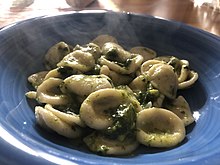
Orecchiette with cime di rapa sauce

Apulia is a massive food producer; major production includes wheat, tomatoes, zucchini, broccoli, bell peppers, potatoes, spinach, eggplants, cauliflower, fennel, endive, chickpeas, lentils, beans, and cheese (like the traditional caciocavallo and the famous burrata). Apulia is also the largest producer of olive oil in Italy. The sea offers abundant fish and seafood that are extensively used in the regional cuisine, especially oysters, and mussels.

Goat and lamb are occasionally used.[130] The region is known for pasta made from durum wheat and traditional pasta dishes featuring orecchiette-style pasta, often served with tomato sauce, potatoes, mussels, or broccoli rabe. Pasta with cherry tomatoes and arugula is also popular.[131]

Regional desserts include zeppole, doughnuts usually topped with powdered sugar and filled with custard, jelly, cannoli-style pastry cream, or a butter-and-honey mixture. For Christmas, Apulians make a very traditional rose-shaped pastry called cartellate. These are fried or baked and dipped in vin cotto, which is either a wine or fig juice reduction.

Most famous street foods are focaccia barese (focaccia with fresh cherry tomatoes), panzerotto (a variant of the pizza that can be baked or fried) and rustico (puff pastry with tomato, bechamel and mozzarella cheese, popular especially in Lecce and Salento)

Basilicata[edit]

Main article: Cuisine of Basilicata
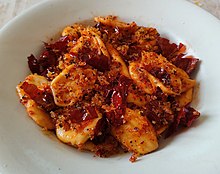
Pasta con i peperoni cruschi, a traditional dish from Basilicata

The cuisine of Basilicata is mostly based on inexpensive ingredients and deeply anchored in rural traditions.

Pork is an integral part of the regional cuisine, often made into sausages or roasted on a spit. Famous dry sausages from the region are lucanica and soppressata. Wild boar, mutton, and lamb are also popular. Pasta sauces are generally based on meats or vegetables. Horseradish is often used as a spice and condiment, known in the region as "poor man's truffle".[132] The region produces cheeses like pecorino di Filiano, canestrato di Moliterno, pallone di Gravina, and padraccio and olive oils like the Vulture.[133] The peperone crusco (lit. 'crusco pepper') is a staple of the local cuisine, defined as the "red gold of Basilicata".[134] It is consumed as a snack or as a main ingredient for several regional recipes.[135]

Among the traditional dishes are pasta con i peperoni cruschi, pasta served with dried crunchy pepper and bread crumbs;[136] lagane e ceci, also known as piatto del brigante (lit. 'brigand's dish'), pasta prepared with chickpeas and peeled tomatoes;[137] tumact me tulez, tagliatelle-dish of Arbëreshe culture; rafanata, a type of omelet with horseradish; ciaudedda, a vegetable stew with artichokes, potatoes, broad beans, and pancetta;[138] and the baccalà alla lucana, one of the few recipes made with fish. Desserts include taralli dolci, made with sugar glaze and scented with anise and calzoncelli, fried pastries filled with a cream of chestnuts and chocolate.

The most famous wine of the region is the Aglianico del Vulture; others include Matera, Terre dell'Alta Val d'Agri, and Grottino di Roccanova.[139]

Basilicata is also known for its mineral waters which are sold widely in Italy. The springs are mostly located in the volcanic basin of the Vulture area.[140]

Calabria[edit]

Main article: Calabria § Cuisine
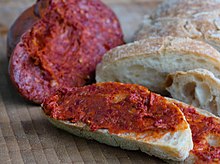
'Nduja with bread, with a piece of'nduja sausage in the background

In Calabria, a history of French rule under the House of Anjou and Napoleon, along with Spanish influences, affected the language and culinary skills as seen in the naming of foods such as cake, gatò, from the French gateau. Seafood includes swordfish, shrimp, lobster, sea urchin, and squid. Macaroni-type pasta is widely used in regional dishes, often served with goat, beef, or pork sauce and salty ricotta.[141]

Main courses include frittuli (prepared by boiling pork rind, meat, and trimmings in pork fat), different varieties of spicy sausages (like 'nduja and capicola), goat, and land snails. Melon and watermelon are traditionally served in a chilled fruit salad or wrapped in ham.[142] Calabrian wines include Greco di Bianco, Bivongi, Cirò, Dominici, Lamezia, Melissa, Pollino, Sant'Anna di Isola Capo Rizzuto, San Vito di Luzzi, Savuto, Scavigna, and Verbicaro.

Calabrese pizza has a Neapolitan-based structure with fresh tomato sauce and a cheese base, but is unique because of its spicy flavour. Some of the ingredients included in a Calabrese pizza are thinly sliced hot soppressata, hot capicola, hot peppers, and fresh mozzarella.

Campania[edit]

Main article: Neapolitan cuisine
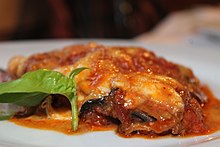
Parmigiana di melanzane
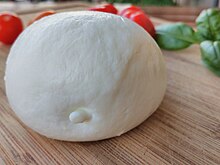
Buffalo mozzarella (Italian: mozzarella di bufala) is a dairy product traditionally made from buffalo milk in southern Italy.

Campania extensively produces tomatoes, peppers, spring onions, potatoes, artichokes, fennel, lemons, and oranges which all take on the flavour of volcanic soil. The Gulf of Naples offers fish and seafood. Campania is one of the largest producers and consumers of pasta in Italy, especially spaghetti. In the regional cuisine, pasta is prepared in various styles that can feature tomato sauce, cheese, clams, and shellfish.[143]

Spaghetti alla puttanesca is a popular dish made with olives, tomatoes, anchovies, capers, chili peppers, and garlic. The region is well known for its mozzarella production (especially from the milk of water buffalo) that is used in a variety of dishes, including parmigiana (shallow fried eggplant slices layered with cheese and tomato sauce, then baked). Desserts include struffoli (deep fried balls of dough), ricotta-based pastiera, sfogliatelle, torta caprese and rum baba.[143]

Originating in Neapolitan cuisine, pizza has become popular worldwide.[144] Pizza is an oven-baked, flat, disc-shaped bread typically topped with a tomato sauce, cheese (usually mozzarella), and various toppings depending on the culture. Since the original pizza, several other types of pizzas have evolved.

Since Naples was the capital of the Kingdom of Two Sicilies, its cuisine took much from the culinary traditions of all the Campania region, reaching a balance between dishes based on rural ingredients (pasta, vegetables, cheese) and seafood dishes (fish, crustaceans, mollusks). A vast variety of recipes is influenced by the local aristocratic cuisine, like timballo and sartù di riso, pasta or rice dishes with very elaborate preparation, while the dishes coming from the popular traditions contain inexpensive but nutritionally healthy ingredients, like pasta with beans and other pasta dishes with vegetables.

Famous regional wines are Aglianico (Taurasi), Fiano, Falanghina, Lacryma Christi, Coda di Volpe dei Campi Flegrei and Greco di Tufo.

Emilia-Romagna[edit]
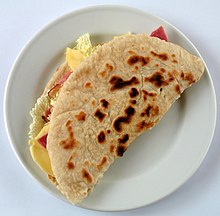
Piadina

Emilia-Romagna is especially known for its egg and filled pasta made with soft wheat flour. The Romagna subregion is renowned for pasta dishes like cappelletti, garganelli, strozzapreti, sfoglia lorda, and tortelli alla lastra as well as cheeses such as squacquerone, piadina snacks are also a specialty of the subregion.

Bologna and Modena are notable for pasta dishes like tortellini, tortelloni, lasagne, gramigna, and tagliatelle which are found also in many other parts of the region in different declinations, while Ferrara is known for cappellacci di zucca, pumpkin-filled dumplings, and Piacenza for pisarei e faśö, wheat gnocchi with beans and lard. The celebrated balsamic vinegar is made only in the Emilian cities of Modena and Reggio Emilia, following legally binding traditional procedures.[145]
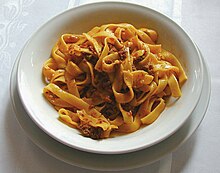
Tagliatelle with ragù

In the Emilia subregion, except Piacenza which is heavily influenced by the cuisines of Lombardy, rice is eaten to a lesser extent than the rest of northern Italy. Polenta, a maize-based side dish, is common in both Emilia and Romagna.

Parmesan (Italian: Parmigiano Reggiano) cheese is produced in Reggio Emilia (and it was invented in Bibbiano, a little town near Reggio Emilia; this city is also known for erbazzone, a kind of egg and vegetables quiche). Grana Padano cheese is produced in Piacenza.

Although the Adriatic coast is a major fishing area (well known for its eels and clams harvested in the Comacchio lagoon), the region is more famous for its meat products, especially pork-based, that include cold cuts such as Parma's prosciutto, culatello, and salame Felino; Piacenza's pancetta, coppa, and salami; Bologna's mortadella and salame rosa; zampone, cotechino, and cappello del prete; and Ferrara's salama da sugo. Piacenza is also known for some dishes prepared with horse and donkey meat. Regional desserts include zuppa inglese (custard-based dessert made with sponge cake and Alchermes liqueur), panpepato (Christmas cake made with pepper, chocolate, spices, and almonds), tenerina (butter and chocolate cake) and torta degli addobbi (rice and milk cake).

Friuli-Venezia Giulia[edit]

Frico, a traditional dish in the Friuli-Venezia Giulia region

The cuisine of Friuli-Venezia Giulia can vary depending on the territory, as certain areas are home to German and Slovene minorities whose local cuisine conserves greater Austro-Hungarian influences and often differs from mainstream Friulian cuisine. Udine and Pordenone, in the western part of the region, are known for their traditional prosciutto di San Daniele, Montasio cheese, cjarsons stuffed pasta and frico cheese dish. Other typical dishes are pitina (meatballs made of smoked meats), game, and various types of gnocchi and polenta.

Typical dishes in the eastern provinces of Gorizia and Trieste include brovada (fermented turnips), Jota (soup of beans, sauerkraut, potatoes, pancetta and onions), local variations of goulash, apple strudel, pinza and presnitz. Pork can be spicy and is often prepared over an open hearth called a fogolar. Collio Goriziano, Friuli Isonzo, Colli Orientali del Friuli, and Ramandolo are well-known denominazione di origine controllata regional wines.

Seafood from the Adriatic is also used in this area, mainly prepared according to Istrian and Venetian recipes. While the tuna fishing has declined, the pilchards from the Gulf of Trieste off Barcola (in the local dialect: sardoni barcolani) are a special and sought-after delicacy.[146][147][148]

Liguria[edit]

Main article: Cuisine of Liguria

Focaccia with rosemary. Focaccia is widely associated with Ligurian cuisine.

Liguria is known for herbs and vegetables (as well as seafood) in its cuisine. Savory pies are popular, mixing greens and artichokes along with cheeses, milk curds, and eggs. Onions and olive oil are used. Due to a lack of land suitable for wheat, the Ligurians use chickpeas in farinata and polenta-like panissa. The former is served plain or topped with onions, artichokes, sausage, cheese or young anchovies.[149] Farinata is typically cooked in a wood-fired oven, similar to southern pizzas. Furthermore, fresh fish features heavily in Ligurian cuisine. Baccalà, or salted cod, features prominently as a source of protein in coastal regions. It is traditionally prepared in a soup.

Hilly districts use chestnuts as a source of carbohydrates. Ligurian pastas include corzetti, typically stamped with traditional designs, from the Polcevera Valley; pansoti, a triangular shaped ravioli filled with vegetables; piccagge, pasta ribbons made with a small amount of egg and served with artichoke sauce or pesto sauce; trenette, made from whole wheat flour cut into long strips and served with pesto; boiled beans and potatoes; and trofie, a Ligurian gnocchi made from wheat flour and boiled potatoes, made into a spiral shape and often tossed in pesto.[149] Many Ligurians emigrated to Argentina in the late 19th and early 20th centuries, influencing the cuisine of the country (which was otherwise dominated by meat and dairy products that the narrow Ligurian hinterland would not have allowed). Pesto, sauce made from basil and other herbs, is uniquely Ligurian, and features prominently among Ligurian pastas.

Lazio[edit]

Main article: Roman cuisine
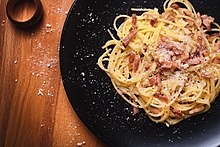
Spaghetti alla carbonara

It features fresh, seasonal and simply-prepared ingredients from Roman Campagna.[150] These include peas, globe artichokes and fava beans, shellfish, milk-fed lamb and goat, and cheeses such as pecorino romano and ricotta.[151] Olive oil is used mostly to dress raw vegetables, while strutto (pork lard) and fat from prosciutto are preferred for frying.[150] The most popular sweets in Rome are small individual pastries called pasticcini, gelato and handmade chocolates and candies.[152] Special dishes are often reserved for different days of the week; for example, gnocchi is eaten on Thursdays, baccalà (salted cod) on Fridays, and trippa (lit. 'tripe') on Saturdays.

Pasta dishes based on the use of guanciale (unsmoked bacon prepared with pig's jowl or cheeks) are often found in Lazio, such as pasta carbonara and pasta amatriciana. Another pasta dish of the region is arrabbiata, with spicy tomato sauce. The regional cuisine widely use offal, resulting in dishes like the entrail-based rigatoni with pajata sauce and coda alla vaccinara.[153] Abbacchio is a meat dish based on lamb from the Roman cuisine.

Iconic of Lazio is cheese made from ewes' milk (pecorino romano), porchetta (savory, fatty, and moist boneless pork roast) and Frascati white wine. The influence of the ancient Jewish community can be noticed in the Roman cuisine's traditional carciofi alla giudia.[153]

Lombardy[edit]

Main article: Lombard cuisine

Ossobuco served with risotto alla milanese

Due to the different historical events of its provinces and the variety of its territory, Lombard cuisine has a very varied culinary tradition. First courses in Lombard cuisine range from risotto, to soups and stuffed pasta, in broth or not. Main courses offer a variegated choice of meat or fish dishes of the tradition of the many lakes and rivers of Lombardy.[154]

In general, the cuisine of the various provinces of Lombardy can be united by the prevalence of rice and stuffed pasta over dry pasta, butter instead of olive oil for cooking, prolonged cooking, the widespread use of pork, milk and derivatives, egg-based preparations, and the consumption of polenta that is common to all of northern Italy.[155]
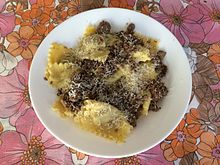
A plate of dry Pavese agnolotti, with a Pavese stew-based sauce

Rice dishes are very popular in this region, often found in soups as well as risotto. The best-known version is risotto alla milanese, flavoured with saffron. Due to its characteristic yellow color, it is often called risotto giallo. The dish is sometimes served with ossobuco (cross-cut veal shanks braised with vegetables, white wine and broth).[156]
A dish of pizzoccheri

Other regional specialties include cotoletta alla milanese (a fried breaded cutlet of veal similar to Wiener schnitzel, but cooked "bone-in"), cassoeula (a typically winter dish prepared with cabbage and pork), mostarda (rich condiment made with candied fruit and a mustard flavoured syrup), Valtellina's bresaola (air-dried salted beef), pizzoccheri (a flat ribbon pasta made with 80% buckwheat flour and 20% wheat flour cooked along with greens, cubed potatoes, and layered with pieces of Valtellina Casera cheese), Pavese agnolotti (a type of ravioli with Pavese stew filling), casoncelli (a kind of stuffed pasta, usually garnished with melted butter and sage, typical of Bergamo) and tortelli di zucca (a type of ravioli with pumpkin filling, usually garnished with melted butter and sage or tomato).[157]

Common in the whole Insubria area are bruscitti, originating from Alto Milanese, which consist in a braised meat dish cut very thin and cooked in wine and fennel seeds, historically obtained by stripping leftover meat. Regional cheeses include Grana Padano, Gorgonzola, crescenza, robiola, and Taleggio (the plains of central and southern Lombardy allow intensive cattle farming). Polenta is common across the region. Regional desserts include the famous panettone (soft sweet bread with raisins and candied citron and orange chunks).

Marche[edit]
Olive all'ascolana

On the coast of Marche, fish and seafood are produced. Inland, wild and domestic pigs are used for sausages and hams. These hams are not thinly sliced, but cut into bite-sized chunks. Suckling pig, chicken, and fish are often stuffed with rosemary or fennel fronds and garlic before being roasted or placed on the spit.[158]

Ascoli, Marche's southernmost province, is well known for olive all'ascolana (stoned olives stuffed with several minced meats, egg, and Parmesan, then fried).[159] Another well-known Marche product are the maccheroncini di Campofilone, from little town of Campofilone, a kind of hand-made pasta made only of hard grain flour and eggs, cut so thin that melts in one's mouth.

Piedmont[edit]
Traditional Piedmontese agnolotti

Between the Alps and the Po Valley, featuring a large number of different ecosystems, the Piedmont region offers a refined and varied cuisine. As a point of union between traditional Italian and French cuisine, Piedmont is the Italian region with the largest number of cheeses with protected geographical status and wines under DOC. It is also the region where both the Slow Food association and the most prestigious school of Italian cooking, the University of Gastronomic Sciences, were founded.[160]

Piedmont is a region where gathering nuts, mushrooms, and cardoons, as well as hunting and fishing, are commonplace. Truffles, garlic, seasonal vegetables, cheese, and rice feature in the cuisine. Wines from the Nebbiolo grape such as Barolo and Barbaresco are produced as well as wines from the Barbera grape, fine sparkling wines, and the sweet, lightly sparkling, Moscato d'Asti. The region is also famous for its Vermouth and Ratafia production.[160]
Polenta with bagna càuda

Castelmagno is a prized cheese of the region. Piedmont is also famous for the quality of its Carrù beef (particularly bue grasso, lit. 'fat ox'), hence the tradition of eating raw meat seasoned with garlic oil, lemon, and salt; carpaccio; Brasato al vino, wine stew made from marinated beef; and boiled beef served with various sauces.[160]

The food most typical of the Piedmont tradition are agnolotti (pasta folded over with roast beef and vegetable stuffing), paniscia (a typical dish of Novara, a kind of risotto with Arborio rice or Maratelli rice, the typical kind of Saluggia beans, onion, Barbera wine, lard, salami, season vegetables, salt and pepper), taglierini (thinner version of tagliatelle), bagna càuda (sauce of garlic, anchovies, olive oil, and butter), and bicerin (hot drink made of coffee, chocolate, and whole milk). Piedmont is one of the Italian capitals of pastry and chocolate in particular, with products like Nutella, gianduiotto, and marron glacé that are famous worldwide.[160]

Sardinia[edit]

Main article: Sardinian cuisine
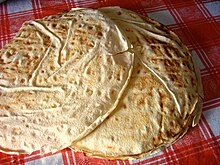
Traditional carasau bread

Suckling pig and wild boar are roasted on the spit or boiled in stews of beans and vegetables, thickened with bread. Herbs such as mint and myrtle are widely used in the regional cuisine. Sardinia also has many special types of bread, made dry, which keeps longer than high-moisture breads.[161] Malloreddus is a typical pasta of the region.

Also baked are carasau bread, civraxu bread, coccoi a pitzus, a highly decorative bread, and pistocu bread, made with flour and water only, originally meant for herders, but often served at home with tomatoes, basil, oregano, garlic, and a strong cheese. Rock lobster, scampi, squid, tuna, and sardines are the predominant seafoods.[161]

Casu marzu is a sheep's cheese produced in Sardinia, but is of questionable legality due to hygiene concerns.[162]

Sicily[edit]

Main article: Sicilian cuisine
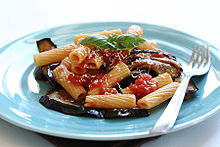
Pasta alla Norma is amongst Sicily's most historic and iconic dishes.

Sicily shows traces of all the cultures which established themselves on the island over the last two millennia. Although its cuisine undoubtedly has a predominantly Italian base, Sicilian food also has Spanish, Greek and Arab influences. Dionysus is said to have introduced wine to the region; a trace of historical influence from ancient Greece.[163]

The ancient Romans introduced lavish dishes based on goose. The Byzantines favoured sweet and sour flavours and the Arabs brought sugar, citrus, rice, spinach, and saffron. The Normans and Hohenstaufens had a fondness for meat dishes. The Spanish introduced items from the New World including chocolate, maize, turkey, and tomatoes.[163]
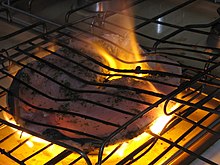
Grilled swordfish

Much of the island's cuisine encourages the use of fresh vegetables such as eggplant, peppers, and tomatoes, as well as fish such as tuna, sea bream, sea bass, swordfish and cuttlefish. In Trapani, in the extreme western corner of the island, North African influences are clear in the use of various couscous based dishes, usually combined with fish.[164] Mint is used extensively in cooking unlike the rest of Italy.

Traditional specialties from Sicily include arancini (a form of deep-fried rice croquettes), pasta alla Norma, caponata, pani câ meusa, and a host of desserts and sweets such as cannoli, granita, and cassata.[165]

Typical of Sicily is Marsala, a red, fortified wine similar to Port and largely exported.[166][167]

Trentino-Alto Adige[edit]
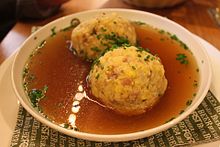
Traditional Speck knödel soup. The cuisine of South Tyrol combines culinary influences from Italy and the Mediterranean with a strong alpine regional and Austrian influence.

The cuisine of South Tyrol – the northern half of the Trentino-Alto Adige region – combines culinary influences from Italy and the Mediterranean with a strong alpine regional and Austrian influence.[168] Before the Council of Trent in the middle of the 16th century, the region was known for the simplicity of its peasant cuisine. When the prelates of the Catholic Church established there, they brought the art of fine cooking with them. Later, also influences from Venice and the Austrian Habsburg Empire came in.[169]

The most renowned local product is traditional speck juniper-flavoured ham which, as speck Alto Adige, is regulated by the European Union under the PGI status. Goulash, knödel, apple strudel, kaiserschmarrn, krapfen, rösti, spätzle, and rye bread are regular dishes, along with potatoes, dumpling, homemade sauerkraut, and lard.[169] Since the 20th century the cuisine has come under the influence of other Italian regions, so that various pizza and pasta dishes have now become staples.[170] This fusion has led to the creation of dishes such as pasta with speck cream sauce and baked apple rings.[170] The territory of Bolzano is also reputed for its Müller-Thurgau white wines.

The cuisine of the Trentino subregion leans more towards Veneto. It is influenced by its geographical position which ranges from isolated Alpine valleys to the southern prealpine lakes. The cuisine is characterized by its peasant dishes and especially the wide presence of soups. Trentino produces various types of sausages, polenta, yogurt, cheese, gnocchi, buckwheat, potato cake, funnel cake and freshwater fish. Typical dishes from Trentino include zuppa d'orzo (barley soup), canederli (bread dumplings), strangolapreti (spinach gnocchi), smacafam (savory Carnival pie), panada (bread soup), brö brusà (toasted soup), tortel di patate (potato pancakes) and risotto with Teroldego. Trentino's protected products include its Non Valley apples.

Tuscany[edit]
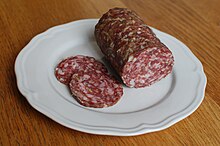
Finocchiona, a classic Tuscan salami

Simplicity is central to the Tuscan cuisine. Legumes, bread, cheese, vegetables, mushrooms, and fresh fruit are used. A good example of typical Tuscan food is ribollita, a notable soup whose name literally means 'reboiled'. Like most Tuscan cuisine, the soup has peasant origins. Ribollita was originally made by reheating (i.e. reboiling) the leftover minestrone or vegetable soup from the previous day. There are many variations but the main ingredients always include leftover bread, cannellini beans, and inexpensive vegetables such as carrot, cabbage, beans, silverbeet, cavolo nero (Tuscan kale), onion, and olive oil.
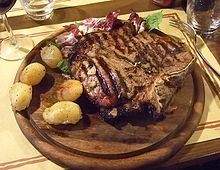
Bistecca alla fiorentina

A regional Tuscan pasta known as pici resembles thick, grainy-surfaced spaghetti, and is often rolled by hand. White truffles from San Miniato appear in October and November. High-quality beef, used for the traditional Florentine steak, come from the Chianina cattle breed of the Chiana Valley and the Maremmana from Maremma.

Pork is also produced.[171] The region is well-known also for its rich game, especially wild boar, hare, fallow deer, roe deer, and pheasant that often are used to prepare pappardelle dishes. Maiale Ubriaco, or "Drunken Pork", is another regional preparation in which pork is braised in Chianti wine and often paired with Tuscan kale.[172] Lardo is a salume of cured fatback, served as thin slices or as a paste; a famous variety is lardo di colonnata.

Regional desserts include cantucci (oblong-shaped almond biscuits), castagnaccio (a chestnut flour cake), pan di ramerino [it] (a sweet bread containing raisins and rosemary), panforte (prepared with honey, fruits, and nuts), ricciarelli (biscuits made using an almond base with sugar, honey, and egg white), necci (galettes made with chestnut flour) and cavallucci (pastry made with almonds, candied fruits, coriander, flour, and honey).

Well-known regional wines include Brunello di Montalcino, Carmignano, Chianti, Morellino di Scansano, Parrina, Sassicaia, and Vernaccia di San Gimignano.

Umbria[edit]
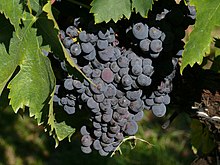
A varietal Sagrantino indigenous to the region of Umbria

Many Umbrian dishes are prepared by boiling or roasting with local olive oil and herbs. Vegetable dishes are popular in the spring and summer,[173] while fall and winter sees meat from hunting and black truffles from Norcia. Meat dishes include the traditional wild boar sausages, pheasants, geese, pigeons, frogs, and snails.

Castelluccio is known for its lentils. Spoleto and Monteleone are known for spelt. Freshwater fish include lasca, trout, freshwater perch, grayling, eel, barbel, whitefish, and tench.[174] Orvieto and Sagrantino di Montefalco are important regional wines.

Valle d'Aosta[edit]
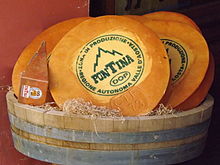
Fontina cheese from Valle d'Aosta

In the Aosta Valley, bread-thickened soups are customary as well as cheese fondue, chestnuts, potatoes, rice. Polenta is a staple along with rye bread, smoked bacon, motsetta (cured chamois meat), and game from the mountains and forests. Butter and cream are important in stewed, roasted, and braised dishes.[175]

Typical regional products include Fontina cheese, Vallée d'Aoste Lard d'Arnad, red wines and Génépi Artemisia-based liqueur.[119]

Veneto[edit]

Main article: Venetian cuisine

Venice and many surrounding parts of Veneto are known for risotto, a dish whose ingredients can highly vary upon different areas. Fish and seafood are added in regions closer to the coast while pumpkin, asparagus, radicchio, and frog legs appear farther away from the Adriatic Sea.
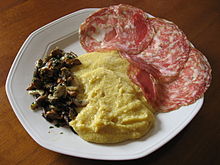
Polenta served with sopressa and mushrooms, a traditional peasant food of Veneto

Made from finely ground maize meal, polenta is a traditional, rural food typical of Veneto and most of northern Italy. It may be included in stirred dishes and baked dishes. Polenta can be served with various cheese, stockfish, or meat dishes. Some polenta dishes include porcini, rapini, or other vegetables or meats, such as small songbirds in the case of the Venetian and Lombard dish polenta e osei, or sausages. In some areas of Veneto it can be also made of a particular variety of cornmeal, named biancoperla, so that the colour of polenta is white and not yellow (the so-called polenta bianca).

Beans, peas, and other legumes are seen in these areas with pasta e fagioli (lit. 'beans and pasta') and risi e bisi (lit. 'rice and peas'). Venice features heavy dishes using exotic spices and sauces. Ingredients such as stockfish or simple marinated anchovies are found here as well.

Less fish and more meat is eaten away from the coast. Other typical products are sausages such as sopressa, garlic salami, Piave cheese, and Asiago cheese. High quality vegetables are prized, such as red radicchio from Treviso and white asparagus from Bassano del Grappa. Perhaps the most popular dish of Venice is fegato alla veneziana, thinly-sliced veal liver sautéed with onions.

Squid and cuttlefish are common ingredients, as is squid ink, called nero di seppia.[176][177] Regional desserts include tiramisu (made of biscuits dipped in coffee, layered with a whipped mixture of egg yolks and mascarpone, and flavoured with liquor and cocoa[178]), baicoli (biscuits made with butter and vanilla), and nougat.

The most celebrated Venetian wines include Bardolino, Prosecco, Soave, Amarone, and Valpolicella DOC wines.

Meal structure[edit]

Main article: Italian meal structure

A typical Italian breakfast (Italian: colazione), consisting of cappuccino and cornetto
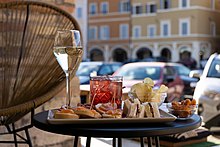
A classic Italian aperitivo
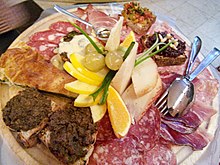
An Italian-style antipasto

Italian meal structure is typical of the European Mediterranean region and differs from North, Central, and Eastern European meal structure, though it still often consists of breakfast (Italian: colazione), lunch (Italian: pranzo), and supper (Italian: cena).[179] However, much less emphasis is placed on breakfast, and breakfast itself is often skipped or involves lighter meal portions than are seen in non-Mediterranean Western countries.[180] Late-morning and mid-afternoon snacks, called merenda, are also often included in this meal structure.[181]

Traditional meals in Italy typically contained four or five courses.[182] Especially on weekends, meals are often seen as a time to spend with family and friends rather than simply for sustenance; thus, meals tend to be longer than in other cultures. During holidays such as Christmas and New Year's Eve, feasts can last for hours.[183]

Today, full-course meals are mainly reserved for special events such as weddings, while everyday meals include only a first or second course (sometimes both), a side dish, and coffee.[184][185] The primo (first course) is usually a filling dish, such as risotto or pasta, with sauces made from meat, vegetables, or seafood.[186] Whole pieces of meat such as sausages, meatballs, and poultry are eaten in the secondo (second course).[187] Italian cuisine has some single-course meals (Italian: piatto unico) combining starches and proteins.[188]

Meal stageDescription

AperitivoApéritif usually enjoyed as an appetizer before a large meal, may be: Campari, Martini, Cinzano, Prosecco, Aperol, Spritz, Vermouth, Negroni.[182]

Antipastolit. 'before (the) meal', hot or cold, usually consists of cheese, ham, sliced sausage, marinated vegetables or fish, bruschetta and bread appetizers.[182]

Primo"First course", usually consists of a hot dish such as pasta, risotto, gnocchi, or soup with a sauce, vegetarian, meat or fish sugo or ragù as a sauce.[182]

Secondo"Second course", the main dish, usually fish or meat with potatoes. Traditionally veal, pork, and chicken are most commonly used, at least in the North, though beef has become more popular since World War II and wild game is found, particularly in Tuscany. Fish is also very popular, especially in the south.[182]

Contorno"Side dish", may be a salad or cooked vegetables. A traditional menu features salad along with the main course.[182]

Formaggio e frutta"Cheese and fruits", the first dessert. Local cheeses may be part of the antipasto or contorno as well.[182]

Dolce"Sweet", such as cakes (like tiramisu), cookies or ice cream.[182]

CaffèCoffee.[182]

Digestivo"Digestives", liquors and liqueurs (grappa, amaro, limoncello, sambuca, nocino, sometimes referred to as ammazzacaffè, 'coffee killer').[182]

Food establishments[edit]

Waiter pouring Prosecco

Arancini

Italian wine and salumi

Baked lasagne with ragù

Each type of establishment has a defined role and traditionally sticks to it.[189]

EstablishmentDescription

AgriturismoWorking farms that offer accommodations and meals. Sometimes meals are served to guests only. According to Italian law, they can only serve locally-made products (except drinks). Marked by a green and gold sign with a knife and fork.[190]

Bar/caffèLocations which serve coffee, soft drinks, juice and alcohol. Hours are generally from 6 am to 10 pm. Foods may include croissants and other sweet breads (often called "brioche" in northern Italy), panini, tramezzini (sandwiches) and spuntini (snacks such as olives, potato crisps and small pieces of frittata).[190]

CaffetteriaLocations where coffee and similar drinks are consumed, and desserts can also be eaten.[191]

BirreriaA bar that offers beer; found in central and northern regions of Italy.[190]

BruschetteriaSpecialises in bruschetta, though other dishes may also be offered.

EnotecaPlace where wines are sold or offered for tasting, displayed to the public on the basis of criteria that facilitate their choice.[192]

FiaschetteriaLocations which serve wine in fiaschi and bottles, though other dishes may also be offered.[193]

FormaggeriaA shop serving cheese.[194]

FrascaFriulian wine producers that open for the evening and may offer food along with their wines.[190]

GelateriaA shop where the customer can get gelato to go, or sit down and eat it in a cup or a cone. Bigger ice desserts, coffee, or liquors may also be ordered.

LocandaLocations where it is possible to consume food and where one can be accommodated.[195]

OsteriaFocused on simple food of the region, often having no written menu. Many are open only at night, but some are open for lunch.[196] The name has become fashionable for upscale restaurants with a rustic regional style.

Panificio or panetteriaA shop serving flour-based food baked in an oven such as bread, cookies, cakes, pastries, and pies.[197]

france

French cuisine is the cooking traditions and practices from France. In the 14th century, Guillaume Tirel, a court chef known as "Taillevent", wrote Le Viandier, one of the earliest recipe collections of medieval France. In the 17th century, chefs François Pierre La Varenne and Marie-Antoine Carême spearheaded movements that shifted French cooking away from its foreign influences and developed France's own indigenous style.

Cheese and wine are a major part of the cuisine. They play different roles regionally and nationally, with many variations and appellation d'origine contrôlée (AOC) (regulated appellation) laws.[1]

Culinary tourism and the Guide Michelin helped to acquaint commoners with the cuisine bourgeoise of the urban elites and the peasant cuisine of the French countryside starting in the 20th century. Many dishes that were once regional have proliferated in variations across the country.

Knowledge of French cooking has contributed significantly to Western cuisines. Its criteria are used widely in Western cookery school boards and culinary education. In November 2010, French gastronomy was added by the UNESCO to its lists of the world's "intangible cultural heritage".[2][3]

History[edit]

Middle Ages[edit]

John, Duke of Berry enjoying a grand meal. The Duke is sitting with a cardinal at the high table, under a luxurious baldaquin, in front of the fireplace, tended to by several servants, including a carver. On the table to the left of the Duke is a golden salt cellar, or nef, in the shape of a ship; illustration from Très Riches Heures du Duc de Berry, circa 1410.

In French medieval cuisine, banquets were common among the aristocracy. Multiple courses would be prepared, but served in a style called service en confusion, or all at once. Food was generally eaten by hand, meats being sliced off in large pieces held between the thumb and two fingers. The sauces were highly seasoned and thick, and heavily flavored mustards were used.

Pies were a common banquet item, with the crust serving primarily as a container, rather than as food itself, and it was not until the very end of the Late Middle Ages that the shortcrust pie was developed.

Meals often ended with an issue de table, which later changed into the modern dessert, and typically consisted of dragées (in the Middle Ages, meaning spiced lumps of hardened sugar or honey), aged cheese, and spiced wine, such as hypocras.[4]: 1–7 

The ingredients of the time varied greatly according to the seasons and the church calendar, and many items were preserved with salt, spices, honey, and other preservatives. Late spring, summer, and autumn afforded abundance, while winter meals were more sparse. Livestock were slaughtered at the beginning of winter. Beef was often salted, while pork was salted and smoked. Bacon and sausages would be smoked in the chimney, while the tongue and hams were brined and dried. Cucumbers were brined as well, while greens would be packed in jars with salt. Fruits, nuts and root vegetables would be boiled in honey for preservation. Whale, dolphin and porpoise were considered fish, so during Lent, the salted meats of these sea mammals were eaten.[4]: 9–12 

Artificial freshwater ponds (often called stews) held carp, pike, tench, bream, eel, and other fish. Poultry was kept in special yards, with pigeon and squab being reserved for the elite. Game was highly prized, but very rare, and included venison, boar, hare, rabbit, and fowl.

Kitchen gardens provided herbs, including some, such as tansy, rue, pennyroyal, and hyssop, which are rarely used today. Spices were treasured and very expensive at that time—they included pepper, cinnamon, cloves, nutmeg, and mace. Some spices used then, but no longer today in French cuisine are cubebs, long pepper (both from vines similar to black pepper), grains of paradise, and galengale.

Sweet-sour flavors were commonly added to dishes with vinegar and verjus combined with sugar (for the affluent) or honey. A common form of food preparation was to thoroughly cook, pound, and strain mixtures into fine pastes and mushes, something believed to be beneficial to make use of nutrients.[4]: 13–15 

Visual display was prized. Brilliant colors were obtained by the addition of, for example, juices from spinach and the green part of leeks. Yellow came from saffron or egg yolk, while red came from sunflower, and purple came from Crozophora tinctoria or Heliotropium europaeum.

Gold and silver leaf were placed on food surfaces and brushed with egg whites. Elaborate and showy dishes were the result, such as tourte parmerienne which was a pastry dish made to look like a castle with chicken-drumstick turrets coated with gold leaf. One of the grandest showpieces of the time was a roast swan or peacock sewn back into its skin with feathers intact, the feet and beak being gilded. Since both birds are stringy, and taste unpleasant, the skin and feathers could be kept and filled with the cooked, minced and seasoned flesh of tastier birds, like goose or chicken.[4]: 15–16 

The most well-known French chef of the Middle Ages was Guillaume Tirel, also known as Taillevent. Taillevent worked in numerous royal kitchens during the 14th century. His first position was as a kitchen boy in 1326. He was chef to Philip VI, then the Dauphin who was son of John II. The Dauphin became King Charles V of France in 1364, with Taillevent as his chief cook. His career spanned sixty-six years, and upon his death, he was buried in grand style between his two wives. His tombstone represents him in armor, holding a shield with three cooking pots, marmites, on it.[4]: 18–21 

Ancien Régime[edit]

Paris was the central hub of culture and economic activity, and as such, the most highly skilled culinary craftsmen were to be found there. Markets in Paris such as Les Halles, la Mégisserie, those found along Rue Mouffetard, and similar smaller versions in other cities were very important to the distribution of food. Those that gave French produce its characteristic identity were regulated by the guild system, which developed in the Middle Ages. In Paris, the guilds were regulated by city government as well as by the French crown. A guild restricted those in a given branch of the culinary industry to operate only within that field.[4]: 71–72 

There were two groups of guilds—first, those that supplied the raw materials: butchers, fishmongers, grain merchants, and gardeners. The second group were those that supplied prepared foods: bakers, pastry cooks, sauce makers, poulterers, and caterers. Some guilds offered both raw materials and prepared food, such as the charcutiers and rôtisseurs (purveyors of roasted meat dishes). They would supply cooked meat pies and dishes as well as raw meat and poultry. This caused issues with butchers and poulterers, who sold the same raw materials.[4]: 72–73 

The guilds served as a training ground for those within the industry. The degrees of assistant cook, full-fledged cook and master chef were conferred. Those who reached the level of master chef were of considerable rank in their individual industry, and enjoyed a high level of income as well as economic and job security. At times, those in the royal kitchens did fall under the guild hierarchy, but it was necessary to find them a parallel appointment based on their skills after leaving the service of the royal kitchens. This was not uncommon as the Paris cooks' Guild regulations allowed for this movement.[4]: 73 

During the 16th and 17th centuries, French cuisine assimilated many new food items from the New World. Although they were slow to be adopted, records of banquets show Catherine de' Medici (1519–1589?) serving sixty-six turkeys at one dinner.[4]: 81  The dish called cassoulet has its roots in the New World discovery of haricot beans, which are central to the dish's creation, but had not existed outside of the Americas until the arrival of Europeans.[4]: 85 

Haute cuisine (pronounced [ot kɥizin], "high cuisine") has foundations during the 17th century with a chef named La Varenne. As an author of works such as Le Cuisinier françois, he is credited with publishing the first true French cookbook. His book includes the earliest known reference to roux using pork fat. The book contained two sections, one for meat days, and one for fasting. His recipes marked a change from the style of cookery known in the Middle Ages to new techniques aimed at creating somewhat lighter dishes, and more modest presentations of pies as individual pastries and turnovers. La Varenne also published a book on pastry in 1667 entitled Le Parfait confitvrier (republished as Le Confiturier françois) which similarly updated and codified the emerging haute cuisine standards for desserts and pastries.[4]: 114–120 

Chef François Massialot wrote Le Cuisinier roïal et bourgeois in 1691, during the reign of Louis XIV. The book contains menus served to the royal courts in 1690. Massialot worked mostly as a freelance cook, and was not employed by any particular household. Massialot and many other royal cooks received special privileges by association with the French royalty. They were not subject to the regulation of the guilds; therefore, they could cater weddings and banquets without restriction. His book is the first to list recipes alphabetically, perhaps a forerunner of the first culinary dictionary. It is in this book that a marinade is first seen in print, with one type for poultry and feathered game, while a second is for fish and shellfish. No quantities are listed in the recipes, which suggests that Massialot was writing for trained cooks.[4]: 149–154 

The successive updates of Le Cuisinier roïal et bourgeois include important refinements such as adding a glass of wine to fish stock. Definitions were also added to the 1703 edition. The 1712 edition, retitled Le Nouveau cuisinier royal et bourgeois, was increased to two volumes, and was written in a more elaborate style with extensive explanations of technique. Additional smaller preparations are included in this edition as well, leading to lighter preparations, and adding a third course to the meal. Ragout, a stew still central to French cookery, makes its first appearance as a single dish in this edition as well; prior to that, it was listed as a garnish.[4]: 155 

Late 18th century – early 19th century[edit]

The Polish wife of Louis XV of France, Queen Marie Leszczyńska, influenced French cuisine.

Marie-Antoine Carême was a French chef and an early practitioner and exponent of the elaborate style of cooking known as grande cuisine

Shortly before the French Revolution, dishes like bouchées à la Reine gained prominence. Essentially royal cuisine produced by the royal household, this is a chicken-based recipe served on vol-au-vent created under the influence of Queen Marie Leszczyńska, the Polish-born wife of Louis XV. This recipe is still popular today, as are other recipes from Queen Marie Leszczyńska like consommé à la Reine and filet d'aloyau braisé à la royale. Queen Marie is also credited with introducing Polonaise garnishing to the French diet.

The French Revolution was integral to the expansion of French cuisine, because it abolished the guild system. This meant anyone could now produce and sell any culinary item they wished.

Bread was a significant food source among peasants and the working class in the late 18th century, with many of the nation's people being dependent on it. In French provinces, bread was often consumed three times a day by the people of France.[5] According to Brace, bread was referred to as the basic dietary item for the masses, and it was also used as a foundation for soup. In fact, bread was so important that harvest, interruption of commerce by wars, heavy flour exploration, and prices and supply were all watched and controlled by the French Government. Among the underprivileged, constant fear of famine was always prevalent. From 1725 to 1789, there were fourteen years of bad yields to blame for the low grain supply. In Bordeaux, during 1708–1789, thirty-three bad harvests occurred.[5]

Marie-Antoine Carême was born in 1784, five years before the Revolution. He spent his younger years working at a pâtisserie until he was discovered by Charles Maurice de Talleyrand-Périgord; he would later cook for Napoleon Bonaparte. Prior to his employment with Talleyrand, Carême had become known for his pièces montées, which were extravagant constructions of pastry and sugar architecture.[6]: 144–145 

More important to Carême's career was his contribution to the refinement of French cuisine. The basis for his style of cooking was his sauces, which he named mother sauces. Often referred to as fonds, meaning "foundations", these base sauces, espagnole, velouté, and béchamel, are still known today. Each of these sauces was made in large quantities in his kitchen, then formed the basis of multiple derivatives. Carême had over one hundred sauces in his repertoire.

In his writings, soufflés appear for the first time. Although many of his preparations today seem extravagant, he simplified and codified an even more complex cuisine that existed beforehand. Central to his codification of the cuisine were Le Maître d'hôtel français (1822), Le Cuisinier parisien (1828) and L'Art de la cuisine française au dix-neuvième siècle (1833–5).[6]: 144–148 

Late 19th century – early 20th century[edit]

Georges Auguste Escoffier was a French chef, restaurateur, and culinary writer who popularized and updated traditional French cooking methods

Georges Auguste Escoffier is commonly acknowledged as the central figure to the modernization of haute cuisine and organizing what would become the national cuisine of France. His influence began with the rise of some of the great hotels in Europe and America during the 1880s-1890s. The Savoy Hotel managed by César Ritz was an early hotel in which Escoffier worked, but much of his influence came during his management of the kitchens in the Carlton from 1898 until 1921. He created a system of "parties" called the brigade system, which separated the professional kitchen into five separate stations.

These five stations included the garde manger that prepared cold dishes; the entremettier prepared starches and vegetables, the rôtisseur prepared roasts, grilled and fried dishes; the saucier prepared sauces and soups; and the pâtissier prepared all pastry and desserts items.

This system meant that instead of one person preparing a dish on one's own, now multiple cooks would prepare the different components for the dish. An example used is oeufs au plat Meyerbeer, the prior system would take up to fifteen minutes to prepare the dish, while in the new system, the eggs would be prepared by the entremettier, kidney grilled by the rôtisseur, truffle sauce made by the saucier and thus the dish could be prepared in a shorter time and served quickly in the popular restaurants.[6]: 157–159 

Escoffier also simplified and organized the modern menu and structure of the meal. He published a series of articles in professional journals which outlined the sequence, and he finally published his Livre des menus in 1912. This type of service embraced the service à la russe (serving meals in separate courses on individual plates), which Félix Urbain Dubois had made popular in the 1860s. Escoffier's largest contribution was the publication of Le Guide Culinaire in 1903, which established the fundamentals of French cookery. The book was a collaboration with Philéas Gilbert, E. Fetu, A. Suzanne, B. Reboul, Ch. Dietrich, A. Caillat and others. The significance of this is to illustrate the universal acceptance by multiple high-profile chefs to this new style of cooking.[6]: 159–160 

Le Guide Culinaire deemphasized the use of heavy sauces and leaned toward lighter fumets, which are the essence of flavor taken from fish, meat and vegetables. This style of cooking looked to create garnishes and sauces whose function is to add to the flavor of the dish, rather than mask flavors like the heavy sauces and ornate garnishes of the past. Escoffier took inspiration for his work from personal recipes in addition to recipes from Carême, Dubois and ideas from Taillevent's Le Viandier, which had a modern version published in 1897. A second source for recipes came from existing peasant dishes that were translated into the refined techniques of haute cuisine.

Expensive ingredients would replace the common ingredients, making the dishes much less humble. The third source of recipes was Escoffier himself, who invented many new dishes, such as pêche Melba.[6]: 160–162  Escoffier updated Le Guide Culinaire four times during his lifetime, noting in the foreword to the book's first edition that even with its 5,000 recipes, the book should not be considered an "exhaustive" text, and that even if it were at the point when he wrote the book, "it would no longer be so tomorrow, because progress marches on each day."[7]

This period is also marked by the appearance of the nouvelle cuisine. The term "nouvelle cuisine" has been used many times in the history of French cuisine which emphasized the freshness, lightness and clarity of flavor and inspired by new movements in world cuisine. In the 1740s, Menon first used the term, but the cooking of Vincent La Chapelle and François Marin was also considered modern. In the 1960s, Henri Gault and Christian Millau revived it to describe the cooking of Paul Bocuse, Jean and Pierre Troisgros, Michel Guérard, Roger Vergé and Raymond Oliver.[8] These chefs were working toward rebelling against the "orthodoxy" of Escoffier's cuisine. Some of the chefs were students of Fernand Point at the Pyramide in Vienne, and had left to open their own restaurants. Gault and Millau "discovered the formula" contained in ten characteristics of this new style of cooking.[6]: 163–164 

The characteristics that emerged during this period were:

1. A rejection of excessive complication in cooking.

2. The cooking times for most fish, seafood, game birds, veal, green vegetables and pâtés was greatly reduced in an attempt to preserve the natural flavors. Steaming was an important trend from this characteristic.

3. The cuisine was made with the freshest possible ingredients.

4. Large menus were abandoned in favor of shorter menus.

5. Strong marinades for meat and game ceased to be used.[6]: 163–164 

6. They stopped using heavy sauces such as espagnole and béchamel thickened with flour based "roux" in favor of seasoning their dishes with fresh herbs, quality butter, lemon juice, and vinegar.

7. They used regional dishes for inspiration instead of haute cuisine dishes.

8. New techniques were embraced and modern equipment was often used; Bocuse even used microwave ovens.

9. The chefs paid close attention to the dietary needs of their guests through their dishes.

10. And finally, the chefs were extremely inventive and created new combinations and pairings.[6]: 163–164 

Some have speculated that a contributor to nouvelle cuisine was World War II when animal protein was in short supply during the German occupation.[9] By the mid-1980s food writers stated that the style of cuisine had reached exhaustion and many chefs began returning to the haute cuisine style of cooking, although much of the lighter presentations and new techniques remained.[6]: 163–164 

When the French colonized Vietnam, one of the most famous and popular dishes, pot-au-feu, was subsequently introduced to the local people. While it did not directly create the widely recognizable Vietnamese dish, Pho, it served as a reference for the modern-day form of Pho.

National cuisine[edit]

Main article: List of French dishes

There are many dishes that are considered part of French national cuisine today.

A meal often consists of three courses, hors d'œuvre or entrée (introductory course, sometimes soup), plat principal (main course), fromage (cheese course) or dessert, sometimes with a salad offered before the cheese or dessert.

Hors d'œuvre

  • Basil salmon terrine

    Basil salmon terrine

  • Bisque is a smooth and creamy French potage.

    Bisque is a smooth and creamy French potage.

  • Foie gras with mustard seeds and green onions in duck jus

    Foie gras with mustard seeds and green onions in duck jus

  • Croque monsieur

    Croque monsieur

Plat principal

  • Pot-au-feu is a cuisine classique dish.

    Pot-au-feu is a cuisine classique dish.

  • Steak frites is a simple and popular dish.

    Steak frites is a simple and popular dish.

  • Blanquette de veau

    Blanquette de veau

Pâtisserie

  • Typical French pâtisserie

    Typical French pâtisserie

  • Mille-feuille

    Mille-feuille

  • Macaron

    Macaron

  • Éclair

    Éclair

Dessert

  • Crème brûlée

    Crème brûlée

  • Mousse au chocolat

    Mousse au chocolat

  • Crêpe

    Crêpe

  • Île flottante

    Île flottante

Regional cuisine[edit]

The 22 regions and 96 departments of metropolitan France include Corsica (Corse, lower right). Paris area is expanded (inset at left).

French regional cuisine is characterized by its extreme diversity and style. Traditionally, each region of France has its own distinctive cuisine.[10]

Paris and Île-de-France[edit]

Paris and Île-de-France are central regions where almost anything from the country is available, as all train lines meet in the city. Over 9,000 restaurants exist in Paris and almost any cuisine can be obtained here. High-quality Michelin Guide-rated restaurants proliferate here.[11]

Champagne, Lorraine, and Alsace[edit]

Game and ham are popular in Champagne, as well as the special sparkling wine simply known as Champagne. Fine fruit preserves are known from Lorraine as well as the quiche Lorraine.[12] As region of historically Allemanic German culture Alsace has retained Elements of German cuisine, especially similar to those from the neighboring Palatinate and Baden region, but has implemented French influences since France first took control of the region in the 17th century. As such, beers made in the area are similar to the style of bordering Germany. Dishes like choucroute (French for sauerkraut) are also popular.[11]: 55  Many "eaux de vie" (distilled alcohol from fruit) also called schnaps are from this region, due to a wide variety of local fruits (cherry, raspberry, pear, grapes) and especially prunes (mirabelle, plum).[9]:259,295[clarification needed]

  • Flute of Champagne wine

    Flute of Champagne wine

  • Alsatian Flammekueche

    Alsatian Flammekueche

  • Quiche

    Quiche

  • Choucroute garnie

    Choucroute garnie

  • Andouillette

    Andouillette

"Carte Gastronomique de la France" belong to the outset of the "Cours Gastronomique" by Charles Louis Cadet de Gassicourt (1809).

Nord Pas-de-Calais, Picardy, Normandy, and Brittany[edit]

The coastline supplies many crustaceans, sea bass, monkfish and herring. Normandy has top-quality seafood, such as scallops and sole, while Brittany has a supply of lobster, crayfish and mussels.

Normandy is home to a large population of apple trees; apples are often used in dishes, as well as cider and Calvados. The northern areas of this region, especially Nord, grow ample amounts of wheat, sugar beets and chicory. Thick stews are found often in these northern areas as well.

The produce of these northern regions is also considered some of the best in the country, including cauliflower and artichokes. Buckwheat grows widely in Brittany as well and is used in the region's galettes, called jalet, which is where this dish originated.[11]: 93 

  • Crème Chantilly, created at the Château de Chantilly.

    Crème Chantilly, created at the Château de Chantilly.

  • Camembert, cheese specialty from Normandy

    Camembert, cheese specialty from Normandy

  • Crêpe and cider, specialties of Brittany

    Crêpe and cider, specialties of Brittany

  • Lille waffles

    Lille waffles

  • Belon oysters

    Belon oysters

Loire Valley and central France[edit]

High-quality fruits come from the Loire Valley and central France, including cherries grown for the liqueur Guignolet and Belle Angevine pears. The strawberries and melons are also of high quality.

Fish are seen in the cuisine, often served with a beurre blanc sauce, as well as wild game, lamb, calves, Charolais cattle, Géline fowl, and goat cheeses.

Young vegetables are used often, as are the specialty mushrooms of the region, champignons de Paris. Vinegars from Orléans are a specialty ingredient used as well.[11]: 129, 132 

Burgundy and Franche-Comté[edit]

Burgundy and Franche-Comté are known for their wines. Pike, perch, river crabs, snails, game, redcurrants, blackcurrants are from both Burgundy and Franche-Comté.

Savory specialties accounted in the Cuisine franc-comtoise from the Franche-Comté region are croûte aux morilles [fr], Poulet à la Comtoise [fr], trout, smoked meats and cheeses such as Mont d'Or, Comté and Morbier which are best eaten hot or cold, coq au vin jaune [fr] and the special dessert gâteau de ménage [fr].

Charolais beef, poultry from Bresse, sea snail, honey cake, Chaource and Époisses cheese are specialties of the local cuisine of Burgundy. Dijon mustard is also a specialty of Burgundy cuisine. Crème de cassis is a popular liquor made from blackcurrants. Oils are used in the cooking here, including nut oils and rapeseed oil.[11]: 153, 156, 166, 185 

  • Bœuf bourguignon

    Bœuf bourguignon

  • Coq au vin

    Coq au vin

  • Escargots, with special tongs and fork

    Escargots, with special tongs and fork

  • Beaujolais wine

    Beaujolais wine

  • Dijon mustard

    Dijon mustard

  • Comté cheese and vin jaune

    Comté cheese and vin jaune

  • Gâteau de ménage

    Gâteau de ménage

Auvergne-Rhône-Alpes[edit]

See also: Lyonnaise cuisine

Grand sechoir, Museum of the Walnut in Vinay, Isère

Salade lyonnaise

Drome apricots

Sweet chestnuts

The area covers the old province of Dauphiné, once known as the "larder" of France,[dubious – discuss] that gave its name to gratin dauphinois,[13] traditionally made in a large baking dish rubbed with garlic. Successive layers of potatoes, salt, pepper and milk are piled up to the top of the dish. It is then baked in the oven at low temperature for 2 hours.[14]

Fruit and young vegetables are popular in the cuisine from the Rhône valley, as are wines like Hermitage AOC, Crozes-Hermitage AOC and Condrieu AOC. Walnuts and walnut products and oil from Noix de Grenoble AOC, lowland cheeses, like St. Marcellin, St. Félicien and Bleu du Vercors-Sassenage.

Poultry from Bresse, guinea fowl from Drôme and fish from the Dombes, a light yeast-based cake, called Pogne de Romans and the regional speciality, Raviole du Dauphiné, and there is the short-crust "Suisse", a Valence biscuit speciality.

Lakes and mountain streams in Rhône-Alpes are key to the cuisine as well. Lyon and Savoy supply sausages while the Alpine regions supply their specialty cheeses like Beaufort, Abondance, Reblochon, Tomme and Vacherin.[15][16][17][18]

Mères lyonnaises are female cooks particular to this region who provide local gourmet establishments.[19] Celebrated chefs from this region include Fernand Point, Paul Bocuse, the Troisgros brothers and Alain Chapel.[20]

The Chartreuse Mountains are the source of the green and yellow digestif liquor Chartreuse, produced by the monks of the Grande Chartreuse.[11]: 197, 230 

Since the 2014 administrative reform, the ancient area of Auvergne is now part of the region. One of its leading chefs is Regis Marcon.

  • Gratin dauphinois

    Gratin dauphinois

  • Bleu du Vercors-Sassenage

    Bleu du Vercors-Sassenage

  • Chartreuse Elixir Végétal

    Chartreuse Elixir Végétal

  • Salade de ravioles

    Salade de ravioles

  • Condrieu wine

    Condrieu wine

  • Suisse de Valence biscuit [fr]

    Suisse de Valence biscuit [fr]

  • Bleu de Bresse

    Bleu de Bresse

  • Poulet de Bresse chicken salad

    Poulet de Bresse chicken salad

  • Rosette de Lyon charcuterie

    Rosette de Lyon charcuterie

  • Noix de Grenoble, unusual trilaterally symmetric walnut

    Noix de Grenoble, unusual trilaterally symmetric walnut

  • Beaufort cheeses ripening in a cellar

    Beaufort cheeses ripening in a cellar

Poitou-Charentes and Limousin[edit]

Oysters come from the Oléron-Marennes basin, while mussels come from the Bay of Aiguillon.

High-quality produce comes from the region's hinterland, especially goat cheese. This region and in the Vendée is grazing ground for Parthenaise cattle, while poultry is raised in Challans.

The region of Poitou-Charentes purportedly produces the best butter and cream in France. Cognac is also made in the region along the river Charente.

Limousin is home to the Limousin cattle, as well as sheep. The woodlands offer game and mushrooms. The southern area around Brive draws its cooking influence from Périgord and Auvergne to produce a robust cuisine.[11]: 237 

thailand

Thai cuisine (Thai: อาหารไทย, RTGS: ahan thai, pronounced [ʔāː.hǎːn tʰāj]) is the national cuisine of Thailand.

Thai cooking places emphasis on lightly prepared dishes with aromatics and spicy heat. The Australian chef David Thompson, an expert on Thai food, observes that unlike many other cuisines, Thai cooking is "about the juggling of disparate elements to create a harmonious finish. Like a complex musical chord it's got to have a smooth surface but it doesn't matter what's happening underneath. Simplicity isn't the dictum here, at all."[1]

Traditional Thai cuisine loosely falls into four categories: tom (boiled dishes), yam (spicy salads), tam (pounded foods), and kaeng (curries). Deep-frying, stir-frying and steaming are methods introduced from Chinese cuisine.[2]

In 2017, seven Thai dishes appeared on a list of the "World's 50 Best Foods", an online poll of 35,000 people worldwide by CNN Travel. Thailand had more dishes on the list than any other country: tom yam kung (4th), pad thai (5th), som tam (6th), massaman curry (10th), green curry (19th), Thai fried rice (24th) and nam tok mu (36th).[3]

History[edit]

Historical influences[edit]

The art of vegetable carving is thought to have originated in the Sukhothai Kingdom nearly 700 years ago.[4]

Thai cuisine and the culinary traditions and cuisines of Thailand's neighbors, especially Cambodia, Laos, Myanmar, India, Malaysia and Indonesia, have influenced one another over the course of many centuries.

According to the Thai monk Venerable Buddhadasa Bhikku's writing, ‘India's Benevolence to Thailand’, Thai cuisine was influenced by Indian cuisine. He wrote that Thai people learned how to use spices in their food in various ways from Indians. Thais also obtained the methods of making herbal medicines from the Indians. Some plants like sarabhi of the family Guttiferae, panika or harsinghar, phikun or Mimusops elengi and bunnak or the rose chestnut etc. were brought from India.[5] According to a book 'Mae Krua Hua Pa' (first published in 1908) by Lady Plian Bhaskarawongse (ท่านผู้หญิงเปลี่ยน ภาสกรวงษ์), she found that Thai cuisine had a strong gastronomical cultural line from Sukhothai (1238–1448) through Ayuttthaya (1351–1767) and Thonburi period (1767–1782) vis-à-vis Siamese governmental officers' daily routines (such as royal cooking) and their related cousins. Thai food during the Thonburi period tended to be more similar to that from the Ayutthaya period, except the addition of Chinese food resulted from her prosperous international trade.[6][7]

Chili peppers, originally from the Americas, were introduced to Thailand by the Portuguese and Spanish.

Western influences, starting in 1511 when the first diplomatic mission from the Portuguese arrived at the court of Ayutthaya, have created dishes such as foi thong, the Thai adaptation of the Portuguese fios de ovos, and sangkhaya, where coconut milk replaces cow's milk in making a custard.[8] These dishes were said to have been brought to Thailand in the 17th century by Maria Guyomar de Pinha, a woman of mixed Japanese-Portuguese-Bengali ancestry who was born in Ayutthaya, and became the wife of Constantine Phaulkon, a Greek adviser to King Narai. The most notable influence from the West must be the introduction of the chili pepper from the Americas in the 16th or 17th century. It, and rice, are now two of the most important ingredients in Thai cuisine.[9] During the Columbian Exchange, Portuguese and Spanish ships brought new foodstuffs from the Americas including tomatoes, corn, papaya, pea eggplants, pineapple, pumpkins, culantro, cashews, and peanuts.

Regional variations[edit]

Regional variations tend to correlate to neighboring states (often sharing the same cultural background and ethnicity on both sides of the border) as well as climate and geography. Northern Thai cuisine shares dishes with Shan State in Burma, northern Laos, and also with Yunnan Province in China, whereas the cuisine of Isan (northeastern Thailand) is similar to that of Southern Laos, and by Vietnamese cuisine to its east. Southern Thailand, with many dishes that contain liberal amounts of coconut milk and fresh turmeric, has that in common with Indian, Malaysian, and Indonesian cuisine.[10]

Thai cuisine is more accurately described as five regional cuisines, corresponding to the five main regions of Thailand:

  • Bangkok: cuisine of the Bangkok metropolitan area, with Teochew and Portuguese influences. In addition, as a capital city, Bangkok cuisine is sometimes influenced by more dedicated royal cuisine. Tastes and looks of food in Bangkok have changed somewhat over time as they have been influenced by other cuisines such as Asian, European or Western countries.
  • Central Thai: cuisine of the flat and wet central rice-growing plains, site of the former Thai kingdoms of Sukhothai and Ayutthaya, and the Dvaravati culture of the Mon people from before the arrival of Siamese in the area. Coconut milk is one of major ingredients used in Central Thai cuisine.
  • Isan or Northeastern Thai: cuisine of the more arid Khorat Plateau, influenced by the culture of Laos and also by Khmer cuisine.[11]
  • Northern Thai: cuisine of the cooler valleys and forested mountains of the Thai highlands, once ruled by the former Lanna Kingdom and home of Lannaese, the majority of northern Thailand. This cuisine shares many ingredients with Isan.
  • Southern Thai: cuisine of the Kra Isthmus which is bordered on two sides by tropical seas, with its many islands and including the ethnic Malay, former Sultanate of Pattani in the deep south. The complex curries, food preparation techniques and usage of chillies and spices in Southern Thai cuisine form a great influence on the whole cuisine in general.

Royal cuisine[edit]

Kaeng phet pet yang, a legacy of the palace cuisine of Ayutthaya

In addition to these regional cuisines, there is also Thai royal cuisine which can trace its history back to the cosmopolitan palace cuisine of the Ayutthaya kingdom (1351–1767 CE). Its refinement, cooking techniques, presentation, and use of ingredients were of great influence to the cuisine of the central Thai plains.[12][13][14] Thai royal cuisine has been influenced by the Khmer royal cuisine through the Khmer palace cooks brought to the Ayutthaya Kingdom during its conquests of the Khmer Empire.[15][16] Thai royal cuisine has become very well known from the Rattanakosin Era onwards.

Typically, Thai royal cuisine has basic characteristics that are close to the basic food prepared by general people. However, Thai royal cuisine focuses on the freshness of seasonal products. Other than that, it is crucial that the way in which Thai royal food is cooked, should be complex and delicate.

La Loubère, an envoy from France during the reign of King Narai, recorded that the food at the court was generally similar to villager food. What makes Thai Royal cuisine different food is its beautiful presentation. For example, they served fish and chicken with the bones removed, and the vegetables were served in bite-sized portions. In addition, if beef is used, it should be tenderloin only.

There are many types of Thai royal cuisine such as ranchuan curry, nam phrik long ruea, matsaman curry, rice in jasmine-flavored iced water or khao chae, spicy salad, fruit, and carved vegetable.

Thai chef McDang, himself descended from the royal family, asserts that the difference between royal Thai cuisine and regular Thai cuisine is fiction. He maintains that the only difference between the food of the palace and that of the common people is the former's elaborate presentation and better ingredients.[17][18]

Serving[edit]

Phat thai kung, from Bangkok

A typical family meal on the floor mat in Isan region

Thai food was traditionally eaten with the hand[19][20] while seated on mats or carpets on the floor or coffee table in upper middle class families, customs still found in more traditional households. Today, however, most Thais eat with a fork and spoon. Tables and chairs were introduced as part of a broader Westernization drive during the reign of King Mongkut, Rama IV. The fork and spoon were introduced by King Chulalongkorn after his return from a tour of Europe in 1897 CE.[21]

Important to Thai dining is the practice of khluk, mixing the flavors and textures of different dishes with the rice from one's plate. The food is pushed by the fork, held in the left hand, into the spoon held in the right hand, which is then brought to the mouth.[22] A traditional ceramic spoon is sometimes used for soup, and knives are not generally used at the table.[23] It is common practice for both the Thais and the hill tribe peoples who live in Lanna and Isan to use sticky rice as an edible implement by shaping it into small, and sometimes flattened, balls by hand (and only the right hand by custom) which are then dipped into side dishes and eaten.

Thai meal in a village temple

Chopsticks were foreign utensils to most ethnic groups in Thailand with the exception of the Thai Chinese, and a few other cultures such as the Akha people, who are recent arrivals from Yunnan Province, China. Traditionally, the majority of ethnic Thai people ate with their hands like the people of India. Chopsticks are mainly used in Thailand for eating Chinese-style noodle soups, or at Chinese, Japanese, or Korean restaurants. Stir-fried noodle dishes such as drunken noodles, pad see ew, and pad thai, and curry-noodle dishes such as khanom chin nam ngiao, are also eaten with a fork and spoon in the Thai fashion.

Thai meals typically consist of rice (khao in Thai) with many complementary dishes shared by all. The dishes are all served at the same time, including the soups, and it is also customary to provide more dishes than there are guests at a table. A Thai family meal would normally consist of rice with several dishes which should form a harmonious contrast of flavors and textures as well as preparation methods. Traditionally, a meal would have at least five elements: a dip or relish for raw or cooked vegetables (khrueang chim) is the most crucial component of any Thai meal.[24][25] Khrueang chim, considered a building block of Thai food by Chef McDang, may come in the form of a spicy chili sauce or relish called nam phrik (made of raw or cooked chilies and other ingredients, which are then mashed together), or a type of dip enriched with coconut milk called lon. The other elements would include a clear soup (perhaps a spicy tom yam or a mellow tom chuet), a curry or stew (essentially any dish identified with the kaeng prefix), a deep-fried dish, and a stir-fried dish of meat, fish, seafood, or vegetables.

A plate of raw vegetables and herbs, together with nam phrik kapi, is often served as a complimentary dish at southern Thai eateries.

In most Thai restaurants, diners will have access to a selection of Thai sauces (nam chim) and condiments, either brought to the table by wait staff or present at the table in small containers. These may include phrik nam pla/nam pla phrik (fish sauce, lime juice, chopped chilies and garlic), dried chili flakes, sweet chili sauce, sliced chili peppers in rice vinegar, Sriracha sauce, and even sugar. With certain dishes, such as khao kha mu (pork trotter stewed in soy sauce and served with rice), whole Thai peppers and raw garlic are served in addition to the sour chili sauce. Cucumber is sometimes eaten to cool the mouth with particularly spicy dishes. They often feature as a garnish, especially with one-dish meals. The plain rice, sticky rice or the khanom chin (Thai rice noodles) served alongside a spicy Thai curry or stir-fry, tends to counteract the spiciness.

When time is limited or when eating alone, single dishes, such as fried rice or noodle soups, are quick and filling. An alternative is to have one or more smaller helpings of curry, stir fries and other dishes served together on one plate with a portion of rice. This style of serving food is called khao rat kaeng (lit. 'rice covered with curry'), or for short khao kaeng (lit. 'rice curry'). Eateries and shops that specialize in pre-made food are the usual place to go to for having a meal this way. These venues have a large display showing the different dishes one can choose. When placing an order at these places, Thais will state if they want the food served as separate dishes or together on one plate with rice (rat khao). Very often, regular restaurants will also feature a selection of freshly made "rice curry" dishes on their menu for single customers.

Ingredients[edit]

Main article: List of Thai ingredients

Ingredients, green curry paste

Pla thu at a market

Thai cuisine, as a whole, features many different ingredients (suan phasom; Thai: ส่วนผสม), and ways of preparing food. Thai chef McDang characterises Thai food as having "intricacy, attention to detail, texture, color, and taste.[23]

Thai food is known for its enthusiastic use of fresh (rather than dried) herbs and spices. Common flavors in Thai food come from garlic, galangal, coriander/cilantro, lemongrass, shallots, pepper, kaffir lime leaves, shrimp paste, fish sauce, and chilies. Palm sugar, made from the sap of certain Borassus palms, is used to sweeten dishes while lime and tamarind contribute sour notes. Meats used in Thai cuisine are usually pork and chicken, and also duck, beef, and water buffalo. Goat, lamb, and mutton are rarely eaten except by Muslim Thais in Southern Thailand. Game, such as wild boar, deer and wild birds, are now less common due to loss of habitat, the introduction of modern methods of intensive animal farming in the 1960s, and the rise of agribusinesses, such as Thai Charoen Pokphand Foods, in the 1980s.[26] Traditionally, fish, crustaceans, and shellfish play an important role in the diet of Thai people. In 2006 the per capita consumption of fish was 33.6 kg.[27][28] Anna Leonowens (of The King and I fame) observed in her book The English Governess at the Siamese Court (1870):[29]

"The stream is rich in fish of excellent quality and flavour, such as is found in most of the great rivers of Asia; and is especially noted for its platoo, a kind of sardine, so abundant and cheap that it forms a common seasoning to the labourer's bowl of rice."

Freshwater varieties come from the many rivers, lakes, ponds, and paddy fields inland, and seafood from the tropical seas of the southern half of the country. Some species, such as the giant river prawn, need brackish water as juveniles but live out their lives in freshwater once mature. Aquaculture of species such as Nile tilapia, catfish, tiger prawns, and blood cockles, now generates a large portion of the seafood sold in, and exported from Thailand.[30]

Rice, noodles and starches[edit]

Khanom chin, freshly made Thai rice noodles

Like most other Asian cuisines, rice is the staple grain of Thai cuisine. According to Thai food expert McDang, rice is the first and most important part of any meal, and the words for rice and food are the same: khao. As in many other rice eating cultures, to say "eat rice" (in Thai "kin khao", pronounced [kīn kʰâːw]) means to eat food. Rice is such an integral part of the diet that a common Thai greeting is "kin khao rue yang?" (lit. '"have you eaten rice yet?').[31]

Thai farmers historically have cultivated tens of thousands of rice varieties. The traditional recipe for a rice dish could include as many as 30 varieties of rice.[32] That number has been drastically reduced due to genetic modifications.

Non-glutinous rice (Oryza sativa) is called khao chao (lit. 'royal rice'). One type, which is indigenous to Thailand, is the highly prized, sweet-smelling jasmine rice (khao hom mali). This naturally aromatic long-grained rice grows in abundance in the patchwork of paddy fields that blanket Thailand's central plains. Once the rice is steamed or cooked, it is called khao suai (lit. 'beautiful rice'). Non-glutinous rice is used for making fried rice dishes, and for congee, of which there are three main varieties: khao tom (a thin rice soup, most often with minced pork or fish), khao tom kui (a thick, unflavored rice porridge that is served with side dishes), or chok (a thick rice porridge that is flavored with broth and minced meat).

Som tam, grilled chicken and sticky rice is a popular combination.

Other varieties of rice eaten in Thailand include: sticky rice (khao niao), a unique variety of rice which contains an unusual balance of the starches present in all rice, causing it to cook up to a sticky texture. Thai Red Cargo rice, an unpolished long grain rice with an outer deep reddish-brown color and a white center, has a nutty taste and is slightly chewy compared to the soft and gummy texture of jasmine rice. Only the husks of the red rice grains are removed which allows it to retain all its nutrients and vitamins, but unlike brown rice, its red color comes from antioxidants in the bran. Black sticky rice is a type of sticky rice with a deep purple-red color that may appear black. Another unpolished grain, black sticky rice has a rich nutty flavor that is most often used in desserts.

Noodles in Thailand are usually made from the flour of rice, wheat, or mung bean. Perhaps one of the oldest type of noodle in Thailand is khanom chin, which is a fresh type of rice vermicelli made from fermented rice, and eaten with toppings like green curry (kaeng khiao wan) with chicken or in green papaya salad (som tam). Other noodle varieties were subsequently introduced by Chinese migrants to Thailand, as is testified by their Sino-Thai name kuaitiao (ก๋วยเตี๋ยว; Chinese: 粿條; pinyin: gǔotiáo). The three most common rice varieties of kuaitiao are sen yai (เส้นใหญ่) wide flat noodles, sen lek (เส้นเล็ก) narrow flat noodles, and sen mi เส้นหมี่; or rice vermicelli), which are round and thin. A fourth popular variety, bami (บะหมี่; Pe̍h-ōe-jī: bah-mī) is made from egg and wheat flour and is usually sold fresh. Bami are similar to the Teochew mee pok. A fifth type, wun sen (วุ้นเส้น; lit. 'jelly strands'), called cellophane noodles or glass noodles in English, are thin round noodles made from mung bean flour which are sold dried. Lastly, and least common in noodle shops, are "silver needle noodles" kiam-i (เกี้ยมอี๋), a somewhat thick round rice noodle similar in size and shape to bean sprouts. Thai noodle dishes, whether stir fried like pad thai or in the form of a noodle soup, usually come as an individual serving and are not meant to be shared and eaten communally.

Rice flour (paeng khao chao) and tapioca flour (paeng man sampalang) are often used in desserts or as thickening agents.

Pastes and sauces[edit]

Nam pla phrik, a table sauce most often eaten with rice dishes, is made from fish sauce and sliced chilies, and often also includes garlic and lime.

An ingredient found in many Thai dishes and used in every region of the country is nam pla, a clear fish sauce that is very aromatic. Fish sauce is a staple ingredient in Thai cuisine and imparts a unique character to Thai food. Fish sauce is prepared with fermented fish that is made into a fragrant condiment and provides a salty flavor. There are many varieties of fish sauce and many variations in the way it is prepared. Some fish may be fermented with shrimp or spices. Another type of sauce made from fermented fish is pla ra. It is more pungent than nam pla, and, in contrast to nam pla, which is a clear liquid, pla ra is opaque and often contains pieces of fish. To add this sauce to a som tam (spicy papaya salad) is a matter of choice. Kapi, Thai shrimp paste, is a combination of fermented ground shrimp and salt. It is used in the famous chili paste called nam phrik kapi, in rice dishes such as khao khluk kapi and it is indispensable for making Thai curry pastes. Tai pla is a pungent sauce used in the southern Thai cuisine, that is made from the fermented innards of the short mackerel (pla thu).[33] It is one of the main condiments of kaeng tai pla curry and is also used to make nam phrik tai pla.[34] Far removed from the nearest sea, from northern Thailand comes nam pu, a thick, black paste made by boiling mashed rice-paddy crabs for hours. It is used as an ingredient for certain northern Thai salads, curries, and chili pastes. It too has a strong and pungent flavor.[35]

Nam phrik pla chi (a chili paste from northern Thailand made with grilled fish) is served here with raw and steamed vegetables as one of the dishes in a communal meal.

Nam phrik long ruea.

Nam phrik are Thai chili pastes, similar to the Indonesian and Malaysian sambals. Each region has its own special versions. The words "nam phrik" are used by Thais to describe many pastes containing chilies used for dipping, although the more watery versions tend to be called nam chim. Thai curry pastes are normally called phrik kaeng or khrueang kaeng (lit. curry ingredients), but some people also use the word nam phrik to designate a curry paste. Red curry paste, for instance, could be called phrik kaeng phet or khrueang kaeng phet in Thai, but also nam phrik kaeng phet. Both nam phrik and phrik kaeng are prepared by crushing together chilies with various ingredients such as garlic and shrimp paste using a mortar and pestle. Some nam phrik are served as a dip with vegetables such as cucumbers, cabbage and yard-long beans, either raw or blanched. One such paste is nam phrik num, a paste of pounded fresh green chilies, shallots, garlic and coriander leaves. The sweet roasted chili paste called nam phrik phao is often used as an ingredient in tom yam or when frying meat or seafood, and it is also popular as a spicy "jam" on bread, or served as a dip with prawn crackers. The dry nam phrik kung, made with pounded dried shrimp (kung haeng), is often eaten plain with rice and a few slices of cucumber. French diplomat Simon de la Loubère observed that chili pastes were vital for the way Thai people eat. He provides us with a recipe for nam phrik with pla ra and onions in Du Royaume de Siam, an account of his mission to Thailand published in 1691.[36]

The soy sauces which are used in Thai cuisine are of Chinese origin, and the Thai names for them are (wholly or partially) loanwords from the Teochew dialect: si-io dam (black soy sauce), si-io khao (light soy sauce), si-io wan (sweet soy sauce), and taochiao (fermented whole soy beans). Namman hoi (oyster sauce) is also of Chinese origin. It is used extensively in vegetable and meat stir fries.

Satay is also common in Thailand, grilled or skewered meat served with a spicy peanut dipping sauce made from roasted or fried peanuts.

Vegetables, herbs and spices[edit]

A vegetable stall, Chiang Mai

At southern Thai restaurants most often a vegetable and herbs platter with nam phrik kapi is served as a complimentary dish

Thai dishes use a wide variety of herbs, spices and leaves rarely found in the West. The characteristic flavor of kaffir lime leaves (bai makrut) appears in many Thai soups (e.g., the hot and sour tom yam) or curry from the southern and central areas of Thailand. The Thai lime (manao) is smaller, darker and sweeter than the kaffir lime, which has a rough looking skin with a stronger lime flavor. Kaffir lime leaves or rind is frequently combined with galangal (kha) and lemongrass (takhrai), either kept whole in simmered dishes or blended together with liberal amounts of chilies and other aromatics to make curry paste. Fresh Thai basil, distinctively redolent of cloves, and with stems which are often tinged with a purple color, are used to add fragrance in certain dishes such as green curry. Other commonly used herbs in Thai cuisine include phak chi, (coriander or cilantro leaves), rak phak chi (cilantro/coriander roots), spearmint (saranae), holy basil (kaphrao), ginger (khing), turmeric (khamin), fingerroot (krachai), culantro (phak chi farang), pandanus leaves (bai toei), and Thai lemon basil (maenglak). Spices and spice mixtures used in Thai cuisine include phong phalo (five-spice powder), phong kari (curry powder), and fresh and dried peppercorns (phrik thai). Northern Thai larb uses a very elaborate spice mix, called phrik lap, which includes ingredients such as cumin, cloves, long pepper, star anise, prickly ash seeds and cinnamon.[37]

Snakehead fish packed with lemongrass and kaffir lime leaves ready for steaming

Besides kaffir lime leaves, several other tree leaves are used in Thai cuisine such as cha-om, the young feathery leaves of the Acacia pennata tree. These leaves can be cooked in omelettes, soups and curries or eaten raw in northern Thai salads. Banana leaves are often used as packaging for ready-made food or as steamer cups such as in ho mok pla, a spicy steamed pâté or soufflé made with fish and coconut milk. Banana flowers are also used in Thai salads or as a vegetable ingredient for certain curries. The leaves and flowers of the neem tree (sadao) are also eaten blanched. Phak lueat (leaves from the Ficus virens) are cooked in curries, and bai makok (from the Spondias mombin) can be eaten raw with a chili paste.

Five main chilies are generally used as ingredients in Thai food. One chili is very small (about 1.25 centimetres (0.49 in)) and is known as the hottest chili: phrik khi nu suan ("garden mouse-dropping chili"). The slightly larger chili phrik khi nu ("mouse-dropping chili") is the next hottest. The green or red phrik chi fa ("sky pointing chili") is slightly less spicy than the smaller chilies. The very large phrik yuak, which is pale green in color, is the least spicy and used more as a vegetable. Lastly, the dried chilies: phrik haeng are spicier than the two largest chilies and dried to a dark red color.

The elaborate spice mix needed for northern Thai larb

Other typical ingredients are the several types of eggplant (makhuea) used in Thai cuisine, such as the pea-sized makhuea phuang and the egg-sized makhuea suai, often also eaten raw. Although broccoli is often used in Asian restaurants in the west in phat phak ruam (stir fried mixed vegetables) and rat na (rice noodles served in gravy), it was never used in any traditional Thai food in Thailand and was rarely seen in Thailand. Usually in Thailand, khana is used, for which broccoli is a substitute. Other vegetables which are often eaten in Thailand are thua fak yao (yardlong beans), thua ngok (bean sprouts), no mai (bamboo shoots), tomatoes, cucumbers, phak tam lueng (Coccinia grandis), phak kha na (Chinese kale), phak kwangtung (choy sum), sweet potatoes (both the tuber and leaves), a few types of squash, phak krathin (Leucaena leucocephala), sato (Parkia speciosa), tua phū (winged beans) and khaophot (corn).

Among the green, leafy vegetables and herbs that are usually eaten raw in a meal or as a side dish in Thailand, the most important are: phak bung (morning glory), horapha (Thai basil), bai bua bok (Asian pennywort), phak kachet (water mimosa), phak kat khao (Chinese cabbage), phak phai (praew leaves), phak kayang (rice paddy herb), phak chi farang (culantro), phak tiu (Cratoxylum formosum), phak "phaai" (yellow burr head) and kalamplī (cabbage).[38] Some of these leaves are highly perishable and must be used within a couple of days.

Several types of mushroom (het) also feature in Thai cuisine such as straw mushrooms (het fang), shiitake (het hom), and white jelly fungus (het hu nu khao).[39]

Flowers are also commonly used ingredients in many Thai dishes, either as a vegetable, such as dok khae (Sesbania grandiflora) and huapli (the flower bud of the banana), or as a food coloring, such as with the blue-colored dok anchan (the flowers of the Clitoria ternatea, which can also be eaten raw or fried).

Fruits[edit]

Durians at a Thai market

Fresh fruit forms a large part of the Thai diet, and are customarily served after a meal as dessert. The Scottish author John Crawfurd, sent on an embassy to Bangkok in 1822, writes in his account of the journey:

"The fruits of Siam, or at least of the neighbourhood of Bangkok, are excellent and various, surpassing, according to the experience of our party (...) those of all other parts of India."[40] The Siamese themselves consume great quantities of fruit, and the whole neighbourhood of Bangkok is one forest of fruit trees.[41]

Fruit is not only eaten on its own, but often served with spicy dips made from sugar, salt, and chilies.[42] Fruits feature in spicy salads such as som tam (green papaya salad) and yam som-o (pomelo salad), in soups with tamarind juice such as tom khlong and kaeng som, and in Thai curries such as kaeng khanun (jackfruit curry), kaeng phet pet yang (grilled duck curry with pineapple or grapes), and kaeng pla sapparot (fish and pineapple curry). Fruits are also used in certain Thai chili pastes, such as in nam phrik long rue made with madan (a close relative of the mangosteen),[43] and nam phrik luk namliap, salted black Chinese olive chilli paste.[44]

Although many of the exotic fruits of Thailand may have been sometimes unavailable in Western countries, Asian markets now import such fruits as rambutan and lychees. In Thailand one can find papaya, jackfruit, mango, mangosteen, langsat, longan, pomelo, pineapple, rose apples, durian, Burmese grapes and other native fruits. Chanthaburi in Thailand each year holds the World Durian Festival in early May. This single province is responsible for half of the durian production of Thailand and a quarter of the world production.[45][46][47] The Langsat Festival is held each year in Uttaradit on weekends in September. The langsat (Lansium parasiticum), for which Uttaradit is famous, is a fruit that is similar in taste to the longan.[48]

Kaeng kanun, a northern Thai curry made with jackfruit

From the coconut comes coconut milk, used both in curries and desserts, and coconut oil.[49] The juice of a green coconut can be served as a drink and the young flesh is eaten in either sweet or savory dishes. The grated flesh of a mature coconut is used raw or toasted in sweets, salads and snacks such as miang kham.[50] Thais not only consume products derived from the nut (actually a drupe), but they also make use of the growth bud of the palm tree as a vegetable. From the stalk of the flowers comes a sap that can be used to make coconut vinegar, alcoholic beverages, and sugar. Coconut milk and other coconut-derived ingredients feature heavily in the cuisines of central and southern Thailand. In contrast to these regions, coconut palms do not grow as well in northern and northeastern Thailand, where in wintertime the temperatures are lower and where there is a dry season that can last five to six months. In northern Thai cuisine, only a few dishes, most notably the noodle soup khao soi, use coconut milk. In the southern parts of northeastern Thailand, where the region borders Cambodia, one can again find dishes containing coconut. It is also here that the people eat non-glutinous rice, just as in central and southern Thailand, and not glutinous rice as they do in northern Thailand and in the rest of northeastern Thailand.[51]

Apples, pears, peaches, grapes, and strawberries, which do not traditionally grow in Thailand and in the past had to be imported, have become increasingly popular in the last few decades since they were introduced to Thai farmers by the Thai Royal Projects, starting in 1969, and the Doi Tung Project since 1988. These temperate fruit grow especially well in the cooler, northern Thai highlands, where they were initially introduced as a replacement for the cultivation of opium, together with other crops such as cabbages, tea, and arabica coffee.

Food controversies[edit]

Agricultural chemicals[edit]

Kung phao, grilled prawns, made with the giant river prawns that are native to the rivers of central Thailand

According to the Thai government's The Eleventh National Economic and Social Development Plan (2012–2016), Thailand is number one in the world in the application of chemicals in agriculture. The report stated that, "The use of chemicals in the agricultural and industrial sectors is growing while control mechanisms are ineffective making Thailand rank first in the world in the use of registered chemicals in agriculture."[52]: 111 

The Thai Pesticide Alert Network (ThaiPAN), a food safety advocacy group, annually tests Thai farm produce for contamination. In their June 2019 report, the group found that of 286 samples, 41% of produce was found to contain unsafe levels of chemicals.[53] The group surveyed both wet markets and retail stores across the nation. Contaminants were found in 44% of samples from retail stores, and 39% of samples from wet markets. Vegetables with the highest levels of contamination were Chinese mustard greens, kale, hot basil, parsley, chilis, and cauliflower. Fruits with the highest contamination were tangerines, rose apples, guavas, and grapes. Contamination levels decreased from 2018, when 46% of samples were found to be contaminated, and 2016, when more than 50% of tested produce was found to be unsafe.[54]

In prior years, "Q-Mark" goods showed a higher prevalence of contamination, 61.5%, than they did during ThaiPAN's March 2016 survey, 57%. Q-Mark is Thailand's National Bureau of Agricultural Commodity and Food Standards (ACFS) mark of quality.[55][56]

In a survey of hydroponically-grown vegetables, ThaiPAN, in late-2017, tested 30 hydroponic vegetables purchased at Thai fresh markets and supermarkets. Of 30 vegetables tested, 19 contained noxious chemical levels above maximum limits. Three samples were contaminated, but at levels below the legal maximum. Eight samples were free of harmful chemicals.[57]

On 22 October 2019, the 26-member National Hazardous Substances Committee (NHSC) changed paraquat, glyphosate, and chlorpyrifos from Type 3 toxic substances to Type 4, effectively prohibiting their production, import, export, or possession. Their use will be prohibited as of 1 December 2019.[58] On 27 November 2019, the NHSC amended that timetable, moving the date for the ban of paraquat and chlorpyrifos to 1 June 2020. They lifted the ban on glyphosate with restrictions on usage: glyphosate will be used only on six major crops: corn, cassava, sugarcane, rubber, oil palms, and fruit. It is not permitted in watershed areas and other sensitive environment zones, and farmers must submit proof of use including the type of crops and the size of their farms when purchasing glyphosate. Industry Minister Suriya Jungrungreangkit, who chairs the NHSC, said the committee reached its decision after reviewing information provided by the Department of Agriculture and the Ministry of Public Health.[59] NCHS member Jirapon Limpananon, chair of the Pharmacy Council of Thailand, announced her resignation from the NCHS Wednesday night following the meeting.[60][61]

Misrepresentation[edit]

  • In September 2016, a shipment of pork labelled "halal"—a permissible food for Muslims—was delivered to a hotel in Krabi Province. The Central Islamic Committee of Thailand (CICOT) denounced the use of a halal-certified logo on pork, saying it will take legal action against people responsible. The committee found the halal label to be fake. Under Thai laws, CICOT is responsible for certifying halal products.[62]
  • A survey of the quality of fish sauce sold across Thailand reported that just over one-third of the samples were not up to standards set by the Public Health Ministry. The three-year survey, from 2012 to 2015, involved 1,121 samples of fish sauce sold under 422 brands from 245 manufacturers. Of the total analysed, 410 samples, or 36.5 percent, did not meet the standard. The major reasons for the substandard fish sauce were low nitrogen readings and the ratio of glutamic acid to nitrogen either higher or lower than the required standards.[63]

Representative dishes[edit]

Main article: List of Thai dishes

See also: Thai curry and Thai salads

Whereas many Thai dishes are now familiar in the West, the vast majority are not. In many of the dishes below, different kinds of protein, or combinations of protein, are interchangeable as the main ingredient. Beef (nuea), chicken (kai), pork (mu), duck (pet), tofu (taohu), fish (pla), prawns or shrimp (kung), crab (pu), shellfish (hoi), or egg (khai) can, for example, all be used as main ingredients for kaeng phet (red curry). Thus kaeng phet kai is red curry with chicken and kaeng phet mu is red curry made with pork.

Breakfast dishes[edit]

Khao chao (Thai: ข้าวเช้า; lit. 'morning rice/food'), breakfast dishes, for Thais are limited. Very often, a Thai breakfast can consist of the same dishes with rice which are also eaten for lunch or dinner. Single dishes such as fried rice, noodle soups, and steamed rice with something simple such as an omelette, fried/grilled pork or chicken, or a stir fry with vegetables, are commonly sold for breakfast from street stalls as a quick take-out.

The following dishes are viewed as being specific breakfast dishes but they can also be found at any other moment of the day:[64][65]

  • Chok – a rice porridge commonly eaten in Thailand for breakfast. Similar to the rice congee eaten in other parts of Asia.
  • Khao khai chiao – an omelet (khai chiao) with white rice, often eaten with a chili sauce and slices of cucumber.
  • Khao tom – a Thai style rice soup, usually with pork, chicken, fish, or shrimp.
  • Pathongko – The Thai version of the Chinese deep-fried bread called youtiao. It can be topped up with spreads such as sangkhaya or with chocolate and sweetened condensed milk.[66]
  • Nam taohu – Soy milk which is often served with sweet jellies.

Individual dishes[edit]

Khao phat

Khao soi nam na

The term ahan chan diao (Thai: อาหารจานเดียว; lit. 'single dish food') represents truly single-plate dishes as well as dishes that are served "rat khao" (lit. 'poured on rice'): one or more dishes served together with rice on one plate. Some eateries offer a large selection of (pre-cooked) dishes; others specialize in only a one dish, or a few dishes, with rice.

  • Phat kaphrao mu rat khao – minced pork fried with chilies, garlic, soy sauce and holy basil, served together with rice, and with nam pla phrik as a condiment.
  • Khanom chin kaeng kiao wan kai – fresh Thai rice noodles (khanom chin) served in a bowl with green chicken curry as a sauce. Raw vegetables, herbs, and fish sauce are served on the side and can be added to taste.
  • Khanom chin nam ngiao – A specialty of northern Thailand, it is Thai fermented rice noodles served with pork blood tofu and raw vegetables, in a sauce made with pork broth and tomato, crushed fried dry chilies, chicken blood, dry fermented soy bean, and dried red kapok flowers.[67]
  • Khanom chin namya – round boiled rice noodles topped with a fish-based sauce and eaten with fresh leaves and vegetables.
  • Khao kha mu – steamed rice served with red cooked pork leg, steamed mustard greens, pickled cabbage, sweet-sour chili sauce, raw garlic, fresh bird's eye chilies, and boiled egg.
  • Khao khluk kapi – rice stir fried with shrimp paste, served with sweetened pork and vegetables.
  • Khao man kai – rice steamed in chicken stock with garlic, with boiled chicken, chicken stock, and a spicy dipping sauce. It is usually served with a bowl of radish soup, or nam kaeng hua chai thao.
  • Khao mu daeng – slices of Thai-style Chinese char siu is served with rice, sliced cucumber, and a thickened gravy. This often comes with a bowl of broth and a few stalks of raw scallions. Thick, black soy sauce with sliced chilies is used as condiment.
  • Khao na pet – rice served with slices of red-roast duck, sliced cucumber, and a thickened gravy. It is served with the same spicy soy sauce condiment as aforementioned khao mu daeng and also often comes with a bowl of soup, and additional stalks of raw scallions.
  • Khao phat – One of the most common rice dishes in Thailand. Usually with chicken, beef, shrimp, pork, crab, coconut or pineapple, or vegetarian (che; Thai: เจ).
    • Khao phat American – although devised in Thailand, it is called "American-style" fried rice because the rice is fried with tomato ketchup, may contain raisins, and is served with a fried egg, hot dogs, and bacon, which were all viewed as being typically American ingredients.
    • Khao phat kai – fried rice with chicken.
    • Khao phat mu – fried rice with pork.
    • Khao phat pu – fried rice with crab meat.
    • Khao phat kung – fried rice with shrimp.
    • Khao phat naem – fried rice with fermented sausage (naem, a typically sausage from the northeast, it is similar to the Vietnamese nem chua).
  • Khao soi – curried noodle soup enriched with coconut milk (traditionally a novel ingredient in the cooking traditions of northern Thailand), garnished with crispy fried wheat noodles, and served with pickled cabbage, lime, a chili paste, and raw shallots on the side. Arguably Chiang Mai's most iconic dish, it was originally a dish of the Chin Haw, Chinese-Muslim traders from Yunnan Province in China.

Kuaitiao rat na

  • Kuaitiao nam and bami nam – noodle soup can be eaten at any time of day; served with many combinations of proteins, vegetables, and spicy condiments. The word kuaitiao, although originally designating only sen yai (wide rice noodles), is now used colloquially for rice noodles in general: sen mi (rice vermicelli), sen lek (narrow rice noodles) and the aforementioned sen yai. The yellow egg noodles are called bami. Four condiments are usually provided on the table: sugar, fish sauce, chili flakes, and sliced chilies in vinegar.
    • Kuaitiao lukchin pla – noodle soup with fish balls.
    • Bami mu daeng – egg noodles with Thai-style char siu.
  • Kuaitiao rat na – wide rice noodles covered in a gravy, with beef, pork, chicken, shrimp, or seafood.
  • Kuaitiao ruea – also known as boat noodles in English, it is a rice noodle dish, which has a strong flavor. It contains both pork and beef, as well as dark soy sauce, pickled bean curd, and some other spices, and is normally served with meatballs and pig's liver.
  • Mi Krop – deep fried rice vermicelli with a sweet and sour sauce.
  • Phat khi mao – noodles stir fried with chilies and holy basil.
  • Phat si-io – rice noodles (often kuai tiao) stir fried with si-io dam (thick sweet soy sauce) and nam pla (fish sauce) and pork or chicken.
  • pad thai – rice noodles pan fried with fish sauce, sugar, lime juice or tamarind pulp, chopped peanuts, and egg combined with chicken, seafood, or tofu. It is listed at number five on the World's 50 most delicious foods readers' poll compiled by CNNGo in 2011.

Bangkok shared dishes[edit]

Kaeng khiao wan or Green curry with chicken, served with roti.

Ho mok pla can be likened to a fish curry pâté.

Kaeng phanaeng or Phanaeng curry.

Ahan Krung Thep (Thai: อาหารกรุงเทพ; lit. 'Bangkok food'), the cuisine has also incorporated many Thai Chinese dishes.

  • Kai phat khing – chicken stir fried with sliced ginger.
  • Kaeng khiao wan – called "green curry" in English, it is a coconut curry made with fresh green chillies and flavoured with Thai basil, and chicken or fish meatballs. This dish can be one of the spiciest of Thai curries.
  • Kaeng phanaeng – a mild creamy coconut curry with beef (phanaeng nuea), chicken, or pork. It includes some roasted dried spices similar to kaeng matsaman.
  • Kaeng phet (lit. 'spicy curry') – also known as red curry in English, it is a coconut curry made with copious amounts of dried red chillies in the curry paste.
  • Kaeng som – a hot and sour soup/curry usually eaten together with rice
  • Kai phat met mamuang himmaphan – The Thai Chinese version of the Sichuan style chicken with cashews known as cashew chicken, fried with whole dried chilies.
  • Phak bung fai daeng – stir fried morning glory with yellow bean paste.
  • Phat phak ruam – stir fried combination of vegetables depending on availability and preference.
  • Phat phrik – often eaten as nuea phat phrik: beef stir fried with chilli.
  • Phat khana mu krop – khana (gailan) stir fried with crispy pork.
  • Phat kaphrao – beef, pork, prawns, or chicken stir fried with Thai holy basil, chillies, garlic, and soy sauce; for instance mu phat kaphrao /kaphrao mu with minced pork.
  • Suki – a Thai variant of the Chinese hot pot.
  • Thot man – deep fried fishcake made from knifefish (thot man pla krai) or shrimp (thot man kung).
  • Tom chuet or kaeng chuet – a clear soup with vegetables and, for instance, wunsen (cellophane noodles), taohu (silken tofu), mu sap (minced pork), or het (mushrooms). It is of Thai Chinese origin.
  • Tom kha kai – hot spicy soup with coconut milk, galangal, and chicken.
  • Tom yam – hot & sour soup with meat. With shrimp it is called tom yam goong or tom yam kung, with seafood (typically shrimp, squid, fish) tom yam thale, with chicken tom yam kai.

Central Thai shared dishes[edit]

Som tam, which contains peanuts, is the Central Thai dish that became famous internationally

Ahan Phak Klang (Thai: อาหารภาคกลาง; lit. 'central region food') is most often eaten with the non-glutinous jasmine rice.

  • Chuchi pla kaphong – snapper in chuchi curry sauce (thick red curry sauce)
  • Ho mok pla – a pâté or soufflé of fish, spices, coconut milk and egg, steamed in a banana leaf cup and topped with thick coconut cream before serving.
  • Pla nueng manao – steamed fish with a spicy lime juice dressing.
  • Pla sam rot – literally, 'three flavours fish': deep fried fish with a sweet, tangy and spicy tamarind sauce.
  • Pu cha – a mixture of cooked crab meat, pork, garlic and pepper, deep fried inside the crab shells and served with a simple spicy sauce, such as Sriracha sauce, sweet-hot garlic sauce, nam phrik phao (roasted chilli paste), nam chim buai (plum sauce), or in a red curry paste, with chopped green onions. It is sometimes also served as deep fried patties instead of being fried in the crab shell.
  • Som tam – grated green papaya salad, pounded with a mortar and pestle, similar to the Laotian and Isan Tam mak hoong. There are three main variations There are three main variations: Som tam with peanuts, dried shrimp and palm sugar, Som tam pu with pickled rice-paddy crab, and Som tam pla ra with salted gourami fish, white eggplants, fish sauce and long beans. Som tam is usually eaten with sticky rice but a popular variation is to serve it with Khanom chin (rice noodles) instead.

Thot man khaophot deep-fried fritters made with corn and herbs, served with a sweet chilli sauce.

  • Yam – general name for many different kinds of sour Thai salads, such as those made with glass noodles (yam wunsen), with seafood (yam thale), or grilled beef (yam nuea). The dressing of a "yam" will normally consist of shallots, fish sauce, tomato, lime juice, sugar, chilies and Thai celery (khuenchai), or coriander.
  • Yam pla duk fu – crispy fried catfish with a spicy, sweet-and-sour, green mango salad.

Northeastern shared dishes[edit]

Larb and sticky rice is typical isan dish

Tam maak hoong, more spicy and salty version of som tam, usually contains pla ra (a sauce of fermented fish).

Yam naem khao thot; the crisp rice balls are on the right

Ahan Isan (Thai: อาหารอีสาน; lit. 'Isan food') generally features dishes similar to those found in Laos, as Isan people historically have close ties with Lao culture and speak a language that is generally mutually intelligible with the Lao language. The staple food of Isan is glutinous rice and most of the Isan food is spicy and cooked with local ingredients found on the farms all through northeastern Thailand. Isan people primarily get their income from farming. Rice, sugar cane, pineapple, potato, and rubber are all farmed in this region.

  • Kaeng khae hoi (snail curry) – Kaeng khae hoi or kaeng khao khua hoi requires the same ingredients as kaeng khae except for using snails instead of chicken. Roasted ground rice thickens the liquid.
  • Lap kai – Lap kai requires minced chicken meat and fresh chicken blood mixed with chili paste for lap made from roasted dried chilies and spices. It is usually eaten with a variety of vegetables and herbs that are pungent known as "phak kap lap". Lap dip refers to the uncooked kind. "Lap suk" is the cooked version which is stir fried with a little oil and water.
  • Yam tao (paddy crabs in algae with eggplant) – Yam tao or tam tao is made from fresh water algae grown in paddy fields in Isan and 2–3 kinds of sliced eggplant with boiled crabs and ginger leaves as well as fresh bird chilies.
  • Tam khai mot daeng (ant eggs and roasted vegetables) – Tam khai mot daeng is made the same as other kinds of "tam" dishes with roasted long peppers and two kinds of chopped mint to enhance the flavor. Shrimp paste is not used in this recipe.
  • Namphrik maeng da (water beetle and chili dip) – This is a rather dry or very thick kind of chili dish. Any kind of chilies (preferably fresh) can be used. Other kinds of edible beetles or wasps or bees can be used instead of the maeng da. Because of the pungent odor of the maeng da, garlic should be left out.
  • Yam phak kum dong (pickled phak kum leaf) – The greens of phak kum have to be pickled for at least three days the same way as pickling mustard greens (phak kat). This recipe calls for roasted dried chilies.
  • Nam tok mu – made with pork (mu) or beef (nuea) and somewhat identical to Lap, except that the pork or beef is cut into thin strips rather than minced.
  • No o (pickled bamboo shoots) – No o refers to bamboo shoots that have a strong smell by the process of quick pickling (2–3 days). Some recipes pickle the shoots with the peels and take off the peel just before boiling. Boiling should be rather long for a good result.
  • Namphrik maeng chon (mola crickets and chili dip) – This kind of chili dish is rather dry and very thick. Use fresh chilies of any kind. Other kinds of edible insects or larvae can be used instead of mola crickets which will be called by the name of the insects used as the main ingredients such as wasp, grasshopper, or bee larvae (namphrik to, namphrik taen and namphrik phueng).
  • Khai mot daeng – ant eggs – clean and high in protein nutrients. Red ants eat mango leaves so their bodies taste like a squirt of lime, but their fresh eggs are fatty and sweet.
  • Kai yang – marinated, grilled chicken.

Lap mu krop, is a variation on the standard lap

  • Lap – a traditional Lao salad containing meat, onions, chillies, roasted rice powder, and garnished with mint.
  • Nam chim chaeo – is a sticky, sweet and spicy dipping sauce made with dried chilies, fish sauce, palm sugar, and black roasted rice flour. It is often served as a dip with mu yang (grilled pork).
  • Phat mi Khorat – a stir fried rice noodle dish commonly served with papaya salad in Thailand. Dried rice noodles of many colors are a specific ingredient for this dish.
  • Tam maak hoong or Som tam pla ra – spicy papaya salad, similar to central thai som tam, but more spicy and less sweet, and containts pla ra (a sauce of fermented fish).
  • Suea rong hai - Grilled beef brisket.
  • Tom saep – Northeastern-style hot and sour soup.
  • Yam naem khao thot or naem khluk – a salad made of crumbled rice-and-curry croquettes and sour pork sausage.

Northern shared dishes[edit]

A selection of northern Thai dishes, served as starters

Miang pla, literally means "wrapped fish"

Ahan Phak Nuea (Thai: อาหารภาคเหนือ; lit. 'northern region food') shares certain dishes with neighboring Shan State, in Burma, and with Laos. As in northeastern Thailand, glutinous rice, not jasmine rice, is eaten as the staple food.

  • Aep – Slow-grilled wrapped in banana leaves, this dish is most often made with chopped meat, small fish or edible insects, mixed with beaten eggs and spices.
  • Kaeng hang le – a Burmese-influenced stewed pork curry which uses peanuts, dried chilies, tamarind juice and curry paste in the recipe, but no coconut milk.
  • Kaeng khae – is a spicy curry of herbs, vegetables, the leaves of an acacia tree (cha-om) and meat (chicken, water buffalo, pork or frog). It does not contain coconut milk.
  • Kaeng khanun – a curry of pork stewed with green jackfruit. Like all northern Thai curries, it does not contain coconut milk.
  • Kaeng pa – Pa in this context has nothing to do with ahan pa ('jungle food'). It does not consist of ingredients found in the forest. It refers to a simple dish with spicy and salty flavours.[2]
  • Kaep mu – deep fried crispy pork rinds, often eaten with chili pastes such as nam phrik num.
  • Lab nuea – drier and smokier in taste, northern Thai larb does not contain lime or fish sauce. Instead it's flavoured and seasoned with a mix of ground dried chillies, dried spices like cumin, cloves, long pepper, star anise, Sichuan pepper, cinnamon, and occasionally blood of the animal used.
  • Nam phrik kha – thick relish made with roasted chilies, garlic, galangal, and salt. This specialty is often served as a dip for steamed mushrooms or steamed sliced beef shank.
  • Nam phrik nam oi – brown sugar chili sauce – brown cane sugar sauce is good as a dip for such sour tasting fruit as green mangoes, mango plums, or tamarinds.
  • Nam phrik nam pu – crab and chili Sauce – Namphrik nam pu is rather thick to almost dry. Many kinds of fresh chilies can be used also. Including smoked chilies.
  • Nam phrik num – a chili paste of pounded large green chilies, shallots, garlic, coriander leaves, lime juice and fish sauce; eaten with steamed and raw vegetables, and sticky rice.
  • Nam phrik pla – fish chili sauce – Namphrik pla or fish chili sauce can be a little thick or thin depending on the amount of liquid from the boiling fish one puts in it. Grilled fish can be used instead of boiled fish. Any kinds of fresh chilies can be used from mild to the hottest kinds to suit one's taste. It goes well with water clover, tips of lead tree greens, or crispy eggplant.
  • Nam phrik ong – resembling a thick Bolognese sauce, it is made with dried chilies, minced pork, fermented soy beans, and tomato; eaten with steamed and raw vegetables, and sticky rice.
  • Sai ua – a grilled sausage of ground pork mixed with spices and herbs; it is often served with chopped fresh ginger and chilies at a meal. It is sold at markets in Chiang Mai as a snack.
  • Tam som-o – a salad made from the slightly pounded flesh of a pomelo fruit, which is mixed with garlic, sliced lemongrass, and a thick pungent black paste (nam pu) made from boiling down the juices and meat of rice-paddy crab.

germany

The cuisine of Germany consists of many different local or regional cuisines, reflecting the country's federal history. Germany itself is part of the larger cultural region of Central Europe, sharing many culinary traditions with neighbouring countries such as Poland and the Czech Republic (and Slovakia as well). In Northern Europe, in Denmark more specifically, the traditional Danish cuisine had also been influenced by German cuisine in the past, hence several dishes being common between the two countries (e.g. potato salad).

At the same time, the German cuisine also shares many similar characteristics with the Western European cuisine, as is reflected by some common traditional dishes served in the Low Countries (i.e. Netherlands, Belgium, and, most notably, Luxembourg). Southern German regions, such as Bavaria and Swabia, share dishes with Austrian cuisine and parts of Swiss cuisine as well.[1] The German cuisine has also influenced other European cuisines from Central-Eastern Europe such as those of Hungary or Romania, both countries sharing past and current German heritage in general, through their ethnic German minorities (see also, for example in this regard, the Transylvanian Saxon cuisine).

Furthermore, the Michelin Guide of 2015 awarded a three-star ranking (the highest designation) to 11 restaurants in Germany, while 38 more received two-star rankings and 233 one-star rankings.[2] As of November 2017, Germany had the fourth-highest number of Michelin three-star restaurants in the world, after Japan, France, and the United States.[3]

Hot foods[edit]

Meat[edit]

Jägerschnitzel with fettuccine

Corned Eisbein, with Sauerkraut, among the favorite dishes around the world.[4]

early versions of Hot Dog

The German döner kebap

Plate of Currywurst with fries

Hamburg steak has been known as "Frikadelle" in Germany since the 17th century and is believed to be a precursor to the modern Hamburger.

The average annual meat consumption is 59.7 kg (132 lb) per person. The most common varieties are pork, poultry, and beef. Other varieties of meat are widely available, but are considered to be insignificant.

Meat is usually braised; fried dishes also exist, but these recipes usually originate from France and Austria. Several cooking methods used to soften tough cuts have evolved into national specialties, including Sauerbraten (sour roast), involving marinating beef, horse meat or venison in a vinegar or wine vinegar mixture over several days.

A long tradition of sausage-making exists in Germany; more than 1,500 different types of sausage (German: Wurst) are made.[5][6][7][8] Most Wurst is made with natural casings of pork, sheep or lamb intestines. Among the most popular and most common are Bratwurst, usually made of ground pork and spices, the Wiener (Viennese), which may be pork or beef and is smoked and fully cooked in a water bath, and Blutwurst (blood sausage) or Schwarzwurst (black sausage) made from blood (often of pigs or geese). Thousands of types of cold cuts also are available which are also called "Wurst" in German. There are many regional specialties, such as the Münchner Weißwurst (Munich white sausage) popular in Bavaria or the Currywurst (depending on region, either a steamed pork sausage or a version of the Bratwurst, sliced and spiced with curry ketchup) popular in the metropolitan areas of Berlin, Hamburg and the Ruhr Area. Strict regulations governing what may and may not be put into them have been in force in Germany since the 13th century. In the market ordinance of Landshut in 1236, it was set down that only top-quality meat could be made into sausages. Döner kebab sales reach more than 3.5 billion euros each year, making it one of the most popular fast food items in the country.[9][10]

Different types of sausages include also: Bierschinken, Bockwurst, Frankfurter Würstchen, Jagdwurst, Knackwurst, Liverwurst, Mettwurst, Nürnberger Bratwürste, Nürnberger Rostbratwurst, Regensburger Wurst, Saumagen, Teewurst, Thuringian sausage, Weisswurst, Westfälische Rinderwurst and Wollwurst.

Fish[edit]

Smoked sprat

A variety of Fischbrötchen, including with Rollmops

Of saltwater fish, whitefish such as Alaska pollock, Atlantic herring, Atlantic cod and saithe are the most common.[11][12] Popular freshwater fish on the German menu are trout, pike, carp, and European perch also are listed frequently.[13] These fish are often served grilled, fried as "Backfisch" or "Fischfrikadelle", or in a soup. Seafood traditionally was restricted to the northern coastal areas, except for pickled herring, which was often served in a Fischbrötchen, as Rollmops (a pickled herring fillet rolled into a cylindrical shape around a piece of pickled gherkin or onion), or Brathering (fried, marinated herring).

Today, many sea fish, such as fresh herring, tuna, mackerel, salmon and sardines, are well established throughout the country.[14][15] Prior to the industrial revolution and the ensuing pollution of the rivers, salmon were common in the rivers Rhine, Elbe, and Oder and only slowly started to return along with a growing consciousness for environmental questions and resulting measures, such as state-of-the-art sewage plant and reduction of agricultural runoff.

Fish fingers, known as Fischstäbchen (lit.: "fish sticklets"),[16] are a popular processed food made using whitefish such as cod, haddock or pollock, which has been battered or breaded.

Vegetables[edit]

Typical serving of asparagus with Hollandaise sauce and potatoes

Vegetables are often used in stews or vegetable soups, but are also served as side dishes. Carrots,[17] cauliflower,[18][19] turnips,[20] spinach,[21] peas,[22] beans, broccoli and many types of cabbage are very common.[19][23] Fried onions are a common addition to many meat dishes throughout the country. Circa 1900, carrots were sometimes roasted in water, with the broth used in place of coffee.[24]

Asparagus is a popular seasonal side or main dish with a yearly per-capita consumption of 1.5 kg (3.3 lb).[25] The white variety is especially popular in Germany and more common than green asparagus.[26][27] Restaurants will sometimes devote an entire menu to nothing but white asparagus when it is in season.[28] Spargel season (German: Spargelzeit or Spargelsaison) traditionally begins in mid-April and ends on St. John's Day (24 June).[29][30]

Structure of meals[edit]

German breakfast buffet in a hotel

Breakfast (Frühstück, pronounced [ˈfʁyːˌʃtʏk] ⓘ) commonly consists of bread, toast, or bread rolls with butter or margarine, cold cuts, cheeses, jam (Konfitüre or more commonly called Marmelade), honey and eggs (typically boiled).[31][32][33] Common drinks at breakfast are coffee, tea, milk, cocoa (hot or cold) or fruit juices.[31] It is very common to eat hearty toppings at breakfast, including deli meats like ham, salted meats, salami and meat-based spreads such as Leberwurst (liver sausage), Teewurst or Mettwurst, and cheeses such as Gouda, Frischkäse (cream cheese), Brie, Harzer Roller, Bergkäse and more. Most bakeries tend to sell belegte Brötchen (sandwiches from bread rolls), especially in the morning, for people on the go.

Traditionally, the main meal of the day has been lunch (Mittagessen, pronounced [ˈmɪtaːkˌʔɛsn̩] ⓘ), eaten around noon.[34] Dinner (Abendessen, pronounced [ˈaːbn̩tˌʔɛsn̩] ⓘ, or Abendbrot) was always a smaller meal, often consisting only of a variety of breads, meat or sausages, cheese and some kind of vegetables, similar to breakfast, or possibly sandwiches. Smaller meals added during the day bear names such as Vesper (in the south), Brotzeit (bread time, also in the south), Kaffee und Kuchen (listenⓘ, literally for "coffee and cake"), or Kaffeetrinken. It is a very German custom and comparable with the English five-o'clock tea. It takes time between lunch and dinner, often on Sundays with the entire family.

However, in Germany, as in other parts of Europe, dining habits have changed over the last 50 years. Today, many people eat only a small meal in the middle of the day at work, often also a second breakfast, and enjoy a hot dinner in the evening at home with the whole family.[35]

For others, the traditional way of eating is still rather common, not only in rural areas. Breakfast is still very popular and may be elaborate and extended on weekends, with friends invited as guests; the same holds for coffee and cake. Since the 1990s, the Sunday brunch has also become common, especially in city cafés.

Side dishes[edit]

German fries (German: Bratkartoffeln)

Noodles, made from wheat flour and egg, are usually thicker than the Italian flat pasta. Especially in the southwestern part of the country, the predominant variety of noodles are Spätzle,[36] made with a large number of eggs, and Maultaschen, traditional stuffed noodles reminiscent of ravioli.

Besides noodles, potatoes are common.[37] Potatoes entered the German cuisine in the late 17th century, and were almost ubiquitous in the 19th century and since. They most often are boiled (in salt water, Salzkartoffeln), but mashed (Kartoffelpüree or Kartoffelbrei) and pan-roasted potatoes (Bratkartoffeln) also are traditional. French fries, called Pommes frites, Pommes (spoken as "Pom fritz" or, respectively, "Pommès", deviating from the French pronunciation which would be "Pom freet" or "Pom") or regionally as Fritten in German, are a common style of fried potatoes; they are traditionally offered with either ketchup or mayonnaise, or, as Pommes rot/weiß (lit. fries red/white), with both.

Also common are dumplings[36][38] (including Klöße as the term in the north or Knödel as the term in the south) and in southern Germany potato noodles, including Schupfnudeln, which are similar to Italian gnocchi.

Salads, also modern variations, as well as vegetarian dishes are increasingly popular in Germany.[39]

Spices and condiments[edit]

Quarkkäulchen, a pancake-like dessert with sugar and cinnamon

With the exception of mustard, horseradish, and hot paprika, German dishes are rarely hot and spicy.[40] The most popular herbs and spices are traditionally parsley, thyme, laurel, chives, black pepper (both ground and peppercorns), juniper berries, nutmeg, caraway, and paprika (both regular and smoked).[40][41] Cardamom, anise seed, and cinnamon are often used in sweet cakes or beverages associated with Christmas time, and sometimes in the preparation of sausages, but are otherwise rare in German meals. Other herbs and spices, such as basil, sage, oregano, hot chili peppers, and curry powder have become popular since the early 1980s. Fresh dill is very common in a green salad or fish fillet.

Traditional German mustard

Mustard (Senf) is a very common accompaniment to sausages and can vary in strength,[8][42][43] the most common version being Mittelscharf (medium hot), which is somewhere between traditional English and French mustards in strength. Düsseldorf, similar to French's Deli Mustard with a taste that is very different from Dijon, and the surrounding area are known for its particularly spicy mustard, which is used both as a table condiment and in local dishes such as Senfrostbraten (pot roast with mustard).[44] In the southern parts of the country, a sweet variety of mustard is made which is almost exclusively served with the Bavarian speciality Weißwurst. German mustard is usually considerably less acidic than American varieties.

Horseradish is commonly used as a condiment either on its own served as a paste, enriched with cream (Sahnemeerrettich), or combined with mustard.[45] In some regions of Germany, it is used with meats and sausages where mustard would otherwise be used. Its use in Germany has been documented to the 16th century, when it was used as medicine, and as a food, whereby its leaves were consumed as a vegetable.[46]

Garlic has never played a large role in traditional German cuisine,[47] but has risen in popularity in recent decades due to the influence of French, Italian, Spanish, Portuguese, Greek, and Turkish cuisines. Ramson, a rediscovered herb from earlier centuries, has become quite popular again since the 1990s.

Desserts[edit]

See also: List of German desserts

Black Forest cake (German: Schwarzwälder Kirschtorte) with cherries on top

A wide variety of cakes, tarts and pastries are served throughout the country,[48][49] most commonly made with fresh fruit. Apples, plums, strawberries, and cherries are used regularly in cakes. Cheesecake is also very popular, often made with quark. Schwarzwälder Kirschtorte (Black Forest cake, made with cherries) is probably the most well-known example of a wide variety of typically German tortes filled with whipped or butter cream.[50]

Rote Grütze with vanilla sauce

German doughnuts (which have no hole) are usually balls of yeast dough with jam or other fillings, and are known as Berliner, Pfannkuchen (in Berlin and Eastern Germany),[51] Kreppel or Krapfen, depending on the region.[52][53] Eierkuchen or Pfannkuchen are large (usually around 20–24 cm in diameter), and relatively thin (~5mm) pancakes,[54] comparable to the French crêpes. They are served covered with sugar, jam or syrup. Salty variants with cheese, ground meat or bacon exist as well as variants with apple slices baked in (called Apfelpfannkuchen, literally for apple pancakes), but they are usually considered to be main dishes rather than desserts. In some regions, Eierkuchen are filled and then wrapped. The word Pfannkuchen means pancake in most parts of Germany.[53]

Apple strudel (German: Apfelstrudel), a traditional Austrian and Bavarian dessert, served with powdered sugar on top and vanilla sauce underneath

A popular dessert in northern Germany is Rote Grütze, red fruit pudding, which is made with black and red currants, raspberries and sometimes strawberries or cherries cooked in juice with corn starch as a thickener.[55] It is traditionally served with cream, but also is served with vanilla sauce, milk or whipped cream.[55] Rhabarbergrütze (rhubarb pudding)[56] and Grüne Grütze (gooseberry fruit pudding) are variations of the Rote Grütze. A similar dish, Obstkaltschale, may also be found all around Germany.[57]

Ice cream and sorbets are also very popular.[58] Italian-run ice cream parlours were the first large wave of foreign-run eateries in Germany, which began around the mid-1850s, becoming widespread in the 1920s.[59] Spaghettieis, which resembles spaghetti, tomato sauce, and ground cheese on a plate, originated in Germany and is a popular ice cream dessert.[60]

Holidays[edit]

On the Christmas Days following Christmas Eve, roast goose is a staple of Christmas Day meals.[61][62] It is sometimes replaced with European carp,[63] particularly in Southern areas. The carp is cut into pieces, coated in breadcrumbs and fried in fat. Common side dishes are potato salad, cucumber salad or potatoes.

  • Chocolate Easter Bunny

    Chocolate Easter Bunny

  • Oktoberfest Gingerbread

    Oktoberfest Gingerbread

  • Roast Christmas goose

    Roast Christmas goose

  • Christmas cookies

    Christmas cookies

  • New Year Sekt

    New Year Sekt

  • Mulled wine (German: Glühwein)

    Mulled wine (German: Glühwein)

Apart from Christmas, nearly all other Christian holidays and seasons have special dishes associated with them, varying regionally and by denomination. The Easter season, for instance, is typically associated with painted Easter eggs, Osterbrot and a meal of freshwater fish on Good Friday. Likewise, Saint Sylvester's Day is often celebrated with a meal of carp. The fasting season, which lasts from Ash Wednesday to Easter Sunday, is observed in many areas, especially Catholic ones. The preceding carnival season is known for Berliner Pfannkuchen (German doughnuts). The last months of the year, especially the Advent and Christmas season, is often associated with Weihnachtsgebäck (literally Christmas bakery products), which includes sweet and spicy foods like Weihnachts-/Christstollen, Lebkuchen, Spekulatius, Marzipan, Weihnachtsplätzchen, Vanillekipferl, Zimtsterne and Dominosteine. German supermarkets also sell these products during this period. Another popular confectioneries are Crêpe, Reibekuchen and Eier-/Pfannkuchen, which are sold in Christmas markets.

Bread[edit]

Bread (Brot) is a significant part of German cuisine, with the largest bread diversity in the world.[64] Around 3000 types of breads[65] and 1,200 different types of pastries and rolls[66] are produced in about 13,000 bakeries.[67]

Roggenmischbrot, also known as Mischbrot for short, one of the most typical German breads

Bread is served usually for breakfast (often replaced by bread rolls) and in the evening as (open) sandwiches, but rarely as a side dish for the main meal (popular, for example, with Eintopf or soup). The importance of bread in German cuisine is also illustrated by words such as Abendbrot (meaning supper, literally evening bread) and Brotzeit (snack, literally bread time). In fact, one of the major complaints of the German expatriates in many parts of the world is their inability to find acceptable local breads.[68]

Pumpernickel

Regarding bread, German cuisine is more varied than that of any other culture.[64] Bread types range from white wheat bread (Weißbrot) to grey (Graubrot) to black (Schwarzbrot), actually dark brown rye bread.[69][70] Some breads contain both wheat and rye flour (hence Mischbrot, mixed bread),[70] and often also wholemeal and whole seeds such as linseed, sunflower seed, or pumpkin seed (Vollkornbrot). Darker, rye-dominated breads, such as Vollkornbrot or Schwarzbrot, are typical of German cuisine. Pumpernickel, sweet-tasting bread created by long-time-steaming instead of regular baking, is internationally well known, although not representative of German black bread as a whole. Most German breads are made with sourdough. Whole grain is also preferred for high fiber. Germans use almost all available types of grain for their breads: wheat, rye, barley, spelt, oats, millet, corn and rice. Some breads are even made with potato starch flour.[71] Many breads are multigrain breads.

Among Germany's most popular breads are spelt (Dinkelbrot), rye (Roggenbrot), rye-wheat (Roggenmischbrot), wheat-rye (Weizenmischbrot), wheat (Weißbrot), toast (Toastbrot), whole-grain (Vollkornbrot), wheat-rye-oats with sesame or linseed (Mehrkornbrot), sunflower seeds in dark rye bread (Sonnenblumenkernbrot), pumpkin seeds in dark rye bread (Kürbiskernbrot), potato bread (Kartoffelbrot) and roasted onions in light wheat-rye bread (Zwiebelbrot).

Bread rolls[edit]

Assortment of German rolls

Bread rolls, known in Germany as Brötchen,[72] which is a diminutive of Brot, with regional linguistic varieties being Semmel (in South Germany), Schrippe (especially in Berlin), Rundstück (in the North and Hamburg) or Wecken, Weck, Weckle, Weckli and Weckla (in Baden-Württemberg, Switzerland, parts of Southern Hesse and northern Bavaria), are common in German cuisine.[73] A typical serving is a roll cut in half, and spread with butter or margarine.[74] Cheese, honey, jam, Nutella, cold cuts such as ham,[74] fish, or preserves are then placed between the two halves, or on each half separately, known as a belegtes Brötchen.

Rolls are also used for snacks, or as a hotdog-style roll for Bratwurst, Brätel, Fleischkäse or Schwenker/Schwenkbraten.

Franzbrötchen, which originated in the area of Hamburg, is a small, sweet pastry roll baked with butter and cinnamon.[75]

Beverages[edit]

Alcoholic drinks[edit]

See also: German wine and Beer in Germany

German wheat beer

Beer is very common throughout all parts of Germany, with many local and regional breweries producing a wide variety of beers.[76] The pale lager pilsner, a style developed in the mid-19th century, is predominant in most parts of the country today, whereas wheat beer (Weißbier/Weizen) and other types of lager are common, especially in Bavaria. A number of regions have local specialties, many of which, like Weißbier, are more traditionally brewed ales. Among these are Altbier, a dark beer available around Düsseldorf and the lower Rhine, Kölsch, a similar style, but light in color, in the Cologne area, and the low-alcohol Berliner Weiße, a sour beer made in Berlin that is often mixed with raspberry or woodruff syrup. Since the reunification of 1990, Schwarzbier, which was common in East Germany, but could hardly be found in West Germany, has become increasingly popular in Germany as a whole. Beer may also be mixed with other beverages such as pils or lager and carbonated lemonade: Radler (lit: cyclist), Alsterwasser (lit: water from the river Alster).

German Riesling

Since a beer tax law was changed in 1993, many breweries served this trend of mixing beer with other drinks by selling bottles of pre-mixed beverages. Examples are Bibob (by Köstritzer), Veltins V+, Mixery (by Karlsberg), Dimix (by Diebels) and Cab (by Krombacher).

Cider is also popular in Germany. It is called Most or Ebbelwoi. In Hessen, people drink it from a traditional type of pitcher called a Bembel.

Wine is also popular throughout the country. German wine comes predominantly from the areas along the upper and middle Rhine and its tributaries. Riesling and Silvaner are among the best-known varieties of white wine, while Spätburgunder and Dornfelder are important German red wines. The sweet German wines sold in English-speaking countries seem mostly to cater to the foreign market, as they are rare in Germany.

Korn, a German spirit made from malt (wheat, rye or barley), is consumed predominantly in the middle and northern parts of Germany. Obstler, on the other hand, distilled from apples and pears, plums, cherries (Kirschwasser), or mirabelle plums, is preferred in the southern parts. The term Schnaps refers to both kinds of hard liquors.

All cold drinks in bars and restaurants are sold in glasses with a calibration mark (Eichstrich)[77] that is frequently checked by the Eichamt (~ Bureau of Weights and Measures) to ensure the guest is getting as much as is offered in the menu.

Non-alcoholic drinks[edit]

Coffee is very common,[78] not only for breakfast, but also accompanying a piece of cake (Kaffee und Kuchen) in the afternoon, usually on Sundays or special occasions and birthdays. It is generally filter coffee, which is weaker than espresso. Coffeeshops are also very common in Germany.[79] Tea is more common in the northwest. East Frisians traditionally have their tea with cream and rock candy (Kluntje). Germany has the tenth highest per capita coffee consumption worldwide.[80]

A glass of Apfelschorle.

Popular soft drinks include Schorle, juice or wine mixed with sparkling mineral water, with Apfelschorle being popular all over Germany,[81] and Spezi, made with cola and an orange-flavored drink such as Fanta. Germans are unique among their neighbors in preferring bottled, carbonated mineral water, either plain (Sprudel) or flavored (usually lemon) to noncarbonated ones.

Drinking water of excellent quality is available everywhere and at any time in Germany. Water provided by the public water utilities can be had without hesitation directly from the tap. Usually, no chlorine is added. Drinking water is controlled by state authority to ensure it is potable. Regulations are even stricter than those for bottled water (see Trinkwasserverordnung).

Hot chocolate (Heiße Schokolade (German: [ˈhaɪ̯sə ʃokoˈlaːdə] ⓘ) or Kakao) is also a very common beverage that is most commonly drunk in the days leading up to christmas, where Schuss (schnapps or liquor) can be added to the beverage. It also often gets served alongside pastries in restaurants, or to go throughout the year.[82][83][84]

Regional cuisine[edit]

See also: List of German dishes

German regional cuisine can be divided into many varieties such as Bavarian cuisine (southern Germany) or Thuringian (central Germany) and Lower Saxon cuisine (northern Germany).[85]

Baden-Württemberg[edit]

Main articles: Baden cuisine and Swabian cuisine

Maultaschen

This southwest German state is divided into Baden and Swabia, whose cuisines are slightly different. Due to Baden's physiogeographical situation in the Upper Rhine Plain, with Germany's warmest climate and fruitful volcanic soils, it had good prerequisites to develop a high-quality gastronomy. Nationwide, this region features the highest density of star-rated restaurants; the municipality of Baiersbronn is especially well-known for its fine-dining restaurants. Swabian cuisine tends to be heavier than Badish cuisine. Famous dishes of Baden-Württemberg are Maultaschen, Spätzle and Black Forest cake.

Bavaria[edit]

Main article: Bavarian cuisine

Roasted Schweinshaxe

The Bavarian dukes, especially the Wittelsbach family, developed Bavarian cuisine and refined it to be presentable to the royal court. This cuisine has belonged to wealthy households, especially in cities, since the 19th century. The (old) Bavarian cuisine is closely connected to Czech cuisine and Austrian cuisine (especially from Tyrol and Salzburg), mainly through the Wittelsbach and Habsburg families. Already in the beginning, Bavarians were closely connected to their neighbours in Austria through linguistic, cultural and political similarities, which also reflected on the cuisine.

A characteristic Bavarian cuisine was further developed by both groups, with a distinct similarity to Franconian and Swabian cuisine. A Bavarian speciality is the Brotzeit, a savoury snack, which would originally be eaten between breakfast and lunch.

Bavaria is a part of Southeastern Germany, including the city of Munich and spreading to Germany's borders with Austria and the Czech Republic. The region is located at higher elevations, and is known for yielding beet and potato crops and also for the production of fine beers.

Franconia[edit]

Main article: Franconian cuisine

Schäufele und Klöße

Franconia, a major region consisting roughly of the northern half of Bavaria, has its own distinct cuisine, so distinct in fact that there is said to be a "White Sausage Equator" (Weißwurstäquator) that separates Franconia from the rest of Bavaria. This is a reference to the fact that those north of the Weißwurstequator do not generally eat the popular Weißwurst common in southern Bavaria. A characteristic of Franconian food would include gravies (Soßen), food derived from potatoes, various meats, and, of course, bread. Franconia is well known throughout Germany for its heavy foods covered in gravy. A good example of Franconian food would be Schäufele and Klöße, which is a pork shoulder served with traditional potato dumplings (Klöße or Knödel) covered in a gravy.

Hamburg[edit]

Main articles: Cuisine of Hamburg, Pomeranian cuisine, and Lower Saxon cuisine

A snack typical for Hamburg: brown shrimps on roasted toast bread garnished with dill

Due to its centuries-old history as a harbour town, the traditional cuisine of Hamburg is very diversified and sapid as the supply of ingredients was safe. Until the 20th century, it was predominantly characterized by the extensive choice of different kinds of fish from the river Elbe and the quick access to both the North Sea and the Baltic Sea, both being roughly 100 kilometers away from the city center. The neighboring regions supplied the city state with fresh vegetables, fruit came mainly from a region called Altes Land just southwest of Hamburg and until industrialization, the neighbourhood of Wilhelmsburg was considered the ‘milk isle’ of Hamburg.

International trade made spices and exotic food items from Asia and South America available since the 16th century, and these were soon incorporated into civic kitchens. From this basis, the cuisine of Hamburg developed its current characteristics thanks to the supraregional harmonization of the Northern German and Scandinavian cuisine. Due to its high economic importance, Hamburg features many internationally recognized gourmet restaurants: 11 of them were awarded a Michelin star in 2010.[86]

Hessen[edit]

Main article: Hessian cuisine

Frankfurter Kranz

Typical for Hessen are Frankfurter Rippchen, a spiked pork cutlet, which is often served with sauerkraut and mashed potatoes.

Also from Hessen comes the Frankfurt green sauce ("Grüne Sauce"). It is a cold sauce based on sour cream with the local herbs borage, chervil, cress, parsley, pimpinelle, sorrel and chives. The start of the season is traditionally Maundy Thursday ("Gründonnerstag"; which means "green Thursday" in German). Green sauce is mostly served with potatoes and boiled eggs.

One of the best-known specialties from Hesse is the Frankfurter Kranz, a buttercream cake whose shape is reminiscent of a crown, a reminiscence of Frankfurt as the historical coronation city of the German emperors.

Cider ("Apfelwein" in German, or "Äppelwoi" in the Hessian dialect) is also very popular in and around Frankfurt. In the historic district Sachsenhausen there is the so-called Cider Quarter ("Äppelwoiviertel"), where there are numerous taverns that offer cider, especially in the summer months. In the cider taverns, "Handkäs mit Musik" is offered as a snack, a sour milk cheese served in a marinade of onions, vinegar and spices.

Palatinate/Pfalz[edit]

Pfälzer Saumagen

Main article: Palatine cuisine

The kitchen of the Palatinate, a region in the south of Rhineland-Palatinate, is largely determined by regional dishes. They are sometimes quite hearty, not least because the cooking recipes were sometimes developed in times of need or in the context of heavy physical work.

Probably the best-known dish is the Pfälzer Saumagen, a pork stomach stuffed with sausage meat, bacon, potatoes and spices. The dish became famous as the favorite meal of Federal Chancellor Helmut Kohl, who especially enjoyed serving this dish at state receptions.

In the Palatinate, the salty-crust Dampfnudel is a traditional main dish, either with sweet side dishes (for example wine sauce, custard or boiled fruit such as plums, pears or the like) or with salty side dishes (for example potato soup, vegetable soups, goulash or pork) is eaten.

Thuringia[edit]

Thuringian marinated cutlet of pork (Rostbrätel) with pan fried potatoes

Wheat, grapes, sugarbeets, and barley grow well, along with a variety of vegetables, which grow near Erfurt, the state's capital. Cauliflower [300 hectares (740 acres)], cabbage (savoy, red, white) [10 ha (25 acres)], kohlrabi [15 ha (37 acres)], and broccoli [15 ha (37 acres)] grow by traditional means near Erfurt. Tomatoes, lettuce, broad beans, onions, and cucumbers are grown in the eastern portion of the region near Jena under glass centers on about 5 ha (12 acres) of land. Thuringia is the second-largest herb-growing region in Germany; the town of Kölleda was once considered the "peppermint town", where herb growers used to congregate to study herb cultivation.[87]

One-third of Thuringia is covered in forest, and is considered to be one of the best game-hunting regions in Germany. Anyone holding a valid hunting license[88] and a local hunting permit for the area may hunt for game such as red deer, roe deer, wild boar, rabbit, duck, and mouflon (mountain sheep). Pheasant and capercaillie are protected game species that may not be hunted. The wooded areas also contain a wide variety of edible mushrooms, such as chestnut mushrooms, porcini, and chanterelles, along with wild berries, such as blueberries, cranberries, raspberries, and blackberries, which are all traditional accompaniments to game dishes.[89]

The most famous foods from Thuringia are Thuringian sausages and Thuringian dumplings. The state is also known for its sausages; steamed, scaled, and cured varieties are all prepared. Popular varieties include Thüringer Mettwurst (a spreadable cured sausage), Feldkieker (a cured, air-dried sausage dried up to eight months), Thüringer Leberwurst (a steamed pork and liver sausage), Thüringer Rotwurst (a steamed blood sausage packed in a bladder or other natural casing)[90] and Mett (minced pork).

Saxony[edit]

Main articles: Saxon cuisine and Ore Mountain cuisine

Sächsische Kartoffelsuppe (potato soup)

In general the cuisine is very hearty and features many peculiarities of central Germany such as a great variety of sauces which accompany the main dish and the fashion to serve Klöße or Knödel as a side dish instead of potatoes, pasta or rice. A typical meal is Sächsischer Sauerbraten. Also much freshwater fish is used in Saxon cuisine, particularly carp and trout as is the case throughout Central and Eastern Europe.

The rich history of the region did and still does influence the cuisine. In the blossoming and growing cities of Dresden and Leipzig an extravagant style of cuisine is cherished (one may only think of the crab as an ingredient in the famous Leipziger Allerlei). In other, impoverished regions where the people had to work hard to yield some harvest (e.g., the Ore Mountains), peasant dishes play a major role; famous dishes originating from there include potatoes with Quark, potato soup or potato with bread and linseed oil. In the Vogtland region, where the peasants were wealthier, the tradition of Sunday roast remains to this day. Typical sweets at Christmas are Pulsnitzer Lebkuchen, Dresdner or Erzgebirgsstollen and Liegnitzer Bombe.

Cereal grain cultivation occupies 62% of the cultivated land in Saxony-Anhalt. Wheat, barley, oats, and rye are grown, with the rye being grown near Borde, where it is used to make Burger Knäckebrot, a flatbread produced there since 1931. Another 10% of the cultivated area is planted in sugar beets for conversion to sugar, popularized after the 19th century, when the region had an economic boom.[91]

International influences[edit]

Elements of international cuisine (apart from influences from neighbouring countries) are a relatively recent phenomenon in German cuisine, compared with other West European states. Colonial goods shops spread only in the 19th and early 20th centuries and brought luxury goods like cocoa, coconuts, rare exotic spices, coffee and (non-herbal) tea to a wider audience.

The first wave of foreigners coming to Germany specifically to sell their food specialties were ice cream makers from northern Italy, who started to arrive in noticeable numbers during the late 1920s. With the post-World War II contacts with Allied occupation troops, and especially with the influx of more and more foreign workers that began during the second half of the 1950s, many foreign dishes have been adopted into German cuisine — Italian dishes, such as spaghetti and pizza, have become staples of the German diet.[92] In 2008, there were around 9,000 pizzerias and 7,000 Italian restaurants in Germany.[92] The pizza is Germany's favourite fast food.[93]

Turkish immigrants have introduced Turkish foods to Germany,[94][92] notably döner kebab.[95][96] In November 2017, it was estimated that 1,500 döner kebab shops were present in Berlin and in circa 16,000 in whole Germany.[96]

Arab (mostly Syrian, Lebanese or Moroccan), Chinese,[97] Balkan, Japanese (especially Sushi) and Greek (especially Gyros)[98] restaurants and bars are also widespread in Germany.[99] Indian (especially Curry dishes),[100] Vietnamese, Thai, and other Asian cuisines are rapidly gaining in popularity since the early 2000s. Until the late 1990s many of the more expensive restaurants served mostly French inspired dishes for decades. Since the end of the 1990s, they have been shifting to a more refined form of German cuisine.

Before 1990, the cuisine from East Germany (1949–1990) was influenced by those of other nations within the former Communist bloc. East Germans traveled abroad to these countries on holiday (and vice versa as well), and soldiers coming to East Germany from these countries brought their dishes with them. A typical dish that came to the East German kitchen this way is Russian Soljanka.

Food industry[edit]

Germany is the third largest agricultural producer in the European Union[101] and the third largest agricultural exporter in the world. In 2013, German food exports were worth around EUR 66 billion.[102] Several food products are internationally known brands.[103]

  • Gummy bears

    Gummy bears

  • Jägermeister liqueur

    Jägermeister liqueur

  • Mini pretzels

    Mini pretzels

  • Chocolate

    Chocolate

  • Lübecker Marzipan

    Lübecker Marzipan

vietnam

Vietnamese cuisine encompasses the foods and beverages originated from Vietnam. Meals feature a combination of five fundamental tastes (ngũ vị): sweet, salty, bitter, sour, and spicy. The distinctive nature of each dish reflects one or more elements (such as nutrients and colors), which are also based around a five-pronged philosophy. Vietnamese recipes use ingredients like lemongrass, ginger, mint, Vietnamese mint, long coriander, Saigon cinnamon, bird's eye chili, lime, and Thai basil leaves.[1] Traditional Vietnamese cooking has often been characterised as using fresh ingredients, not using much dairy or oil, having interesting textures, and making use of herbs and vegetables. The cuisine is also low in sugar and is almost always naturally gluten-free, as many of the dishes are rice-based instead of wheat-based, made with rice noodles, papers and flour.[2] Vietnamese cuisine is strongly influenced not only by the cuisines of neighboring China, Cambodia and Laos, but also by French cuisine due to French colonial rule over the region from 1887 to 1954.[citation needed]

Kikkoman, a leading soy sauce manufacturer, did market research confirming that fish sauce (nước mắm) is the predominant table sauce in Vietnamese homes, where it captures over 70% of the market, while the share for soy sauce is under 20%.[3]

Historical influences[edit]

Mì vằn thắn (wonton noodles soup) influenced by Southern Chinese migrants

Bò kho (beef stew) and bánh mì (Vietnamese baguette) influenced by the French

Cà ri gà (chicken curry with coconut milk) influenced by South East Asian cuisine

Besides indigenous Vietnamese influences, which are the major core of Vietnamese food, owing to historical contact with China and centuries of sinicization, some Vietnamese dishes share similarities with Chinese cuisine. In culinary traditions, the Chinese introduced to Vietnam several dishes, including vằn thắn/hoành thánh (wonton), xá xíu (char siu), há cảo (har gow), hủ tiếu (shahe fen), mì (wheat noodles), bò bía (popiah), bánh quẩy (youtiao), mooncake and bánh pía (Suzhou-style mooncake), bánh tổ (nian gao), sủi dìn (tang yuan), bánh bò, bánh bao (baozi), cơm chiên Dương Châu (Yangzhou fried rice), and mì xào (chow mein). The Vietnamese adopted these foods and added their own styles and flavors to the foods. Ethnic minorities in the mountainous region near the China–Vietnam border also adopted some foods from China. Ethnic Tày and Nùng in Lạng Sơn Province adopted thịt lợn quay (roasted pork) and khâu nhục (braised pork belly) from China. Some New World vegetables, such as chili peppers and corn (maize), also made their way to Vietnam from the Ming dynasty.

The French introduced baguettes to Vietnam, which were combined with Vietnamese stuffing to become a popular fast food in Vietnam called bánh mì thịt, known overseas as "Vietnamese baguettes". Bánh mì is just the bread, whereas thịt implies meat or stuffing. The French also introduced Vietnam to onions, cauliflower, lettuce, potatoes, tarragon, carrot, artichoke, asparagus, and coffee.

The western-introduced ingredients often have a name derived from a similar native Vietnamese ingredient, then adding the word tây (meaning western). Onions are called hành tây (literally "western shallots"), asparagus as măng tây (western bamboo shoots) and potatoes are called khoai tây (western yam) in Vietnamese, which reflects their origin before arriving in Vietnam. French-influenced dishes are numerous and not limited to: sa lát (salad), pâté, patê sô (a Brittany pasty called "pâté chaud"), bánh sừng trâu/bánh sừng bò (croissant), bánh flan, ya ua (yogurt), rôti (rotisserie), bơ (butter), vịt nấu cam (duck à l'orange), ốp lết (omelette), ốp la (œufs au plat), phá xí (farcies), bít tết (beefsteak), sốt vang (cooking with wine), dăm bông (jambon), and xúc xích (saucisse). Owing to influences from French colonial rule, the French Indochinese countries of Laos, Vietnam, and Cambodia have several shared dishes and beverages, including baguettes and coffee. The French also introduced the use of dairy products in Vietnamese-French fusion dishes.

Vietnamese cuisine also has influences from Champa, Malaysia and Cambodia. The use of coconut milk and various central dishes such as bánh khọt were influenced by Cham cuisine. Spices including curries were also introduced to Vietnam by Malay and Indian traders.[4] Though not common in the north, cà ri is a quite popular dish in central and southern Vietnam. The most common form is chicken curry, and to a lesser extent, goat curry. Chicken curry is an indispensable dish in many social gathering events, such as weddings, funerals, graduations, and the yearly death anniversary of a loved one. Similar to Cambodia, curry in Vietnam is eaten either with bread, steamed rice, or round rice noodles (rice vermicelli). Mắm bồ hóc or prahok, adopted from ethnic Khmer in Southern Vietnam, is used as a central ingredient of a Vietnamese rice noodle soup called bún nước lèo which originated with ethnic Khmers in Vietnam and is not found in Cambodia.

Owing to contact with previous communist countries from Eastern Europe, the Vietnamese adopted dishes such as stuffed cabbage soup, sa lát Nga (Olivier salad) and bia Tiệp (Czech beer).

Regional cuisines[edit]

Chả cá Lã Vọng, a specialty of Hanoi

Mì Quảng, a specialty of Đà Nẵng and Quang Nam Province

Bún mắm, a specialty of Soc Trang Province

The mainstream culinary traditions in all three regions of Vietnam share some fundamental features:

  • Freshness of food: Most meats are only briefly cooked. Vegetables are eaten fresh; if they are cooked, they are boiled or only briefly stir-fried.
  • Presence of herbs and vegetables: Herbs and vegetables are essential to many Vietnamese dishes and are often abundantly used.
  • Variety and harmony of textures: Crisp with soft, watery with crunchy, delicate with rough.
  • Broths or soup-based dishes are common in all three regions.
  • Presentation: The condiments accompanying Vietnamese meals are usually colorful and arranged in eye-pleasing manners.

While sharing some key features, Vietnamese culinary tradition differs from region to region.[5]

In northern Vietnam, a colder climate limits the production and availability of spices. As a result, the foods there are often less spicy than those in other regions.[6] Black pepper is used in place of chilies as the most popular ingredient to produce spicy flavors. In general, northern Vietnamese cuisine is not bold in any particular taste—sweet, salty, spicy, bitter, or sour. Most northern Vietnamese foods feature light and balanced flavors that result from subtle combinations of many different flavoring ingredients. The use of meats such as pork, beef, and chicken were relatively limited in the past. Freshwater fish, crustaceans, and mollusks, such as prawns/shrimp, squids, crabs, clams, and mussels, are widely used. Many notable dishes of northern Vietnam are crab-centered (e.g., bún riêu). Fish sauce, soy sauce, prawn sauce, and limes are among the main flavoring ingredients. Being the cradle of Vietnamese civilization,[7][citation needed] northern Vietnam produces many signature dishes of Vietnam, such as bún riêu and bánh cuốn, which were carried to central and southern Vietnam through Vietnamese migration.[8] Other famous Vietnamese dishes that originated from the north, particularly from Hanoi include "bún chả" (rice noodle with grilled marinated pork), phở gà (chicken soup with rice noodles), chả cá Lã Vọng (rice noodle with grilled fish).

The abundance of spices produced by Central Vietnam's mountainous terrain makes this region's cuisine notable for its spicy food, which sets it apart from the two other regions of Vietnam, where foods are mostly not spicy. Once the capital of the last dynasty of Vietnam, Huế's culinary tradition features highly decorative and colorful food, reflecting the influence of ancient Vietnamese royal cuisine. The region's cuisine is also notable for its sophisticated meals consisting of many complex dishes served in small portions. Chili peppers and shrimp sauces are among the frequently used ingredients. Some Vietnamese signature dishes produced in central Vietnam are bún bò Huế and bánh khoái.

The warm weather and fertile soil of southern Vietnam create an ideal condition for growing a wide variety of fruits, vegetables, and livestock. As a result, foods in southern Vietnam are often vibrant and flavorful, with liberal uses of garlic, shallots, and fresh herbs. Sugar is added to food more than in the other regions.[9] The preference for sweetness in southern Vietnam can also be seen through the widespread use of coconut milk in southern Vietnamese cuisine. Vast shorelines make seafood a natural staple for people in this region. Some signature seafood dishes from southern Vietnam include bánh khọt and bún mắm.[10][11]

The Mekong Delta cuisine relies heavily on fresh products which is abundant in the new land with heavy use of palm sugar, fermented fishes, seafoods and wild herbs and flowers. The history of the region being a newly settled area reflects on its cuisine, with Ẩm thực khẩn hoang or Settlers cuisine means dishes are prepared fresh from wild and newly-caught ingredients. The cuisine is also influenced by Khmer, Cham and Chinese settlers.

The cuisine of the Northern and Central Highlands regions is influenced by tribal traditions, with items such as thắng cố (Hmong horse stew), dried meats, cơm lam and rượu cần.

Relation to Vietnamese philosophy[edit]

Vietnamese cuisine always has five elements which are known for its balance in each of these features.

  • Many Vietnamese dishes include five fundamental taste senses (ngũ vị): spicy (metal), sour (wood), bitter (fire), salty (water) and sweet (earth), corresponding to five organs (ngũ tạng): gall bladder, small intestine, large intestine, stomach, and urinary bladder.
  • Vietnamese dishes also include five types of nutrients (ngũ chất): powder, water or liquid, mineral elements, protein, and fat.
  • Vietnamese cooks try to have five colours (ngũ sắc): white (metal), green (wood), yellow (earth), red (fire) and black (water) in their dishes.
  • Dishes in Vietnam appeal to gastronomes via the five senses (năm giác quan): food arrangement attracts eyes, sounds come from crisp ingredients, five spices are detected on the tongue, aromatic ingredients coming mainly from herbs stimulate the nose, and some meals, especially finger food, can be perceived by touching.[12]

Five-element correspondence[edit]

Raw ingredients to make filling of nem rán before mixing together. They represent the five-element principle of Vietnamese cuisine.

Vietnamese cuisine is influenced by the Asian principle of five elements and Mahābhūta.

CorrespondenceElements[13]

WoodFireEarthMetalWater

Spices (ngũ vị)SourBitterSweetSpicySalty

Organs (ngũ tạng)Gall bladderSmall intestineStomachLarge intestineUrinary bladder

Colors (ngũ sắc)GreenRedYellowWhiteBlack

Senses (ngũ giác)VisualTasteTouchSmellSound

Nutrients (ngũ chất)CarbohydratesFatProteinMineralsWater

Yin-yang balance[edit]

The principle of yin and yang (Vietnamese: Âm dương) is applied in composing a meal in a way that provides a balance that is beneficial for the body. While contrasting texture and flavors are important, the principle primarily concerns the "heating" and "cooling" properties of ingredients. Certain dishes are served in their respective seasons to provide contrasts in temperature and spiciness of the food and environment.[14] Some examples are:[15]

  • Duck meat, considered "cool", is served during the hot summer with ginger fish sauce, which is "warm". Conversely, chicken, which is "warm", and pork, which is "hot", are eaten in the winter.
  • Seafoods ranging from "cool" to "cold" are suitable to use with ginger ("warm").
  • Spicy foods ("hot") are typically balanced with sourness, which is considered "cool".
  • Balut (trứng vịt lộn), meaning "upside-down egg" ("cold"), must be combined with Vietnamese mint (rau răm) ("hot").

Food in relation to lifestyle[edit]

A platter of different boiled pork offal

A number of Vietnamese condiments including nước mắm

A variety of Vietnamese fruits

Vietnamese cuisine is reflective of the Vietnamese lifestyle, from the preparation to how the food is served. Going through long phases of war and political conflict, as well as cultural shifts, the vast majority of the Vietnamese people have been living in poverty. Therefore, the ingredients for Vietnamese food are often very inexpensive but nonetheless, the way they are cooked together to create a yin–yang balance makes the food simple in appearance but rich in flavor.

Because of economic conditions, maximizing the use of ingredients to save money has become a tradition in Vietnamese cooking. In earlier decades and even nowadays in rural areas, every part of a cow is used, from the muscle meat to the intestines; nothing is wasted. The higher quality cuts from farmed animals (cows, pigs) would be cooked in stirfry, soup or other dishes, while the secondary cuts would be used in blood sausages or soup. The same goes for vegetables like scallions: the leafy part is diced into small bits which are used to add flavor to the food while the crunchy stalk and roots are replanted.

Nước mắm (fish sauce) is the most commonly used and iconic condiment in Vietnamese cooking. It is made from fermented raw fish and is served with most of the Vietnamese dishes. Vietnamese cuisines are not known for ingredients with top quality, but rather for the very inexpensive and simple scraps that are creatively mixed to create dishes with bold flavor. A traditional southern Vietnamese meal usually includes cơm trắng (plain white rice), cá kho tộ (catfish in a clay pot), canh chua cá lóc (sour soup with snakehead fish), and it would be incomplete without fish sauce served as a condiment. Dishes are prepared less with an appearance in mind but are served family-style to bring everyone together after a long day of work. Cooking and then serving fish in the same clay pot has been proven to be an ancient tradition.[16]

Despite being a small country in Southeast Asia, the foods from each region in Vietnam carry their distinctive and unique characteristics that reflect the geographical and living conditions of the people there. The traditional southern Vietnamese meal is made up of fresh ingredients that only the fertile Mekong Delta could provide, such as cá lóc, and a wide range of tropical fruit like mangosteen, mango, and dragon fruit. The southern-style diet is very 'green', with vegetables, fish and tropical fruits as the main ingredients.

Central Vietnam is the region in which food is prepared with the strongest, boldest flavors. This region is constantly under harsh weather conditions throughout the year, so people there do not have as many green ingredients as others do in the north and south of Vietnam. Instead, the coastline around the central Vietnam area is known for its salt and fish sauce industries; these two condiments are central to their daily diets.

Northern Vietnamese cuisine has a strong Chinese influence, and its iconic dish is phở. While rice is a staple in the southern Vietnamese diet, the north has a preference for noodles. Owing to the drastic differences in climate and lifestyles throughout the three main regions of Vietnam, the foods vary. Northern Vietnamese cooking is the least bold and spicy in flavor compared to the foods from central and southern Vietnam.

Typical Vietnamese family meal[edit]

Typical modern Vietnamese family meal served on a round metal tray. Dishes cooked from various native and introduced ingredients which include pork ribs, tofu, potatoes, tomato, gourd, Basella alba and fish sauce with chilli

Daily meals of Vietnamese people are quite different from Vietnamese foods served in restaurants or stalls. A typical meal for the average Vietnamese family would include:[17]
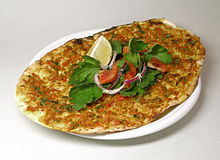
  • Cơm trắng: Cooked white rice
  • Món mặn or main dishes to eat with rice: Fish/seafood, meat, tofu (grilled, boiled, steamed, stewed or stir-fried with vegetables)
  • Rau: Sauteed, boiled or raw fresh green vegetables
  • Canh (a clear broth with vegetables and often meat or seafood) or other kinds of soup
  • Nước chấm: Dipping sauces and condiments depending on the main dishes, such as pure fish sauce, ginger fish sauce, tamarind fish sauce, soy sauce, muối tiêu chanh (salt and pepper with lime juice) or muối ớt (salt and chili)
  • Small dish of relishes, such as salted eggplant, pickled white cabbage, pickled papaya, pickled garlic or pickled bean sprouts
  • Tráng miệng or desserts: Fresh fruits, drinks or sweets, such as chè.

Except individual bowls of rice, all dishes are communal and are to be shared in the middle of the table. It is also customary for younger people to ask/wait for the elders to eat first and for the woman who sits directly next to the rice pot to serve rice for other people. People should "invite" the others to enjoy the meal (somehow similar to saying "Enjoy your meal"), in order from the elders to younger people. They also pick up food for each other as an action of care.

Feast[edit]

A typical feast for one table (6–8 diners) in an engagement ceremony (Ăn hỏi) of regional Northern Vietnam

A feast (Vietnamese: cỗ, tiệc) is a significant event for families or villages, usually up to 12 people for each table. A feast is prepared for weddings, funerals, and festivals, including the longevity-wishing ceremony. In a feast, ordinary foods are not served, but boiled rice is still used.

A Vietnamese feast has two courses: the main course (món mặn—salty dish) and dessert (món ngọt—sweet dish). All dishes, except for individual bowls of rice, are enjoyed collectively. All main course dishes are served simultaneously rather than one after another. The major dish of the main course is placed in the center of the tables, usually big pots of soup or a hot pot.

A basic feast (cỗ một tầng) consists of 10 dishes: five in bowls (năm bát): bóng (dried and fried pork skin), miến (cellophane noodles), măng (bamboo shoot), mọc (meatball), chim or gà tần (bird or chicken stew dishes) and five on plates (năm đĩa): giò (Vietnamese sausage), chả, gà or vịt luộc (boiled chicken or duck), nộm (Vietnamese salad) and xào (stir-fried dishes). This kind of feast is traditional and is organized only in northern Vietnam. Other variations are found in central and southern Vietnam.

Four dishes essential in the feast of Tết are chả giò (spring rolls), nem (in northern Vietnam, nem refers to a spring roll called nem cuon or nem ran; in southern Vietnam, nem mainly refer to nem chua, fermented pork rolls), ninh (stew dishes) and mọc (noodle soup). At this time, the feast for offering ancestors includes sticky rice, boiled chicken, Vietnamese rice wine, and other foods preferred by ancestors. Gifts are given before guests leave the feast.

Royal cuisine[edit]

Nem công (peacock spring-rolls) is a well-known royal dish in Huế

In the Nguyễn dynasty, the 50 best chefs from all over the kingdom were selected for the Thượng Thiện board to serve the king. There were three meals per day—12 dishes at breakfast and 66 dishes for lunch and dinner (including 50 main dishes and 16 sweets). An essential dish was bird's nest soup (tổ yến). Other dishes included shark fin (vi cá), abalone (bào ngư), deer's tendon (gân nai), bears' hands (tay gấu), and rhinoceros' skin (da tê giác). Water had to come from the Hàm Long well, the Báo Quốc pagoda, the Cam Lồ well (near the base of Thúy Vân mountain), or from the source of the Hương River. Rice was the de variety from the An Cựu imperial rice field. Phước Tích clay pots for cooking rice were used only a single time before disposal. No one was allowed to have any contact with the cooked dishes except for the cooks and Thượng Thiện board members. The dishes were first served to eunuchs, then the king's wives, after which they were offered to the king. The king enjoyed meals (ngự thiện) alone in a comfortable, music-filled space.[18]

Cultural importance[edit]

Salt is used as the connection between the worlds of the living and the dead. Bánh phu thê is used to remind new couples of perfection and harmony at their weddings. Food is often placed at the ancestral altar as an offering to the dead on special occasions (such as Lunar New Year). Cooking and eating play an extremely important role in Vietnamese culture.

Proverbs[edit]

The word ăn (to eat) is included in a great number of proverbs and has a large range of semantic extensions.

  • Ăn trông nồi, ngồi trông hướng ("Checking the status of the rice pot when eating, watch where/what direction you are sitting.") = Be careful of possible faux pas.
  • Ăn theo thuở, ở theo thì = living in accordance to one's limit and social circumstance
  • Cha ăn mặn, con khát nước ("The father eats salty food, the children go thirsty.") = Bad actions will later bring bad luck/consequences to descendants.
  • Nhai kĩ no lâu, cày sâu tốt lúa ("Chewing carefully [makes one] feel full longer, ploughing deep is good for the rice") = Careful execution brings better results than hasty actions.
  • Học ăn, học nói, học gói, học mở ("Learning how to eat, how to speak, how to wrap, how to open") = Everything needs to be learned, even the simplest, start from "how to eat" politely.

Many Vietnamese idioms reflect the sex-is-eating mapping:

  • Ông ăn chả, bà ăn nem ("He eats meatballs, she eats springrolls") = Both husband and wife are having affairs.
  • Chán cơm thèm phở ("Tired of rice, craving noodle soup") = A man gets bored of his wife and find another girl.
  • Ăn bánh trả tiền ("You eat snack, you pay money") = Pay before having sex with prostitutes. (Long story short, bánh is a metaphor for the prostitute)
  • Ăn vụng không biết chùi mép ("Eating on the sly without cleaning your mouth") = Committing adultery but left trace

International popularity[edit]

Outside of Vietnam, Vietnamese cuisine is widely available in countries with strong Vietnamese immigrant communities, such as Australia, the United States, Canada, and France. Vietnamese cuisine is also popular in Japan, Korea, the Czech Republic, Slovakia, Germany, United Kingdom, Poland, Philippines and Russia, and in areas with dense Asian populations.

Television shows featuring Vietnamese food have increased in popularity. Luke Nguyen from Australia currently features a television show, Luke Nguyen's Vietnam, dedicated on showcasing and instructing how to cook Vietnamese dishes.

On The Great Food Truck Race, a Vietnamese sandwich truck called Nom Nom Truck received the most money in the first five episodes.

Anthony Bourdain wrote:[19]

You don't have to go looking for great food in Vietnam. Great food finds you. It's everywhere. In restaurants, cafes, little storefronts, in the streets; carried in makeshift portable kitchens on yokes borne by women vendors. Your cyclo-driver will invite you to his home; your guide will want to bring you to his favorite place. Strangers will rush up and offer you a taste of something they're proud of and think you should know about. It's a country filled with proud cooks—and passionate eaters.

Gordon Ramsay visited Vietnam in his reality show Gordon's Great Escape - S02E02 (2011) and fell in love with the taste of the culinary here. Especially the dish called Hủ tiếu Mì by Mrs. Dì Hai, prepped and served on a small boat in Cái Răng floating market, Cần Thơ. He even praised it as "The greatest dish I have ever eaten" when he brought it up as one of the dishes for the elimination challenge for the top 5 finalists of American MasterChef season 4 episode 21.

Cooking techniques[edit]

Cutting dough and rán quẩy

Xào (stir-fry)

Thịt nướng (grilled pork)

Bánh tẻ is boiled (luộc) after wrapped in a leaf (gói lá)

Tráng (spread rice flour on a steamed cloth) bánh tráng

Some common Vietnamese culinary terms include:

  • Rán, chiên – fried dishes
    • Chiên nước mắm – fried then tossed with fish sauce
    • Chiên bột – battered then deep-fried
  • Rang – dry-fried dishes with little to no oil
  • Áp chảo – pan-fried then sautéed
  • Xào – stir fry, sautéing
    • Xào tỏi – stir fry with garlic, very common way of cooking vegetables
    • Xào sả ớt – sautéed with lemongrass and chili pepper
    • Xào lăn – pan searing or stir frying quickly to cook raw meat
    • Xáo măng – braised or sautéed with bamboo shoots
  • Nhồi thịt – stuffed with minced meat before cooking
  • Sốt chua ngọt – fried with sweet and sour sauce
  • Kho – stew, braised dishes
    • Kho khô – literally dried stew (until the sauce thickens)
    • Kho tiêu/kho gừng/kho riềng – stewed with peppercorns/ginger/galangal
  • Nấu – means cooking, usually in a pot
    • Nấu nước dừa – cooked with coconut water
  • Hầm/ninh – slow-cook with spices or other ingredients
  • Canh – broth-like soup to be served over rice
  • Rim – simmering
  • Luộc – boiling with water, usually fresh vegetables and meat
  • Chần/trụng – blanche
  • Hấp – steamed dishes
    • Hấp sả – steamed with lemongrass
    • Hấp Hồng Kông or hấp xì dầu – "Hong Kong-style" steamed dish (i.e.: with scallion, ginger and soy sauce)
  • Om – clay pot cooking of northern style
    • Om sữa – cooked in clay pot with milk
    • Om chuối đậu – cooked with young banana and tofu
  • Gỏi – salad dishes, usually with meat, fish
  • Gói lá – wrap raw ingredients by a leaf (often banana) to form shape and enhance fragrangce
  • Nộm – salads, usually meatless
  • Nướng – grilled dishes
    • Nướng xiên – skewered dishes
    • Nướng ống tre – cooked in bamboo tubes over fire
    • Nướng mọi/nướng trui/thui – char-grilled over open fire
    • Nướng đất sét/lá chuối – cooked in a clay mould or banana leaves wrap, or recently, kitchen foil, hence the method has evolved into nướng giấy bạc
    • Nướng muối ớt – marinated with salt and chili pepper before being grilled
    • Nướng tỏi – marinated with garlic then grilled
    • Nướng mỡ hành – grilled then topped with melted lard, peanuts, and chopped green onions
  • Bằm/băm – sauteed mix of chopped ingredients
  • Cháo – congee dishes
  • Súp – soup dishes (not canh or clear broth soup)
  • Rô ti – roasting then simmering meat, usually with strong spices
  • Tráng – spreading ingredient into a thin layer on a steamed/hot surface
  • Cà ri – curry or curry-like dishes
  • Quay – roasted dishes
  • Lẩu – hot pot dishes
  • Nhúng dấm – cooked in a vinegar-based hot pot, some variations include vinegar and coconut water-based hot pot
  • Cuốn – any dish featuring rice paper wraps with bún and fresh herbs
  • Bóp thấu/tái chanh – raw meat or seafood prepared with lime or vinegar

Vietnamese utensils[edit]

A traditional set of serving utensils used in Northern Vietnam up to the 20th century include: wooden tray, 'small bottom' bowls (bát chiết yêu), stoneware dishes, flat chopsticks (for portioning rice), chopsticks and ladle (for sharing soup)

  • Basket, various kinds (rổ or rá)
  • Bowl (small bowl: bát in northern Vietnam or chén in southern Vietnam; large bowl: tô)
  • Chopsticks (đũa)
  • Chõ – a kind of steamer to cook glutinous rice
  • Clay pot cooking (thố đất)
  • cup (cốc or ly)
  • Dipper (gáo)
  • Flat drying basket (nong or nia)
  • Knife (dao)
  • Mill (cối xay gạo)
  • Mortar (cối giã)
  • Pestle (chày)
  • Plate (dĩa or đĩa)
  • Pot, various kinds (nồi and niêu)
  • Spoon (thìa in northern Vietnam or muỗng in southern Vietnam)
  • Teacup (tách or chén uống trà)
  • Teapot (ấm pha trà)
  • Tray, various kinds (mâm and khay)

Common ingredients[edit]

Further information: List of Vietnamese ingredients

Vegetables[edit]

A vegetable stand in a Hanoi market

  • Bitter melon (khổ qua or mướp đắng) (southern & northern Vietnamese dialects)
  • Bok choy (cải thìa)
  • Cabbage (bắp cải)
  • Carrot (cà rốt)
  • Cauliflower (bông cải or súp lơ)
  • Celery (cần tây)
  • Ceylon spinach (mồng tơi)
  • Chayote (su su)
  • Chili pepper (ớt)
  • Cucumber (dưa chuột or dưa leo)
  • Crown daisy (cải cúc or tần ô)
  • Radish (củ cải trắng)
  • Eggplant (cà tím)
  • Jicama (củ đậu or củ sắn)
  • Katuk (rau ngót)
  • Tonkin jasmine (hoa thiên lý)
  • Tricolor amaranth (rau dền đỏ)
  • Water celery (rau cần (ta))
  • Water cress (xà lách xoang)
  • Water spinach (rau muống)

Fruits[edit]

A fruit stand in Da Nang

  • Acerola (sơ ri or xê-ri)
  • Buddha's hand (phật thủ)
  • Canistel (trái trứng gà)
  • Cherimoya (mãng cầu tây)
  • Coconut (dừa)
  • Chinese date (táo tàu)
  • Custard apple (bình bát or mãng cầu)
  • Durian (sầu riêng)
  • Milk fruit (vú sữa)
  • Guava (ổi)
  • Jackfruit (mít)
  • Langsat (bòn bon)
  • Longan (nhãn)
  • Lychee (vải)
  • Mango (xoài)
  • Mangosteen (măng cụt)
  • Otaheite gooseberry (chùm ruột)
  • Papaya (đu đủ)
  • Persimmon (hồng)
  • Pitaya – dragon fruit (thanh long)
  • Plum (mận)
  • Pomelo (bưởi)
  • Rambutan (chôm chôm)
  • Sapodilla (hồng xiêm or xa-pô-chê)
  • Spondias cytherea (cóc)
  • Soursop (mãng cầu Xiêm or mãng cầu gai)
  • Star fruit (khế)
  • Sweetsop (na or mãng cầu ta)
  • Rose apple (roi in the north, mận Đà Lạt in the south)
  • Tea fruit (thanh trà)
  • Tomato (cà chua)
  • Water apple (roi in the north, mận in the south)
  • Watermelon (dưa hấu)

Herbs (rau thơm)[edit]

Herbs and vegetables were displayed in Ben Thanh Market

  • Genus Allium:
    • Using leaf and flower: Welsh onion or green onion (hành lá or hành hương or hành hoa), garlic chives (hẹ)
    • Using bulb: garlic (tỏi), shallot (hành tím), onion (hành tây), Allium chinense (củ kiệu) and chives (củ nén or hành tăm).
    • Welsh onion (hưng cừ) and leek (tỏi tây or hành boarô) are not traditionally used.
  • Family Zingiberaceae: using ginger (gừng), galangal (riềng)—greater galangal (riềng nếp) is preferred to lesser galangal (riềng thuốc) because of the stronger flavour, turmeric (nghệ) and black cardamom (thảo quả)
  • Polygonum aviculare (rau đắng)
  • Coriander leaf (cilantro) (rau mùi or ngò rí)
  • Lemongrass (xả or sả)
  • Dill (thì là)
  • Elsholtzia ciliata (kinh giới)
  • Long coriander/culantro (ngò gai or mùi tàu)
  • Rice paddy herb (ngò ôm or rau ngổ)
  • Houttuynia cordata (giấp cá or diếp cá)
  • Parsley (mùi tây)
  • Peppermint ((húng) bạc hà)
  • Perilla (tía tô)
  • Spearmint (húng dũi)
  • Thai basil (rau quế or húng quế) sometimes substituted with sweet basil in the United States
  • Hot mint (rau răm)

Condiments and sauces[edit]

Condiments[edit]

Vietnamese usually use raw vegetables, rau sống, or rau ghém (sliced vegetable) as condiments for their dishes to combine properly with each main dish in flavour. Dishes in which rau sống is indispensable are bánh xèo and hot pot. The vegetables principally are herbs and wild edible vegetables gathered from forests and family gardens. Leaves and buds are the most common parts of vegetables used. Most of the vegetables have medicinal value.[20]

Rau sống includes lettuce, raw bean sprout, herbs, shredded banana flower, green banana, water spinach, mango bud and guava leaves.

Herbs and spices[edit]

Vietnamese hot chili peppers are added to most foods, especially in central and southern Vietnam.

  • Coriander and green onion leaves can be found in most Vietnamese dishes.
  • A basic technique of stir-frying vegetable is frying garlic or shallot with oil before putting the vegetable into the pan.
  • In northern Vietnam, dishes with fish may be garnished with dill.
  • In central Vietnam, the mixture of ground lemongrass and chili pepper is frequently used in dishes with beef.
  • In southern Vietnam, coconut water is used in most stew dishes.
  • The pair culantro (ngò gai) and rice paddy herb (ngò om or ngổ) is indispensable in all kinds of sour soups in the southern Vietnam.
  • Spearmint is often used with strongly fishy dishes.
  • Perilla is usually used with crab dishes.

Pairing[edit]

  • Chicken dishes are combined with lime leaves.
  • Crab and seashell dishes are combined with fishy-smelling herb and perilla.
  • Dishes reputed as "cold" or "fishy-smelling", such as catfish, clams, or snails, are combined with ginger or lemongrass.
  • Beef dishes are combined with celeries or pineapples.

Sauces[edit]

  • Nước chấm
  • Mắm tôm (shrimp paste)
  • Nước mắm (fish extract) can be used as it is or mixed with lemon juice, garlic, vinegar, sugar, and chili. This mixture is called nước mắm pha.
  • Tương is made from fermented soybeans.
  • Soy sauce mostly is used in marinades and sauces.
  • Hoisin sauce is used in Southern Vietnam to mix with phở while serving.
  • Hot chili sauce.

Food colourings[edit]

Xôi ngũ sắc (five colours sticky rice) is coloured with plant-based ingredients.

Traditionally, the colouring of Vietnamese food comes from natural ingredients; however, today there is an increase in the use of artificial food dye agents for food colouring, in Vietnam.

  • Red – usually from beetroot or by frying annatto seeds to make oil (dầu điều)
  • Orange – usually used for sticky rice, comes from gac
  • Yellow – from turmeric
  • Green – from the pandan leaf or katuk
  • Purple – from the magenta plant (lá cẩm)
  • Black – in banh gai is from the ramie leaf (lá gai)
  • Dark brown – for stew dishes, uses nước màu or nước hàng, which is made by heating sugar to a temperature above that of caramel (170 °C).

Colourings can be absorbed by mixing ground colourings or colouring liquid or wrapping before boiling to get the extracts. When colouring dishes, the tastes and smells of colourings must also be considered.

Popular dishes[edit]

For a longer list of popular dishes, see List of Vietnamese dishes. For a list of popular dishes organized by province, see List of Vietnamese culinary specialities.

When Vietnamese dishes are referred to in English, it is generally by the Vietnamese name without the diacritics. Some dishes have gained descriptive English names, as well.

Popular Vietnamese dishes include:

Noodle soups[edit]

Main article: Vietnamese noodles

Bánh đa cua (Crab red noodle soup)

Bún mắm (Mix seafood noodles soup)

Vietnamese cuisine boasts a huge variety of noodle soups, each with distinct influences, origins and flavours. A common characteristic of many of these soups is a rich broth.[21]

NameDescription

Bún bò HuếSpicy beef noodle soup originated from the royal city of Huế in Central Vietnam. Beef bones, fermented shrimp paste, lemongrass, and dried chilies give the broth its distinctive flavors. Often served with mint leaves, bean sprouts, and lime wedges. Pig's feet are also common ingredients at some restaurants.[clarification needed]

Bún măng vịtBamboo shoots and duck noodle soup.[22]

Bún ốcVermicelli with snails (freshwater snails with noodles, tomato pork bone broth, tofu and herbs)

Bánh canhA thick tapioca/rice noodle soup with a simple broth, often includes pork, crab, chicken, shrimp, spring onions and fresh onions sprinkled on top

Bún riêuA noodle soup made of thin rice noodles, topped with crab and shrimp paste, served in a tomato-based broth and garnished with bean sprouts, prawn paste, herb leaves, tamarind/lime, tofu, water spinach, and chunks of tomato

Mì (súp mì)A Chinese-influenced wheat (egg) noodle soup.

PhởA noodle soup with a rich, clear broth made from a long boiling of meat and spices, its many varieties are made with different meats (most commonly beef or chicken) along with beef meatballs. Phở is typically served in bowls with spring onion, (in phở tái) slices of semi-cooked beef (to be cooked by the boiling hot broth), and broth. In the south, bean sprouts and various herbs are also added.[21]

Phở satếSpicy noodle soup with thinly sliced rare beef steak, satế hot chili sauce, sliced cucumber, tomatoes, and peanut

Mì vịt tiềmYellow noodle soup with roasted duck and Chinese broccoli

Bún chả cáRice vermicelli soup with fried fishcake

Hủ tiếuA noodle soup with many varied styles, including a 'dry' (not soup, but with sauce) version, which was brought to Vietnam by way of Chinese (Teochew) immigrants from Cambodia. The noodles are usually egg noodles or rice noodles, but many other types may be used. The soup base is made of pork bones.

Soup and cháo (congees)[edit]

Canh chua, sour soup

NameDescription

Súp măng cuaAsparagus and crab soup typically served as the first dish at banquets

Lẩu (Vietnamese hot pot)A spicy variation of the Vietnamese sour soup with assorted vegetables, meats, seafood, and spicy herbs

CháoA variation of congee, it uses a variety of different broths and meats, including duck, offal, fish, etc. When chicken is used, it is called cháo gà.

Cháo lòngRice porridge with pork intestine, liver, gizzard, heart, and kidney

Bò khoBeef stew with carrots, usually served with toasted bread or rice noodles

Nhúng dấmFire pot with a combination of sliced rare beef and seafood cooked in sour broth, served with thin rice vermicelli noodles, fresh vegetables, rice spring roll wrapper, and dipping sauce

Canh chuaVietnamese sour soup – typically includes fish, pineapples, tomatoes, herbs, beansprouts, tamarind, and various kinds of vegetables

Rice dishes[edit]

Cơm tấm

NameDescription

Cơm chiên Dương ChâuA Chinese fried rice dish, named after the Yangzhou region in China, it is a well-known dish in Vietnam.

Cơm gà rau thơm (chicken and rice with mint)This dish is rice cooked in chicken stock and topped with fried then shredded chicken, with mint and other herbs. The rice has a unique texture and taste that the fried mint garnish enhances. It is served with a special herb sauce on the side.

Cơm hếnRice with clams – a popular, inexpensive dish in the city of Huế and its vicinity

Cơm chiên cá mặnFried rice with salty fermented fish and chopped snow pea and chicken

Cá/thịt khoA traditional family dish of fish or pork braised in a clay pot and served with sweet and sour soup (canh chua)

Gà xào gừngChicken sauteed with ginger and fish sauce

Bò lúc lắcCubed beef sauteed with cucumber, tomatoes, onion, pepper, and soy sauce

Cơm lamRice (often glutinous rice) cooked in a bamboo tube either boiled or steamed

Cơm tấmIn general, grilled pork (either ribs or shredded) is mixed with bì (thinly shredded pork mixed with cooked and thinly shredded pork skin and fried ground rice) over com tam ("broken rice") and is served with sweet and sour fish sauce. Other types of meat, prepared in various ways, may be served with the broken rice. Barbecued beef, pork, or chicken are common choices and are served with the broken rice. The rice and meat are accompanied by various greens and pickled vegetables, along with a prawn paste cake (chả tôm), steamed egg (trứng hấp) and grilled prawns.

philipines

Filipino cuisine is composed of the cuisines of more than a hundred distinct ethnolinguistic groups found throughout the Philippine archipelago. A majority of mainstream Filipino dishes that compose Filipino cuisine are from the food traditions of various ethnolinguistic groups and tribes of the archipelago, including the Ilocano, Pangasinan, Kapampangan, Tagalog, Bicolano, Visayan, Chavacano, and Maranao ethnolinguistic groups. The dishes associated with these groups evolved over the centuries from a largely indigenous (largely Austronesian) base shared with maritime Southeast Asia with varied influences from Chinese, Spanish, and American cuisines, in line with the major waves of influence that had enriched the cultures of the archipelago, and adapted using indigenous ingredients to meet local preferences.[1]

Dishes range from the very simple meal of fried salted fish and rice to curries, paellas, and cozidos of Iberian origin made for fiestas. Popular dishes include lechón[2] (whole roasted pig), longganisa (Philippine sausage), tapa (cured beef), torta (omelette), adobo (vinegar and soy sauce-based stew ), kaldereta (meat stewed in tomato sauce and liver paste), mechado (larded beef in soy and tomato sauce), pochero (beef and bananas in tomato sauce), afritada (chicken or beef and vegetables simmered in tomato sauce), kare-kare (oxtail and vegetables cooked in peanut sauce), pinakbet (kabocha squash, eggplant, beans, okra, bitter melon, and tomato stew flavored with shrimp paste), sinigang (meat or seafood with vegetables in sour broth), pancit (noodles), and lumpia (fresh or fried spring rolls).

History[edit]

See also: Domesticated plants and animals of Austronesia and spice trade

Austronesian maritime trade routes (including the Spice Trade and Maritime Silk Road) which enabled the exchange of cuisine and ingredients between Island Southeast Asia, South Asia, and China.[3]

Negritos, the first peoples of the Philippine archipelago, were nomadic hunter-gatherers whose diet consisted of foraged wild tubers, seafood, and game meat.

Around 6000 BP, subsequent migrations of seafaring Austronesians, whom the majority of contemporary Filipinos descend from, brought new techniques in aquaculture and agriculture, and various domesticated foodstuffs and animals.

The plains of central and southwestern Luzon, Bicol peninsula, and eastern Panay were major producers of rice, exporting surplus elsewhere to the rest of the archipelago. Rice was a symbol of wealth, with many rice-based delicacies used as offerings in important ceremonies.[4][5]

Pre-Colonial period[edit]

While the colonial periods brought much influence to the culture and cuisine of the Philippines, it should not be understated the importance of the influences of countries surrounding the Philippines before those times, as well as the origins of that cuisine within the Philippines itself.

Pre-dating their colonization by the Spaniards, the Philippines had frequent trade with China. Their trade with Chinese merchants was frequent enough to where there were Chinese outposts along some of the coastal cities of the Philippines.[6][7] The Chinese introduced rice noodles to the islands, the main ingredient of pancit, and eggrolls; the Philippine version is known as lumpia.[8][9]

The start of rice cultivation was a major development in Filipino cuisine. In Northern Luzon, the famous Banaue rice terraces were created over 2,000 years ago by the Ifugao people. Using only basic tools, the Ifugao built the terraces using stone and mud walls to create flat surfaces on the steep mountain slopes, which allowed them to cultivate rice in the highlands.[10] Like much of Asia, rice is a staple of Filipino cuisine. Rice-based dishes are common among all regions, with influences from various countries, e.g., arroz caldo is similar to Chinese congee.[11]

Spanish colonial period[edit]

See also: Manila galleon

Spanish rule ushered several large changes to the cuisines of much of the archipelago, from the formation of the Manila galleon trade network to domestic agricultural reform.

The galleon trade brought two significant culinary influences to the islands: Chinese and Mexican.

Chinese pancitero serving pancit

The galleon exchange was mainly between Manila and Acapulco, mainland New Spain (present-day Mexico), hence influence from Mexican cuisine brought a vast array of both New World and Spanish foodstuffs and techniques. Directly from the Americas were primarily crops: maize, chili peppers, bell peppers, tomatoes, potatoes, peanuts, chocolate, pineapples, coffee beans, jicama, various squashes, annatto, and avocados, among others. Mexicans and other Latin Americans also brought various Spanish cooking techniques, including sofrito, sausage making (longganisa, despite more akin to chorizos), bread baking, alongside many dishes giving way to locally adapted empanadas, paellas, omelettes called tortas, and tamales.

Likewise, migrating Filipinos brought their culinary techniques, dishes, and produce to the Americas and several Pacific islands also under Spanish rule, notably Guam and the Marianas. Rice, sugarcane, coconuts, citruses, mangoes, and tamarind from the Philippine islands were all naturalized in these areas. Within Mexican cuisine, Filipino influence is particularly prevalent in the west coast of Guerrero, which includes tuba winemaking, guinatan coconut milk-based dishes, and probably ceviche. In Guam, several Filipino dishes like pancit and lumpia became regular fare, and dishes like kelaguen and kalamai were local adaptations of Filipino predecessors (respectively, kilawin and kalamay).

American colonial period[edit]

The United States emerged as the victor of the Spanish–American War in 1898, purchasing the Philippines from Spain for $20 million during the Treaty of Paris.[12] The Philippines remained a colony until 1946. Americans introduced Filipinos to fast food, including hot dogs, hamburgers, fried chicken, and ice cream. They also introduced convenient foods such as Spam, corned beef, instant coffee, and evaporated milk. Today, Spam is a common breakfast item often served with garlic fried rice.

Contemporary period[edit]

Filipino cuisine continues to evolve as new techniques and styles of cooking, and ingredients find their way into the country.[13] Traditional dishes both simple and elaborate, indigenous and foreign-influenced, are seen as are more current popular international dishes and fast food fare. However, the Filipino diet is higher in total fat, saturated fat, and cholesterol than other Asian diets.[14] In 2013, President Noynoy Aquino signed Republic Act No. 10611, or the Food Safety Act, to establish safeguards for the Filipino people's diet and health in regards to food quality and consumption.[15] In 2022, TasteAtlas ranked Filipino cuisine as the 23rd best in the world, while chicken inasal and sisig were ranked one of the best dishes globally.[16]

Characteristics[edit]

Pinakbet

Filipino cuisine centres around the combination of sweet (tamis), sour (asim), and salty (alat),[2] although in Bicol, the Cordilleras and among Muslim Filipinos, spicy (anghang) is a base of cooking flavor.
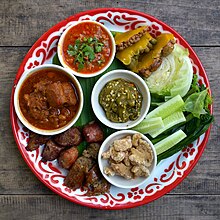
Counterpoint is a feature in Filipino cuisine which normally comes in a pairing of something sweet with something salty. Examples include champorado (a sweet cocoa rice porridge), being paired with tuyo (salted, sun-dried fish); dinuguan (a savory stew made of pig's blood and innards), paired with puto (sweet, steamed rice cakes); unripe fruits such as green mangoes (which are only slightly sweet but very sour), are eaten dipped in salt or bagoong; the use of cheese (which is salty-sweet) in sweetcakes (such as bibingka and puto), as well as an ice cream flavoring.

Native ingredients[edit]

Kalamansi

Ube halaya

Filipino cuisine has a variety of native ingredients used. The biota that developed yielded a particular landscape and in turn gave the place local ingredients that enhanced flavors to the dishes. Kalamansi, a fruit that belongs to the genus citrus, is one of these well known ingredients and is mostly used to contribute sourness to a dish.[17] Another is the tabon-tabon, a tropical fruit used by pre-colonial Filipinos as an anti-bacterial ingredient, especially in Kinilaw dishes.[18]

The country also cultivates different type of nuts and one of them is the pili nut, of which the Philippines is the only known exporter of edible varieties. It is usually made as a merienda or is incorporated in other desserts to enhance the flavor due to the milky texture it gives off as it melts in the mouth.[19]

Vinegar is a common ingredient. Adobo is popular[2] not solely for its simplicity and ease of preparation, but also for its ability to be stored for days without spoiling, and even improve in flavor with a day or two of storage. Tinapa is a smoke-cured fish while tuyo, daing, and dangit are corned, sun-dried fish popular because they can last for weeks without spoiling, even without refrigeration.

Cooking, serving and consumption[edit]

Some of this section's listed sources may not be reliable. Please help improve this article by looking for better, more reliable sources. Unreliable citations may be challenged and removed. (June 2015) (Learn how and when to remove this template message)

Cooking and eating in the Philippines has traditionally been an informal and communal affair centered around the family kitchen. Food tends to be served all at once and not in courses.

Like many of their Southeast Asian counterparts Filipinos do not eat with chopsticks. The traditional way of eating is with the hands, especially dry dishes such as inihaw or prito. The diner will take a bite of the main dish, then eat rice pressed together with their fingers. This practice, known as kamayan (using the washed left hand for picking the centralized food and the right hand for bringing food to the mouth), is rarely seen in urbanized areas. However, Filipinos tend to feel the spirit of kamayan when eating amidst nature during out-of-town trips, beach vacations, and town fiestas.[20]

During the Spanish occupation, which yielded Western influences, Filipinos ate with the paired utensils of spoon and fork. The knife was not used as in other countries, because Spain prohibited them to have knives. Filipinos use the side of the spoon, to "cut" the food. Due to Western influence, food is often eaten using flatware—forks, knives, spoons—but the primary pairing of utensils used at a Filipino dining table is that of spoon and fork, not knife and fork.[20]

Boodle fight in Baler, Aurora

Kamayan is also used in the "boodle fight" concept, a style of dining popularized by the Philippine Army which utilizes banana leaves spread out on the table as the main serving platter, upon which is laid out portions of rice and a variety of Filipino dishes for friendly, filial or communal feasting. The use of spoons and forks, however, is still the norm.

Meals of the day[edit]

Tapsilog, a common breakfast meal

Filipinos traditionally eat three main meals a day: almusal or agahan (breakfast), tanghalían (lunch), and hapunan (dinner) plus morning and an afternoon snack called meryenda (also called minandál or minindál).[20]

A traditional Filipino breakfast (almusal) might include pandesal (small bread rolls), kesong puti (fresh, unripened, white Filipino cheese, traditionally made from carabao's milk) champorado (chocolate rice porridge), silog which is sinangag (garlic fried rice) or sinaing, with fried egg and meat—such as tapa, longganisa, tocino, karne norte (corned beef), or fish such as daing na bangus (salted and dried milkfish)—or itlog na pula (salted duck eggs). Coffee is also commonly served particularly kapeng barako, a variety of coffee produced in the mountains of Batangas noted for having a strong flavor.

Fried tilapia with kamatis maalat na itlog

Certain portmanteaus in Filipino have come into use to describe popular combinations of items in a Filipino breakfast. An example of such a combination order is kankamtuy: an order of kanin (rice), kamatis (tomatoes) and tuyo (dried fish). Another is tapsi: an order of tapa and sinangág or sinaing. Other examples include variations using a silog suffix, usually some kind of meat served with sinangág or sinaing, and itlog (egg). The three most commonly seen silogs are tapsilog (having tapa as the meat portion), tocilog (having tocino as the meat portion), and longsilog (having longganisa as the meat portion). Other silogs include hotsilog (with a hot dog), bangsilog (with bangus (milkfish)), dangsilog (with danggit (rabbitfish)), spamsilog (with spam), adosilog (with adobo), chosilog (with chorizo), chiksilog (with chicken), cornsilog (with corned beef), and litsilog (with Manila lechon" (or "Luzon lechon"). Pankaplog is slang for a breakfast consisting of pandesal, kape (coffee), and itlog (egg).[21] An establishment that specializes in such meals is called a tapsihan or tapsilugan.

A typical Filipino lunch (tanghalian) is composed of a food variant (or two for some) and rice, sometimes with soup. Whether grilled, stewed, or fried, rice is eaten with everything. Due to the tropical climate of the Philippines, the preference is to serve ice-cold water, juices, or soft drinks with meals.[22]

Dinner, while still the main meal, is smaller than in other countries.[20] Typical meals in a Filipino dinner are usually leftover meals from lunch. Filipino dinner is usually served in the time period between 6–8 pm, though dinner is served much more early in the countryside.

Merienda[edit]

Puto in banana leaf liners

Merienda is taken from the Spanish, and is a light meal or snack especially in the afternoon, similar to the concept of afternoon tea.[23] If the meal is taken close to dinner, it is called merienda cena, and may be served instead of dinner.[24]

Filipinos have a number of options to take with kapé, which is the Filipino pronunciation of café (coffee): breads and pastries like pandesal, ensaymada (buttery brioche covered in grated cheese and sugar), hopia (pastries similar to mooncakes filled with mung bean paste) and empanada (savoury, meat-filled pasties). Also popular are kakanín, or traditional pastries made from sticky rice like kutsinta, sapin-sapin (multicoloured, layered pastry), palitaw, biko, suman, Bibingka, and pitsi-pitsî (served with desiccated coconut).

Ube halaya, sapin-sapin, kalamay, suman, and various other kakanin

Savoury dishes often eaten during merienda include Pancit canton (stir-fried noodles), palabok (rice noodles with a shrimp-based sauce), tokwa't baboy (fried tofu with boiled pork ears in a garlic-flavored soy sauce and vinegar dressing), and dinuguan (a spicy stew made of pork blood), which is often served with puto (steamed rice flour cakes).

Dim sum and dumplings, brought to the islands by Fujianese migrants, have been given a Filipino touch and are also popular merienda fare. Street food, such as squid balls and fish balls, are often skewered on bamboo sticks and consumed with soy sauce and the sour juice of the calamondin as condiments.

Pulutan[edit]

Kapampangan sisig

Pulutan[25] (from the Filipino word pulot which literally means "to pick up") is a term roughly analogous to the English term "finger food" or Spanish Tapas. Originally, it was a snack accompanied with liquor or beer but has found its way into Filipino cuisine as appetizers or, in some cases, main dishes, as in the case of sisig.

Deep fried pulutan include chicharon (less commonly spelled tsitsaron), pork rinds that have been boiled and then twice fried, the second frying gives the crunchiness and golden color; chicharong bituka, pig intestines that have been deep fried to a crisp; chicharong bulaklak, similar to chicharong bituka it is made from mesenteries of pig intestines and has an appearance roughly resembling a flower, hence the bulaklak name; and chicharong manok, chicken skin that has been deep fried until crisp. Other examples of deep fried pulutan are crispy crablets, crispy frog legs, chicharong isda or fish skin cracklings, and tugnas or deep fried pork fat (also known as pinaigi).

Bagnet from Ilocos Norte

Examples of grilled foods include isaw, or chicken or pig intestines skewered and then grilled; Inihaw na tenga, pig ears that have been skewered and then grilled; pork barbecue, skewered pork marinated in a sweet soy-garlic blend and then grilled; betamax, salted solidified pork or chicken blood which is then skewered and lightly grilled; adidas which is grilled or sautéed chicken feet. There is also sisig, a popular pulutan made from the pig's cheek skin, ears, and liver that is initially boiled, then charcoal grilled and afterwards minced and cooked with chopped onions, chillies, and spices.

Crispy crablets

Smaller snacks such as mani (peanuts) are often sold steamed in the shell, salted, spiced, or flavored with garlic by street vendors in the Philippines. Another snack is kropeck, which is fish crackers.

Tokwa't baboy is fried tofu with boiled pork marinated in a garlic-flavored soy sauce or vinegar dip. It is also served as a side dish to pancit luglog or pancit palabok.

Also, "tuhog-tuhog" is accompanied by sweet or spicy sauce. This includes Fish balls, Kikiam, Squid balls, etc., these are commonly served during a small gathering or in local bars.

Fiesta food[edit]

Lechón being roasted in Cadiz, Negros Occidental

For festive occasions, people band together and prepare more sophisticated dishes. Tables are often laden with expensive and labor-intensive treats requiring hours of preparation. In Filipino celebrations, lechon (less commonly spelled litson)[26] serves as the centerpiece of the dinner table. It is usually a whole roasted pig, but suckling pigs (lechonillo, or lechon de leche) or cattle calves (lechong baka) can also be prepared in place of the popular adult pig. It is typically served with lechon sauce, which is traditionally made from the roasted pig's liver. Other dishes include hamonado (honey-cured beef, pork or chicken), relleno (stuffed chicken or milkfish), mechado, afritada, caldereta, puchero, paella, menudo, morcon, embutido (referring to a meatloaf dish, not a sausage as understood elsewhere), suman (a savory rice and coconut milk concoction steamed in leaves such as banana), and pancit canton. The table may also have various sweets and pastries such as leche flan, ube, sapin-sapin, sorbetes (ice cream), totong or sinukmani (a rice, coconut milk and mongo bean pudding), ginataan (a coconut milk pudding with various root vegetables and tapioca pearls), and gulaman (an agar jello-like ingredient or dessert).

Christmas Eve, known as Noche Buena, is the most important feast. During this evening, the star of the table is the Christmas ham and Edam cheese (queso de bola). Supermarkets are laden with these treats during the Christmas season and are popular giveaways by Filipino companies in addition to red wine, brandy, groceries, or pastries. Available mostly during the Christmas season and sold in front of churches along with bibingka, puto bumbong is purple colored ground sticky rice steamed vertically in small bamboo tubes.

More common at celebrations than in everyday home meals, lumpiang sariwa, or fresh lumpia, is a fresh spring roll that consists of a soft crepe wrapped around a filling that can include strips of kamote (sweet potato), singkamas (jicama), bean sprouts, green beans, cabbage, carrots and meat (often pork). It can be served warm or cold and typically with a sweet peanut and garlic sauce. Ukoy is shredded papaya combined with small shrimp (and occasionally bean sprouts) and fried to make shrimp patties. It is often eaten with vinegar seasoned with garlic, salt and pepper. Both lumpiang sariwa and ukoy are often served together in Filipino parties. Lumpiang sariwa has Chinese origins, having been derived from popiah.[27]

Staples[edit]

Further information: List of Philippine dishes

Rice is a staple food in Filipino cuisine

As in most Asian countries, the staple food in the Philippines is rice.[28] It is most often steamed and always served with meat, fish and vegetable dishes. Leftover rice is often fried with garlic to make sinangag, which is usually served at breakfast together with a fried egg and cured meat or sausages. Rice is often enjoyed with the sauce or broth from the main dishes. In some regions, rice is mixed with salt, condensed milk, cocoa, or coffee. Rice flour is used in making sweets, cakes and other pastries. Sticky rice with cocoa, also called champorado is also a common dish served with daing (dried herring).

Rice and coconuts as staples throughout the archipelago as in the rest of Southeast Asia meant similar or adopted dishes and methods based on these crops. Some of these are evident in the infusion of coconut milk particularly in the renowned laing and sinilihan (popularized as Bicol Express) of Bikol. Other regional variants of stews or soups commonly tagged as ginataan(g) or "with coconut milk" also abound Filipino kitchens and food establishments. A dish from the Visayas simmered in coconut water, ideally in bamboo, is the binakol usually with chicken as the main ingredient.

Philippine chicken curry with its popular coconut milk sauce

A variety of fruits and vegetables are often used in cooking. Plantains (also called saba in Filipino), kalamansi, guavas (bayabas), mangoes, papayas, and pineapples lend a distinctly tropical flair in many dishes, but mainstay green leafy vegetables like water spinach (kangkong), Chinese cabbage (petsay), Napa cabbage (petsay wombok), cabbage (repolyo) and other vegetables like eggplants (talong) and yard-long beans (sitaw) are just as commonly used. Coconuts are ubiquitous. Coconut meat is often used in desserts, coconut milk (kakang gata) in sauces, and coconut oil for frying. Abundant harvests of root crops like potatoes, carrots, taro (gabi), cassava (kamoteng kahoy), purple yam (ube), and sweet potato (kamote) make them readily available. The combination of tomatoes (kamatis), garlic (bawang), and onions (sibuyas) is found in many dishes.

Sisig

Meat staples include chicken, pork, beef, and fish. Seafood is popular as a result of the bodies of water surrounding the archipelago. Popular catches include tilapia, catfish (hito), milkfish (bangus), grouper (lapu-lapu), shrimp (hipon), prawns (sugpo), mackerel (galunggong, hasa-hasa), swordfish (isdang-ispada), oysters (talaba), mussels (tahong), clams (halaan and tulya), large and small crabs (alimango and alimasag respectively), game fish, sablefish, tuna, cod (bakalaw), blue marlin, and squid/cuttlefish (both called pusit). Also popular are seaweeds (damong dagat), abalone, and eel (igat).

Leche flan

The most common way of having fish is to have it salted, pan-fried or deep-fried, and then eaten as a simple meal with rice and vegetables. It may also be cooked in a sour broth of tomatoes or tamarind as in pangat, prepared with vegetables and a souring agent to make sinigang, simmered in vinegar and peppers to make paksiw, or roasted over hot charcoal or wood (inihaw). Other preparations include escabeche (sweet and sour), relleno (deboned and stuffed), or "kinilaw" (similar to ceviche; marinated in vinegar or kalamansi). Fish can be preserved by being smoked (tinapa) or sun-dried (tuyo or daing).

Food is often served with various dipping sauces. Fried food is often dipped either in vinegar with onions, soy sauce with juice squeezed from kalamansi (Philippine lime or calamansi). Patis (fish sauce) may be mixed with kalamansi as dipping sauce for most seafood or mixed with a stew called nilaga. Fish sauce, fish paste (bagoong), shrimp paste (bagoong alamang) and crushed ginger root (luya) are condiments that are often added to dishes during the cooking process or when served.
Main dishes[edit]

This section needs additional citations for verification. Please help improve this article by adding citations to reliable sources in this section. Unsourced material may be challenged and removed. (April 2016) (Learn how and when to remove this template message)

Kare-kare

Adobo is one of the most popular Filipino dishes and is considered unofficially by many as the national dish. It usually consists of pork or chicken, sometimes both, stewed or braised in a sauce usually made from vinegar, cooking oil, garlic, bay leaf, peppercorns, and soy sauce. It can also be prepared "dry" by cooking out the liquid and concentrating the flavor. Bistek, also known as "Filipino beef steak," consists of thinly sliced beef marinated in soy sauce and calamansi and then fried in a skillet that is typically served with onions.

Some well-known stews are kare-kare and dinuguan. In kare-kare, also known as "peanut stew", oxtail or ox tripe is the main ingredient and is cooked with vegetables in a peanut-based preparation. It is typically served with bagoong (fermented shrimp paste). In dinuguan, pig's blood, entrails, and meat are cooked with vinegar and seasoned with chili peppers, usually siling mahaba.

Crispy pata

Pork adobo

Paksiw refers to different vinegar-based stews that differ greatly from one another based on the type of meat used. Paksiw na isda uses fish and usually includes the addition of ginger, fish sauce, and maybe siling mahaba and vegetables. Paksiw na baboy is a paksiw using pork, usually pork hocks, and often sees the addition of sugar, banana blossoms, and water so that the meat is stewed in a sweet sauce. A similar Visayan dish called humba adds fermented black beans.[citation needed] Both dishes are probably related to pata tim which is of Chinese origin. Paksiw na lechon is made from lechon meat and features the addition of ground liver or liver spread. This adds flavor and thickens the sauce so that it starts to caramelize around the meat by the time dish is finished cooking. Although some versions of paksiw dishes are made using the same basic ingredients as adobo, they are prepared differently, with other ingredients added and the proportions of ingredients and water being different.

In crispy pata, pork knuckles (known as pata) are marinated in garlic-flavored vinegar then deep fried until crisp and golden brown, with other parts of the pork leg prepared in the same way. Lechon manok is the Filipino take on rotisserie chicken. Available in many hole-in-the-wall stands or restaurant chains (e.g. Andok's, Baliwag, Toto's, Sr. Pedro's, G.S. Pagtakhan's), it is typically a specially seasoned chicken roasted over a charcoal flame served with "sarsa" or lechon sauce made from mashed pork liver, starch, sugar, and spices.

Dinuguan, a pork blood stew with siling haba

Bistek Tagalog, strips of sirloin beef slowly cooked in soy sauce, calamansi juice, and onions

Sinigang na hipon with siling labuyo (wild chili)

Tinola, a chicken soup notable as the dish mentioned in José Rizal's novel Noli Me Tángere

Ensaladang Lato or "Seaweed Salad" (also known as Kinilaw na Guso in Cebuano), a Filipino salad made from the edible green algae Caulerpa lentillifera

Mechado, kaldereta, and afritada are Spanish influenced tomato sauce-based dishes that are somewhat similar to one another. In these dishes meat is cooked in tomato sauce, minced garlic, and onions. Mechado gets its name from the pork fat that is inserted in a slab of beef making it look like a wick (mitsa) coming out of a beef "candle". The larded meat is then cooked in a seasoned tomato sauce and later sliced and served with the sauce it was cooked in. Kaldereta can be beef but is also associated with goat. Chunks of meat are cooked in tomato sauce, minced garlic, chopped onions, peas, carrots, bell peppers and potatoes to make a stew with some recipes calling for the addition of soy sauce, fish sauce, vinegar, chilies, ground liver or some combination thereof. Afritada tends to be the name given to the dish when chicken and pork is used. Another similar dish said to originate from the Rizal area is waknatoy. Pork or beef sirloin is combined with potatoes and cut sausages and cooked in a tomato-based sauce sweetened with pickles. Puchero is derived from the Spanish cocido; it is a sweeter stew that has beef and banana or plantain slices simmered in tomato sauce.

Filipinos also eat tocino and longganisa. Tocino is a sweetened cured meat made with either chicken or pork and is marinated and cured for a number of days before being fried. Longganisa is a sweet or spicy sausage, typically made from pork though other meats can also be used, and are often colored red traditionally through the use of the annatto seed but also artificial food coloring.

Filipino soups tend to be very hearty and stew-like containing large chunks of meat and vegetables or noodles. They are usually intended to be filling and not meant to be a light preparatory introduction for the main course. They tend to be served with the rest of the meal and eaten with rice when they are not meals unto themselves. They are often referred to on local menus under the heading sabaw (broth). Sinigang is a popular dish in this category distinguished by its sourness that often vies with adobo for consideration as the national dish. It is typically made with either pork, beef, chicken or seafood and made sour with tamarind or other suitable souring ingredients. Some seafood variants for example can be made sour by the use of guava fruit or miso. Another dish is tinola. It has large chicken pieces and green papaya/sayote slices cooked with chili, spinach, and moringa leaves in a ginger-flavored broth. Nilagang baka is a beef stew made with cabbages and other vegetables. Binacol is a warm chicken soup cooked with coconut water and served with strips of coconut meat. La Paz batchoy is a noodle soup garnished with pork innards, crushed pork cracklings, chopped vegetables, and topped with a raw egg. Another dish with the same name uses misua, beef heart, kidneys and intestines, but does not contain eggs or vegetables. Mami is a noodle soup made from chicken, beef, pork, wonton dumplings, or intestines (called laman-loob). Ma Mon Luk was known for it. Another chicken noodle soup is sotanghon, consisting of cellophane noodles[29] (also called sotanghon and from whence the name of the dish is derived), chicken, and sometimes mushrooms.

Pancit luglug topped with hardboiled eggs, shrimp, and chorizo

Noodle dishes are generally called pancit. Pancit recipes primarily consist of noodles, vegetables, and slices of meat or shrimp with variations often distinguished by the type of noodles used. Some pancit, such as mami and La Paz-styled batchoy, are noodle soups while the "dry" varieties are comparable to chow mein in preparation. Then there is spaghetti or ispageti in the local parlance that is a modified version of spaghetti bolognese. It is sometimes made with banana ketchup instead of tomato sauce, sweetened with sugar and topped with hot dog slices.

There are several rice porridges that are popular in the Philippines. One is arroz caldo, which is a rice porridge cooked with chicken, ginger and sometimes saffron, garnished with spring onions (chives), toasted garlic, and coconut milk to make a type of gruel. Another variant is goto which is an arroz caldo made with ox tripe. There is also another much different rice porridge called champorado which is sweet and flavored with chocolate and often served at breakfast paired with tuyo or daing.

Another rice-based dish is arroz a la valenciana,[30] a Spanish paella named after the Spanish region Valencia that has been incorporated into the local cuisine. Bringhe is a local rice dish with some similarities to paella but using glutinous rice, coconut milk, and turmeric. Kiampong a type of fried rice topped with pork pieces, chives and peanuts. It can be found in Chinese restaurants in Binondo and Manila. Camaron rebosado con jamon has been described as a classic dish in the Binondo district of Manila, the city's Chinatown.[31]

For vegetarians, there is dinengdeng, a dish consisting of moringa leaves (malunggay) and slices of bittermelon. There is also pinakbet, stewed vegetables heavily flavored with bagoong. A type of seafood salad known as kinilaw is made up of raw seafood such as fish or shrimp cooked only by steeping in local vinegar, sometimes with coconut milk, onions, spices and other local ingredients. It is comparable to the Peruvian ceviche.

Side dishes[edit]

Atchara

Itlog na pula (red eggs) are duck eggs that have been cured in brine or a mixture of clay-and-salt for a few weeks, making them salty. They are later hard boiled and dyed with red food coloring (hence the name) to distinguish them from chicken eggs before they are sold over the shelves. They are often served mixed in with diced tomatoes. Atchara is a side dish of pickled papaya strips similar to sauerkraut. It's a frequent accompaniment to fried dishes like tapa or daing.

Nata de coco is a chewy, translucent, jelly-like food product produced by the fermentation of coconut water[32] can be served with pandesal. Kesong puti is a soft white cheese made from carabao milk (although cow milk is also used in most commercial variants). Grated mature coconut (niyog), is normally served with sweet rice-based desserts.

Bread and pastries[edit]

Sugar coated and cheese filled ensaymada

In a typical Filipino bakery, pandesal, monay and ensaymada are often sold. Pandesal comes from the Spanish pan de sal (literally, bread of salt), and is a ubiquitous breakfast fare, normally eaten with (and sometimes even dipped in) coffee.[33] It typically takes the form of a bread roll, and is usually baked covered in bread crumbs. Contrary to what its name implies, pandesal is not particularly salty as very little salt is used in baking it.[34] Monay is a firmer slightly denser heavier bread.[35] Ensaymada, from the Spanish ensaimada, is a pastry made using butter and often topped with sugar and shredded cheese that is especially popular during Christmas.[36][37] It is sometimes made with fillings such as ube (purple yam) and macapuno (a variety of coconut the meat of which is often cut into strings, sweetened, preserved, and served in desserts). Also commonly sold in Filipino bakeries is pan de coco, a sweet roll filled with shredded coconut mixed with molasses.[38] Putok (also known in some localities as "star bread" or "pinagong"), which literally means "explode", refers to a small, hard bread roll whose cratered surface is glazed with sugar.[39] Kababayan (Filipino muffins) is a small, sweet gong-shaped muffin that has a moist consistency.[40] Spanish bread (nothing to do with the Spanish bread of Spain – Pan de Horno) refers to a rolled pastry which looks like a croissant prior to being given a crescent shape, and has a filling consisting of sugar and butter.[41][42]

A large bibingka topped with grated coconut, cheese and muscovado sugar

There are also rolls like pianono, which is a chiffon roll flavored with different fillings.[43] Brazo de mercedes, a rolled cake or jelly roll, is made from a sheet of meringue rolled around a custard filling.[44] Similar to the previous dessert, it takes on a layered presentation instead of being rolled and typically features caramelized sugar and nuts for sans rival. Silvañas are large, oval-shaped, cookie-sized desserts, with a thin meringue on either side of a buttercream filling and dusted with crumbed cookies.[45][46] Not overly sweet, they are rich, crisp, chewy, and buttery all at the same time. Barquillos use sweet thin crunchy wafers rolled into tubes that can be sold hollow or filled with polvoron (sweetened and toasted flour mixed with ground nuts).[47][48] Meringues are also present in the Philippines, due to the Spanish influence, but they are called merengue – with all the vowels pronounced. Leche flan is a type of caramel custard made with eggs and milk similar to the French creme caramel. Leche flan (the local term for the original Spanish flan de leche, literally "milk flan") is a heavier version of the Spanish flan made with condensed milk and more egg yolks. Leche flan is usually steamed over an open flame or stove top, although on rare occasions it can also be seen baked. Leche flan is a staple in celebratory feasts.

A heavier version of leche flan, tocino del cielo, is similar, but has significantly more egg yolks and sugar.

Pandesal

The egg pie with a very rich egg custard filling is a mainstay in local bakeries. It is typically baked so that the exposed custard on top is browned. Buko pie is made with a filling made from young coconut meat and dairy. Mini pastries like turrones de casuy are made up of cashew marzipan wrapped with a wafer made to resemble a candy wrapper but take on a miniature look of a pie in a size of about a quarter. There is also napoleones – again with all the vowels pronounced – a mille-feuille pastry stuffed with a sweet milk-based filling.

There are hard pastries like biskotso a crunchy, sweet, twice-baked bread. Another baked goody is sinipit which is a sweet pastry covered in a crunchy sugar glaze, made to resemble a length of rope. Similar to sinipit is a snack eaten on roadsides colloquially called shingaling. It is hollow but crunchy with a salty flavor.

An icebox cake version of crema de fruta made with cream, Graham crackers, condensed milk, and ripe mangoes

For a softer treat there is mamon a chiffon-type cake sprinkled with sugar, its name derived from a slang Spanish term for breast. There's also crema de fruta, which is an elaborate sponge cake topped in succeeding layers of cream, custard, candied fruit, and gelatin. Similar to a sponge cake is mamoncillo which generally refers to slices taken from a large mamon cake, but it is unrelated to the fruit of the same name. Sandwich pastries like inipit are made with two thin layers of chiffon sandwiching a filling of custard that is topped with butter and sugar. Another mamon variant is mamon tostada, basically mamoncillo toasted to a crunchy texture.

Stuffed pastries that reflect both Western and Eastern influence are common. One can find empanadas, a turnover-type pastry filled with a savory-sweet meat filling. Typically filled with ground meat and raisins, it can be deep fried or baked. Siopao is the local version of Chinese baozi. Buchi is another snack that is likely of Chinese origin. Bite-sized, buchi is made of deep-fried dough balls (often from rice flour) filled with a sweet mung bean paste, and coated on the outside with sesame seeds; some variants also have ube as the filling. There are also many varieties of the mooncake-like hopia, which come in different shapes (from a flat, circular stuffed form, to cubes), and have different textures (predominantly using flaky pastry, but sometimes like the ones in mooncakes) and fillings.

Cooking methods[edit]

Tinapa, smoked fish

"Asado ning Bacolor"

The Filipino words commonly used for cooking methods and terms are listed below:[49]

  • Adobo (inadobo) − cooked in vinegar, oil, garlic and soy sauce.
  • Afritada – braised in tomato sauce.
  • Babad (binabad, ibinabad) − to marinate.
  • Banli (binanlian, pabanli) − to blanch.
  • Bagoong (binagoongan, sa bagoong) − fermented or cooked with fermented fish/shrimp paste (bagoong)
  • Bibingka – baked cakes, traditionally glutinous rice.
  • Binalot – literally "wrapped". This generally refers to dishes wrapped in banana leaves, pandan leaves, or even aluminum foil. The wrapper is generally inedible (in contrast to lumpia—see below).
  • Buro (binuro) − fermented, pickled, or preserved in salt or vinegar. Synonymous with tapay in other Philippine languages when referring to fermented rice.
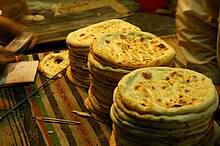
  • Daing (dinaing, padaing) − salted and dried, usually fish or seafood. Synonymous with tuyô, bulad or buwad in other Philippine languages
  • Giniling – ground meat. Sometimes used as a synonym for picadillo, especially in arroz a la cubana.
  • Guinataan (sa gata) − cooked with coconut milk.
  • Guisa (guisado, ginuisa) − sautéed with garlic and onions. Also spelled gisa, gisado, ginisa.
  • Hamonado (endulsado) – marinated or cooked in a sweet pineapple sauce. Sometimes synonymous with pininyahan or minatamis
  • Halabos (hinalabos) – mostly for shellfish. Steamed in their own juices and sometimes carbonated soda.
  • Halo-halo - made up of crushed ice, evaporated milk or condensed milk, and various ingredients including, ube, sweetened beans, coconut strips, sago (pearls), gulaman (gelatin), pinipig rice, boiled taro or soft yams in cubes, fruit slices, flan, and topped with a scoop of ube ice cream.
  • Hilaw (sariwa) – unripe (for fruits and vegetables), raw (for meats). Also used for uncooked food in general (as in lumpiang sariwa).
  • Hinurno – baked in an oven (pugon) or roasted.
  • Ihaw (inihaw) − grilled over coal. In Visayas, it is also known as sinugba; inasal refers to grilling meat on sticks.
  • Kinilaw or Kilawin − fish or seafood marinated in vinegar or calamansi juice along with garlic, onions, ginger, cucumber, peppers. Also means to eat raw or fresh, cognate of Hilaw.
  • Lechon (nilechon) − roasted on a spit. Also spelled litson.
  • Lumpia – savory food wrapped with an edible wrapper.
  • Minatamis (minatamisan) − sweetened. Similar to hamonado.
  • Nilaga (laga, palaga) − boiled/braised.
  • Nilasing − cooked with an alcoholic beverage like wine or beer.
  • Paksiw (pinaksiw) − cooked in vinegar.
  • Pancit (pansit, fideo) – noodle dishes, usually of Chinese Filipino origin.
  • Pangat (pinangat) − boiled in salted water/brine with fruit such as tomatoes or ripe mangoes.
  • Palaman (pinalaman, pinalamanan) − "filled" as in siopao, though "palaman" also refers to the filling in a sandwich.
  • Pinakbet (pakbet) − to cook with vegetables usually with sitaw (yardlong beans), calabaza, talong (eggplant), and ampalaya (bitter melon) among others and bagoong.
  • Pinakuluan – boiled.
  • Pininyahan – marinated or cooked with pineapples. Sometimes synonymous with hamonado.
  • Prito (pinirito) − fried or deep fried. From the Spanish frito.
  • Puto – steamed cakes, traditionally glutinous rice.
  • Relleno (relyeno) – stuffed.
  • Sarza (sarciado) – cooked with a thick sauce.
  • Sinangag – garlic fried rice.
  • Sisig - is a traditional food of Filipino specially partnered with beer. It made by different parts of pig.
  • Sigang (sinigang) − boiled in a sour broth usually with a tamarind base. Other common souring agents include guava, raw mangoes, calamansi also known as calamondin.
  • Tapa or Tinapa – dried and smoked. Tapa refers to meat treated in this manner, mostly marinated and then dried and fried afterwards. Tinapa meanwhile is almost exclusively associated with smoked fish.
  • Tapay – fermented with yeast, usually rice, traditionally in tapayan jars. Synonymous with buro in early phases. Can also refer to various products of fermented rice, including rice wines. A very briefly fermented glutinous rice version is known as galapong, which is an essential ingredient in Filipino kakanin (rice cakes). Cognate of tinapay (leavened bread).
  • Tosta (tinosta, tostado) – toasted.
  • Torta (tinorta, patorta) – in the northern Philippines, to cook with eggs in the manner of an omelette. In the southern Philippines, a general term for a small cake.

Beverages[edit]

Chilled drinks and shakes[edit]

A taho shake from Quezon City

Calamansi extract

Sago't gulaman in Ilonggo style

Chilled drinks are popular due to the tropical climate. Stands selling cold fruit drinks and fruit shakes are common in many of the city areas, where some are based on green mandarin orange (dalandan or dalanghita), pomelo (suha), pineapple (pinya), banana (saging), and soursop (guyabano). The shakes usually contain crushed ice, evaporated or condensed milk, and fruits like mango, avocado, cantaloupe, durian, papaya, strawberry and watermelon, to name a few.

Other chilled drinks include sago't gulaman, a flavored ice drink of pre-Hispanic Malay origin (Malay: gula melaka) with sago and agar gelatin with banana extract sometimes added to the accompanying syrup; fresh buko or coconut juice, the water or juice straight out of a young coconut via an inserted straw, a less fresh variation of which is from bottled coconut juice, scraped coconut flesh, sugar, and water; and kalamansi juice, the juice of kalamansi or Philippine limes usually sweetened with honey, syrup or sugar.

Brewed beverages[edit]

The Philippines is a predominantly coffee-drinking nation. One of the most popular variants of coffee coming from the mountains of Batangas is known as kapeng barako. Another well-known variant of coffee is the civet coffee. It is called kape motit in the Cordilleras, kape alamid in Tagalog region, and kape musang in Mindanao. The Kalinga coffee known for its organic production is also rapidly gaining popularity. Highlands coffee, or Benguet coffee, is a blend of Robusta and Excelsa beans.[50]

Even before the establishment of coffeehouses in the Philippines, coffee has been part of the Filipino meal. Carinderias would often serve them along with meals. The opening of Starbucks in 1997 paved the way for other coffee shops.[51]

Tea consumption in the Philippines is driven primarily by growing health consciousness amongst middle- to high-income consumers.[52] Tea is commonly prepared using Philippine wild tea or tea tree.[53] There are several known variations of tea using different additives. Pandan iced tea is one of these, made with pandan leaves and lemongrass (locally known as tanglad). Salabat, sometimes called ginger tea, is brewed from ginger root and usually served during the cold months, and when illnesses such as flu or sore throat strikes.

The late 2010s saw the opening of teahouses in major cities, and with a glass of milk tea being more affordable than the usual cold designer coffee, it paved the way into making tea a well-known food trend. Notable teahouse chains in the Philippines are Chatime and Serenitea.[54]

Tsokolate is the Filipino style of hot chocolate. It is traditionally made with tablea, which are pure cacao beans that are dried, roasted, ground and then formed into tablets.[55] It is also popular during Christmas season, particularly among children.

Alcoholic beverages[edit]

Further information: Beer in the Philippines and Philippine wine

There are a wide variety of alcoholic drinks in the Philippines manufactured by local breweries and distilleries. Red Horse is one of the most popular beer.

Traditional drinks

A bubblegum-flavored lambanog

A bottle of tapuy rice wine

Tuba (toddy) is a type of hard liquor made from fresh drippings extracted from a cut young stem of palm. The cutting of the palm stem usually done early in the morning by a mananguete, a person who climbs palm trees and extracts the tuba to supply to customers later in the day. The morning's accumulated palm juice or drippings are then harvested by noon, and brought to buyers then prepared for consumption. Sometimes this is done twice a day so that there are two harvests of tuba occurring first at noon-time and then in the late-afternoon. Normally, tuba has to be consumed right after the mananguete brings it over, or it becomes too sour to be consumed as a drink. Any remaining unconsumed tuba is then often stored in jars to ferment for several days and become palm vinegar. Tuba can be distilled to produce lambanog (arrack), a neutral liquor often noted for its relatively high alcohol content.

Lambanog is an alcoholic beverage commonly described as coconut wine or coconut vodka. The drink is distilled from the sap of the unopened coconut flower, and is known for its potency and high alcohol content (80 and 90 proof). Most of the Lambanog distilleries are in the Quezon province of Luzon, Philippines. Constant efforts at standardizing lambanog production has led to its better quality. Presently, lambanog is being exported to other countries and continues to win foreign customers over due to its natural ingredients as well as its potency.

Tapuy is a traditional Philippine alcoholic drink made from fermented glutinous rice. It is a clear wine of luxurious alcoholic taste, moderate sweetness and lingering finish. Its average alcohol content is 14% or 28 proof, and it does not contain any preservatives or sugar. To increase the awareness of tapuy, the Philippine Rice Research Institute has created a cookbook containing recipes and cocktails from famous Filipino chefs and bartenders, featuring tapuy as one of the ingredients.

Modern drinks

Beer or serbesa (from the Spanish "cerveza") is the most widely available alcoholic drink in the Philippines. San Miguel Pale Pilsen is the most popular and widely sold brand. Together with associated San Miguel beer brands such as San Mig Light and Gold Eagle Beer the company holds an aggregate market share of 92.7%.[56] Beer na Beer produced by local conglomerate Asia Brewery is another widely sold pale Pilsner style beer. Asia Brewery also produces under license and distributes a number of other mass market beers such as Colt 45, Asahi Super Dry, Heineken and Tiger Beer. Other beer labels include Red Horse Beer, Lone Star, Lone Star Light, Lone Star Ultra, Carlsberg, Coors Light, San Miguel Superdry, San Mig Strong Ice, and just recently, Manila Beer. Echoing trends in international markets, bars in urban areas have also begun to serve locally produced and imported craft beers in a variety of styles.

Rum is often associated with Tanduay.

Several gins, both local varieties like Ginebra San Miguel (as well as GSM Blue and GSM Premium Gin) and imported brands like Gilbey's, are commonly found. Some people refer to gin by the shape of the bottle: bilog for a circular bottle and kwatro kantos (literally meaning four corners) for a square or rectangular bottle. Gin is sometimes combined with other ingredients to come up with variations.

Desserts[edit]

Further information: List of Philippine desserts

A suman with latik syrup

A woman selling puto bumbong at the Nagcarlan Public Market in Laguna province

Shakoy (also known as lubid-lubid), a doughnut variant from the Visayas

As the Philippines is a tropical country, many desserts made from rice and coconuts. One often seen dessert is bibingka, a hot rice cake optionally topped with a pat of butter, slices of kesong puti (white cheese), itlog na maalat (salted duck eggs), and sometimes grated coconut. There are also glutinous rice sweets called biko made with sugar, butter, and coconut milk. In addition, there is a dessert known as bitsu-bitsu, also known as a Pinoy donut, made with fried rice flour which is then coated with Muscovado sugar syrup. There is also Karioka, made from glutinous rice flour, coconut, and coconut milk, fried and skewered and slathered with a brown sugar glaze. Another brown rice cake is kutsinta.

Puto is another well-known example of sweet steamed rice cakes prepared in many different sizes and colors. Sapin-sapin (sapin means layer) are three-layered, tri-colored sweets made with rice flour, purple yam, and coconut milk characterized by its gelatinous appearance. Palitaw are rice patties that are covered with sesame seeds, sugar, and coconut; pitsi-pitsi which are cassava patties coated with cheese or coconut; and tibok-tibok is based on carabao milk as a de leche (similar to maja blanca). As a snack, Binatog is created with corn kernels with shredded coconut. Packaged snacks wrapped in banana or palm leaves then steamed, suman are made from sticky rice. For cold desserts there is halo-halo, a dessert made with shaved ice, milk, and sugar, with additional ingredients like coconut, ube halaya (mashed purple yam) or ube ice cream, leche flan, plantains, jackfruit, red beans, tapioca and pinipig.

Other similar treats made with shaved ice include saba con yelo which is shaved ice served with milk and minatamis na saging (ripe plantains chopped and caramelized with brown sugar); mais con yelo which is shaved ice served with steamed corn kernels, sugar, and milk; and buko pandan sweetened grated strips of coconut with gulaman, milk, and the juice or extract from pandan leaves. Sorbetes (ice cream) is popular, as well, with some local versions utilizing coconut milk instead of cow milk. Ice candy, are popular frozen snacks usually made from fruit juice, chocolate or local ingredients such as mung beans and ube. It can be any kind of flavor depending on the maker; chocolate and buko (coconut) flavored ice candy are two of the most popular. Another dessert, often served during Christmas and New Year's Eve, is mango float,[57] a dessert composed of Graham cracker, mangoes, cream and milk, and created by layering them together in a dish and then refrigerating or blast chilling.

Regional dishes[edit]

Sapin-sapin, a sweet Filipino rice-based delicacy similar to mochi

Filipino cuisine prepared in Baliuag, Bulacan

The Philippine islands are home to various ethnic groups resulting in varied regional cuisines.

Luzon[edit]

Ilocanos from the mountainous Ilocos Region commonly have diets heavy in boiled or steamed vegetables and freshwater fish, and they are particularly fond of dishes that are bitter and salty. Many dishes are flavored with bagoong monamon, fermented fish that is often used as a substitute for salt. Ilocanos often season boiled vegetables with bugguong such as pinakbet. Local specialties include the soft white larvae of ants and "jumping salad" of tiny live shrimp.

The Igorot prefer roasted meats, particularly carabao meat, goat meat, and venison.

Due to its mild, sub-tropical climate, Baguio, along with the outlying mountainous regions, is renowned for its produce. Temperate-zone fruits and vegetables (strawberries being a notable example) which would otherwise wilt in lower regions are grown there. It is also known for a snack called sundot-kulangot which literally means "poke the booger." It is a sticky kind of sweet made from milled glutinous rice flour mixed with molasses, and served inside pitogo shells, and with a stick to "poke" its sticky substance with.

Isabela is known for Pancit Cabagan of Cabagan, Inatata & Binallay of Ilagan City are rice cakes prepared year-round in the city and both famous delicacies specially during the lenten season. Cagayan for its famous Carabao Milk Candy in the town Alcala and Tuguegarao City for Pancit Batil Patung and Buko Roll.

bangeladesh

Bangladeshi cuisine has been shaped by the region's history and river-line geography. Bangladesh has a tropical monsoon climate. The staple of Bangladesh is rice and fish.[1] The majority of Bangladeshi people are ethnic Bengali, accustomed to Bengali cuisine, with a minority of non-Bengalis, many used to cuisines from different traditions and regions.[2][3][4] Bangladeshi cooking features more meat dishes than the cuisine of neighbouring West Bengal, India.[5][6]

History[edit]

Bangladeshi culinary habits were strongly influenced by the cuisine of the area's Mughal rulers. This includes rich, aromatic dishes such as biriyani and korma that require the use of a large array of spices along with a great deal of ghee. Dhaka was the Mughal capital of the Bengal Subah and a major trading center in South Asia. Traders, immigrants and visitors brought culinary styles from around the world, which influenced the city's cuisine. After Dhaka became the capital of East Bengal, Persian, Turkish and Arabic-influenced dishes became popular.[7] Black pepper and chui jhal were used to add spiciness before chili was introduced from the Americas.[8]

Culinary style and influences[edit]

Rice is the staple food of Bangladesh,[1] while fish is the most common source of protein in Bangladesh.[1] There are 250 plant-based ingredients in Bangladeshi cooking.[1] The use of mustard oil is common.[5]

Specialties by region[edit]

Dhaka[edit]

Bakarkhani in Dhaka, Bangladesh

The culinary customs of the nation's capital have been influenced by Mughlai, Central Asian, Armenian, Hindustani and native Bengali cuisines. The city's cuisine also has unique local dishes.[9]

The Nawabs of Dhaka brought Mughlai cuisine to Bengal. Mughlai cuisine is often lavish and expensive, and was out of reach for many people up for many centuries, becoming more widespread as Bangladesh's economy grew. It is characterised by use of meat and dairy ingredients such as lamb, mutton, beef and yoghurt together with mild spices. Its dishes include kebab; stuffed breads; kacchi biriyani; roast lamb, duck, and chicken; patisapta; Kashmiri tea and korma are still served at special occasions like Eid and at weddings.[10][11][12]

Chowk Bazaar in Old Dhaka is a centuries-old food market and a focal point during Ramadan for the Iftar meal after sunset. [13][14][15]

Dhakaiya paratha is a multi-layered bread that found popularity in Kolkata when immigrants from Dhaka introduced it there following the Partition of India.[16]

Haji Biriyani

Haji biryani is a rice dish originating from a Dhaka restaurant of the same name. The dish consists of rice, goat meat and spices.[17][18][19][20][21]

Bakarkhani is a thick, spiced flat-bread from Mughlai cuisine often served with tea. Dhakai Bakarkhani is the variant found in Dhaka, where it has been prepared for centuries.[22][23]

Morog pulao is a signature dish of the city, an aromatic rice pilaf with chicken.[24][25]

Traditional meal: mustard seed Ilish curry, Dhakai biryani and pitha

Chittagong Division[edit]

In Chittagong and the surrounding region curries are generally highly spiced and often include beef.[26][27] Mejbani Gosht is a beef curry for special occasions;[28][27] a Mejban or Mezban is a communal feast.[27]

Mezban preparations

Beef dishes are popular with Bengali Muslims and often served at Mezban feasts, where they indicate prosperity.[28][29][27]

Hindus tend to cook with fish rather than beef. The Hindu community of Chittagong organises Mezban feasts each year as "Chittagong Parishad", with curries of fish and vegetables.[27]

Kala bhuna, blackened beef, is a dish from Chittagong[30][31] made of beef shoulder cooked with spices until dark and tender.[32][33]

Durus kura or duroos is a dish comprising a whole chicken cooked in thick broth, served with rice, either as polao or khichuri.[34][35] It also a part of Rohingya Cuisine.[36]

Akhni, also commonly known as Orosher Biriyani is a biriyani variant made with chinigura rice (an aromatic, short-grained rice). It contains cubes of beef or goat meat with potatoes and dried fruits.

Chittagong is near the coast and has several dishes using sea fish,[37] including rupchanda (silver pomfret) and loita (Bombay duck).[37] Shutki is cured and dried loita, a pungent delicacy typical of the region.[37] Churi (ribbonfish) is dried then cooked with chili and onions.[37] Koral/bhetki (barramundi) and giant tiger prawns from the Bay of Bengal are eaten in coastal regions.[37][38]

Chittagong Hill Tracts[edit]

The Chittagong Hill Tracts are home to tribes with their own culture and cuisine.[39][40] Chakma cuisine uses sidol, a paste made from fermented shrimps and fish, and suguni, dried shrimp or fish.[41] Their dishes use more herbs from the hills more than the spices common in Bengali dishes.[41] Important seasonal ingredients include wild mushrooms and the Flowers of ginger and turmeric plants.[41] Sumoh gorang is a dish cooked in bamboo and Hebaang is baked in banana leaves in a mud oven.[41] Marma cuisine uses a paste of dried fish called nappi.[4] Rice beer is a popular drink.[4]

Tribal food in Chittagong hill tracts

Greater Mymensingh[edit]

In Mymensingh doi yogurt is often combined with puffed or flattened rice.[42]

Monda is a sweet yogurt patty from Muktagachhar, first made in 1824.[43][44][45][46]

The Garo people are an ethnic and religious minority in Mymensingh region with their own unique culture and cuisine.[3][47] Their cuisine is notable for the use of pork, eel, and turtle meat.[3] The Garo brew liquor at home[3] and cook with soda and in bamboo.[48]

Northern Bangladesh[edit]

Northern Bangladesh has numerous dairy farms that produce yogurt (doi).[49] Yogurt is also made of evaporated milk which gives it a more intense taste, similar to kheer.[49] Biral Upazila is well known for large Koi fish[49] which are baked in banana leaves.[50] Catla fish is commonly cooked in doi yogurt.[49]

Bogra is well known nationally and internationally for its sweet curds.[51]

Bograr Doi (curd)

The Rangpur region has a beef dish cooked with pumpkin.[31]

The Santal people in the Rajshahi region[52] eat crab, pork, squirrel, and fish[52] and tend to use fewer spices in their cooking.[53] They produce an alcoholic drink from rice called hadia.[52] They make liquor using palm tree resin which is used for ritual ceremonies.[52]

Southern Bangladesh[edit]

Piper chaba is a fiery aromatic spice grown in South Bengal. It pre-dates the introduction of chilli from the Americas in the 16th century.[8][54][30][55] Its peeled and chopped stem and roots are added to meat and fish dishes.[56]

Barisal, a coastal region, uses coconut in cooking.[57]

Sylhet Division[edit]

Seven colour tea

Traditional Sylheti diet

The Sylhet area of Bangladesh has a number of characteristic dishes and ingredients. It is home to several citrus fruit varieties such as hatkora and thoikor, Adajamir or Ada Lebu, and Ashkul Lebu or Ashkoni Lebu that are commonly used in the region's fish and meat dishes. [58][59] [60][33][61] Although Ashkul Lebu or Ashkoni Lebu is unheard of amongst many Sylhetis due to lack of knowledge on it, and it is most likely to be nearly extinct; the juices of Ashkul Lebu is used to make Tenga or Khatta.

Rice dishes[edit]

Akhni is a mixed rice dish similar to biryani or polao, made with meat and/or vegetables.

Red and white Birin rice (also transliterated as Biroin or Bireen) is found only in the Sylhet region.[62] It is eaten in savoury and sweet dishes and is the main ingredient for Chunga Pitha, a traditional rice cake prepared by stuffing sticky rice inside young bamboo and smoking it slowly. The rice cake is removed from the tube and has the shape of a candle. The dish may also be made with milk, sugar, coconut, and rice powder.

Khichuri is a rice dish similar in consistency to porridge. During the holy month of Ramadan, it is served as a staple food for Iftar. It consists of aromatic rice mixed with spices, ghee, cumin and fenugreek. It is also offered to sick people mixed with ginger.

Meat dishes[edit]

Beef Hatkhora is a traditional festive dish of beef cooked with hatkora juice.

Aash Bash is a traditional dish using duck and bamboo shoots. It is also known as Aash ar Khoril.

Fish dishes[edit]

mashed vegetables

Fish is eaten both curried and fried. Dried and fermented fish called shutki also known by many locals of Sylhet as hutki or hukoin, and hatkora, a bitter and fragrant citrus fruit are used in fish curries. Extremely hot Naga Morich peppers are used in broths.[63]

Some local dishes incorporate hidol, a pungent chutney of dried fish matured in earthenware pots.[64] This includes Hutki Shira, a fish curry with vegetables.

Thoikor Tenga is a dish fish cooked with thoikor, a bitter citrus fruit that grows in the Sylhet region.

Other foods from Sylhet[edit]

Fob

Bakarkhani is a flatbread that resembles porota and is commonly eaten during Iftar, the evening meal during the month of Ramadan[65]

Handesh is a snack made of deep-fried dough sweetened with molasses or sugar. It is served on special occasions such as the festival of Eid al-Fitr.

Sylheti rice-cakes and dumplings

Nunor Bora is a savoury snack made of rice flour and with onion, ginger and turmeric, fried to a golden colour.

Tusha Shinni is a dessert halwa made from sweetened dough with nuts and raisins that is usually served on special occasions.

Seven Color Tea is a colourful drink with multiple different layers of flavoured tea.[66][67]

Bangladeshi-run restaurants in Great Britain[edit]

In the early 20th century sailors from Sylhet, known as Lascars, settled in the United Kingdom.[68] They bought fish and chip restaurants and developed them into full service Indian restaurants.[68] They based the cuisine offered there on that sold by established Anglo-Indian restaurants and on Mughal Cuisine.[68]

More than 8 out of 10 of over 8,000 "Indian restaurants" in the UK are owned by Bangladeshis,[33][69] 95% of who come from Sylhet.[70][71][72]

Culinary historian Lizzie Collingham wrote that

"Sylheti curry cooks converted “unadventurous British palates” to a new flavour spectrum".[73]

Sweets[edit]

Amriti is a flower-shaped deep-fried dessert in sugary syrup[74] that is popular in Dhaka and Tangail.[75][76]

Chomchom is a traditional sweet that originated in Porabari.[77][78] The sweet is oval and brown.

Boondi is popular during Ramadan.[79]

Balish Mishti (lit. pillow sweet) is a large pillow-shaped sweet from Natore District.[80]

Jilapi is a pretzel-shaped sweet in syrup that is popular throughout South Asia.[81] Shahi jilapi (royal jilapi) is a very large, pinwheel-shaped variant from Dhaka.[82]

Kachagolla is a dessert made of dairy ingredients and sugar that is from Natore District in Rajshahi Division.[83] It may have been presented to the 18th century ruler Rani Bhabani.[83][84]

Dessert made with the fruit of Palmyra palm

Ledikeni is a light fried reddish-brown ball made of chhena and flour, soaked in sugar syrup.[85] It was devised in the mid-19th century and named after Lady Canning, the wife of the Governor-General of India.[86][87]

Pantua is the Bengali version of gulab jamun.[88]

Ras malai is a dessert of balls of chhana milk solids in a cream sauce flavoured with cardamom.[89][90]

Taal, the fruit of the Palmyra palm is used in a variety of desserts.[91]

Dimer Jorda

Dimer Jorda is a Bangladeshi informal popular dish.

Beverages[edit]

  • Borhani, (Bengali: বোরহানী) is a traditional yogurt-like[92] drink[93] Borhani is made from sour doi, green chilli, mustard seeds, black salt, coriander and mint.[94] It is popular as a digestive after heavy meals[95] or as an appetizer beforehand.[96][97][98]
  • Taal er rosh (Palm juice) is the sap extracted from palm trees and drank as a cool beverage in summer.[99]
  • Rooh Afza is a concentrated squash made by Hamdard Bangladesh.[100]
  • Ghol and matha are buttermilk drinks made in Bangladesh, especially in the village of Solop in Ullahpara Upazila of Sirajganj District.[101]
  • Lassi is a blend of yogurt with water and either spices or sweet flavourings.[102]

Alcoholic beverages[edit]

As a majority Muslim country, alcohol sales in Bangladesh are controlled. A government permit is necessary to purchase alcoholic drinks.[103]

  • Hunter Beer is the only alcoholic beer produced in Bangladesh.[103] It is manufactured by Jamuna Group.[103]
  • Carew & Co is a government-owned distillery located in Chuadanga District.[103][104][105]
  • Non-Bengali tribes produce and consume alcohol from fermented rice.[106]

ukraine

Ukrainian cuisine is the collection of the various cooking traditions of the people of Ukraine, one of the largest and most populous European countries. It is heavily influenced by the rich dark soil (chornozem) from which its ingredients come, and often involves many components.[1] Traditional Ukrainian dishes often experience a complex heating process – "at first they are fried or boiled, and then stewed or baked. This is the most distinctive feature of Ukrainian cuisine".[2]

The national dish of Ukraine is red borscht, a well-known beet soup, of which many varieties exist. However, varenyky (boiled dumplings similar to pierogi) and a type of cabbage roll known as holubtsi are also national favourites, and are a common meal in traditional Ukrainian restaurants.[3] These dishes indicate the regional similarities within Eastern European cuisine.

The cuisine emphasizes the importance of wheat in particular, and grain in general, as the country is often referred to as the "breadbasket of Europe".[4] The majority of Ukrainian dishes descend from ancient peasant dishes based on plentiful grain resources such as rye, as well as staple vegetables such as potato, cabbages, mushrooms and beetroots. Ukrainian dishes incorporate both traditional Slavic techniques as well as other European techniques, a byproduct of years of foreign jurisdiction and influence. As there has been a significant Ukrainian diaspora over several centuries (for example, over a million Canadians have Ukrainian heritage), the cuisine is represented in European countries and those further afield, particularly Argentina, Brazil, and the United States.

Soups[edit]

Ukrainian borscht with smetana (sour cream)

  • Chervonyi borshch (red borscht; usually simply called borshch) is a vegetable soup made out of beets, cabbage, potatoes, tomatoes, carrots, onions, garlic, dill.[5][6] There are about 30 varieties of Ukrainian borscht.[6] It may include meat or fish.[5]
  • Zelenyi borshch (green borscht) or shchavlevyi borshch (sorrel soup): water or broth based soup with sorrel and various vegetables, served with chopped hard-boiled egg and sour cream. It is to be noted the word "borscht" is not implying beet's presence.
  • Hrechanyi sup: soup made with buckwheat, vegetables, and sometimes meat.
  • Kapusniak: soup made with pork, salo, cabbage, beans, and served with smetana (sour cream).
  • Rosolnyk: soup with pickled cucumbers.
  • Solianka: thick, spicy and sour soup made with meat, fish or mushrooms and various vegetables and pickles.
  • Yushka: clear soup; the most common variety - rybna yushka (fish yushka) is made from various types of fish such as carp, bream, wels catfish, or even ruffe. Another common variety is hrybna yushka (clear mushroom soup).

Salads and appetizers[edit]

Kholodets

  • Brynza or bryndza: white cow or sheep cheese from the Carpathians.
  • Kovbasa: various kinds of smoked or boiled pork, beef or chicken sausage. One specific variety is krovyanka, the blood sausage.
  • Salo: cured fatback. Usually served sliced, with pieces of bread, onion, and horseradish or hot mustard sauce. It may also be fried (shkvarky), or even boiled.
  • Kavyar or ikra: caviar, served on top of buttered slices of bread.
  • Kholodets: aspic (studenets) made with meat or fish (zalyvna ryba).
  • Olivier: salad made out of cooked and chopped potatoes, dill pickles, boiled chopped eggs, cooked and chopped chicken or ham, chopped onions, peas, mixed with mayonnaise.
  • Vinehret: salad with cooked and shredded beets, sauerkraut, cooked and chopped potatoes, onions, and carrots, sometimes pickles mixed with some sunflower oil and salt.

Bread and grain[edit]

Traditional Ukrainian paska

Bread and wheat products are important to Ukrainian cuisine. The country has been considered one of the traditional "breadbaskets" of the world.[7] Decorations on the top can be elaborate for celebrations.

  • Babka: Easter bread, usually a sweet dough with raisins and other dried fruit. It is usually baked in a tall, cylindrical form.
  • Bublyk: ring-shaped bread roll made from dough that has been boiled before baking. It is similar to bagel, but usually somewhat bigger and with a wider hole.
  • Kolach: ring-shaped bread typically served at Christmas and funerals. The dough is braided, often with three strands representing the Holy Trinity. The braid is then shaped into a circle (circle = kolo in Ukrainian) representing the circle of life and family.
  • Korovai: a round, braided bread, similar to the kolach. It is most often baked for weddings and its top decorated with birds and periwinkle.
  • Palianytsia: regular baked bread (famously difficult to pronounce for non-Ukrainian speakers).
  • Savory pampushky: soft, fluffy bread portions, or deep-fried pieces of dough, topped with garlic butter.
  • Paska: traditional rich pastry.

Main courses[edit]

Varenyky stuffed with meat, served with fried onions and sour cream

Smetannyk, a traditional Ukrainian dessert

  • Banush: a cornmeal stew.
  • Deruny: potato pancakes, usually served with sour cream.
  • Fish (ryba): fried in egg and flour; cooked in oven with mushrooms, cheese, and lemon; marinaded, dried or smoked variety.
  • Holubtsi: cabbage leaves, or sometimes vine leaves (fresh or preserved) rolled with rice or millet filling that may contain meat (minced beef or bacon), baked in oil and caramelized onions and may contain as a baking sauce tomato soup, cream or sour cream, bacon drippings or roasted with bacon strips on top.[8]
  • Huliash: refers to stew in general, or specifically Zakarpattian variety of Hungarian goulash.
  • Kasha: porridge, usually made out of buckwheat, wheat, barley, rye, millet, rice, oat, or corn. One specific variety is kasha hrechana zi shkvarkamy (buckwheat cereal with fried pork rinds and onion).
  • Kartoplianyky: fried balls of potato mash with flour and eggs; may have a filling.
  • Kotlety or sichenyky (cutlets, meatballs): minced meat or fish mixed with onions, raw eggs, breadcrumbs or bread, and sometimes garlic and milk, fried in oil and sometimes rolled in breadcrumbs.
  • Kotleta po-kyivsky: Kyiv-style chicken cutlet filled with butter and fresh herbs.
  • Kruchenyky or zavyvantsi: pork or beef rolls with various stuffing: mushrooms, onions, eggs,[9] cheese, prunes, sauerkraut, carrots, etc.
  • Mlyntsi: thin pancakes, similar to French crêpes. Stuffed mlyntsi are called nalysnyky, and they are usually filled with quark, meat, cabbage, or fruits, and served with sour cream.
  • Potato (kartoplia, also dialectally barabolia, bulba, krumplia, mandeburka): young or peeled, served with butter, sour cream, dill; a more exclusive variety includes raw egg. May be boiled, fried, baked, or mashed.
  • Pyrizhky: baked buns stuffed with different fillings, such as ground meat, liver, eggs, rice, onions, fried cabbage or sauerkraut, quark, cherries etc.
  • Pyrih: a big pie with various fillings.
  • Roast meat (pechenia): pork, veal, beef or lamb roast.
  • Smazhenyna: fried meat.
  • Stuffed duck or goose with apples.
  • Varenyky: dumplings made with fillings[5][6] such as mashed potatoes and fried onions, boiled ground meat and fried onions, liver and fried onions, fried cabbage with fried onions, quark, cherries, and strawberries. Served with sour cream and butter or sugar, when filled with fruits.
  • Deruny in a traditional crockery dish.

    Deruny in a traditional crockery dish.

  • Kotleta po-kyivsky (Kyiv-style chicken)

    Kotleta po-kyivsky (Kyiv-style chicken)

Desserts[edit]

For a more comprehensive list, see List of Ukrainian desserts.

  • Kutia: traditional Christmas dish, made of poppy seeds, wheat, nuts, honey, and delicacies.[10]
  • Kyiv cake: creamy dessert consisting of two layers of meringue with hazelnuts and a buttercream filling.
  • Molozyvo: dish made by baking a beestings and egg mixture.
  • Sweet pampushky: sweet dough similar to doughnut holes. Frequently tossed with sugar. Traditionally filled with rose preserve, but can also be filled with poppy seed or other sweet fillings.
  • Pinnyk: berry mousse.
  • Ptashyne moloko (literally: bird's milk): milk soufflé with chocolate coating.
  • Syrnyky: fried quark fritters, sometimes with raisins, served with sour cream, jam (varennya), honey or apple sauce.
  • Tort: many varieties of cakes, from moist to puffy, most typical ones being Kyivskyi, Prazhskyi, and Trufelnyi. They are frequently made without flour, instead using ground walnuts or almonds.
  • Varennia: a whole fruit preserve made by cooking berries and other fruits in sugar syrup.
  • Vatrushka: pastry with sweet quark filling.
  • Verhuny: crispy deep-fried pastry, similar to angel wings.
  • Zhele: (plural and singular): jellied fruits, like cherries, pears, etc.
  • Kutia

    Kutia

  • Syrnyky with raisins

    Syrnyky with raisins

Beverages[edit]

Mead

Alcoholic[edit]

  • Horilka (горілка): strong spirit of industrial production or its home-made equivalent – samohon (самогон or moonshine) is also popular, including with infusions of fruit, spices, herbs or hot peppers. One of the most exotic is flavoured with honey and red pepper.
  • Beer (пиво, pyvo): the largest producers of beer are Obolon, Lvivske, Chernihivske, Slavutych, Sarmat, and Rogan, which partly export their products.
  • Wine (вино, vyno): from Europe and Ukraine (particularly from Crimea), mostly sweet. See Ukrainian wine.
  • Mead (мед, med, or медуха, medukha): a fermented alcoholic beverage made from honey, water, and yeast. Its flavour depends on the plants frequented by the honeybees, the length of time and method of aging, and the specific strain of yeast used. Its alcohol content will vary from maker to maker depending on the method of production.
  • Nalyvka (наливка): a homemade wine made from cherries, raspberries, gooseberries, bilberries, blackberries, plums, blackthorns or other berries. Berries were put into a sulija (a big glass bottle), some sugar was added. After the berries fermented, the liquid was separated from the berries, and put into corked bottles. The berries were used to make pyrizhky (baked or fried pastry). The wine has about 15% of alcohol.

Non-alcoholic[edit]

Ryazhanka

  • Mineral water: well-known brands are Truskavetska, Morshynska, and Myrhorodska. They usually come strongly carbonated.
  • Kompot (компот): a sweet beverage made of dried or fresh fruits or berries boiled in water.
  • Uzvar (узвар): a specific type of kompot made of dried fruit, usually apples, pears, and/or prunes. Traditionally served on Christmas.
  • Kysil (кисіль): a kompot that is thickened with potato starch.
  • Kvas (квас): a sweet-and-sour sparkling beverage brewed from yeast, sugar, and dried rye bread.
  • Kefir (кефір):[5] milk fermented by both yeast and lactobacillus bacteria, that has a similar taste to yogurt. Homemade kefir may contain a slight amount of alcohol.
  • Pryazhene moloko (пряжене молоко): baked milk, a milk product that has a creamy colour and a light caramel flavour. It is made by simmering milk on low heat for at least eight hours.
  • Ryazhanka (ряжанка): fermented baked milk.
  • Syta (сита): water with honey.

somalia

Somali cuisine was influenced by many different countries mainly due to trade, but traditionally also varies from region to region due to the expansive landmass Somalis inhabit.[1] It is the product of Somalia's tradition of trade and commerce. Some notable Somali specialties include kimis/sabaayad, canjeero/lahoh, xalwo (halwa), sambuusa (samosa), bariis iskukaris, and muqmad/odkac.

Pork consumption is forbidden to Muslims in Somalia, in accordance with Sharia, the Islamic law.

Breakfast[edit]

Breakfast (quraac) is an important meal for Somalis, who often start the day with Somali-style tea (shaah/shaax) or coffee (qaxwa). The tea, brewed from black tea leaves, can be served regularly as-is (shaah rinji or shaah bigays). It can be also flavoured with spices such as ginger, cardamom and cinnamon (though black pepper is not used, unlike other spiced teas), while milk is added after the brewing instead of during it; this is known as shaah cadeeys.[2]

The main dish is typically a pancake-like bread called a canjeero or lahoh originating in Somalia[3][4] and is eaten in different ways. It is often eaten along with honey and ghee, olive oil, or sesame oil, and washed down with a cup of tea. It may also be broken into small pieces with Somali ghee (subag) and sugar. For children, it is mixed with tea and sesame oil or olive oil (macsaro) until mushy. Typically, there is a side dish of liver (usually beef), goat meat (hilib ari), diced beef cooked in a bed of soup (suqaar), or odkac, which consists of small dried pieces of beef, goat or camel meat, boiled in ghee. Different from Ethiopian injera, Somali canjeero is smaller, thinner and sweeter. It might also be eaten with a stew (maraq) or soup.[5]

  • Sabaayad or kimis/cesh is another type of flatbread which is similar to the Desi paratha. During lunch, kimis/sabaayad is sometimes consumed with Somali curry, soup, or stew.
  • Muufo[6] is another type of Somali flatbread popular within south Somalia and is usually eaten with stews and soup but is also sometimes eaten at breakfast with honey or sugar, subag, and black tea.
  • Mushaari or boorash (porridge), with butter, nuts and sugar, is eaten across Somalia.
  • Nationally, a sweeter and greasy version of canjeero, similar to a crepe known as malawax or malawah, is a staple of most home-cooked meals and is usually eaten for breakfast with tea, similarly to how canjeero is eaten.

Lunch[edit]

Baasto (pasta) made of spaghetti and digaag (chicken) take-out from a Somali restaurant

Lunch (qado) is often an elaborate main dish of laxoox, pasta (baasto) or rice (Bariis iskukaris) spiced with cumin (kamuun), cardamom (heyl), cloves (dhegayare), and sage (Salvia somalensis). The use of pasta (baasto), such as spaghetti,[7] comes from the Italians, though it is frequently accompanied by a heavier stew than pasta sauce. As with the rice, it is often served with a banana.

Spaghetti can also be served with rice, forming a novelty dish referred to as "federation". The dish is usually served with equal (whole) portions of rice and spaghetti, split on either side of a large oval plate. It is then layered with assorted stewed meats and vegetables, served with salad and an optional banana. It has been suggested that the name of the dish is derived from the union of two dishes in Somalia and also from the size and quantity of the food. It is more common to order the dish from traditional Somali restaurants, where both rice and spaghetti are always readily available; it is rare in Somali households to prepare both rice and pasta for the same meal.

In Somalia, many people eat some Arab cuisines such as ful (fava beans) with kimis or canjeero, also with hummus. Other dishes include falafel with hummus or are eaten with pita bread, salad and hummus (like a sandwich).

Another popular dish in the south is iskukaris, a hot pot (maraq) of rice, vegetables and meat, a national staple. Beyond the many styles of hot pot, rice is usually served with a banana on the side. In Mogadishu, steak (busteeki) and fish (kalluun/mallaay) are widely eaten.

Southern Somalis commonly consume a stiff cornmeal referred to as "soor", which is usually eaten alongside stews or soup.

Another commonly eaten cornmeal is eaten called asida. It is mashed with fresh milk, butter and sugar, or presented with a hole in the middle filled with maraq, or olive oil.

Bariis iskukaris, a Somali camel meat and rice dish

A variation of flat bread is sabaayad/kimis/cesh. Like the rice, is served with maraq and meat on the side. The sabaayad of Somalia is often somewhat sweet, and is cooked in a little oil.

Popular drinks at lunch are balbeelmo (grapefruit), raqey (tamarind) and isbarmuunto (lemonade). In Mogadishu, fiimto (Vimto) and laas (lassi) are also common. In the northwest, the preferred drinks are cambe (mango) (guava) and tufaax (apple).

Bariis iskukaris is also popular, a rice dish cooked and fried with onions, meat, then mixed with a Somali spice mixture called xawaash which contains cumin, coriander, turmeric, cardamon, black pepper, cloves, and nutmeg. It is traditionally served at Somali weddings.

Dinner[edit]

A bag of traditional Somali cambuulo (azuki beans)

Dinner (casho) in Somalia is served as late as 9 pm. During Ramadan, dinnertime often follows Tarawih prayers, sometimes as late as 11 pm. Cambuulo, a common dinner dish, is made from well-cooked adzuki beans mixed with butter and sugar. The beans, which on their own are referred to as digir, can take up to five hours to finish cooking when left on the stove at a low temperature. Qamadi (wheat) is also used; cracked or uncracked, it is cooked and served just like the azuki beans.

Rooti iyo xalwo, slices of bread served with a gelatinous confection, is another dinner dish. Muufo, a variation of cornbread, is a dish made of maize and is baked in a tinaar (clay oven). It is eaten by cutting it into small pieces, topped with sesame oil (macsaro) and sugar, then mashed together with black tea.

Before sleeping, a glass of milk spiced with cardamom is often consumed.

Snacks[edit]

Somali sambuusas (samosas) being prepared

Sambusa, the Somali variation of the Desi samosa, is a triangular snack that is commonly eaten throughout Somalia during the afur (iftar). Kebab is a snack eaten in western Somalia. There are several varieties of this dish. For instance, it may be served on sticks or skewers with vegetables. Another common variety consists of minced meat mixed with egg and flour then fried is popular in south Somalia. It resembles kofta kebab. Other snacks eaten include chicken and vegetable filled rolls and bajiyo, which is made from black-eyed peas or adzuki beans and usually served with spicy sauce. These along with samosas are very popular, not only during Ramadan, but also in special occasions such as weddings and family gatherings. Homemade chips are made with fresh potato and some black pepper. Fruits, such as mango (cambo), guava (seytuun), banana (moos), and orange (liinbanbeelmo) are eaten throughout the day.

Sweets[edit]

Gashaato, a coconut-based confection

Xalwo (halwo) or halva is a staple of Somali cuisine.

  • Xalwo or halwo (not comparable to the well-known halva) is a popular Benadiri snack confection served during special occasions,[8] such as Eid celebrations or wedding receptions. Xalwo is made from sugar, cornstarch, cardamom powder, nutmeg powder, and ghee. Peanuts are also sometimes added to enhance texture and flavor.[9] In the south there is a rice pudding called ruz bil laban.
  • Gashaato, kashaato or qumbe, made from coconut, sugar and oil, which is spiced with cardamom, is a much-loved sweet.From [[Benadir The sugar is brought to a boil with a bit of water, then the cardamom is added, followed by shredded coconut.
  • Lows iyo sisin is a favorite sweet in the south. It consists of a mixture of peanuts (lows) and sesame seeds (sisin) in a bed of caramel. The confection sticks together to form a bar.
  • Jallaato, similar to the American ice pop, is made by freezing naturally sweet fruits with a stick in the middle. More recently in Mogadishu (Xamar), it has grown to include caano jallaato, which is made with milk and requires sugaring up. The word jallaato comes from gelato, which is Italian for "frozen".
  • Buskut or buskud is also from the south comprises many different types of cookies, including very soft ones called daardaar (literally "touch-touch" due to its smooth, delicate texture).
  • Doolshe encompasses many styles of cakes.
  • Icun is a sweet mostly eaten by southern Somalis. It is made from sugar and flour mixed with oil and is most frequently served at weddings and for Eid.
  • Shushumow is a fried Somali pastry with a crystallised shell which is usually made as a party snack.
  • Basbousa is a traditional Somali sweet cake of Arab influence.[10] It is made from cooked semolina or farina soaked in simple syrup.
  • Also in the north there is lokma, a sweet fried-dough pastry.
  • Baklava is also eaten by some Somalis.

There are many sweets eaten during festive occasions, such as weddings, parties or Eid. Among these are baalbaaloow, shuushuumoow, bur hindi, bur tuug, and qumbe (coconut), the last of which is made from coconuts mixed with sugar to form a bar.

After-meal[edit]

A dabqaad incense burner

Somalis traditionally perfume their homes after meals. Frankincense (luubaan) or a prepared incense (uunsi) is placed on top of hot charcoal inside an incense burner or censer (a dabqaad) or idin.[11] It then burns for about ten minutes. This keeps the house fragrant for hours. The burner is made from soapstone found in specific areas of Somalia.

south sudan

South Sudanese cuisine is based on grains (maize, sorghum). It uses yams, potatoes, vegetables, legumes (beans, lentil, peanuts), meat (goat, mutton, chicken and fish near the rivers and lakes), okra and fruit as well. Meat is boiled, grilled or dried.[1]

South Sudanese cuisine was influenced by Arab cuisine.[2]

Examples of South Sudanese dishes[edit]

  • Kisra, sorghum pancake, national dish[3][4][5][6]
  • Mandazi, fried pastry[7][8]
  • Wala-wala, millet porridge[4][5]
  • Aseeda, sorghum porridge[1]
  • Gurassa, yeasted pancake[1][9]
  • Kajaik, fish stew[1][6]
  • Ful sudani, peanut sweet[1]
  • Tamia, falafel[5][10]
  • Ful medames[1][11]
  • Combo, dish from spinach, peanut butter and tomatoes[5][12]
  • Goat meat soup[4][5]
  • Molokhia[2][13]

South Sudanese drinks[edit]

  • Coffee[1]
  • Karkade[1]
  • Southern Sudan Beverages Limited, the only brewery in South Sudan, went bankrupt in 2016. It made three types of beer, like White Bull Lager.[1][14]

References[edit]

  1. ^ Jump up to:a b c d e f g h i "Eating and sleeping - South Sudan - Africa - Destinations | Bradt Travel Guides". www.bradtguides.com. Retrieved 2020-03-07.
  2. ^ Jump up to:a b https://www.tasteofsouthsudan.com/south-sudan-culture/[dead link]
  3. ^ "Kisra | Traditional Flatbread From Sudan | TasteAtlas". www.tasteatlas.com. Retrieved 2020-03-07.
  4. ^ Jump up to:a b c "About the Food of South Sudan | Global Table Adventure". Retrieved 2020-03-07.
  5. ^ Jump up to:a b c d e "South Sudan food and drink guide". World Travel Guide. Retrieved 2020-03-07.
  6. ^ Jump up to:a b "Traditional Food In Sudan". Trip101. 2019-01-18. Retrieved 2020-03-07.
  7. ^ Lovell-Hoare, Sophie; Lovell-Hoare, Max (2013). South Sudan. Bradt Travel Guides. ISBN 978-1-84162-466-2.
  8. ^ "Mandazi Recipe". SparkRecipes. Retrieved 2020-03-07.
  9. ^ Lovell-Hoare, Sophie; Lovell-Hoare, Max (2013). South Sudan. Bradt Travel Guides. ISBN 978-1-84162-466-2.
  10. ^ "Tamia | Okus doma". Tamia | Okus doma. Retrieved 2020-03-07.
  11. ^ Recipe, Salata Aswad be Zabadi; recette; says, receta-Inside Africa (2014-04-16). "South Sudan: Salata Aswad be Zabadi". 196 flavors. Retrieved 2020-03-07.
  12. ^ "Peanut Stew with Beef & Spinach | Combo | Global Table Adventure". Retrieved 2020-03-07.
  13. ^ "Best Molokhia; Egyptian Mulukhia". Amira's Pantry. 2019-09-20. Retrieved 2020-03-07.
  14. ^ "SSBL to stops producing White Bull in South Sudan". hotinjuba.com. 14 January 2016. Retrieved 2020-03-07.

hide

  • v
  • t
  • e

African cuisine

National cuisines

  • Algeria
  • Angola
  • Benin
  • Botswana
  • Burkina Faso
  • Burundi
  • Cameroon
  • Cape Verde
  • Central African Republic
  • Chad
  • Comoros
  • Democratic Republic of the Congo
  • Djibouti
  • Egypt
  • Equatorial Guinea
  • Eritrea
  • Eswatini (Swaziland)
  • Ethiopia
  • Gabon
  • Gambia
  • Ghana
  • Guinea
  • Guinea-Bissau
  • Ivory Coast
  • Kenya
  • Lesotho
  • Liberia
  • Libya
  • Madagascar
  • Malawi
  • Mali
  • Mauritania
  • Mauritius
  • Morocco
  • Mozambique
  • Namibia
  • Niger
  • Nigeria
  • Republic of the Congo
  • Rwanda
  • Saint Helena
  • São Tomé and Príncipe
  • Senegal
  • Seychelles
  • Sierra Leone
  • Somalia
  • South Africa
  • South Sudan
  • Sudan
  • Tanzania
  • Togo
  • Tunisia
  • Uganda
  • Western Sahara
  • Zambia
  • Zimbabwe

Ethnic and regional cuisines

  • Arab
  • Berber
  • Jewish
    • Ethiopian
    • Mizrahi
    • Sephardi
  • Maghrebi
  • Mediterranean
  • West African
  • Zanzibar

Lists

  • List of African cuisines
  • List of African dishes
  • Category

afghinistan

Afghan cuisine is influenced to a certain extent by Persian, Central Asian and Indian cuisines due to Afghanistan's close proximity and cultural ties.[1][2] The cuisine is halal and mainly based on mutton, beef, poultry and fish with rice and Afghan bread. Accompanying these are common vegetables and dairy products, such as milk, yogurt, and whey,[3] and fresh and dried fruits such as apples, apricots, grapes, bananas, oranges, plums, pomegranates, sweet melons, and raisins.[4] The diet of most Afghans revolves around rice-based dishes, while various forms of naan are consumed with most meals.[5] Tea is generally consumed daily in large quantities, and is a major part of hospitality.[6] The culinary specialties reflect the nation's ethnic and geographic diversity. The national dish of Afghanistan is Kabuli palaw, a rice dish cooked with raisins, carrots, nuts, and lamb or beef.[7]

Background[edit]

Location of Afghanistan in Asia

The cuisine of Afghanistan is halal and has elements from various places, for example garam masala from India, coriander and mint from Iran, dumplings and noodles from Uzbekistan and Xinjiang, China, and baklava from Turkey.[8][9] The similarities can be seen in the use of spices like cumin and cinnamon (as in Indian cuisine), green cardamom flavors (as in Chinese tea), and kebabs and yoghurts (as in Turkish and Arab cuisines).[10]

Staple foods[edit]

Rice[edit]

Afghan Kabuli palaw

Rice with kofta (meatballs) and corn

Rice is a core staple food in Afghan cuisine and the most important part of any meal.[9] Biryani is one of the less popular rice dishes in Afghanistan. It is consumed mostly in cities closer to neighboring Pakistan, such as Kandahar, Jalalabad and Khost. Challow, or white rice cooked with mild spices,[11] is served mainly with qormas (korma: stews or casseroles). Palaw is cooked similarly to challow, but a combination of meat, stock, qorma, and herbs are also mixed in before baking, resulting in the elaborate colors, flavors, and aromas from which the rice got its name. Sometimes caramelized sugar is used to give the rice a rich brown color. Examples of palaw include:

  • Kabuli palaw (the national dish[7]) – meat and stock are added, plus a topping of fried raisins, slivered carrots, and pistachios
  • Yakhni palaw – meat and stock are added to give the rice a brown color
  • Zamarod palaw – spinach qorma is mixed in before the baking process, hence zamarod, meaning "emerald"
  • Bore palaw – lawand is added giving the rice a yellow color
  • Landi palaw – a traditional meal of rice (with stock made from chicken or mutton that has been salted and dried in the sun)
  • Bonjan-e-roomi palaw – bonjan-e-roomi (tomato qorma) is added during baking giving the rice a red color
  • Serkah palaw – similar to yakhni pulao, but with vinegar and other spices
  • Shibet palaw – fresh dill and raisins are added during baking
  • Narenj palaw – a sweet elaborate rice dish made with saffron, orange peel, pistachios, almonds, and chicken
  • Maash palaw – a strictly vegetarian sweet-and-sour pilaf baked with mung beans, apricots, and bulgur wheat
  • Alou balou palaw – a sweet rice dish with plums and chicken

Afghan bread[edit]

This section is in list format but may read better as prose. You can help by converting this section, if appropriate. Editing help is available. (February 2022)

Naan (bread) from a local baker, the most widely consumed bread in Afghanistan

Afghan bread is flat and cooked in a tanoor or tandoor (a vertical ground clay oven). The bread is slapped onto a stone wall to cook. Tabakhai is a flatbread cooked on a flat upside-down pan.

Major dishes[edit]

Steamed dumplings[edit]

Mantu in a steamer before cooking

Afghan aushak

There is a wide variety of dumplings. Known under the name khameerbob and often eaten as dumplings, these native dishes are popular. Due to the long time required to make the dough for the dumplings, they are rarely served at large gatherings, such as weddings. They are instead served on special occasions at home.[citation needed]

  • Aushak – dumplings filled with a mixture consisting mainly of leeks, topped with either garlic-mint qoroot or a garlic yogurt sauce, sautéed tomatoes, red kidney beans, and a well-seasoned ground-meat mixture (It is a dish associated with Kabul, the capital of Afghanistan.)
  • Mantu – steamed dumplings filled with onion and ground beef or lamb, usually topped with a tomato- and yogurt- or qoroot-based sauce and then garnished with dried mint and coriander (The yogurt-based topping is usually a mixture of yogurt, garlic, and split chickpeas. The qoroot-based sauce is made of goat's cheese and also mixed with garlic; a qoroot and yogurt mixture will sometimes be used.)

Qormah[edit]

This section is in list format but may read better as prose. You can help by converting this section, if appropriate. Editing help is available. (February 2022)

Qormah (also spelled "korma" or "qorma") is an onion- and tomato-based stew or casserole usually served with challow rice.[3] First, onion is caramelized, for a richly colored stew. Then tomato is added, along with a variety of fruits, spices, and vegetables, depending on the recipe. The main ingredient, which can be meat or other vegetables, is added last. There are hundreds of different types of qormahs including:

  • Qormah e gosht (meat qormah) – usually the main qormah served with palaw at gatherings
  • Qormah e alou-bokhara wa dalnakhod – onion-based using veal or chicken, sour plums, lentils, and cardamom
  • Qormah e nadroo – onion-based, using lamb meat or veal, yogurt, lotus roots, cilantro, and coriander
  • Qormah e lawand – onion-based, using chicken, lamb, or beef, plus yogurt, turmeric, and cilantro
  • Qormah e sabzi – lamb, sautéed spinach, and other greens
  • Qormah e shalgham – onion-based using lamb, turnips, and sugar (sweet and sour taste)

Kabob[edit]

Kofta kabob with naan

Afghan kabob is most often found in restaurants and at outdoor street vendor stalls. Most of the time, it contains lamb meat. Kabob is made with naan instead of rice. Customers have the option to sprinkle sumac or ghora (dried ground sour grapes) on their kabob. Pieces of fat from the sheep's tail (jijeq) are usually added to the skewers to add extra flavor.

Chopan kabob being prepared

Other popular kabobs include the lamb chop, ribs, kofta (ground beef), and chicken.

Chapli kebab, a specialty of eastern Afghanistan, is a patty of minced beef. It is a popular barbecue meal in both Pakistan and Afghanistan. It is prepared flat and round and served with naan. The original recipe of chapli kabob dictates a half-meat, half-flour mixture which renders it lighter in taste and less expensive.

Chicken[edit]

Afghan chicken or murgh-e is a classic example of one of the most famous dishes of Afghanistan. Chicken dishes are usually found in restaurants and at outdoor street vendor stalls. Unlike in the Indian cooking style, chicken in Afghan cuisine is often used with the intention that it be halal. Cream, butter, and curd are customary ingredients in all chicken recipes, whether served as an appetizer or a main course.

Quroot[edit]

Quroot (or qoroot) is a reconstituted dairy product, traditionally a by-product of butter made from sheep's or goat's milk. The residual buttermilk remaining after churning butter is soured further (by keeping it at room temperature for a few days), treated with salt, and then eventually boiled. The precipitated casein is filtered through cheesecloth, pressed in order to remove liquid, and then shaped into balls; the product is thus a hard and very sour cottage cheese. Though it can be eaten raw as a savory snack, it is typically served with cooked Afghan dishes such as aushak, mantu, and kichri qoroot.

Miscellaneous[edit]

This section is in list format but may read better as prose. You can help by converting this section, if appropriate. Editing help is available. (February 2022)

A table setting of Afghan food in Kabul

Badenjan (eggplant) is usually served for lunch as a light meal or as a side dish. It tastes best with freshly baked bread along with sour minted yogurt. Shomleh/shlombeh (a cold drink made of yogurt that is sprinkled with fresh or dried mint).

Afghan men eating at a lunchtime feast in Kunar Weleyat

  • Afghan burger
  • Afghan Chatni[12] made with fresh coriander leaves
  • Afghan Kofta (meatballs)[13]
  • Afghan salad
  • Aush (hand-made noodles)
  • Baamiyah or Bhindi (cooked okra)
  • Badenjan (cooked eggplant with potatoes and tomatoes)
  • Badenjan-Burani (fried slices of eggplant, topped with a garlic sour cream sauce and sprinkled with dried mint)
  • Badenjan Salad (eggplant salad with garlic)
  • Bichak (small turnovers with various fillings, including potato and herbs, or ground meat)
  • Bolani also called “Buregian” in southern Afghanistan (somewhat similar to a quesadilla)
  • Chakida or chakka (type of sour cream)
  • Chopan (Pashto/Persian: چوپان, meaning "shepherd") kabob (Pashto/Persian: کباب) (skewered lamb chops grilled on charcoal)
  • Dampukht (steamed rice)
  • Delda or Oagra (mainly a Southern dish, whose main ingredient is a mixture of split wheat and a variety of beans)
  • Dolma (stuffed grape leaves)
  • Gosh e feel (thin, fried pastries covered in powdered sugar and ground pistachios)
  • Halwaua-e-Aurd-e-Sujee
  • Kaddo Borwani (sweet pumpkins)[1]
  • Kalah Chuquki or Kalah Gunjeshk (battered deep-fried bird heads)
  • Kalah Pacha (lamb or beef head/feet cooked in a broth, served in bowls as a soup dish or in a stew or curry)
  • Kebab (similar to Middle Eastern and Central Asian style)
  • Khoujoor[14] (Afghan pastry, deep-fried, oval-shaped, similar to doughnuts in taste)
  • Kichri (sticky medium-grain rice cooked with mung beans and onions)
  • Londi, or gusht-e-qaaq (spiced jerky)
  • Maast or labanyat (type of plain yogurt)
  • Maushawa (mixed beans and tiny meatballs, served in a bowl)
  • Moraba (fruit preserves, sugar syrup and fruits, apple, sour cherry, or various berries, or made with dried fruits. "Afghan favorite is the Alu-Bakhara".)
  • Nargis kabob (egg-based angel hair pasta soaked in sugar syrup, wrapped around a piece of meat)
  • Narenge Palau (dried sweet orange peel and green raisins with a variety of nuts, mixed with yellow rice glazed with light sugar syrup)
  • Osh Pyozee (stuffed onion)
  • Owmach (made from flour; a soup-like dish, very thick and pasty)
  • Salata (tomato and onion-based salad, often incorporating cucumber)
  • Rosh (cooked lamb and mutton with no spices)[15]
  • Shami kabob (cooked beef blended with spices, flour, and eggs, and rolled into hot dog shapes or flat round shapes and fried)
  • Shola Ghorbandi
  • Shor-Nakhood (chickpeas with special toppings)
  • Torshi (eggplant and carrot mixed with other herbs and spices, pickled in vinegar and aged)
  • Bolani

    Bolani

  • Cooked okra is also served for lunch or as a side dish

    Cooked okra is also served for lunch or as a side dish

  • Afghan lamb kebab with yellow saffron rice

    Afghan lamb kebab with yellow saffron rice

  • Roasted chicken

    Roasted chicken

  • Samples of some native Afghan fruits

    Samples of some native Afghan fruits

Desserts and snacks[edit]

Samples of Afghan fresh and dried fruits

As a desert after a meal, most Afghans generally eat fresh fruit. For snacks, they may drink tea with something sweet like cakes, cookies or pastries. On occasions, they also eat dried fruits which are widely available in every Afghan market. Other typical desserts include the following:

  • Afghan cake (similar to pound cake, sometimes with real fruit or jelly inside)
  • Baklava (pastry)
  • Bastani
  • Cream roll (pastry)
  • Falooda or Faloodeh
  • Firini[16]
  • Fernea, sometimes spelled feereny, (milk and cornstarch help make this very sweet, similar to rice pudding without the rice)
  • Kolcha (variety of cookies, baked in clay ovens with charcoal)
  • Sheer yakh, a traditional wet ice cream
  • Sheer khurma, a traditional dessert
  • Sheer berinj (rice pudding)

Soups[edit]

This section is in list format but may read better as prose. You can help by converting this section, if appropriate. Editing help is available. (February 2022)

  • Shorba (Afghan soup similar to borscht)
  • Shorwa-E-Tarkari[17] (meat and vegetable soup)
  • Peyawa or Eshkana (a soup based on flour, similar to a gravy, but mixed with chopped onion, potatoes, and eggs)
  • Aushe Sarka (vinegar-based flat noodle soup)

Drinks[edit]

Chai[edit]

Village elders and US special forces drinking Afghan green tea in 2007

Chai is tea in Afghanistan, which can either be green or black. It is consumed at all times, especially a short time after finishing a meal or with guests during any social gathering. Most people drink green tea with no sugar. Some add cardamom, saffron, or sugar.

Sheer chai (which translates from "milk tea") is also consumed but mostly in the morning and on special occasions. It is a type of Kashmiri chai. Many people of Afghanistan also drink masala chai, particularly in cities such as Asadabad, Jalalabad, Khost and Kandahar.

Doogh[edit]

Doogh (also known by some Afghans as shomleh or shlombeh) is a cold drink made by mixing water with yogurt and then adding fresh or dried mint. Some variations of doogh include the addition of crushed or diced cucumber chunks. It is the second most widely consumed drink in Afghanistan (the first being tea), especially during lunchtime in summer. Doogh can be found at almost every Afghan grocery store and is served in restaurants.

Eating habits[edit]

[icon]

This section is empty. You can help by adding to it. (November 2021)

Sub-cuisines[edit]

While Afghans have a common cuisine, certain ethnicities form sub-variations of it.

Pashtun cuisine[edit]

Main article: Pashtun cuisine

Pashtuns are the largest ethnic group of Afghanistan, constituting about 42% of the country's total population.[18] A major dish in Pashtun culture are Rosh (cooked lamb and mutton with no spices)[15] and Sohbat, found at traditional gatherings and events.[19][20] Other major Pashtun dishes include lamb-skewered sajji and chapli kebab. The name dampukht stands for steamed meat, and Khaddi kebab is the Afghan shashlik, which is grilled on an open fire, on a spit.[21]

Although it differs from region to region, Pashtun cuisine is meat-heavy and often includes caramelized rice. For example, the dish known as bolani in the north and east is often called borogyen in the south and west of Afghanistan.

Common summer beverages include shlombeh, also known in Persian as doogh, a drink consisting of liquid yogurt, mint, and bedreng (Afghan cucumber). Sherbet is an ice-sugared cold drink. Sheer yakh is a sweet ice-like product, literally translating to "cold milk".[21]

Hazara cuisine[edit]

Main article: Hazaragi cuisine

The Hazara people in central Afghanistan (in the region of Hazarajat) and western Pakistan (Balochistan province) have their own fare. The Hazaragi cuisine shares some similarities with neighboring regional cuisines, so it is mainly influenced by Central Asian, Persian, and South Asian cooking. However, cooking methods vary in some of the dishes of these neighboring cuisines.

Dining etiquette[edit]

Traditionally, dinners are served on a tablecloth on the floor, which is called the dastarkhan. Meals are normally eaten with the right hand. After a meal, tea with dessert is served.[9]

Special occasions[edit]

Serving tea and white sugared almonds (called nuql) is customary during Afghan festivals.[3][22]

myanmar

Burmese cuisine encompasses the diverse regional culinary traditions of Myanmar, which have developed through longstanding agricultural practices, centuries of sociopolitical and economic change, and cross-cultural contact and trade with neighboring countries at the confluence of South Asia, Southeast Asia, and East Asia, including the modern-day nations of India, China, and Thailand.[1] Mohinga, a savory fish soup with lemongrass and banana leaves are eaten for breakfast with rice noodles, lunch is rice accompanied with small side dishes of vegetables, a small soup and a meat or fish dish. Dinner is consumed in a similar fashion to lunch. Burmese stews or curries are not Indian curries but milder with reliance on the trio of onion garlic and ginger to create savory gravies. Burmese food does not rely heavily on coconut such as in Thai cuisine. Burmese however enjoy spicy food with addition of chilis mixed into the dishes.

Laphet, served in a traditional lacquer tray called laphet ok.

Burmese cuisine is typified by a wide-ranging array of dishes, including traditional stews Burmese curries, Burmese salads, accompanied by soups and a medley of vegetables that are traditionally eaten with white rice.[2] Burmese cuisine also features Indian breads as well as noodles in many forms, such as fried, in soups, or as most popularly consumed as salads. Street food and snack culture has also nurtured the profuse variety of traditional Burmese fritters and modern savory and sweet snacks labeled under the umbrella of mont.

The contrasting flavor profile of Burmese cuisine is broadly captured in the phrase chin ngan sat (ချဉ်ငန်စပ်), which literally means "sour, salty, and spicy."[3] A popular Burmese rhyme — "of all the fruit, the mango's the best; of all the meat, the pork's the best; and of all the vegetables, lahpet's (tea leaves are) the best" — sums up the traditional favourites.[Note 1]

History[edit]

A traditional Burmese painting depicts the Royal Ploughing Ceremony, during which the monarch ceremonially ploughs a rice field outside the royal palace, to mark the traditional start of the rice-growing season.

Rice is the principal staple in Burmese cuisine, reflecting several millennia of rice cultivation, which first emerged in the country's Chindwin, Ayeyarwady, and Thanlwin river valleys between 11,000 and 5000 BCE.[4] By 3000 BCE, irrigated rice cultivation flourished in the region, paralleled by the domestication of cattle and pigs by inhabitants.[4]

In addition to rice, tea originated in the borderlands separating Myanmar from China, precipitating a longstanding tradition of tea consumption and the development of pickled tea known as laphet, which continues to play a pivotal role in Burmese ritual culture.[5][6] This longstanding history is reflected in the Burmese language, which is among the few world languages whose word for "tea" is not etymologically traced back to the Chinese word for "tea" (see etymology of tea).[6]

Agrarian settlements were settled by ancestors of Myanmar's modern-day ethnolinguistic groups. From these settlements emerged a succession of Burmese, Mon, Shan, Rakhine-speaking kingdoms and tributary states that now make up contemporary Myanmar. Paddy rice cultivation remains synonymous with the predominantly Buddhist Bamar, Mon, Shan, and Rakhine peoples who inhabit the country's fertile lowlands and plateaus.[7]

Burmese cuisine has been significantly enriched by contact and trade with neighboring kingdoms and countries well into modern times. The Columbian exchange in the 15th and 16th centuries introduced key ingredients into the Burmese culinary repertoire, including tomatoes, chili peppers, peanuts, and potatoes.[8] A series of Burmese–Siamese wars between the 16th to 19th centuries resulted in the emergence of Thai-inspired delicacies, including khanon dok, shwe yin aye, mont let hsaung, and Yodaya mont di.[9]

Buddhist monks in Mandalay receive food alms from a htamanè hawker during their daily alms round (ဆွမ်းလောင်းလှည့်).

While record-keeping of pre-colonial culinary traditions is scant, food was and remains deeply intertwined with religious life, especially among Buddhist communities, exemplified in the giving of food alms (dāna), and communal feasts called satuditha and ahlu pwe (အလှူပွဲ). One of the few remaining pre-colonial cookbooks is the Sadawhset Kyan (စားတော်ဆက်ကျမ်း, lit. 'Treatise on Royal Foods'), written on a palm leaf manuscript in 1866 during the Konbaung dynasty.[10] By the Konbaung dynasty (16th to 19th centuries), elaborate preparations of food played a central role in key court ceremonies (e.g., naming ceremonies, wedding ceremonies, etc.), including as ritual offerings to Hindu and indigenous deities, and as celebratory meals for attendees.[11] By the Konbaung period, 126 distinct varieties of rice were cultivated in the country.[12]

British rule in Burma between the 19th and 20th centuries led to the establishment of Burmese Indian and Sino-Burmese communities that introduced novel cooking techniques, ingredients, food vocabulary, and fusion dishes that are now considered integral parts of Burmese cuisine.[13] These range from Indian breads such as naan and paratha to Chinese stir frying techniques and ingredients like tofu and soy sauce.

Etiquette and customs[edit]

Dining[edit]

A traditional Burmese meal includes a bowl of soup, rice, several meat curries, and ngapi yay (a dip or dipping sauce) with tozaya (vegetables for dipping).

Traditionally, the Burmese eat meals from plates on a low table or daunglan, while sitting on a bamboo mat.[14] Dishes are simultaneously served and shared.[14] A traditional meal includes steamed white rice as the main dish accompanied by Burmese curries, a light soup or consommé, and other side dishes, including fried vegetables, Burmese fritters, and ngapi yay gyo (ငါးပိရည်ကျို), a plate of fresh and blanched vegetables served with pickled fish dip.[12] The meal is then finished with a piece of palm sugar or laphet (fermented tea leaves).[15]

Out of respect, the eldest diners are always served first before the rest join in; even when the elders are absent, the first morsel of rice from the pot is scooped and put aside as an act of respect to one's parents, a custom known as u cha (ဦးချ, lit. 'first serve').[16]

The Burmese traditionally eat with their right hand, forming the rice into a small ball with only the fingertips and mixing this with various morsels before popping it into their mouths.[16] Chopsticks and Chinese-style spoons are used for noodle dishes, although noodle salads are more likely to be eaten with just a spoon. Western-style utensils, especially forks and knives, have gained currency in recent years.

In traditional Burmese eateries, green tea and numerous side dishes are served complimentary alongside the main dishes and rice.[17][18]

Religious practices[edit]

The country's diverse religious makeup influences its cuisine, as Buddhists and Hindus traditionally avoid beef and Muslims pork. Beef is considered taboo by devout Buddhists and farmers because the cow is highly regarded as a beast of burden.[19] Vegetarianism is commonly practiced by Buddhists during the three-month Vassa (ဝါတွင်း) between July and October, as well as during Uposatha days, reflected in the Burmese word for "vegetarian," thet that lut (သက်သတ်လွတ်, lit. 'free of killing'). During this time, devout Buddhists observe eight or more precepts, including fasting rules that restrict food intake to two daily meals (i.e., breakfast and lunch) taken before noon.

Beef taboo[edit]

The beef taboo is fairly widespread in Myanmar, particularly in the Buddhist community. In Myanmar, beef is typically obtained from cattle that are slaughtered at the end of their working lives (16 years of age) or from sick animals.[20] Cattle is rarely raised for meat; 58% of cattle in the country is used for draught animal power.[20] Few people eat beef, and there is a general dislike of beef (especially among the Bamar and Burmese Chinese),[21][22] although it is more commonly eaten in regional cuisines, particularly those of ethnic minorities like the Kachin.[13] Buddhists, when giving up meat during the Buddhist (Vassa) or Uposatha days, will forego beef first.[23] Butchers tend to be Muslim because of the Buddhist doctrine of ahimsa (no harm).[24]

During the country's last dynasty, the Konbaung dynasty, habitual consumption of beef was punishable by public flogging.[25] In 1885, Ledi Sayadaw, a prominent Buddhist monk wrote the Nwa-myitta-sa (နွားမေတ္တာစာ), a poetic prose letter which argued that Burmese Buddhists should not kill cattle and eat beef, because Burmese farmers depended on them as beasts of burden to maintain their livelihoods, that the marketing of beef for human consumption threatened the extinction of buffalo and cattle, and that the practice was ecologically unsound.[26] He subsequently led successful beef boycotts during the colonial era, and influenced a generation of Burmese nationalists in adopting this stance.[26]

On 29 August 1961, the Burmese Parliament passed the State Religion Promotion Act of 1961, which explicitly banned the slaughtering of cattle nationwide (beef became known as todo tha (တိုးတိုးသား); lit. 'hush hush meat').[27] Religious groups, such as Muslims, were required to apply for exemption licences to slaughter cattle on religious holidays. This ban was repealed a year later, after Ne Win led a coup d'état and declared martial law in the country.

Food theories[edit]

In traditional Burmese medicine, foods are divided into two classes: heating (အပူစာ, apu za) or cooling (အအေးစာ, a-aye za), based on their effects on one's body system, similar to the Chinese classification of food.[16] Examples of heating foods include chicken, bitter melon, durian, mango, chocolate, and ice cream. Examples of cooling foods include pork, eggplant, dairy products, cucumbers, and radish.

The Burmese also hold several taboos and superstitions regarding consumption during various occasions in one's life, especially pregnancy. For instance, pregnant women are not supposed to eat chili, due to the belief that it causes children to have sparse scalp hairs.[16]

Cooking techniques[edit]

[icon]

This section needs expansion. You can help by adding to it. (January 2021)

Beans and pulses are commonly used in Burmese cuisine.

Burmese dishes are not cooked with precise recipes. The use and portion of ingredients used may vary, but the precision of timing is of utmost importance.[16][10] Burmese dishes may be stewed, boiled, fried, roasted, steamed, baked or grilled, or any combination of the said techniques.[10] Burmese curries use only a handful of spices (in comparison to Indian ones) and use more fresh garlic and ginger.[10]

Regional cuisines[edit]

Htamin jin, 'fermented' rice kneaded with fish and/or potato with twice-fried Shan tofu, is a popular local dish at Inle Lake.

Broadly speaking, Burmese cuisine is divided between the culinary traditions of Upper Myanmar, which is inland and landlocked; and Lower Myanmar, which is surrounded by numerous rivers, river deltas, and the Andaman Sea.[28] Variations between regional cuisines are largely driven by the availability of fresh ingredients. Myanmar's long coastline has provided an abundant source of fresh seafood, which is particularly associated with Rakhine cuisine.[29] Southern Myanmar, particularly the area around Mawlamyaing, is known for its cuisine, as the Burmese proverb goes: "Mandalay for eloquence, Yangon for boasting, Mawlamyaing for food."[30][Note 2]

Cuisine in Lower Myanmar, including Yangon and Mawlamyaing, makes extensive use of fish and seafood-based products like fish sauce and ngapi (fermented seafood).[28] The cuisine in Upper Myanmar, including the Bamar heartland (Mandalay, Magway, and Sagaing Regions), Shan State, and Kachin States, tends to use more meat, poultry, pulses and beans.[28] The level of spices and use of fresh herbs varies depending on the region; Kachin and Shan curries will often use more fresh herbs.[2]

Fusion Chettiar (ချစ်တီးကုလား) cuisine, originating from Southern Indian cuisine, is also popular in cities.

Dishes and ingredients[edit]

Main articles: List of Burmese dishes and List of Ingredients in Burmese cuisine

Burmese cuisine incorporates numerous local ingredients that are less frequently used in other Southeast Asian cuisines, among them sour roselle leaves, astringent pennywort leaves, goat, mutton, and dried beans and lentils.[31]

Because a standardised system of romanisation for spoken Burmese does not exist, pronunciations of the following dishes in modern standard Burmese approximated using IPA are provided (see IPA/Burmese for details).

Preserved foods[edit]

Main articles: Ngapi and Lahpet

A plate of ngapi yay gyo is surrounded by an assortment of traditional Burmese side dishes.

Myanmar is one of very few countries where tea is not only drunk but eaten as lahpet, pickled tea served with various accompaniments.[32][33] The practice of eating tea dates in modern-day Myanmar back to prehistoric antiquity, reflecting the legacy of indigenous tribes who pickled and fermented tea leaves inside bamboo tubes, bamboo baskets, plantain leaves and pots.[6] Tea leaves are traditionally cultivated by the Palaung people.[6] Pickled tea leaves continue to play an important role in Burmese culture today.[6] Ngapi (ငါးပိ), a fermented paste made from salted fish or shrimp, is considered the cornerstone of any Burmese traditional meal. It is used to season many soups, salads, curries and dishes, and condiments, imparting a rich umami flavor.[2] The ngapi of Rakhine State contains no or little salt, and uses marine fish. Meanwhile, ngapi made with freshwater fish is common in Ayeyarwady and Tanintharyi regions. Ngapi yay (ငါးပိရည်) is an essential part of Karen and Bamar cuisine, in which a sauce dip of ngapi cooked in various vegetables and spices is served with blanched and fresh vegetables, similar to Thai nam phrik, Indonesian lalab, and Malay ulam. Pickled fish, called ngachin, is also used in Burmese cooking.

Dried fermented bean cakes called pè bok are grilled or fried in Shan cooking.

Shan cuisine traditionally uses fermented beans called pè ngapi (ပဲငါးပိ; lit. 'bean ngapi'), in lieu of ngapi, to impart umami.[2] Dried bean ngapi chips (ပဲပုပ်; lit. 'spoiled beans') are used as condiments for various Shan dishes.[34]

Pon ye gyi (ပုံးရည်ကြီး), a thick salty black paste made from fermented beans, is popular in the Bamar heartland. It is used in cooking, especially with pork, and as a salad with peanut oil, chopped onions and red chili. Bagan is an important pon ye gyi producer.[35]

Burmese cuisine also features a wide variety of pickled vegetables and fruits that are preserved in oil and spices, or in brine and rice wine.[3] The former, called thanat (သနပ်), are similar to South Asian pickles, including mango pickle. The latter are called chinbat (ချဉ်ဖတ်), and include pickles like mohnyin gyin.

Rice[edit]

Buddhist monks cooking rice at the Mahagandhayon Monastery in Amarapura.

The most common staple in Myanmar is steamed rice, called htamin (ထမင်း). Burmese varieties of rice are typically starchier than jasmine or basmati rice.[12] Fragrant, aromatic varieties of white rice, including paw hsan hmwe (ပေါ်ဆန်းမွှေး), are popular. Lower-amylose varieties of glutinous rice, which are called kauk hnyin (ကောက်ညှင်း), also feature in Burmese cuisine, including a purple variety called ngacheik (ငချိပ်). Consumers in the northern highlands (e.g., Shan State) prefer stickier, lower-amylose varieties like kauk hnyin and kauk sei, while consumers in lower delta regions preferring higher-amylose varieties like kauk chaw and kauk kyan.[36] Lower-amylose varieties of rice are commonly used in traditional Burmese snacks called mont.[36] While rice is traditionally eaten plain, flavored versions like buttered rice and coconut rice are commonplace festive staples.[37]

Hsi htamin, glutinous rice seasoned with oil and turmeric, is a popular breakfast food.

  • Htamin gyaw (ထမင်းကြော် [tʰəmɪ́ɴ dʒɔ̀]) – fried rice with boiled peas, sometimes with meat, sausage, and eggs.[38]
  • San byok (ဆန်ပြုတ် [sʰàɴbjoʊʔ]) – rice congee with fish, chicken or duck often fed to invalids.
  • Danbauk (ဒံပေါက် [dàɴbaʊʔ], from Persian dum pukht) – Burmese-style biryani with either chicken or mutton served with mango pickle, a fresh salad of sliced onions, julienned cabbage, sliced cucumbers, fermented limes and lemons, fried dried chilies, and soup[39][40]
  • Htamin jin (ထမင်းချဉ်‌ [tʰəmíɴ dʒɪ̀ɴ]) – a rice, tomato and potato or fish salad kneaded into round balls dressed and garnished with crisp fried onion in oil, tamarind sauce, coriander and spring onions often with garlic, Chinese chive roots, fried whole dried chili, grilled dried fermented bean cakes (pé bok) and fried dried tofu (tohu gyauk kyaw) on the side[41]
  • Thingyan rice (သင်္ကြန်ထမင်း [ðədʒàɴ tʰəmɪ́ɴ]) – fully boiled rice in candle-smelt water served with pickled marian plums[42]

Noodles[edit]

Rice noodles sun-drying in Hsipaw.

Burmese cuisine uses a wide variety of noodles, which are prepared in soups, salads, or other dry noodle dishes and typically eaten outside of lunch, or as a snack.[2] Fresh, thin rice noodles called mont bat (မုန့်ဖတ်) or mont di (မုန့်တီ), are similar to Thai khanom chin, and feature in Myanmar's national dish, mohinga. Burmese cuisine also has a category of rice noodles of varying sizes and shapes called nan, including nangyi (နန်းကြီး), thick udon-like noodles; nanlat (နန်းလတ်), medium-sized rice noodles; nanthe (နန်းသေး), thinner rice noodles; and nanbya (နန်းပြား), flat rice noodles.[43] Cellophane noodles, called kyazan (ကြာဆံ, lit. 'lotus thread') and wheat-based noodles called khauk swe (ခေါက်ဆွဲ),[43] are often used in salads, soups, and stir-fries.[2]

Shan khao swè and tohpu jaw, with monnyin gyin on the side

Dry or fried noodle dishes include:

  • Kat kyi kaik (ကတ်ကြေးကိုက် [kaʔtɕígaɪʔ], lit. 'bitten with scissors') – a southern coastal dish (from the Dawei area) of flat rice noodles with a variety of seafood, land meats, raw bean sprouts, beans and fried eggs, comparable to pad thai[44]
  • Meeshay (မြီးရှေ [mjíʃè]) – rice noodles with pork or chicken, bean sprouts, rice flour gel, rice flour fritters, dressed with soy sauce, salted soybean, rice vinegar, fried peanut oil, chilli oil, and garnished with crisp fried onions, crushed garlic, coriander, and pickled white radish/mustard greens
  • Mont di – an extremely popular and economical fast-food dish where rice vermicelli are either eaten with some condiments and soup prepared from ngapi, or as a salad with powdered fish and some condiments.
  • Panthay khao swè (ပန်းသေးခေါက်ဆွဲ [páɴðé kʰaʊʔ sʰwɛ́]) – halal egg noodles with a spiced chicken curry. The dish is associated with Panthay community, a group of Burmese Chinese Muslims.[45]
  • Sigyet khauk swè (ဆီချက်ခေါက်ဆွဲ [sʰìdʑɛʔ kʰaʊʔ sʰwɛ́]) – wheat noodles with duck or pork, fried garlic oil, soy sauce and chopped spring onions. The dish originated from with the Sino-Burmese community[46]

Mandalay meeshay, served with a thin hingyo broth.

Noodle soups include:

  • Mohinga (မုန့်ဟင်းခါး [mo̰ʊɴhíɰ̃ɡá]) – the unofficial national dish, made with fresh thin rice noodles in a fish broth with onions, garlic, ginger, lemon grass and tender banana stem cores, served with boiled eggs, fried fishcake and Burmese fritters[47]
  • Ohn-no khauk swè (အုန်းနို့ခေါက်ဆွဲ [ʔóʊɴno̰ kʰaʊʔsʰwɛ́]) – curried chicken and wheat noodles in a coconut milk broth. It is comparable to Malaysian laksa and Northern Thai khao soi[48]
  • Kyay oh (ကြေးအိုး [tʃé ʔó]) – rice noodles in a broth of pork offal and egg, traditionally served in copper pot[49]
  • Kawyei khao swè (ကော်ရည်ခေါက်ဆွဲ [kɔ̀ jè kʰaʊʔ sʰwɛ́]) – noodles and duck (or pork) curried with five-spice powder in broth with eggs, comparable to Singaporean/Malaysian lor mee[50]
  • Mi swan (မြူစွမ် [mjù swàɴ]) – thin wheat noodles, known as misua in Singapore and Malaysia. It is a popular option for invalids, usually with chicken broth.
  • Shan khauk swé (ရှမ်းခေါက်ဆွဲ [ʃáɴ kʰaʊʔsʰwɛ́]) – rice noodles with chicken or minced pork, onions, garlic, tomatoes, chili, crushed roasted peanuts, young snowpea vine, served with tofu fritters, and pickled mustard greens[51]

Salads[edit]

Main article: Burmese salads

Samosa salad in Mandalay

Burmese salads (အသုပ်; transliterated athoke or athouk) are a diverse category of indigenous salads in Burmese cuisine. Burmese salads are made of cooked and raw ingredients that are mixed by hand to combine and balance a wide-ranging array of flavors and textures.[2] Burmese salads are eaten as standalone snacks, as side dishes paired with Burmese curries, and as entrees.[3]

Thayet chin thoke – fermented green mango salad with onions, green chilli, roasted peanuts, sesame and peanut oil

  • Lahpet thoke (လက်ဖက်သုပ် [ləpʰɛʔ ðoʊʔ]) – a salad of pickled tea leaves with fried peas, peanuts and garlic, toasted sesame, fresh garlic, tomato, green chili, crushed dried shrimps, preserved ginger and dressed with peanut oil, fish sauce and lime[3]
  • Gyin thoke (ချင်းသုပ်‌ [dʒɪ́ɰ̃ ðoʊʔ]) – a salad of pickled ginger with sesame seeds[3]
  • Khauk swè thoke (ခေါက်ဆွဲသုပ် [kʰaʊʔsʰwɛ́ ðoʊʔ]) – wheat noodle salad with dried shrimps, shredded cabbage and carrots, dressed with fried peanut oil, fish sauce and lime
  • Let thoke son (လက်သုပ်စုံ [lɛʔ θoʊʔzòʊɴ]) – similar to htamin thoke with shredded green papaya, shredded carrot, ogonori sea moss and often wheat noodles
  • Nan gyi thoke (နန်းကြီးသုပ် [náɰ̃dʒí ðoʊʔ]) or Mandalay mont di, thick rice noodle salad with chickpea flour, chicken, fish cake, onions, coriander, spring onions, crushed dried chilli, dressed with fried crispy onion oil, fish sauce and lime[52]
  • Samusa thoke (စမူဆာသုပ် [səmùsʰà ðoʊʔ]) – samosa salad with onions, cabbage, fresh mint, potato curry, masala, chili powder, salt and lime[53]
  • Kya zan thoke – glass vermicelli salad with boiled prawn julienne and mashed curried duck eggs and potatoes

Curries[edit]

Main article: Burmese curry

A traditional Danu-style meal featuring a curry broth, rice disks, and a requisite plate of blanched vegetables and dip.

Burmese curry refers to a diverse array of dishes in Burmese cuisine that consist of protein or vegetables simmered or stewed in an base of aromatics.[2] Burmese curries generally differ from other Southeast Asian curries (e.g., Thai curry) in that Burmese curries make use of dried spices, in addition to fresh herbs and aromatics, and are often milder.[54] The most common variety of curry is called sibyan (ဆီပြန်; lit. 'oil returns'), which is typified by a layer of oil that separates from the gravy and meat after cooked.[28] Pork, chicken, goat, shrimp, and fish are commonly prepared in Burmese curries.

  • Pork sibyan (ဝက်သားဆီပြန်) – classic Burmese curry with fatty cuts of pork[55]
  • Chicken sibyan (ကြက်သားဆီပြန်) – the classic Burmese curry, served with a thick gravy of aromatics[38][3]
  • Bachelor's chicken curry (ကြက်ကာလသားချက်) – a red and watery chicken curry cooked with calabash[56][38]
  • Goat hnat (ဆိတ်သားနှပ်) – a braised goat curry spiced with masala, cinnamon sticks, bay leaf, and cloves[57]
  • Nga thalaut paung (ငါးသလောက်ပေါင်း [ŋəθəlaʊʔbáʊɴ]) – a curry of hilsa fish and tomatoes, which is slowly simmered to melt the fish bones[58]
  • Egg curry (ဘဲဥချဥ်ရည်ဟင်း) – a sour curry made with hardboiled duck or chicken eggs, cooked in tamarind paste and mashed tomatoes[3]

Soups[edit]

Dandalun chinyay, a sour soup with chopped drumsticks

In Burmese cuisine, soups typically accompany meals featuring both rice and noodles, and are paired accordingly to balance contrasting flavors. Lightly flavored soups, called hin gyo (ဟင်းချို) are served with saltier dishes, while sour soups, called chinyay hin (ချဉ်ရည်ဟင်း), are paired with rich, fatty Burmese curries.[3]

Thizon chinyay (သီးစုံချဉ်ရည် [θízòʊɴ tʃìɴjè], lit. 'sour soup of assorted vegetables'), cooked with drumstick, lady's finger, eggplant, green beans, potato, onions, ginger, dried chilli, boiled eggs, dried salted fish, fish paste and tamarind, is an elevated version of chinyay hin, and served during festive occasions.[3]

Other grains and breads[edit]

Palata is commonly dusted with sugar as a dessert or teatime snack.

Indian breads are commonly eaten for breakfast or teatime in Myanmar. Palata (ပလာတာ), also known as htattaya (ထပ်တစ်ရာ), a flaky fried flatbread related to Indian paratha, is often eaten with curried meats or as dessert with sprinkled sugar,[59] while nanbya (နံပြား), a baked flatbread, is eaten with any Indian dishes.[38] Other favorites include aloo poori (အာလူးပူရီ), chapati (ချပါတီ), and appam (အာပုံ).[60][61]

Burmese-style omelette fried with acacia leaves

Other dishes include:

  • Burmese tofu (ရှမ်းတို့ဟူး [ʃáɴ tòhú]) – a tofu of Shan origin made from chickpea flour, eaten as fritters, in a salad, or in porridge forms
  • A sein kyaw (အစိမ်းကြော် [ʔəséɪɴdʒɔ̀]) – cabbage, cauliflower, carrot, green beans, baby corn, corn flour or tapioca starch, tomatoes, squid sauce[62]
  • Ngapi daung (ငါးပိထောင်း) – a spicy Rakhine-style condiment made from pounded ngapi and green chili
  • Nga baung htoke (ငါးပေါင်းထုပ် [ŋəbáʊɴ doʊʔ]) – a Mon-style steamed parcel of mixed vegetables and prawns, wrapped in morinda and banana leaves[63]
  • Wet tha chin (ဝက်သားချဉ် [wɛʔ θə dʑɪ̀ɴ]) – Shan-style preserved minced pork in rice[64]

Snacks[edit]

Main articles: Mont (food) and Burmese fritters

A street hawker in Ponnagyun selling an assortment of fritters and mont to passersby.

Burmese cuisine has a wide variety of traditional snacks called mont, ranging from sweet desserts to savory food items that are steamed, baked, fried, deep-fried, or boiled. Traditional Burmese fritters, consisting of vegetables or seafood that have been battered and deep-fried, are also eaten as snacks or as toppings.[65]

Savory snacks include:

  • Hpet htok (lit. 'leaf wrap', ဖက်ထုပ် [pʰɛʔtʰoʊʔ]) – meat, pastry paper, ginger, garlic, pepper powder, and salt. Usually served with soup or noodles.
  • Samusa (စမူဆာ [səmùzà]) – Burmese-style samosa with mutton and onions served with fresh mint, green chilli, onions and lime
  • Burmese pork offal skewers (ဝက်သား တုတ်ထိုး [wɛʔθá doʊʔtʰó]) – pork offal cooked in light soy sauce, and eaten with raw ginger and chili sauce.
  • Htamane (ထမနဲ [tʰəmənɛ́]) – dessert made from glutinous rice, shredded coconuts and peanuts

Sweet snacks include:

  • Mont let hsaung (မုန့်လက်ဆောင်း [mo̰ʊɴlɛʔsʰáʊɴ]) – tapioca or rice noodles, glutinous rice, grated coconut and toasted sesame with jaggery syrup in coconut milk[66]
  • Sanwin makin (ဆနွင်းမကင်း [sʰà.nwɪ́ɴ məgɪ́ɴ]) – semolina cake with raisins, walnuts and poppy seeds[3]
  • Shwe yin aye (ရွှေရင်အေး [ʃwè jɪ̀ɴ ʔé]) – agar jelly, tapioca and sago in coconut milk
  • Pathein halawa (ပုသိမ်ဟလဝါ [pəθèɪɴ ha̰ləwà]) – a sticky sweetmeat made of glutinous rice, butter, coconut milk,[67] inspired by Indian halwa
  • Hpaluda (ဖာလူဒါ [pʰàlùdà]) – rose water, milk, coconut jelly, coconut shavings, sometimes served with egg custard and ice cream, similar to Indian falooda[3]
  • Ngapyaw baung (ငှက်ပျောပေါင်း) – A Mon-style dessert of bananas stewed in milk and coconut, and garnished with black sesame[68]
  • Saw hlaing mont (စောလှိုင်မုန့်) – a Rakhine-style baked sweet, made from millet, raisins, coconut and butter

Fruits and fruit preserves[edit]

A street-side fruit stall in Yangon.

Myanmar has a wide range of fruits, mostly of tropical origin. Fruit is commonly eaten as a snack or dessert.[2] While most fruits are eaten fresh, a few, including jengkol, are boiled, roasted or otherwise cooked. Popular fruits include banana, mango, watermelon, papaya, jujube, avocado, pomelo, and guava.[69] Others include marian plum, mangosteen, sugar-apple, rambutan, durian, jackfruit, lychee, and pomegranate. Some fruits, including green mangoes, plums, and guavas, are traditionally eaten before they ripen, often mixed with chili powder and salt.[12]

Burmese fruit preserves, called yo (ယို), are also commonly eaten as standalone snacks. Common ones include fruit preserves made from fig, jujube, marian plum, citrus, mango, pineapple, and durian.

300 cultivars of mango are grown in Myanmar, including seintalon (စိန်တစ်လုံး, lit. 'one diamond'), Ma Chit Su (မချစ်စု), and mya kyauk (မြကျောက်, lit. 'emerald stone').[12][70] 13 species of banana are locally cultivated in Myanmar, including the following cultivars:[71]

  • red - locally called shweni (ရွှေနီ, lit. 'golden red')
  • Dwarf Cavendish - locally called htawbat (သီးမွှေး, lit. 'fragrant fruit')
  • Mysore - locally called Rakhine (ရခိုင်), sweet and rounder in shape[12]
  • Latundan - locally called htawbat (ထောပတ်, lit. 'butter')

Beverages[edit]

Clay pots containing drinking water are commonly seen throughout Myanmar, left for travellers and passersby to rehydrate.

Tea is the national drink of Myanmar, reflecting the influence of Buddhism and its views on temperance.[72] Tea is central to Burmese dining culture; complimentary green tea is customarily served to diners at restaurants and teashops alike.[18] Various liquid concoctions made from fruits and coconut milk, including sugarcane juice, and mont let hsaung (မုန့်လက်ဆောင်း) are also popular.[73] Indigenous fermented drinks like palm wine are also found across the country. During a traditional Burmese meal, drinks are not often served; instead, the usual liquid refreshment is a light broth or consommé served from a communal bowl.

Burmese tea[edit]

Snacks served at a Burmese tea house alongside Burmese milk tea.

Main articles: Laphet and Burmese milk tea

Plain green tea, yay nway gyan (ရေနွေးကြမ်း, lit. 'crude tea water'), is a popular form of tea drunk in Myanmar.[32] Tea leaves are traditionally cultivated in Shan State and Kachin State.[32] Milk tea, called laphet yay cho (လက်ဖက်ရည်ချို), made with strongly brewed black tea leaves, and sweetened with a customized ratio of condensed milk and evaporated milk, is also popular.[74][6]

Alcohol[edit]

See also: Beer in Myanmar

Shwe yin aye is a popular and refreshing dessert

Palm wine, called htan yay (ထန်းရည်), made from the fermented sap of the toddy palm, is traditionally consumed in rural parts of Upper Myanmar[75] Ethnic communities, including the Kachin and Shan, also brew local moonshines.[76] Several ethnic minorities traditionally brew alcoholic beverages using rice or glutinous rice called khaung [my] (ခေါင်ရည်).[77] The khaung of the Chin peoples is brewed using millet seeds.[77] Locally brewed beers include Irrawaddy, Mandalay, Myanmar, and Tiger.[72]

Food establishments[edit]

Restaurants[edit]

[icon]

This section needs expansion. You can help by adding to it. (January 2021)

Dine-in restaurants that serve steamed rice with traditional Burmese curries and dishes are called htamin hsaing (ထမင်းဆိုင်; lit. 'rice shop'). At traditional curry shops, soup is typically served complimentary, alongside pickled and raw vegetables, chutneys and various seasonings.[12]

Tea shops[edit]

An outdoor café in Yangon

During British rule in Burma, Burmese Indians introduced tea shops to the country, first known as kaka hsaing, which later evolved into teashops called laphet yay hsaing (လက်ဖက်ရည်ဆိုင်) or kaphi (ကဖီး), the latter word from French café. Burmese tea shop culture emerged from a combination of British, Indian, and Chinese influences throughout the colonial period.[78] Teashops are prevalent across the country, forming an important part of communal life.[33][79] Typically open throughout the day, some Burmese tea shops cater to locals, long distance drivers and travellers alike. The Burmese typically gather in tea shops to drink milk tea served with an extensive array of snacks and meals.[78]

Street food[edit]

A street hawker selling Burmese pork offal skewers.

Street food stalls and hawkers are a feature of the Burmese urban landscape, especially in major cities like Yangon.[80] Burmese salads, snacks, and fritters are especially popular street foods.[81] In recent years, some major cities have clamped down on street food vendors. In 2016, Yangon banned the city's 6,000 street vendors from selling food on major thoroughfares, and relocated them to formal night markets set up by the city.[82]

Night markets, called nya zay (ညဈေး), are a feature of many Burmese towns and cities. Colonial observers as early as 1878 noted Burmese street hawkers selling delicacies, such as fruits, cakes, and laphet during "night bazaars."[83] The streets surrounding major daytime markets, such as Zegyo Market in Mandalay, typically double as makeshift night markets during the evenings.[84]

zambia

Zambian cuisine offers a range of dishes, which primarily features nshima, a staple thick porridge crafted from maize flour, locally known as mealie meal.[1] Nshima itself is quite plain, but it is typically accompanied by an array of traditional Zambian side dishes that introduce a spectrum of flavors to the meal.[1]

About[edit]

Food[edit]

Zambia's cultural diversity, comprising over 72 tribes across 10 provinces, has an array of culinary practices. The national cuisine is unified by staple foods, with variations manifesting chiefly in cooking techniques that vary by region. A notable example is the popular snack made from cassava and groundnuts, which is roasted in some locales while fried in others.[1] Additionally, Zambia's tropical climate facilitates the cultivation of a vast range of crops that contribute to the local gastronomy. Markets and street vendors are abundant with fresh vegetables, and foraged wild greens are also a staple in the Zambian diet.[1]

Zambia's staple food is maize.[2] Nshima makes up the main component of Zambian meals and is made from pounded white maize.[3][4] It is served with "relish", stew and vegetables and eaten by hand (preferably the right hand).[3][4] Nshima is eaten during lunch and dinner.[5] Nshima may be made at home, at food stalls and at restaurants.[4][6] In traditional communities, the making of nshima is a long process, which includes drying the maize, sorting the kernels, pounding it and then finally cooking it.[7]

The types of relish eaten with nshima can be very simple, such as chibwabwa, or pumpkin leaves.[6][6] Other names for the relish are katapa, kalembula and tente.[5] The relish made with green vegetables is generally known as delele or thelele.[5] A unique way to create relish relies on cooking with chidulo and kutendela.[5] Chidulo is used in dishes made with green, leafy vegetables and also for wild mushrooms.[5] The chidulo is made of burnt, dry banana leaves, bean stalks or maize stalks and leaves.[5] The ashes are then collected, added to water and strained.[5] The resulting liquid tastes like vinegar.[5] Kutendela is a prepared peanut powder made of pounded raw peanuts and is added to the chidulo sauce.[5]

Ifisashi is another common food in Zambia.[8] It is a type of stew, made with greens and peanuts and served with nshima.[8] Ifisashi can be vegetarian or cooked meat can be added to the stew.[9] Samp is also eaten in Zambia.[10]

Kapenta, a small sardine from Lake Tanganyika, has been introduced in lakes in Zambia.[11] The fish is caught and dried to be cooked later, or it can be cooked fresh.[11] Gizzards are also a popular delicacy in Zambia.[12]

Various insects are also eaten. These include stink bugs[13] and mopani worms.[14]

Street foods[edit]

Tute Ne Mbalala (Cassava with Groundnuts) is a Zambian street food that elevates its taste with a smoky, nutty twist. This snack blends the starchy texture of cassava with the richness of groundnuts, making it an ideal grab-and-go bite.[15] Samosas are a favorite among fried treats in Zambia, they have traversed from Indian origins to become a beloved snack. Recognizable by their triangular shape, they're packed with a savory filling of minced meat and spiced vegetables like carrots and potatoes.[15] Vitumbuwa (Puff-Puff) is a common sight in Zambia and across many African nations, sold by street vendors and in markets. Made from wheat flour dough, these golden-brown, deep-fried balls are a budget-friendly treat, often found at bus stops and schools, and are a perfect complement to tea, coffee, or juice.[15] Chikanda (African Polony) is another unique Zambian dish with enough versatility to be enjoyed as a snack, dessert, side, or even a main course that originates from the Bemba tribe in northeastern Zambia.[15] It is crafted from the dried and ground tubers of orchids mixed with peanuts and chili, it has a meaty texture, earning it the nickname “African Polony”.[15]

Beverages[edit]

Thobwa is a Zambian traditional drink, known for its carbohydrate content. While it's popular across Africa and thought to have originated there, it's especially favored in Zambia's eastern regions. Made from simple ingredients like sugar, water, and millet or sorghum flour, Thobwa is not only a refreshing choice but also a common energy-boosting breakfast option. It can be enjoyed either warm or cold.[15] Munkoyo is another indigenous Zambian beverage that is crafted from the roots of the munkoyo plant and corn flour. The roots are a key component in many of Zambia's nutritional drinks. Its preparation involves thickening corn flour with boiling water, adding munkoyo roots, and then allowing the mixture to ferment overnight. Further fermentation follows after removing the roots, culminating in a drink that pairs well with meat or fish, or stands alone as a satisfying refreshment.[15] Maheu is a beloved drink in Zambia, akin to Thobwa but differentiated by its base of corn flour. This mixture of corn flour, water, and sugar ferments over several days to create a non-alcoholic, tangy beverage. Maheu's sour profile is a result of its natural fermentation, offering a preservative-free drink experience. Served chilled, it stands out as one of the many natural beverages available in Zambia.[15]

Alcohol[edit]

In Zambia, traditional beer is made from maize.[16] Individual villages once brewed their own recipes and it was shared communally.[17] Maize beer is also brewed commercially in Lusaka, with Chibuku and Shake-Shake being popular brands.[18][19] Other types of beer that are popular include Mosi and Rhino.[16][19] The first Zambian beer festival was held on September 25, 2009, at the Barclays Sports Complex in Lusaka.[20]

History[edit]

See also: History of Zambia

The use of maize in dishes such as nsima or nshima happened during the latter half of the 20th century.[21]

The Bemba people, who live in what is now Zambia, traditionally ate what was available depending on weather patterns.[22] Bemba meals included a type of thick porridge made of millet called ubwali which was eaten with "relish" called umunani.[23] Ubwali was eaten with nearly every meal.[24] Umunani was most often a type of stew made with meat, fish, insects or vegetables.[25] The Bemba preferred to eat ubwali with only one type of relish at a time.[26] The stews made with meat and vegetables were cooked with salt and sometimes groundnuts.[26] Generally, the Bemba did not eat raw food.[27] Overall, Bemba cooking was fairly plain in taste and only occasionally acidic or spicy.[28] Beer was an important part of social events for the Bemba people and beer was brewed often during harvest months.[29][30]

Like the Bemba, the Chewa people also eat a porridge, called nsima, which is eaten with vegetables and used as a scoop.[7]

The Tonga people of the region have traditionally eaten insects which are cooked or dried.[31]Zambian Cuisine - TravelingEast

chile

Chilean cuisine[1] stems mainly from the combination of traditional Spanish cuisine, Chilean Mapuche culture and local ingredients, with later important influences from other European cuisines, particularly from Germany, the United Kingdom and France. The food tradition and recipes in Chile are notable for the variety of flavours and ingredients, with the country's diverse geography and climate hosting a wide range of agricultural produce, fruits and vegetables. The long coastline and the peoples' relationship with the Pacific Ocean add an immense array of seafood to Chilean cuisine, with the country's waters home to unique species of fish, molluscs, crustaceans and algae, thanks to the oxygen-rich water carried in by the Humboldt Current. Chile is also one of the world's largest producers of wine and many Chilean recipes are enhanced and accompanied by local wines. The confection dulce de leche was invented in Chile and is one of the country's most notable contributions to world cuisine.[2]

Chilean cuisine shares some similarities with Mediterranean cuisine, as the Matorral region, stretching from 32° to 37° south, is one of the world's five Mediterranean climate zones.

History[edit]

Main article: History of Chile

With the arrival of the Spanish conquerors led by Pedro de Valdivia in 1540 came some of the products that would become staples of Chilean cuisine—wheat, pigs, sheep, cattle, chickens and wine—while the native peoples contributed potatoes, maize, beans, and seafood. Various combinations of these basic ingredients form the basis of most characteristic Chilean dishes. After the establishment of the colony, products and dishes like chuchoca (coarsely ground dry corn), humitas, locro, and seaweeds like cochayuyo and luche served with boiled eggs became popular. Meals in colonial times tended to be heavy and rich. Lunch was always bigger than dinner, starting with a dish called de residencia of fish, meat, or poultry, followed by a guiso stew with choclo (fresh sweet corn) and potatoes. There were three kinds of bread accompanying the meals: tortilla de rescoldo, Spanish bread (made of fatty dough), and Chilean bread (flat and crunchy). Lunch and dinner ended with herbal infusions, generally paico to help digestion, and finally fruit for dessert, mainly strawberries and lucumas.

In the seventeenth century, pastry was popularized by the nuns who baked it in convents. A popular Chilean saying, “tiene mano de monja” (“s/he has the hands of a nun”), comes from this period and refers to someone who is skilled at baking or cooking in general. The nuns’ pastry recipes quickly become popular among the rest of the Chilean population. During the same period, geese and turkeys arrived in Chile from Mexico and melons and watermelons came from Jamaica. During the eighteenth century, Chilean cuisine started to become more sophisticated, particularly among the aristocracy. Tea and coffee began to replace mate, Chilean wine became popular and people started to drink chicha, a sweet, undistilled wine made from fermented grapes or apples.

During the early years of Chilean independence, the so-called Patria Vieja, Chileans celebrated with empanadas, chicha and red wine, which is still traditional today at the annual celebrations of independence.

Immigration to Chile[edit]

Main article: Immigration to Chile

During the nineteenth century, Chile began to form its own identity and food became a part of this. Immigration, which had been limited and incidental at the beginning of the young republic, was now actively encouraged by the Chilean government between late nineteenth century and early 20th century. The variety of produce increased with the arrival of German immigrants in the south of the country, who had a strong influence on Chilean cuisine, even until today. They brought with them pork dishes, sausages and pastries. Today, Berliners and kuchens are common in bakeries throughout Chile. Italian immigrants contributed pasta and meat products, and in towns like Capitán Pastene in the south of Chile, they still prepare prosciutto in the same way as the first Italian immigrants.[3]

In the twentieth century, French culture had a strong influence on Chile, including its cuisine. French gastronomy and techniques influenced the preparation of the food, and even replaced some dishes, for example the Spanish tortilla, which was replaced by the omelette. Along with the Italians, Germans, and French came Croatians, Greeks, Palestinians, Belgians and Basques. In the 21st century, Chile is a modern and prosperous country with strong economic growth bringing greater disposable income and the consequent development of a rich gastronomic industry.[4]

To some extent food consumption is related to blanqueamiento or whitening. For example, in Osorno, a Chilean city with a strong German heritage, consumption of desserts, marmalades and kuchens whitens the inhabitants of the city.[5] While indigenous and raw dishes such a ñachi are associated with masculinity, European cuisine and specially desserts are considered feminine.[5]

  • Asado Chileno

    Asado Chileno

  • Paila marina, a shellfish soup containing different kinds of cooked fish and seasoned with herbs.

    Paila marina, a shellfish soup containing different kinds of cooked fish and seasoned with herbs.

  • Almejas a la Parmesana

    Almejas a la Parmesana

  • Caldillo de congrio (“caldillo” is a clear thin soup)

    Caldillo de congrio (“caldillo” is a clear thin soup)

Major crops and products[edit]

Main article: Agriculture in Chile

Agriculture in Chile encompasses a wide range of different activities and products, due to the unique geography, climate and geology. Historically, agriculture was one of the bases of Chile's economy; now, however, agriculture and related sectors like forestry, logging and fishing accounts for only about 4.9% of the GDP. Major agricultural products of Chile include grapes, apples, pears, onions, wheat, maize, oats, peaches, garlic, asparagus, beans, beef, poultry, wool, fish and timber.[6]

American crops[edit]

  • Cherimoya or chirimoya: this fruit native to the subtropical regions of the Peruvian Andes mountains is widely consumed and produced.
  • Maize: Known in Chile and Peru as choclo, and in some English-speaking countries as corn, maize was the staple diet that prospered in the empires of the Maya, Aztecs, and Incas. It was also cultivated using varying techniques by the Atacameño people of northern Chile. Through trade and travel, maize was brought to and eventually embraced by the Mapuche, who began using it in their own preparations. Chilean choclo is a different variety of maize than that known elsewhere. It originated in Peru and is distinguishable by its very large kernels, which are tougher than North American corn, and its savoury, somewhat nutty flavour.
  • Lúcuma: A subtropical fruit of Peruvian Andes origin, native to Peru, lúcuma is grown in southern Ecuador and the northern coast of Chile. The fruit is very nutritious, having high levels of carotene and vitamin B3. Lúcuma is exported all over the world and is a popular flavour for desserts and ice cream.
  • Murta or Murtilla: an endemic shrub native to southern Chile. The Mapuche name is uñi, and Spanish names include Murta and Murtilla (“little myrtle”); it is also sometimes known as “Chilean guava”. It was used by the Mapuche before the arrival of the Spaniards. It is used in the preparation of jams and liquor.
  • Potato: Featured heavily in dishes such as cazuela, the potato has two centres of origin, namely the South of Peruvian Andes (Solanum indigenous) and the Chiloé Archipelago (Solanum tuberosum).[7][verification needed] It is a fundamental product in a wide array of dishes.
  • Quinoa: grown as a crop primarily for its edible seeds, quinoa originated in the Peruvian Andean region of South America, where it has been an important food for 6,000 years. Varieties of quinoa are grown in Concepción and Temuco.
  • Nalca or pangue: The Chilean rhubarb is a plant species native to southern Chile. Its leaves are used in the preparation of curanto and the stems in salad, as fruit or in preserves.
  • Avocado: Palta, as it is called in Chile, has been consumed since pre-Hispanic times. Avocado originated in Mexico and Peru. The Chilean variety is called Negra de la Cruz (“La Cruz Black”) after the town of La Cruz in the Valparaíso Region, the main producer; it is also called Prada or Vicencio.
  • Aji verde (green chili): One of the most common varieties in Chile; called green chile because it is consumed before its maturation.
  • Choclo

    Choclo

  • Chirimoya

    Chirimoya

  • Cochayuyo salad

    Cochayuyo salad

  • Bundles of Cochayuyo

    Bundles of Cochayuyo

  • Avocado

    Avocado

Old-world crops[edit]

  • Artichoke
  • Garlic
  • Lemon
  • Lettuce
  • Olives: Although originating in Europe, olives from Azapa in Arica are considered a variety of their own, typical of the dry northern region, and are widely recognized in Chile.
  • Onion
  • Quince
  • Wheat

Fish and seafood[edit]

A characteristic of Chilean cuisine is the variety and quality of fish and seafood, due to the geographic location and extensive coastline. The Humboldt current brings a supply of seafood that gathers along the Pacific coast perpendicular to Chilean waters. These include:

Fish[edit]

  • Soleidae (Solecane *use)
  • Albacore
  • Codfish (Bacalao)
  • Hake (Merluza)
  • Sciaenidae (Corvina)
  • Salmon
  • Tuna
  • Jurel
  • Reineta (southern ray's bream, Brama australis)
  • Congrio
  • Patagonian toothfish (Lubina)
  • Swordfish (albacora)

Seafood[edit]

  • Abalone
  • Macha similar to Ensis macha is a kind of razor clams.
  • Prawn
  • Choros or mussels, (mejillones in other Spanish speakers countries)
  • Clam
  • Centolla Chilena or Southern King Crab
  • crab (Jaiba)
  • Shrimp
  • Oyster
  • Lobster
  • Langosta de Juan Fernández (Juan Fernández Island lobsters)
  • Locos
  • Picorocos
  • Pyura chilensis (Piure)
  • Squid (Jibia)
  • Sea urchin (Erizo)
  • Pyura chilensis (Piure) on machas

    Pyura chilensis (Piure) on machas

  • Chorito (Chilean Mejillon)

    Chorito (Chilean Mejillon)

  • Picorocos

    Picorocos

  • A Pacific razor clam similar to Chilean Machas

    A Pacific razor clam similar to Chilean Machas

Cuisine of the north[edit]

Northern cuisine is strongly influenced by the Andean Aymara, Diaguita and Atacameño cultures, and also by the coastal Chango people. The northern diet is traditionally high in protein. The use of tubers like the apilla or oca and the ulluco is common, though these are practically unknown in central and southern Chilean cuisine. Traditional northern Chilean cuisine also includes the use of camelid meats like llama and alpaca. The herb rica-rica, which is endemic to the region, is used as a seasoning.[8] Dishes like chairo have been prepared for centuries by the Andean cultures, although they are not as common nowadays among the northern Chilean population and are almost unknown in the rest of Chile.

Recipes from the northern regions of Chile[edit]

  • Asado: Meat roasted on the barbecue. In the north it is possible to find asados prepared with alpaca meat.
  • Chicharrón de papa: Pieces of meat and fat from llama and lamb, boiled and then fried. Served with potatoes, salad, or consumed as a snack by farmers and peasants.
  • Guatitas: A stew of cow stomach (guatita means “tummy”).
  • Chairo: An altiplanic llama stew, one of the least known in the rest of Chile.
  • Charqui: Dried and salted meat, originally llama.
  • Carapulcra: Spicy soup, with potatoes, corn and different kinds of meat.
  • Tortilla de mariscos: A kind of omelette of beaten eggs fried with seafood and chorizo, similar to prawn tortilla from Spain.
  • Machas a la parmesana: A type of shellfish similar to the razor clam that is cooked in the oven with bits of Parmesan cheese and other condiments. Is often eaten as an appetizer.
  • Conchas de camarones: Prawns, leeks, and cheese, milk and other ingredients form a mix that is served in oyster shells.
  • Erizos con salsa verde: Sea urchin is very abundant in the Chilean seas, but its extraction is limited by the government to only certain times of the year. It is often eaten raw with a little lemon, coriander or parsley, and onion, as an appetizer.
  • Caldillo de congrio: A fish stew with conger eel and vegetables, commonly found throughout the country.
  • Picante de conejo, cow stomach or chicken: Spicy dish of vegetables fried and stewed with meat of rabbit, chicken, or cow stomach. Hand crushed potatoes are added at the end.
  • Plateada con quinoa: Literally “silver-plated”. A cut of beef known in English as “rib cap” is cooked with quinoa, onions, garlic and white wine.
  • Cazuela marina: A stew of different types of seafood, such as razor clams, oysters and shrimp, similar to paila marina but with more vegetables.
  • Estofado de cordero: Lamb stew.
  • Ensalada chilena nortina: Onions and tomatoes prepared a la julienne. It is similar to the basic ensalada chilena with the addition of goat cheese and olives.
  • Ensalada de quinoa: Quinoa salad comprising quinoa and other vegetables.
  • Timbal de quinoa: A mix of quinoa, avocado and other ingredients; served shaped like a timbal drum.
  • Risotto de quinoa y pimientos amarillos: Quinoa risotto with yellow peppers.
  • Sango: A kind of bread made from wheat flour cooked with oil and salt; served with chicharrones

Cuisine of the central valley and coast[edit]

The cuisine of the central valley and coast has been influenced by the traditions of the native people and European immigrants, particularly those who arrived during the second half of the nineteenth century, with farm life and agriculture the most important influence. In the past, agriculture was a very important aspect of the economy and the Fundo (ranch, farm) was the centre of everyday life. Country traditions still survive and food is a good example of this.

Dishes from the central regions of Chile[edit]

  • Sopa de mariscos: A soup of mixed seafood.
  • Locos con mayonesa (“Locos with mayonnaise”), accompanied usually with lettuce and potato salad.
  • Palta reina: Avocado stuffed with chicken salad, tuna, prawns, or other fillings.
  • Tomates rellenos: Stuffed tomatoes, generally filled with sweetcorn, mayonnaise, and other ingredients.
  • Pastel de choclo: a layered pie, usually made in a deep dish or a clay paila with chopped beef at the bottom prepared “al pino” (a thick stew of minced or chopped beef, chopped onions and seasoning), chicken, olives and a hard-boiled egg, topped with a mixture of ground fresh corn and basil, and baked in the oven.
  • Humitas: similar to Mexican tamales, the humita is a mixture of fresh and ground corn baked inside corn husks.
  • Porotos granados: a stew of fresh white beans, ground choclo and other vegetables.
  • Albóndigas al jugo (meatballs in sauce)
  • Cazuela de ave: like normal cazuela but with chicken instead of beef
  • Empanadas fritas de queso: empanadas stuffed with cheese and then deep fried.
  • Pantrucas: a type of dumpling or pasta made without eggs, cut in irregular pieces and later mixed with vegetable soup or beef stock.
  • Charquican: a stew of charqui (dried beef) or regular beef, with potatoes, corn and other vegetables
  • Jaibas rellenas: stuffed crabs
  • Pastel de jaiba: crab pie
  • Tomaticán: a thick vegetable stew, similar to Charquican but with tomatoes.
  • Pastel de papa: a pie made in layers, with minced beef in the bottom and mashed potatoes on top, similar to the English cottage pie.
  • Brochetas: a variety of anticucho or kebab
  • Pan de Pascua: similar to a sweet sponge cake flavoured with ginger, cinnamon, liquor and honey. It usually contains candied fruits, raisins, walnuts and almonds.
  • Pan amasado: a traditional type of bread, which has animal fat in it. It is kneaded for a long time to achieve a very dense type of bread.
  • Leche asada: A baked milk dessert with caramel, similar to the original panna cotta made with eggs instead of gelatine, as it is made in most places today.

Cuisine from southern Chile[edit]

Southern Chilean cuisine has been greatly influenced by Mapuche cuisine and Chilote cuisine. There are two products that have attracted particular attention: the Merkén condiment and the “Kollongka”, Araucana or Mapuche chicken, known by their unusual blue-green eggs. Another great influence on southern Chilean cuisine was immigration from Europe, particularly the German migration of the nineteenth century. Traditional German cakes and desserts have been adopted in much of Chile. As in the rest of Chile, seafood has a very important place in the diet, but due to the thousands of islands that make up the southern region, the ocean has a particular relevance here.

  • Curanto a la olla or Pulmay

    Curanto a la olla or Pulmay

  • Milcao for the curanto

    Milcao for the curanto

  • Bottle of Licor de oro

    Bottle of Licor de oro

  • Kuchen, one of the Chilean traditional cakes introduced by German migrants

    Kuchen, one of the Chilean traditional cakes introduced by German migrants

Dishes from southern Chile[edit]

  • Merkén: a traditional Mapuche condiment, made with dried and smoked red chillis and coriander, ground to a fine powder. It is used to season all kinds of dishes.
  • Araucana, Kollongka or Mapuche Chicken: Endemic to southern Chile, known by their light blue/green eggs.
  • Caldillo de almejas: Clam soup[9] (“caldillo” is a clear thin soup).
  • Chupe de locos: A rich stew made with the loco or Chilean abalone, served with bread and baked in clay pots or “Paila de greda”
  • Sopa de ostras: Oyster soup
  • Pastel de pescado: Fish pie
  • Arrollado de chancho and Arrollado de huaso: Pork roll and chilli roll.
  • Asado de cordero: Lamb barbecue.
  • Asado al palo: A form of roasting or barbecuing meat in which the whole animal (usually a lamb) is put on a stick next to a big wood fire and cooked for several hours until tender.
  • Cancato: A baked stew of fish, cheese, onions and pepper, seasoned with lemon and wine.
  • Cazuela chilota: The Chiloé version of cazuela differs from traditional cazuela because the stock is made either of dried cholgas (ribbed mussels) and cabbage or of luche (a brown leafy alga) and lamb instead of beef or chicken, giving it a very distinct flavour.
  • Sopa chilota de pescado seco: Dried fish soup.
  • Curanto: A traditional preparation where seafood and meat is cooked in a big hole in the ground using heated stones.
  • Pulmay: A kind of curanto, cooked in a big casserole dish instead of a hole.
  • Chapalele: A Chilean dumpling made from boiled potatoes and wheat flour.
  • Crudos: Crudos (Spanish for “raw”) is a typical German-Chilean dish similar to a steak tartare.
  • Empanadas: a stuffed baked pastry, filled with meat, onions and other condiments. They can also be fried or have different fillings.
  • Milcao: The dish is a type of potato pancake prepared with raw grated potatoes and cooked mashed potatoes mixed with other ingredients.
  • Chochoca: Also known as chochoyeco, trotroyeco or trutru, this is a traditional Chilote dish prepared with raw squeezed potatoes and boiled mashed potatoes or flour, stuck to a pole and roasted in a fireplace.
  • Valdiviano: One of the oldest dishes in Chilean cuisine and named after the conquistador Pedro de Valdivia, this soup made of jerky, onions and potatoes was one of the dishes eaten by the conquering Spanish troops.

Baked goods, desserts and breads

  • Brazo de Reina: a classic Swiss Roll, usually filled with strawberry jam, raspberry jam or manjar (Chilean dulce de leche), and topped with chocolate swirls or icing sugar.
  • Empanadas de manzana: a baked pastry filled with baked apples and cinnamon.
  • Kuchen: the traditional German cake filled with seasonal fruits such as strawberries, blackberries, apricots, plums, peaches, rhubarb, etc.
  • Murta con membrillo
  • Tortilla de rescoldo
  • Mazamorra de manzana
  • Sopaipillas: A deep fried dough. There are two versions: one plain, which is made with white flour, animal fat and water, and another in which pureed pumpkin is mixed to the dough. In each version, the dough is formed as disks and then deep fried. It can be eaten sweet, with icing sugar or a sweet caramel sauce, or as a salty snack, topped with a chili sauce or mustard.

Alcoholic and non-alcoholic beverages

  • Chicha de manzana: A fermented apple cider.
  • Chicha de calafate: chicha made with calafate, a berry that only grows in Chilean and Argentinian Patagonia
  • Licor de oro
  • Muday: an alcoholic beverage made of corn, wheat or piñón, the seed of the Araucaria araucana tree.
  • Murtado: Made by preserving Ugni molinae (Murta) inside a bottle with aguardiente for some weeks and then mixing it with syrup.

Other typical Chilean dishes[edit]

Easter Island or Rapa Nui cuisine[edit]

Easter Island cuisine includes dishes of both Chilean and Polynesian extraction. It includes a much wider array of fish than the mainland cuisine, and some fruits and tubers that are not possible to find in continental Chile.[10]

  • Ceviche: Can be made with soy or coconut milk, in contrast to the traditional continental version, and with mata huira (glasseye), toremo (yellowfin tuna) or kana-kana (swordfish).
  • Po`e: Banana or cassava cake.
  • Umu Rapa Nui: The Easter Island version of curanto.

Alcoholic and non-alcoholic beverages[edit]

Main articles: Chilean wine and Beer in Chile

Chile's unique combination of geography and climate make it ideal for wine growing. This tradition goes back to the sixteenth century and the arrival Spanish conquistadors, and has grown as an industry in recent decades, making Chile one of the world's biggest wine producers. Wine is not the only traditionally produced and consumed beverage, however: the northern regions produce aguardiente a distill of grape, the favourite liquor of many Chileans, and the southern regions are known for their high quality beers.

  • Borgoña (drink): Cold red wine with chopped strawberries and sugar.
  • Chicha - Sweet fermented wine, usually made from grapes but sometimes from apples too. This is typically drunk around the 18 September independence day celebrations.
  • Chilean Aguardiente: Similar to Italian grappa, made by distilling grape residues.
  • Licor de oro (golden liquor): A liquor distilled from a mixture of aguardiente and fermented milk.
  • Cola de mono (literally, monkey's tail): Made and consumed throughout Chile, this is a traditional Chilean drink served around Christmas time, very much like the tradition of serving eggnog during Christmas in North America. Its texture and taste are somewhat similar to a White Russian.
  • Murtado: Liquor based on Aguardiente and Ugni molinae.
  • Fanschop: A glass of half beer, and half orange Fanta.
  • Jote: Red wine with cola, popular among students.
  • Melon con Vino: Honeydew melon, called Melon Tuna in Chile, with the top cut off and filled with ice and wine.
  • Navegado: Warm red wine with slices of orange and sugar, similar to mulled wine.
  • Pipeño or Vino pipeño: A type of sweet fermented wine.
  • Piscola: Pisco with cola and ice.
  • Ponche a la Romana: Champagne with pineapple ice cream. Typically served on New Year's Eve.[11]
  • Terremoto (Earthquake): Vino pipeño with pineapple ice cream served in a one-liter glass. The next round usually contains the same drink though only in a glass that holds half a liter. This is called a Replica (aftershock).
  • Mango sour: a mixture of aguardiente and mango juice, similar to the Peruvian pisco sour
  • Papaya sour: a mixture of aguardiente and papaya juice.
  • Pajarete: originally from Spain, a sweet viscous wine produced in the Atacama Region and Coquimbo Region.
  • Té frío: A curiosity rather than a unique beverage. In the market of Angelmo, Puerto Montt, at a time when it was forbidden to serve alcohol, the white wine was served in a cup of tea instead of a glass to disguise the forbidden content.
  • Vaina Chilena [es]: A cocktail containing cognac, aged wine, egg yolk, cinnamon and sometimes cocoa liquor.
  • Borgoña

    Borgoña

  • Chicha

    Chicha

  • Chilean Pisco Sour

    Chilean Pisco Sour

  • Mote con huesillo

    Mote con huesillo

Non-alcoholic beverages

  • Ulpo: Toasted flour and water or milk.
  • Leche con Plátano: Fresh milk blended with banana and ice.
  • Leche con Lucuma: Fresh milk blended with lucuma and ice
  • Mote con huesillo: Cooked dried peaches and fresh cooked husked wheat served as a drink. It can also be classified as a dessert.

Sandwiches and Chilean fast food[edit]

Beside the big fast food chains present in almost every country in the world, Chile has its own traditional “fast food”. The traditional empanada can be eaten at September independence day celebrations or as a quick lunch. The Chilean version of the hot dog is more complex than standard North American hotdogs: as well as mustard and ketchup, it can be topped with mashed avocado, chopped tomatoes, sauerkraut and home-made mayonnaise. During the cold winter, sopaipillas are also a popular snack served on the streets.

  • Barros Jarpa: Grilled cheese and ham on white bun. Named after Chilean minister Ernesto Barros Jarpa.
  • Barros Luco: Grilled cheese and meat on white bread. Named after the Chilean President Ramón Barros Luco (President from 1910 to 1915).
  • Churrasco Italiano (Italian): Named after the colours of the Italian flag (red tomatoes, white mayonnaise and green mashed avocados), it is a beef sandwich topped with tomato, avocado and mayonnaise.
  • Chacarero: like the normal churrasco, but with green beans and tomatoes.
  • Choripán: chorizo or longaniza in bun, which in Chile is usually a piece of marraqueta.
  • Completo: Hot dog with tomato, avocado, salsa Americana (a mashed mixture of gherkins, pickled carrots and onion) and sauerkraut (chucrut).
  • Italiano: Hot dog with tomato, avocado and mayonnaise.
  • Lomito Alemán (German): Pork sandwich topped with tomatoes, mayonnaise and sauerkraut; may contain sliced pickles.
  • Sopaipilla
  • Sopaipillas, in background with chancaca

    Sopaipillas, in background with chancaca

  • Completo italiano (Chilean hotdog)

    Completo italiano (Chilean hotdog)

  • Empanadas

    Empanadas

  • Chacarero, one of the most popular sandwiches

    Chacarero, one of the most popular sandwiches

Starters and salads[edit]

  • Ensalada Chilena
  • Ensalada Chilena Nortina
  • Ensalada de pencas
  • Ensalada de apio: Celery salad, with the celery peeled chopped and seasoned with lemon, salt and olive oil. It can also contain boiled eggs.
  • Panqueques verdes: Layered pancakes filled with vegetables.
  • Zapallitos rellenos: Stuffed zucchini.
  • Palta reina: Stuffed avocado.
  • Tomates rellenos: Stuffed tomatoes.
  • Tortilla de porotos verdes: Green bean tortilla.

Cereals and legumes[edit]

Legumes have been important in Chilean cuisine since pre-colonial times, with beans, lentils and chickpeas as part of a traditional diet and generally cooked with rice, fresh sweet corn or even pasta (Porotos con rienda)

  • Garbanzos con arroz: Chickpeas with rice cooked in a stew.
  • Porotos con riendas (literally, “beans with reins”): A stew of beans and spaghetti.
  • Porotos Granados con mazamorra: fresh beans and ground fresh corn.
  • Porotos Granados con pilco: Pilco is a mix of corn, tomato, onion, garlic, cumin, basil, green chilli, paprika and pumpkin.
  • Lentejas con arroz: Stew of lentils and rice, usually accompanied by longaniza or chorizo.
  • Arroz graneado: Rice is one of the most popular side dishes, in Chile is generally fried with a clove of garlic and carrot (Brunoise). It can also contain red peppers and onions.
  • Arroz con huevo: Arroz graneado and fried eggs
  • Choritos con arroz: Arroz graneado topped with mussels before the rise of fully cooked.

Pasta[edit]

Pasta is very common in everyday Chilean meals, but is not prepared very differently from in other countries, except for some changes in the name and forms of the pasta itself. Bolognese, white sauce (béchamel), and cream-based sauces are the most common.

Tortillas[edit]

  • Croquetas de pescado: Fish cakes, generally made of tuna and called “croquetas de atun”.
  • Fritos de coliflor: Cauliflower cakes
  • Panqueques: Crepes, are usually eaten with Dulce de leche or Manjar, but they can also be a main course, layered with vegetables, or layered into a sweet cake.
  • Tortilla: The basic flour and egg tortilla can be mixed with potatoes, cauliflower, peas, green beans, carrots, seafood and many other ingredients.
  • Sopaipillas: can be also described as tortillas.
  • Chapalele
  • Milcao

Empanadas[edit]

Empanadas are common in many cultures with different names. In Chile, empanadas can have distinctive fillings and can also be cooked in unusual ways to give them a very distinctive flavour and shape. For this reason, empanada sellers in Chile (whether a restaurant, street stand, market, etc.) always specify if their empanadas are fried or baked.

  • Empanadas: Can either be “de horno”, baked, or “fritas”, fried.

The most popular fillings are

  • Pino (beef and onions)
  • Cheese, and, more recently, ham and cheese.
  • Seafood (mix of mussels, clams, and other molluscs).
  • Onions, called Empanadas Pequenes.
  • Prawns
  • Cheese, basil and tomatoes.

Breads[edit]

Chileans are one of the biggest bread eaters in the world; second after the Germans, in fact.[12][13][14][15] Chileans eat bread at breakfast, lunch (as a side or appetiser), Las onces or dinner. Bread for “onces” should be as fresh as possible, ideally bought still hot from the local bakery.

Chilean breads Hallulla and Marraqueta

  • Marraqueta, also called Pan Batido or Pan Frances: a staple in any home, marraqueta is a simple kind of bread which is characteristic for having a crispy crust and a soft, airy interior. Marraqueta and mashed avocado are the most common element in “las onces”.
  • Hallulla
  • Pan amasado
  • Pan de huevo
  • Coliza This bread is rectangular or diamond shaped with a flat top. The bread is made of layers and layers of dough and is easily pulled apart. It also looks like the bread is folded over and over.[16]
  • Dobladas, also called dobladitas: similar to colizas, made of fatty and heavy dough folded in triangles.
  • Pan con chicharrones
  • Tortilla de rescoldo

Salsas (sauces)[edit]

  • Pebre
  • Chancho en piedra
  • Salsa verde: Parsley, onion, lemon juice and white vinegar, finely chopped or blended
  • Salsa americana: Puréed gherkins, pickled onions, and pickled carrots

Meat dishes[edit]

Meat is very important in Chilean cuisine and for many Chileans it is essential ingredient in every dinner or lunch. According to studies, Chilean per capita meat consumption (including poultry, beef and pork) has doubled in the last two decades[17] while seafood consumption has decreased.

  • Cazuela: This soup/stew can contain poultry, beef, pork lamb or goat.
  • Asado: Barbecues can also contain poultry, beef, pork lamb or goat.
  • Carne al disco or asado al disco: meat prepared in a disc over a bonfire.[18]

Poultry dishes

Chicken is the most common of the poultry meats and is an ingredient in traditional dishes like Asado, Pastel de choclo and Cazuela. Although in recent years turkey has become popular, it is not quite a tradition. Duck is rarely consumed in the centre and northern regions, but can be popular in southern countryside.

  • Pollo arvejado: Chicken and pea casserole.
  • Pollo al Cognac: Chicken stew slowly cooked with plenty of cognac and white wine.

Beef dishes

Although imported beef is available from other Latin American countries, Chileans prefer locally produced beef. Chilean cattle is fed with mineral-rich prairie grass and produced generally in small herds in small farms instead of being mass-produced and fattened on corn, as in some other countries. This produces leaner beef, but since it is the fat within the muscle tissue that makes beef tender, it also makes it tougher beef.[19] Along with the previously mentioned asado, cazuela and empanadas, other Chilean beef dishes include:

  • Niños envueltos (literally, “wrapped children”): This peculiarly-named dish contains vegetables and other ingredients wrapped in thin sliced beef.
  • Crudos
  • Lomo a lo pobre/Bistec a lo pobre: Beef (steak or loin respectively) with fries, fried onions and fried eggs.
  • Tapapecho a la cacerola: Tapapecho casserole, similar to spare ribs; also known as Pescetto.
  • Chorrillana
  • Carne mechada
  • Arrollado de Malaya

Pork dishes

  • Costillar de chancho: A whole rack of pork ribs, roasted in the oven or barbecue.
  • Arrollado de chancho and Arrollado Huaso
  • Queso de cabeza (literally, “head cheese”):A kind of pudding with a jelly consistency made from the soft parts of a pig's head.
  • Longaniza
  • Chorizo
  • Chicharron Fried pieces of meat and fat.
  • Prietas con Papas Cocidas: a blood sausage with boiled potatoes.
  • Estofado de chancho: Pork stew.
  • Patas de chancho Rebozadas: Pork feet boiled with herbs, accompanied by pebre and bread.
  • Pernil con papas cocidas: Roasted pork leg with boiled potatoes, and usually accompanied by sauerkraut.

Lamb and goat dishes[edit]

This rich meat is not commonly eaten in much of Chile but it is very popular in Patagonia among both local people and tourists.

  • Cordero al palo: Another characteristic dish of the southern regions - a lamb roasted on a stake over a bonfire. In the northern regions, similar dishes are prepared but with young goats, called cabritos.

Rabbit dishes

  • Conejo escabechado is probably the most popular rabbit dish. The rabbit is cooked in a casserole with oil, vinegar, onions and garlic.

Rabbit can also be prepared as:

  • Conejo al horno: Roasted
  • Estofado de conejo: Stewed

Intestinos (offal) dishes[edit]

  • Criadillas: Bull testicles
  • Guatitas: Beef stomach
  • Lengua con salsa tártara: Beef tongue
  • Panitas: Liver
  • Bistec de Panitas: Liver steak
  • Riñones al Jerez (wine): Kidney and sherry
  • Ubres asadas: Udders quickly roasted
  • Queso de cabeza (head cheese): A kind of pudding with a jelly consistency made from the soft parts of a pig's head.

Various stews[edit]

  • Ajiaco
  • Carbonada
  • Guiso de acelga: Chard stew
  • Charquicán
  • Charquicán de cochayuyo

Fish and shellfish[edit]

Chileans enjoy all kinds of seafood, sometimes prepared raw with lemon, coriander and onions, or just simply in the shell with lemon juice and a glass of white wine. Seafood markets are commonly found in fishing villages.

Fish

  • Reineta a la plancha: Grilled reineta
  • Caldillo de congrio
  • Caldillo de pescado: like caldillo de congrio, but made with any other fish.
  • Pescado frito: Deep-fried buttered fish; can be congrio, merluza or others.
  • Ceviche
  • Corvina al horno: A whole corvina stuffed with cheese, tomatoes and longaniza, baked.
  • Smoked salmon
  • Jurel: Eaten in salad or as a cheaper substitute for tuna.

Shellfish

  • Almejas al matico
  • Camarón de mar
  • Camarón de río (Caridea)
  • Cangrejo or Jaiba: can be prepared in a pie made of the crab carcass, as pie filling, steamed, or even roasted in a barbecue.
  • Centolla
  • Choritos (mussels) en salsa verde
  • Choros zapato (mussels): “Shoe mussels” are like normal mussels but bigger (shoe size).
  • Langostas de Juan Fernández (lobsters from Juan Fernández Islands)
  • Oysters
  • Scallops
  • Piures
  • Picorocos
  • Empanada de mariscos: Seafood empanadas
  • Machas a la parmesana: Baked with Parmesan cheese and white wine.
  • Choritos al vapor: Steamed mussels
  • Chupe de mariscos
  • Consomé de locos
  • Locos Chilean abalone
  • Mariscal
  • Pastel de jaibas: Crab pie
  • Cholgas al Alicate: Stuffed mussel shells wired closed.
  • Chupe de locos: Crab or any other seafood can be used in this recipe.
  • Chorrillana

    Chorrillana

  • Marraqueta, one of the favourite breads among Chileans.

    Marraqueta, one of the favourite breads among Chileans.

  • Pebre and bread is served on the table before the meal at most restaurants in Chile.

    Pebre and bread is served on the table before the meal at most restaurants in Chile.

  • Pantrucas and beef soup

    Pantrucas and beef soup

Sweets, cakes, and desserts[edit]

Two cuchuflíes.

There are many different kinds of cakes in Chile and home baking is a popular alternative to the bakery. These are the most common varieties:

In Chile, most desserts and sweets include dulce de leche, which is referred to as manjar

  • Alfajor: A kind of cookie filled with manjar.
  • Tortas: Sponge cakes in layers, filled with whipped cream, creme patissiere, Dulce de leche and fruit. The sponge should be very light and moist, and can be covered with more whipped cream or meringue. This is the most common type of cake for birthdays.
  • Queques: A heavier and drier cake, with no layers and usually covered in icing sugar.
  • Pasteles: Like a torta but smaller in size, usually square.
  • Tartaletas: Like a pie covered in fruit.
  • Torta tres leches
  • Pan de huevo
  • Cuchuflí: A spongy pastry tube, filled with manjar.
  • Barquillo: The cone from an ice cream cone.
  • Berlines
  • Kuchen
  • Pie de Limon: Lemon pie

turkey

Turkish cuisine (Turkish: Türk mutfağı) is the cuisine of Turkey and the Turkish diaspora. Although the cuisine took its current rich form after numerous cultural interactions throughout centuries, it should not be confused with other cuisines such as Ottoman cuisine (Osmanlı mutfağı) or Seljuk cuisine.[1][2] Turkish cuisine with traditional Turkic elements such as yogurt, ayran, kaymak, exerts and gains influences to and from Mediterranean, Balkan, Middle Eastern, Central Asian and Eastern European cuisines.[3]

Turkish cuisine shows variation across Turkey. The cooking of Istanbul, Bursa, İzmir, and rest of the Anatolia region inherits many elements of Ottoman court cuisine, including moderate use of spices, a preference for rice over bulgur, koftes, and a wider availability of vegetable stews (türlü), eggplant, stuffed dolmas and fish. The cuisine of the Black Sea Region uses fish extensively, especially the Black Sea anchovy (hamsi) and includes maize dishes. The cuisine of the southeast (e.g. Urfa, Gaziantep, Adıyaman and Adana) is famous for its variety of kebabs, mezes and dough-based desserts such as baklava, şöbiyet, kadayıf, katmer and künefe.

Especially in the western parts of Turkey, where olive trees grow abundantly, olive oil is the major type of oil used for cooking.[4] The cuisines of the Aegean, Marmara and Mediterranean regions are rich in vegetables, herbs, and fish. Central Anatolia has many famous specialties, such as keşkek, mantı (especially from Kayseri) and gözleme. Food names directly cognate with mantı are also found in Chinese (mantou or steamed bun) and Korean cuisine (mandu) and it is generally considered to have originated in Mongolia during the 13th century.[5]

Specialties are often named for places, and may refer to different styles of preparation. For example, Urfa kebap is less spicy and thicker than Adana kebap. Although meat-based foods such as kebabs are common in Turkish cuisine abroad, meals in Turkey largely center around rice, vegetables, and bread.

History[edit]

In the early years of the republic, a few studies were published about regional Anatolian dishes, but cuisine did not feature heavily in Turkish folkloric studies until the 1980s when the fledgling tourism industry encouraged the Turkish state to sponsor two food symposia. The papers submitted at the symposia presented the history of Turkish cuisine on a "historical continuum" that dated back to Turkic origins in Central Asia and continued through the Seljuk and Ottoman periods.[6]

Many of the papers presented at these first two symposia were unreferenced. Prior to the symposia, the study of Turkish culinary culture was first popularized by the publication of Süheyl Ünver's Fifty Dishes in Turkish History in 1948. This book was based on recipes found in an 18th-century Ottoman manuscript. His second book was about the 15th century palace cuisine during the reign of Sultan Mehmed II. Following the publication of Ünver's book, subsequent studies were published, including a 1978 study by a historian named Bahaettin Ögel about the Central Asian origins of Turkish cuisine.[6]

Culinary customs[edit]

Breakfast[edit]

Simit, a circular bread with sesame seeds, is a common breakfast item in Turkey.

A traditional Turkish breakfast is rich in variety. A typical serving consists of cheese (beyaz peynir, kaşar, etc.), butter, olives, eggs, muhammara, tomatoes, cucumbers, jam, honey, and kaymak, sucuk (optionally spicy Turkish sausage), pastırma, börek, simit, poğaça, açma, fried dough (known as pişi), as well as soups are eaten as a morning meal in Turkey. A specialty for breakfast is called menemen, which is prepared with tomatoes, green peppers, onion, olive oil and eggs. The breakfast menu can also include kuymak (depending on the province the dish is also known as muhlama, mıhlama and yağlaş). Another specialty is the Balkan Turkish dish çılbır, also known as Turkish eggs, made with poached eggs and yogurt. Invariably, Turkish tea is served at breakfast. The Turkish word for breakfast, kahvaltı, means "before coffee".

Homemade food[edit]

Homemade food is still preferred by Turkish people. Although the newly introduced way of life pushes the new generation to eat out, Turkish people generally prefer to eat at home. A typical meal starts with soup (especially in wintertime), followed by a dish made of vegetables (olive oil or with ground meat), meat or legumes boiled in a pot (typically with meat or minced meat), often with or before Turkish pilav,[7] pasta or bulgur pilav accompanied by a salad or cacık (diluted cold yogurt dish with garlic, salt, and cucumber slices). In summertime many people prefer to eat a cold dish of vegetables cooked with olive oil (zeytinyağlı yemekler) instead of the soup, either before or after the main course, which can also be a chicken, meat or fish plate.

Restaurants[edit]

Food from Turkey including börek and sarma

Adana kebabı

fast food is gaining popularity and many major foreign fast food chains have opened all over Turkey. Some traditional Turkish foods, especially köfte, döner, kokoreç, kumpir, midye tava, börek and gözleme, are often served as fast food in Turkey. Eating out has always been common in large commercial cities.[8] Esnaf lokantası (meaning restaurants for shopkeepers and tradesmen) are widespread, serving traditional Turkish home cooking at affordable prices.

Summer cuisine[edit]

In the hot Turkish summer, a meal often consists of fried vegetables such as eggplant (aubergine) and peppers or potatoes served with yogurt or tomato sauce. Menemen and çılbır are typical summer dishes, based on eggs. Sheep cheese, cucumbers, tomatoes, watermelons and melons also make a light summer meal. Those who like helva for dessert prefer "summer helva", which is lighter and less sweet than the regular version.

Key ingredients[edit]

Manti of Kayseri

Frequently used ingredients in Turkish specialties include lamb, chicken, beef, fish, rice, eggplants, green peppers, onions, garlic, lentils, beans, zucchinis, chickpeas and tomatoes. Average per person per year beef consumption is 15 kilograms (33 lb).[9] Nuts, especially pistachios, chestnuts, almonds, hazelnuts, and walnuts, together with spices, have a special place in Turkish cuisine, and are used extensively in desserts or eaten separately. About 1.5 kg of pistachios are eaten per person per year, some packaged and some used in desserts such as baklava.[10] Tahini is a common sauce from sesame seeds sold both pre-packaged or in bulk on tap. Semolina flour is used to make a cake called revani and irmik helvasi.

Commonly used spices and flavorings:

NameTurkishUsed inReferences

AllspiceYenibahar or Dolma baharDolma, vegetables, pilav, fish, köfte[11][12]

AniseAnasonPeksimet, rakı, used to season nut and dried fruit mixtures in both sweet and savory dishes[11][12]

Black pepperKara biberEgg dishes, meat dishes, Laz böreği[11]

CardamomKakuleRarely used, mostly in coffee. A common ingredient in Persian and Indian desserts, Turkish variations usually replace it with vanilla and rosewater.[12]

CinnamonTarçınDesserts, pastries, salep, boza, iç pilav, fish, lamb, vegetables, tomato sauces, milk puddings, desserts[11][12]

CloveKaranfilFruit compotes, spiced black tea, meat casseroles, sweets, breads, pastries[11][12]

CorianderKişnişExtremely rare. Used in some fish and meat dishes, particularly in southern and eastern Anatolia.[12]

CuminKimyonKofta spice, pastirma, lentil soup[11]

FenugreekÇemen otuVegetables, fish, breads, pastirma[12]

HaspirYalancı safran (fake saffron)Used primarily in the regional cuisine of Gaziantep to give yogurt soups a saffron-like tint[11]

IsotUrfa biberiCiğ köfte[11]

MahlepMahlepBaked goods[11]

MasticSakızUsed in milk desserts, ice creams, Turkish delight[11]

Nigella seedsÇörek otuSavory pastries, homemade cheese. Can be mixed with coriander, cumin and haspir to make a spice for fish.[11][12]

Red pepperkırmızı biber, pul biberGarnish for soups, manti, Adana kebab[11][12]

Rose waterGül suyu,Su muhallebisi, güllaç, aşure[11]

Poppy seedsHaşhaşBread, rolls, meat, fish, light sauces and yogurt dressings[12]

SaffronSafranzerde, pilav[11]

SalepSalepA winter beverage made with milk and sugar[11]

Sesame seedsSusamSimit, tahini, helva[11]

SumacSumakJuice from sumac berries can be used in a marinade for fish or chicken. Ground sumac can be used to season salads, pilav and soups. A spice mix of sumac, dried thyme and roasted sesame seeds is used with grilled meats.[12]

Olives are also common on various breakfasts and meze tables frequently. Beyaz peynir and yoğurt are part of many dishes including börek, manti, kebab and cacık.

Oils and fats[edit]

Meze from Turkey uses different types of oil.

Butter or margarine, olive oil, sunflower oil, canola oil, and corn oil are widely used for cooking. Sesame, hazelnut, peanut and walnut oils are used as well. Kuyruk yağı (tail fat of sheep) is sometimes used in kebabs and meat dishes.

Fruit[edit]

The diverse flora of Turkey means that fruit is varied, abundant and cheap. In Ottoman cuisine, fruit frequently accompanied meat as a side dish. Plums, apricots, pomegranates, pears, apples, grapes, figs and quinces along with many kinds of citrus are the most frequently used fruit, either fresh or dried, in Turkish cuisine. For example, komposto (compote) or hoşaf (from Persian khosh âb, literally meaning "nice water") are among the main side dishes to meat or pilav. Dolma and pilav usually contain currants or raisins. Etli yaprak sarma (vine leaves stuffed with meat and rice) used to be cooked with sour plums in Ottoman cuisine. Turkish desserts do not normally contain fresh fruit, but may contain dried varieties.

Meats[edit]

The main use of meat in cooking remains the combination of ground meat and vegetable, with names such as kıymalı fasulye (beans with ground meat) or kıymalı ıspanak (spinach with ground meat, which is sometimes served with yoğurt).

Alternatively, in coastal towns cheap fish such as sardalya (sardines) or hamsi (anchovies) are widely available, as well as many others with seasonal availability. Poultry consumption, almost exclusively of chicken and eggs, is common. Milk-fed lambs, once the most popular source of meat in Turkey, comprise a small part of contemporary consumption. Kuzu çevirme, cooking milk-fed lamb on a spit, once an important ceremony, is rarely seen.

Dishes and foods[edit]

Dairy products[edit]

Fresh ayran with a head of foam

Yoğurt is an important element in Turkish cuisine.[4] In fact, the English word yogurt or yoghurt derives from the Turkish word yoğurt. Yoğurt can accompany almost all meat dishes (kebabs, köfte), vegetable dishes (especially fried eggplant, courgette, spinach with minced meat, etc.), meze and a specialty called mantı (folded triangles of dough containing minced meat). In villages, yoğurt is regularly eaten with pilav or bread. A thicker, higher-fat variety, süzme yoğurt or "strained yogurt", is made by straining the yoğurt curds from the whey. One of the most common Turkish drinks, ayran, is made from yoğurt. Also, yoğurt is often used in the preparation of cakes, some soups and pastries. Kashk is a fermented and strained sour yogurt that can be consumed on its own as a cheese, or used as an ingredient in soups.

Cheeses[edit]

Beyaz peynir with eggs

Varieties of tulum: Otlu tulum peyniri, or tulum with herbs, in Ankara

Turkey produces many varieties of cheese, mostly from sheep's milk. In general, these cheeses are not long matured, with a comparatively low fat content. The production of many kinds of cheese is local to particular regions. There are 193 different cheeses in Turkey, but only 8 of these cheeses have geographical indication.

  • Beyaz peynir – is a salty brined cheese taking its name from its white color ("white cheese"). It is similar to feta but not as strong. This is produced in styles ranging from unmatured cheese curds to a quite strong mature version. It has many varieties due to source of milk, region (Ezine or Thrace) and production methods (classic or cultured). It is eaten plain (e.g. as part of the traditional Turkish breakfast), used in salads, and incorporated into cooked foods such as menemen, börek and pide.
  • Çerkez peyniri – means "Circassian cheese". It has two variations, smoked or non-smoked.
  • Çökelek – is dried cottage cheese. There are many regional varieties of çökelek. Some are eaten fresh while others are preserved, either by storage in goatskin bags or pottery jars, or by drying in the sun.
  • Çömlek cheese – is a typical artisanal cheese from Central Anatolia.
  • Kurut and keş – are regional names for dried bricks of yogurt made from low-fat milk or from çökelek made from buttermilk.[13]
  • Golot cheese – is one of the most important traditional cheeses produced in the region of East Black Sea.
  • Gravyer – is produced in Turkey as well. Among others, Kars is famous for this type of cheese.
  • Hellim – is a salty, firm-textured goat cheese, generally with some mint added, made in Cyprus. In Turkey, it is common to fry hellim in a pan in some olive oil.
  • Kaşar – is Turkey's other ubiquitous cheese made from cow's milk (occasionally mixed with sheep's or goat's milk), sometimes marketed as "Turkish cheddar", being closer in consistency and taste to mild cheddar-style cheese than other Turkish cheeses. Less matured kaşar, called fresh kaşar, is widely consumed as well. Two varieties are popular Kars and Thrace.
  • Kaşkaval – is a wheel-shaped yellow sheep's cheese, similar to fresh kaşar. The name comes from Romanian word cașcaval, which bears the Italian structure of caciocavallo.
  • Lor – is the other type of unsalted whey cheese, similarly made from the whey left over from kaşar or strained yogurt manufacture. Lor is used in traditional foods and desserts made from unsalted cheese like "ekşimik" and höşmerim
  • Mihaliç peyniri or Kelle peyniri – is a hard sheep's cheese that can be grated, like Parmesan cheese. Sometimes goat or cow milk is used. It is a specialty from Karacabey, a town in Bursa province which was called Mihaliç during Byzantine and Ottoman period. Mostly it is produced from non-pasteurized milk and processed by salt.
  • Örgü peyniri (braided cheese) – is a specialty from Diyarbakır.
  • Otlu peynir, Van herbed cheese, 'herbed cheese', – is produced in many areas, chiefly in East Anatolia. Traditionally sheep's or goat's milk is used, but more recently cow's milk otlu peynir has been produced. The type of herb used varies by region: in Van wild garlic is traditional; Bitlis otlu peynir contains a damp-loving herb known as sof otu. In other areas horse mint (Mentha longifolia) and Pimpinella rhodentha are used.[13]
  • Tulum – is a mostly sheep's curd molded in an animal skin bag called as tulum. There are regional varieties of tulum peynir in such areas as İzmir, Ödemiş and Erzincan.[13] And each of the tulum cheeses have very different characteristics.

Soups[edit]

A Turkish meal usually starts with a thin soup (çorba). Soups are usually named after their main ingredient, the most common types being mercimek (lentil) çorbası, yogurt, and wheat (often mashed) called tarhana çorbası. Delicacy soups are the ones that are usually not the part of the daily diet, such as İşkembe soup and paça çorbası, although the latter also used to be consumed as a nutritious winter meal. Before the popularisation of the typical Turkish breakfast, soup was the default morning meal for some people. The most common soups in Turkish cuisine are:

Yayla çorbası, also known as yogurt soup

Sulu köfte

Ezogelin lentil soup

  • Analı kızlı soup
  • Yayla çorbası
  • Erişte aşı
  • Buğday aşı/Ayran çorbası – which is served cold.
  • Corba
  • Domates çorbası (tomato soup)
  • Düğün çorbası (wedding soup)
  • Ekşi Aşı
  • Mercimek çorbası - (lentil soup)
  • Ezogelin çorbası - another lentil soup
  • İşkembe çorbası
  • Karalahana çorbası - soup with cabbage and kidney beans
  • Keledoş
  • Mahluta
  • Paça
  • Pazı
  • Şehriye
  • Sheep's sorrel soup
  • Sulu köfte
  • Sumak aşı
  • Tarhana çorbası
  • Tavuk (chicken soup) – with almond it becomes bademli tavuk.
  • Toyga soup
  • Trabzon Balık çorbası
  • Tutmaç (noodles soup with chickpeas and green lentils)
  • Yüksük çorbası (contains flour, eggs, salt, tomato paste and plum syrup)
  • Arabaşı çorbası

Bread[edit]

  • Bazlama
  • Gözleme
  • Mısır ekmeği (corn bread)
  • Lavaş
  • Poğaça
  • Pide – a broad, round and flat bread made of wheat flour.
  • Simit – known as "gevrek" in İzmir, another type of ring-shaped bread covered with sesame seeds. Simit is commonly eaten in Turkey, plain or with cheese, butter or marmalade.
  • Açma
  • Yufka – also known as "sac ekmeği", a round and flat bread, made of wheat flour, thinner than pide.
  • Pişi

Pastries[edit]

Lahmacun ready to be served

Maraş börek can be with cheese, potato, spinach and many other fillings.

Turkish cuisine has a range of savoury and sweet pastries. Dough-based specialties form an integral part of traditional Turkish cuisine.

The use of layered dough is rooted in the nomadic character of early Central Asian Turks.[14][15][16] The combination of domed metal sač and oklava (the Turkish rod-style rolling pin) enabled the invention of the layered dough style used in börek (especially in Su Böreği, or 'water pastry', a salty baklava-like pastry with cheese filling), güllaç and baklava.[14][15][16]

Börek is the general name for salty pastries made with yufka (a thick phyllo dough), which consists of thin layers of dough. Su Böreği, made with boiled yufka/phyllo layers, cheese and parsley, is the most frequently eaten. Çiğ börek (also known as Tatar böreği) is fried and stuffed with minced meat. Kol böreği is another well-known type of börek that takes its name from its shape, as do fincan (coffee cup), muska (talisman), Gül böreği (rose) or Sigara böreği (cigarette). Other traditional Turkish böreks include Talaş böreği (phyllo dough filled with vegetables and diced meat), Puf böreği. Laz böreği is a sweet type of börek, widespread in the Black Sea Region.

Pogača is the label name for dough based salty pastries. Likewise çörek is another label name used for both sweet and salty pastries.

Gözleme is a food typical in rural areas, made of lavash bread or phyllo dough folded around a variety of fillings such as spinach, cheese and parsley, minced meat or potatoes and cooked on a large griddle (traditionally sač).

Katmer is another traditional rolled-out dough. It can be salty or sweet according to the filling. Katmer with pistachio and kaymak is a sweet food and one of the most popular breakfast items in Gaziantep.

Lahmacun (meaning dough with meat in Arabic) is a thin flatbread covered with a layer of spiced minced meat, tomato, pepper, onion or garlic.

Pide, which can be made with minced meat (together with onion, chopped tomatoes, parsley and spices), kashar cheese, spinach, white cheese, pieces of meat, braised meat (kavurma), sucuk, pastirma or/and eggs put on rolled-out dough, is one of the most common traditional stone-baked Turkish specialities.

Açma is a soft bagel found in most parts of Turkey. It is similar to simit in shape, is covered in a glaze, and is usually eaten as a part of breakfast or as a snack.

Pilav and pasta[edit]

Manti with yogurt and garlic, spiced with red pepper powder and melted butter.

Typical Turkish pilav. Rice with orzo.

TurkishEnglishDefinition

Sade pilavPlain rice pilav is often the primary side dish to any meal. It is made by sauteing rice with butter until lightly toasted and simmering with water or stock.

Pilav

Domatesli pilavTomato pilaf

Etli pilavRice containing meat pieces

Nohutlu pilavRice cooked with chickpeas

İç pilavRice with liver slices, currants, peanuts, chestnut, cinnamon and a variety of herbs

Patlıcanlı pilavRice with eggplant

Özbek pilavıUzbek pilafRice with lamb, onion, tomato, carrot

Acem pilavıPersian pilafRice with lamb, cooked in meat broth with pistachios, cinnamon, etc.[17]

Bulgur pilavıA cereal food generally made of durum wheat. Most of the time, tomato, green pepper and minced meat are mixed with bulgur. The Turkish name (bulgur pilavı) indicates that this is a kind of rice but it is, in fact, wheat.

Perde pilavıRice with chicken, onion and peanuts enveloped in a thin layer of dough, topped with almonds

Hamsili pilavSpiced rice covered with anchovies, cooked in an oven. A speciality from the Black Sea Region.

Frik pilavıRice made of burnt wheat. A speciality from Antioch/Antakya.

MantiTurkish pasta that consists of folded triangles of dough filled with minced meat, often with minced onions and parsley. It is typically served hot topped with garlic yogurt and melted butter or warmed olive oil, and a range of spices such as oregano, dried mint, ground sumac, and red pepper powder. The combination of meat-filled dough with yogurt differentiates it from other dumplings such as tortellini, ravioli, and Chinese wonton. Manti is usually eaten as a main dish. Minced chicken and quail meats are also used to prepare mantı in some regions of Turkey.

ErişteHomemade pasta is called "erişte" in Turkey. It can be combined with vegetables but it can also be used in soups and rice.

KeşkekA meat and wheat (or barley) stew

KuskusThe Turkish version of couscous, which can be served with any meat dish or stew

Vegetarian dishes[edit]

Vegetable dishes[edit]

İmam bayıldı

Mercimek köftesi - Lentil balls

A vegetable dish can be a main course in a Turkish meal. A large variety of vegetables are used, such as spinach, leek, cauliflower, artichoke, cabbage, celery, eggplant, green and red bell peppers, string bean and sunchokes. A typical vegetable dish is prepared with a base of chopped onions, carrots sautéed first in olive oil and later with tomatoes or tomato paste. The vegetables and hot water will then be added. Quite frequently a spoon of rice and lemon juice is also added. Vegetable dishes usually tend to be served with its own water (the cooking water) thus often called in colloquial Turkish sulu yemek (literally "a dish with juice"). Minced meat can also be added to a vegetable dish but vegetable dishes that are cooked with olive oil (zeytinyağlılar) are often served cold and do not contain meat. Spinach, leek, string bean and artichoke with olive oil are among the most widespread dishes in Turkey.

Mücver

Dolma is the name used for stuffed vegetables. Like the vegetables cooked with olive oil as described above dolma with olive oil does not contain meat. Many vegetables are stuffed, most typically green peppers (biber dolması), eggplants, tomatoes, or zucchini/courgettes (kabak dolması), vine leaves (yaprak dolması). If vine leaves are used, they are first pickled in brine. However, dolma is not limited to these common types; many other vegetables and fruits are stuffed with a meat or pilav mixture. For example, artichoke dolma (enginar dolması) is an Aegean region specialty. Fillings used in dolma may consist of parts of the vegetable carved out for preparation, pilav with spices or minced meat.

Mercimek köftesi, although being named köfte, does not contain any meat. Instead, red lentil is used as the major ingredient together with spring onion, tomato paste etc.

İmam bayıldı is a version of karnıyarık with no minced meat inside. It can be served as a meze as well. Another popular dish of arabic origin (Levant region) is baba ghanoush (also called abugannush) - a puree of smoked eggplants with tahini sauce.

Fried eggplant and pepper is a common summer dish in Turkey. It is served with yoğurt or tomato sauce and garlic.

Mücver is prepared with grated squash/courgette or potatoes, egg, onion, dill or cheese and flour. It can be either fried or cooked in the oven.

Pilav can be served either as a side dish or main dish but bulgur pilavı (pilav made of boiled and pounded wheat – bulgur) is also widely eaten. The dishes made with kuru fasulye (white beans), nohut (chickpeas), mercimek (lentils), börülce (black-eyed peas), etc., combined with onion, vegetables, minced meat, tomato paste and rice, have always been common due to being economical and nutritious.

Legumes are actively used, especially kidney beans, chickpeas, fava beans, red and green lentils.[18][19][20]

Turşu is pickle made with brine, usually with the addition of garlic. It is often enjoyed as an appetizer. It is made with a large variety of vegetables, from cucumber to courgette. In the towns on the Aegean coast, the water of turşu is consumed as a drink. It comes from the Persian "Torshi", which refers to pickled "Torsh" (sour) vegetables.

Egg dishes[edit]

Menemen (left) as part of a Turkish breakfast

  • Menemen – consists of scrambled eggs cooked in tomato, green pepper, and optionally onion and garlic.
  • Çılbır – is made with poached eggs, yogurt and oil.
  • Ispanaklı yumurta – consists of eggs with spinach and onion.
  • Kaygana – can be described as something of a cross between the crepe and the omelet in Ottoman cuisine. It used to be served with cheese, honey, crushed nuts, or eggplant.

Meze and salads[edit]

A plate of Turkish meze

A bowl of Cacık, the original form of seasoned, diluted yoğurt with chopped cucumber, eaten throughout the former Ottoman world, under different names, like the tarator and tzatziki of the Balkans

A plate of piyaz

A plate of kısır decorated with green olive and cucumber pieces

Çoban salatası

Meze is a selection of food served as the appetizer course with or without drinks. Some of them can be served as a main course as well.

Aside from olive, mature kaşar kashar cheese, white cheese, various mixed pickles turşu, frequently eaten Turkish mezes include:

  • Acılı ezme – hot spicy freshly mashed tomato with onion and green herbs.
  • Acuka (also known as 'muhammara') – a spread having both Circassian and Syrian origins, prepared with from Aleppo pepper paste, ground walnuts, tomato paste, bread crumbs, garlic, and spices.
  • Arnavut ciğeri (literally "Albanian liver") – fried liver cubes served with onion, parsley and hot pepper.
  • Roka (arugula) salatası
  • Patlıcan salatası – eggplant salad.
  • Piyaz – white bean salad with onion and vinegar.
  • Şakşuka or in another version köpoğlu – fried and chopped eggplants and peppers served with garlic yogurt or tomato sauce.
  • Bakla ezmesi – hummus prepared from broad bean.
  • Barbunya pilaki – borlotti beans cooked with garlic, tomato paste, carrot and olive oil.
  • Borani
  • Börek – very thin dough layers stuffed with cheese, meat or vegetables.
  • Cacık – cucumber with yogurt, dried mint and olive oil.
  • Cevizli biber – a meze prepared with walnut, red pepper, pepper paste, onion and cumin.
  • Çerkez tavuğu (literally "Circassian chicken")
  • Ahtapot (octopus) – in seatowns served as a salad or grilled.
  • Çiğ köfte – raw meat patties, similar to steak tartare, prepared with ground beef (sometimes lamb) and fine-ground bulgur; a vegetarian version using tomato paste is known as etsiz çiğ köfte (literally "meatless raw meatballs").
  • Çoban salatası – a mixed salad of tomato, cucumber, onion, green peppers, and parsley.
  • Deniz börülcesi salatası – a salad made with young shoots of Salicornia europaea (also called common glasswort or marsh samphire), garlic, lemon juice and olive oil.
  • Dolma – vine leaves, cabbage leaves, chard leaves, peppers, tomato, squash, pumpkin, eggplant or mussels stuffed with rice or meat.
  • Fasulye pilaki – white beans cooked with garlic, tomato paste, carrot and olive oil.
  • Ezme – red pepper, onion, garlic, parsley leaves with tomato paste. The salad is seasoned with lemon, olive oil, cumin, salt and pepper.
  • Fava – broad/horse bean puree.
  • Gavurdağı salatası
  • Hardalotu – mustard plant salad.
  • Haydari
  • Humus (from the Arabic for "chickpea") – a spread prepared from sesame tahini, chickpeas, garlic, olive oil, and lemon juice.
  • İçli köfte (also known as 'oruk') – served either as a meze or a main dish; especially in the east of Turkey, when it is cooked through boiling in a pot, içli köfte is served as a main dish.
  • Kabak çiçeği dolması – stuffed zucchini blossoms, a kind of dolma.
  • Kalamar (calamari) – fried or grilled, served with tarator sauce.
  • Karides (shrimp) – served as a salad, grilled, or stewed with vegetables in a güveç (a casserole).
  • Kısır (also known as 'sarma içi') – a very popular meze or side dish prepared with fine-ground bulgur, tomato paste, parsley, onion, garlic, sour pomegranate juice and a lot of spices.
  • Kızartma – various fried vegetables (eggplants, peppers, courgettes) served with yogurt or tomato-and-garlic sauce.
  • Köfte – meatballs.
  • Lakerda – picked bonito traditionally served with raki at taverns.
  • Muhammara: see Acuka
  • Oruk: see İçli köfte
  • Semizotu (summer purslane) salatası – served with yogurt.
  • Sıgara boreğı – feta or hot dogs wrapped in phyllo dough and fried.
  • Soslu patlıcan – cubed eggplant served in a sauce of olive oil and tomato.
  • Tarama – a spread made with fish roe.
  • Turp otu salatası
  • Zeytin piyazi – olives and green onion salad.

Dolma and sarma[edit]

Turkish yaprak sarma

Dolma is a verbal noun of the Turkish verb dolmak 'to be stuffed (or filled)', and means simply 'stuffed thing'.[21] Sarma is also a verbal noun of the Turkish verb sarmak 'to wrap', and means simply 'wrapped/wrapping'. Dolma and sarma have a special place in Turkish cuisine. They can be eaten either as a meze or a main dish. They can be cooked either as a vegetable dish or meat dish. If a meat mixture is put in, they are usually served hot with yogurt and spices such as oregano and red pepper powder with oil. If the mixture is vegan, only olive oil, rice or bulgur are used, with some nuts and raisins inside, especially blackcurrant.

mozambique

The cuisine of Mozambique has deeply been influenced by the Portuguese, who introduced new crops, flavorings, and cooking methods.[1] The staple food for many Mozambicans is xima (chi-mah), a thick porridge made from maize/corn flour. Cassava and rice are also eaten as staple carbohydrates. All of these are served with sauces of vegetables, meat, beans or fish.[2] Other typical ingredients include cashew nuts, onions, bay leaves, garlic, coriander, paprika, pepper, red pepper, sugar cane, corn, millet, sorghum and potatoes.

Gallery[edit]

  • Tomatoes and peppers

    Tomatoes and peppers

  • Liponda

    Liponda

  • Small dried fish

    Small dried fish

  • Crayfish

    Crayfish

  • Ngumbi

    Ngumbi

pakistan

Pakistani cuisine (Urdu: پاکستانی پکوان, romanized: pākistānī pakwān) can be characterized as a blend of regional cooking styles and flavours from across South, Central and Western Asia. Pakistani cuisine is influenced by Persian, Indian, and Arab cuisine. The cuisine of Pakistan also maintains certain Mughal influences within its recipes and cooking techniques.[2][3] Pakistan's ethnic and cultural diversity, diverse climates, geographical environments, and availability of different produce lead to diverse regional cuisines.

Pakistani cuisine, as in the food culture of most Muslim nations, is structured around halal principles, which, for example, forbid pork and alcohol consumption in accordance with Sharia, the religious laws of Islam. Many more details of halal regulations apply to meats, which types of animals are acceptable or “clean” for human consumption.

International cuisine and fast food are popular in major cities such as Islamabad[4] and Karachi;[5] blending local and foreign recipes (fusion food), such as Pakistani Chinese cuisine, is also common in large urban centres. As a result of lifestyle changes, health trends, and new dietary research being published, traditional ingredients such as masala (pre-mixed and ready-to-use) and ghee (clarified butter)—with its health benefits and high smoke point—have been increasingly popular.

Historical influences[edit]

Main article: History of Pakistani cuisine

Pakistan's national cuisine directly inherits both Indo-Aryan and Iranic culture coupled with Muslim culinary traditions. Evidence of controlled preparatory cuisine in the region can be traced back to as early as the Bronze Age with the Indus Valley Civilization. Around 3000 BCE, sesame, eggplant, and humped cattle were domesticated in the Indus Valley;[6] spices like turmeric, cardamom, black pepper and mustard were harvested in the region concurrently.[7] For a thousand years, wheat and rice served as basic comestibles in the Indus Valley.[8]

The arrival of Islam in South Asia and intermittent conquests influenced the local cuisine of the region to a great degree. Due to its Muslim-majority population, Pakistan's cuisine sees a strict observance of Islamic dietary laws. Most prominently, forbiddance on the consumption of pork and alcohol by Islamic regulation has shifted the focus of Pakistani cuisine to other types of meat, such as beef, lamb, chicken, and fish, alongside a variety of fruits, vegetables, and dairy.

Elements[edit]

Main articles: Origins of Pakistani foods, List of Pakistani spices, and List of plants used in Pakistani cuisine

Pakistani dishes are known for being aromatic and spicy. Some dishes contain liberal amounts of oil, contributing to a richer, fuller mouthfeel and flavour. Brown cardamom, green cardamom, cinnamon, cloves, nutmeg, mace, star anise and black pepper are the most commonly used spices in the making of a wide variety of dishes throughout Pakistan. Cumin seeds, chili powder, turmeric, and bay leaves are also very popular. In the Punjab province, spice blends are characterized by their use of coriander powder. Garam masala (a mixture of aromatic spices) is a popular blend of spices used in several Pakistani dishes including Bannu Pulao.

Regional cuisines[edit]

Balochistan[edit]

Main article: Balochi cuisine

Balochi cuisine belongs to the Balochistan region of Pakistan. Baloch food has a regional variance in contrast to the many cuisines of Pakistan.[9][10] Among the most popular Balochi dishes are Balochi sajji (skewered lamb or chicken filled with rice), mutton rosh (mutton chops) and dampukht (meat slow-cooked in fats).

Khyber Pakhtunkhwa[edit]

Main article: Pashtun cuisine

Rice dishes and kebabs feature prominently in Pashtun cuisine. Lamb is eaten more often in Pashtun cuisine than any other Pakistani cuisines. Kabuli palaw, Bannu Pulao, Chapli kabab, tika, and mutton karahi are the most famous dishes of the region. Historical variations include Peshawari cuisine. The Pashtun and Balochi cuisines are traditionally non-spicy.

Kalash[edit]

Main article: Kalash cuisine

Kalashi people have a rich food culture that includes various types of breads and cheese. The famous bread is made with flour and different types of nuts. Some breads are bilili (walnut bread), jã'u, (walnut bread), and kurau (flour kindled in crushed grape juice).

Punjab[edit]

Main article: Punjabi cuisine

Since Punjabi identity is considered geographical and cultural, almost all inhabitants of Punjab follow some variations within the cuisine, but on the other hand show many similarities together. This cuisine then falls into the broad category of Punjabi cuisine. Regional cuisine is mutual with some differences in many regions, including the South Punjab regions. Paye/kharoray (made from legs and joints of cow, goat, buffalo or sheep), pulao, saag (mustard leaves), makai roti (maizeflour tortilla) and murgh cholay (chicken and chickpeas slow-cooked) are considered authentic Punjabi specialties in Pakistani cuisines. The most popular Punjabi drink is Lassi.

Sindh[edit]

Main articles: Sindhi cuisine and Cuisine of Karachi

Sindhi cuisine refers to the native cuisine of the Sindhi people from Sindh, Pakistan. Sindhi Cuisine is considered to be very meaty (not many vegetarian dishes) and consists of a variety of chicken dishes. Karhi, daal pakwan, Palo fish and many other. They usually eat less spicy food.

The capital of Sindh Karachi is mixture of all regions. However the same is heavily dominated by the Mughlai, Deccani and other cuisines of Muslims who migrated from present day India post partition of British India in 1947.

Gilgit-Baltistan[edit]

Main articles: Gilgiti cuisine and Balti (food)

Gilgit Baltistan is rich in unique food and dishes, each district of Gilgit Baltistan has their cultural dish that symbolizes the people.

Gilgiti cuisine is the cuisine of Gilgit-Baltistan, Pakistan. Prominent Gilgiti dishes, such as the Chapshoro have gained massive popularity among different parts of Pakistan. Dumplings (Locally called Mumtu) are often served with yogurt and parsley and black pepper, vinegar, chili sauce.

Hunza[edit]

Staple foods like barley, wheat, and millet form the foundation of dishes such as chapshuro and thukpa, hearty soups that provide warmth in the cold climate. Fresh fruits like apricots and cherries are transformed into jams, dried fruits, and juices, while dairy products like yogurt and cheese play a significant role in both savory and sweet offerings. Dishes like buckwheat bread, rosehip oil bread, and almond bread are commonly prepared in Hunza.

Nagar[edit]

Chapshuro is the local alternative of pizza in Nagar. Initially a local product of only Nagar valley, now it is widely prepared in Hunza and other localitises on the Karakoram.

Ghizer[edit]

Ghizer is famous for kelawo (also spelled kilao), walnuts dipped in honey and mulberry juice.

Gilgit[edit]

Dumplings locally called mumtu are well known in Gilgit cuisine. As Gilgit itself is a blend of cultures from neighboring districts like Hunza, Ghizer and Chilas, the cuisines of these regions is also widely found here.

Baltistan[edit]

See also: Hunza diet

Meal structure[edit]

A Sindhi/Punjabi-style woven plate for chapati (flat bread)

Pakistanis generally eat three meals a day, i.e. breakfast, lunch, and dinner. During the evening, many families have tea with snacks. During the Islamic holy month of Ramadan, the eating patterns change to suhur, pronounced “Sehari” in Pakistan, and iftar. It is considered proper to eat only with the right hand, per Islamic tradition (also a tradition in many other Asian cultures). Many Pakistani families, particularly when guests are too many to fit at a table, eat sitting at a cloth known as Dastarkhān, which is spread out on the floor. In Pakistan, many street eateries serve food on a takht, in a style similar to what is seen in Afghanistan. A takht is a raised platform, where people eat their food sitting cross-legged, after taking tith sauce with a piece of baked bread (naan) or rice.

Breakfast[edit]

Having nihari and halwa puri in breakfast is popular among people living in Lahore.

A typical Pakistani breakfast, locally called nāshtā (ناشتہ), consists of eggs (boiled/scrambled/fried/omelette), a slice of loaf bread or roti, parathas, sheermal with tea or lassi, kulcha with chole, qeema (minced meat), fresh seasonal fruits (mangoes, apples, melons, bananas, etc.), milk, honey, butter, jam, shami kebab or nuts. Sometimes breakfast includes baked goods like bakarkhani and rusks. During holidays and weekends, halwa poori and chickpeas are sometimes eaten. In Punjab, sarson ka saag (mustard leaves) and maakai ki roti (cornbread) are local favourites. Punjabi people also enjoy khatchauri, a savory pastry filled with cheese. Pakistan is not unlike many other Asian nations, in the sense that meat dishes are eaten as breakfast, especially on holidays. A traditional Sunday breakfast might be Siri-Payay (the head and feet of lamb or cow) or Nihari (نہاری) (a dish which is cooked overnight to get the meat extremely tender. The name "Nihari" comes from the Arabic word "Nahar", meaning "Day" or "Daybreak".) Many people used to eat "Bong" (Shank curry) in their Sunday brunch.

Lunch[edit]

A typical Pakistani lunch consists of meat curry or shorba (depending on the region) along with a carbohydrate such as rice or roti. Daal chawal is among the most commonly served dishes at lunch. Breads such as roti or naan are usually served for dinner, but have become more common during the day; rice may be served for dinner as well. Popular lunch dishes may include aloo gosht (meat and potato stew) or a vegetable and mutton salan (stew). Chicken dishes like chicken karahi are also popular. Alternatively, roadside food stalls often sell just lentils and tandoori rotis, or masala stews with chapatis. People who live near the main rivers also eat fish for lunch, which is sometimes cooked in the tandoori style.

Dinner[edit]

A variety of Pakistani dinner dishes – Starting from the left: gobi aloo, seekh kebab, and beef karahi

Dinner is considered the main meal of the day as the whole family gathers for the occasion. Food which requires more preparation and which is more savoury (such as biryani, nihari, Bannu pulao, kofte, kebabs, qeema, korma) is prepared. Lentils are also a dinnertime staple. These are served with a bread such as roti or naan or rice, along with yogurt, pickle and salad. The dinner may sometimes be followed by fresh fruit, or on festive occasions, traditional desserts like kheer, gulab jamun, shahi tukray, gajraila, qulfi or ras malai.

Snacks and fast foods[edit]

A typical bun kabab with ketchup and chutney

Pakistani snacks comprise food items that are quick to prepare, spicy, usually fried,[11] and eaten in the evening or morning with tea or with any one of the meals as a side dish. A given snack may be part of a local culture, and its preparation and popularity can vary from place to place. These snacks are often prepared and sold by hawkers on footpaths, railway stations and other such places, although they may also be served at restaurants. Some typical snacks are dahi bhala, vutlass (aloo tikki), chaat and samosa chaat, bun kebab, chana masala, chapli kebab, shami kebab, seekh kebab, malai tikka kebab (meat and yogurt), reshami kebab, pakora, and papar. Others include katchauri, gol gappay, samosas (vegetable or beef), bhail puri, daal seu, panipuri, and egg rolls. Nuts, such as pistachios and pine nuts, are also often eaten at home.

Main courses[edit]

Lahori Beef Karahi, usually served with freshly made tandoori naan

In Pakistan, main courses are usually served with wheat bread (either roti or naan) or rice. Salad is generally taken as a side dish with the main course, rather than as an appetizer beforehand. Assorted fresh fruit or sometimes desserts are consumed at the end of a meal.[citation needed] Meat plays a much more dominant role in Pakistani food, compared to other South Asian cuisines. According to a 2003 report, an average Pakistani consumed three times more meat than an average Indian.[12] Of all the meats, the most popular are goat, lamb and mutton, beef and chicken, which are particularly sought after as the meats of choice for kebab dishes or the classic beef shank dish nihari. Seafood is generally not consumed in large amounts, though it is[13] very popular in the coastal areas of Sindh and the Makran coast of Balochistan and was a dominant element of the cuisine of the former East Pakistan (now Bangladesh).

Dishes, with or without meat, combined with local vegetables, such as bitter gourd, cauliflower, eggplant, okra, cabbage, potatoes, rutabaga, saag, and chili peppers are most common and cooked for everyday consumption. A typical example is aloo gosht (literally "potatoes and meat"), a homestyle recipe consisting of a spiced meat and potato stew, prepared in many households. Korma is a classic dish of Mughlai origin made of either chicken or mutton, typically eaten with naan or other bread, and is very popular in Pakistan.

Vegetable and legume dishes[edit]

Main article: Pakistani vegetable dishes

There are plenty of vegetarian-friendly vegetable and legume dishes popular in Pakistan. These are often cooked using traditional spices and flavoring agents such as chilis, turmeric, garlic, ginger, cumin, cloves, cinnamon, and fennel seeds. Dishes such as baingan bartha and sarson da saag are typical examples eaten in most homes. Aloo mutter is made with potatoes and peas.

There are plenty of vegetables which are grown seasonally in Pakistan, which are cooked into curries which are eaten for lunch or dinner. Some vegetable dishes, such as aloo paratha and channa puri, are also consumed for breakfast.

Meat dishes[edit]

The meat dishes in Pakistan include bovine, ovine, poultry and seafood dishes. Chicken karahi is a famous poultry dish. The meat is usually cut in 3 cm cubes and cooked in a stew. Minced meat is used for kebabs, qeema, and other dishes. Meat dishes may also be cooked with pulses, legumes and rice. In Sindh poultry, beef and mutton meat are also consumed. The camel, rabbit, many birds like Aari (Fulica atra), Kunj (Demoiselle crane), Titar (Grey francolin), Jhirkri (Sparrow), Duck meat is also consumed.

Further important points declare precisely how animals are to be slaughtered; it must be done quickly and with minimal suffering, with the animal's awareness of the situation being extremely brief (preferably nonexistent, as stress releases cortisol and adrenaline, potentially spoiling meat quality). The animals must also be healthy as halal principles forbid the consumption of sick, abused, cancerous or otherwise unhealthy animals. Additionally, animals that are killed inadvertently, or during accidents are forbidden, as the intention was not slaughter in those cases.

Barbecue and kebabs[edit]

Main articles: Pakistani meat dishes, Kebab, Barbecue, and Rotisserie

Meat and grilled meat have played an important role in Pakistan for centuries. Kebabs are a staple item in Pakistani cuisine today, and one can find countless varieties all over the country. Each region has its own varieties, but some, like seekh kebab, chicken tikka, and shami kebab are especially popular throughout the country and in some other parts of South Asia.

  • A variety of dishes cooked by barbecuing

    A variety of dishes cooked by barbecuing

  • Seekh kebab (minced meat on skewers), a famous Pakistani food specialty

    Seekh kebab (minced meat on skewers), a famous Pakistani food specialty

  • Chapli kebab is another famous Pakistani food specialty.

    Chapli kebab is another famous Pakistani food specialty.

Pulses[edit]

Various kinds of pulses or legumes make up an important part of Pakistani cuisine. While lentils (called daal) and chickpeas (called channa/chanay ki daal) are popular ingredients in homestyle cooking, they are traditionally considered to be inexpensive food sources. As such, they are typically not served to guests who are invited for dinner or during special occasions. Meat may be combined with lentils and pulses, whether in simple preparations or in elaborate dishes such as haleem.

Beans such as black-eyed peas (lobia) and kidney beans (rajma) are sometimes served in a tomato-based masala sauce, especially in Punjab.

Chickpeas, red kidney beans, and other legumes are also popular in Pakistani cooking. They are usually cooked in a spicy gravy and served with rice or traditional flatbread (roti). Chickpeas, known as channa, are also a common breakfast food when served with puri. Channa chaat is another favorite street food and iftaar dish; it is made of chickpeas, chopped onions, tomatoes, and chillies, and seasoned with spices (chaat masala) and tamarind paste.

A wide variety of lentils is consumed in Pakistan and frequently with rice. Daal chawaal (lentils and rice) is known as a popular comfort food in many Pakistani households.

Rice dishes[edit]

Main article: Pakistani rice dishes

Sindhi biryani

Pakistan is a major exporter and consumer of rice. Basmati is the most popular type of rice consumed in Pakistan.

Dishes made with rice include many varieties of pulao:

  • Bannu Pulao – A classic dish from Khyber Pakhtunkhwa, combines beef, spices, and rice. The beef is slow-cooked with bones for a rich, flavorful taste, while the rice is prepared separately with ghee and aromatic spices.
  • Maash pulao – A sweet and sour pulao baked with mung beans, apricots and bulgur (a kind of roughly milled cracked wheat). Exclusively vegetarian.7
  • Chana pulao – Pulao with chickpeas, a very popular vegetarian pulao in Punjab.
  • Matar pulao – Pulao made with peas.
  • Murgh pulao – Chicken and stock added. Creates a brown rice.
  • Yakhni pulao – Meat and stock added. Creates a brown rice.
  • Kabuli Palaw – is an Afghan dish, which is popular in Pashtun dominated regions in Pakistan such as the Tribal Areas, FATA, Khyber Pakhtunkhwa province in North-West Pakistan, and Balochistan in the South-West Pakistan. It is a variety of pilaf, consisting of steamed rice mixed with raisins, carrots, and lamb

Biryani is a very popular dish in Pakistan, and has many varieties, such as Lahori and Sindhi biryani. Tahiri, which is a vegetarian form of biryani, is also popular. All of the main dishes (except those made with rice) are eaten alongside bread. To eat, a small fragment of bread is torn off with the right hand and used to scoop and hold small portions of the main dish. Pickles made out of mangoes, carrots, lemon, etc. are also commonly used to further spice up the food.

In the Khyber-Pakhtunkhwa, feasts using mountains of spiced rice combined with pieces of slowly roasted lamb are often served for guests of honour. These kind of pulaos often contain dried fruit, nuts, and whole spices such as cloves, saffron and cardamom. Kabuli Palaw is very popular in Pashtun dominated regions in Western Pakistan. Such rice dishes have their origins in Central Asia and the Middle East. Pulaos featuring aromatic spices, such as Bannu Pulao, are also popular in the province, particularly in the southern region.

Varieties of bread[edit]

Chapati (bread) with a piece of chicken meat

Peshwari naans freshly made in the tandoor (open oven)

Main article: List of Pakistani breads

Pakistanis eat breads made of wheat flour as a staple part of their diet. Pakistan has a wide variety of breads, often prepared in a tandoor. The tandoori style of cooking is common throughout rural and urban Pakistan, and also has strong roots in neighboring India, Iran and Afghanistan. Some of these are:

  • Chapati – Most common bread made in urban homes, where a tandoor is not available. Chapatis are cooked over a flat or slightly convex dark colored pan known as 'tava'. Chapatis are made of whole-wheat flour and are thin and unleavened. Tortillas are probably the most common analogue to chapatis, though chapatis are slightly thicker. A variant, known as 'romali roti' (lit. Handkerchief bread), is very thin and very large.
  • Kandahari Naan – Long, salty naan originating in Western Pakistan and commonly eaten with Peshawari Karahi or Chapli Kebab.
  • Kulcha – This is a type of naan usually eaten with chickpeas and potatoes and mostly popular in urban centers of Punjab.
  • Naan – In Urdu, the national language of Pakistan, the word Naan means bread. Unlike chapatis, naans are slightly thicker, typically leavened with yeast and mainly made with white flour. Some varieties like Roghani and Peshwari naan may also be sprinkled with sesame seeds. Naans are seldom, if ever, made at home since they require tandoor-based cooking and require prep work. Numerous varieties of plain, as well as stuffed naans are available throughout Pakistan and each region or city can have its own specialty. Naan is a versatile bread and is eaten with almost anything. For instance, 'saada naan' or 'plain naan' is often served with Siri-Payay (cow's head and trotters) or Nihari (slow cooked beef stew) for breakfast in many parts of the country.
  • Paratha – A flat, layered bread made with ghee or cooking oil and generally cooked on a 'tava'. However, a 'tandoor'-based version is also common in rural areas. Parathas are very similar to pastry dough. Parathas most likely originated in the Punjab, where a heavy breakfast of parathas with freshly churned butter and buttermilk was commonly consumed by the farmers to prepare themselves for the hard day of work ahead. However, parathas are now a common breakfast element across the country. Along with the plain layered version, many stuffed versions, such as 'Aloo ka Paratha' (Potato stuffed paratha), 'Mooli ka Paratha' (Radish stuffed paratha), and 'Qeemah ka Paratha' (Ground meat stuffed paratha) are popular.
  • Puri – This is a breakfast bread made of white flour and fried. Typically eaten with sweet semolina halwa or gravy (made out of chickpeas and potatoes). Puri is a fairly urban concept, not part of rural cuisine anywhere in Pakistan. However, Halwa Puri has now become a favored weekend or holiday breakfast in urban Pakistan, where it is sometimes sold in shift carts or in specialty breakfast shops.
  • Roghani Naan (lit. Buttered Naan) – It is a preferred variety of Naan sprinkled with white sesame seeds and cooked with a small amount of oil.
  • Sindhi trikundo (triangular) ofrato.

    Ofrata: Sindhi paratha made with a lot of oil and ghee, a four corner Ofrato is called Chokundo, and three corner Ofrato is called Trikundo.
  • Busri: a special Sindhi sweet bread made of two Ofratas, crushed jaggery powder or sugar filled in, cooked with desi ghee and Makhan (butter).
  • Bajhar Mani: pearl millet bread made in rural Sindh in winters.
  • Sindhi Chawran ji mani, Sagg and Lasi.

    Chawaran ji Mani: rice flour bread made in Sindh, it is common in upper (north) Sindh.
  • Roti – This bread is extremely popular all over Pakistan. Tandoori rotis are baked in a tandoor, and are consumed with just about anything. In rural Pakistan, many houses have their own tandoors, while the ones without it use a communal one. In urban Pakistan, bread shops or "nanbai"/"tandoor" shops are fairly common and supply fresh, tandoor baked breads to household customers.
  • Sheermal – Saffron-flavored traditional flatbread. It is a festive bread prepared with milk ('sheer') and butter with added candied fruits. Sheermal is often a vital part of food served in marriages, along with taftan. It is often sweetened.
  • Taftan – This is a leavened flour bread with saffron and a small amount of cardamom powder, baked in a tandoor. The taftan made in Pakistan is slightly sweeter and richer than the one made in neighboring Iran.

Desserts[edit]

Main articles: List of Pakistani desserts and Pakistani sweets

Gulab jamun

Popular desserts include Peshawari ice cream, sheer khurma, qulfi, falooda, kheer, Firni, zarda, shahi tukray and rabri. Sweetmeats are consumed on various festive occasions in Pakistan. Some of the most popular are gulab jamun, barfi, ras malai, kalakand, jalebi and panjiri. Pakistani desserts also include a long list of halva, such as Multani Halwa, hubshee, Gajar ka halwa, sohan halvah, Ugham Halwo, Sindhi Halwo, Seero.

Kheer made of roasted seviyaan (vermicelli) instead of rice is popular during Eid ul-Fitr. Gajraila is a sweet made from grated carrots, boiled in milk, sugar, cream and green cardamom, topped with nuts and dried fruit. It is popular in Pakistan, as well as in other parts of South Asia, including Afghanistan.

Tea varieties[edit]

Main article: Pakistani tea culture

Pakistanis drink a great deal of tea, locally called "chai". Both black (with milk) and green teas are popular and there are different varieties common in different parts of Pakistan. [citation needed]

  • In Gilgit-Baltistan and Chitral, as well as areas near the Chinese border, salty Tibetan-style butter tea is consumed.
  • Doodh pati chai is made by cooking tea leaves with milk and sugar, sometimes served with cardamom for fragrance. Extremely sweet, this is a local variation of a builder's tea.
  • "Kashmiri chai" or "noon chai", a pink, milky tea with pistachios and cardamom, is consumed primarily at special occasions, weddings, and during the winter, when it is sold in many kiosks.
  • "Sabz chai" or "kahwah", a green tea often served after every meal in Kashmir, Khyber Pakhtunkhwa, and the Pashtun belt of Balochistan, served with saffron and nuts.
  • Sulaimani chai is black tea served with lemon.

Beverages[edit]

Besides tea, there are other drinks that may be included as part of the Pakistani cuisine. All of them are non-alcoholic as the consumption of alcohol is prohibited by Islam. During the 20th century, beverages such as coffee and soft drinks have also become popular in Pakistan. It is very common to have soft drinks nowadays with Pakistani meals.

  • Almond sherbet – Sherbet made with almonds
  • Baraf Gola – Frozen Ice in a cup mould served with syrup as a topping
  • Kashmiri chai/Gulabi chai – A milky tea known for its pink color, with an either sweet or salty taste
  • Lassi – Milk with yogurt, with an either sweet or salty taste
  • Lemonade (Limu pani)
  • Qehwa – Green tea with cardamom
  • Sardai – Mixture of different nuts and kishmish
  • Sathu – Famous drink from Punjab
  • Sherbet (syrup mixed in water)
  • Sherbet-e-Sandal – Drink made with the essence of sandal wood
  • Sikanjabeen – Lemonade (mint is also added)
  • Sugarcane juice (Ganney ka ras)
  • Thadal – A sweet drink from Sindh

Halal[edit]

Main article: Halal

Observant Muslims follow the Islamic law that lists foods and drinks that are halal, permissible to consume. The criteria specify both what foods are allowed and how the food must be prepared. The foods addressed are mostly types of meat. [citation needed]

Foreign influences[edit]

  • McDonald's outlet at Queens Road, Sargodha

    McDonald's outlet at Queens Road, Sargodha

  • KFC outlet, University Road, Sargodha

    KFC outlet, University Road, Sargodha

  • Pizza Hut outlet in Karachi

    Pizza Hut outlet in Karachi

In addition to the traditional food, fast food is also very popular across the country.[14] In big cities, there are many international fast food restaurants, such as KFC, McDonald's, Pizza Hut, Subway, Domino's, Burger King, Hardee's, Papa John's Pizza, Dunkin' Donuts, Baskin-Robbins and Taco Bell.[15][16][17][18][19][20][21][22][23]

Occasionally, people in Pakistan dine out at restaurants with foreign-influenced food, such as Western, Arab and Chinese dishes. There are many westernized, Chinese restaurants and fast food outlets in urban parts of Pakistan. In the Punjab and Sindh provinces, the majority of urban chains of many American, European and British restaurants have opened in many metropolitan cities, such as Karachi, Lahore, Faisalabad, Islamabad-Rawalpindi, Gujranwala, Peshawar, Multan, Hyderabad, Quetta, Sargodha, Bahawalpur, Sialkot, Sukkur, Larkana and many others. Marketing and advertisements have attracted Pakistanis to try them out.

Outside Pakistan, Pakistani cuisine is prevalent in countries where there are large Pakistani communities present.

Pakistani food makes use of fresh, hand-pounded masalas. Ghee is used, but the main component of the meal or a dish is meat (beef, lamb, chicken, goat, or fish), and vegetables are sparingly used. Surprisingly, Pakistani food also makes extensive use of olive oil. Sparingly used vegetables does not mean there is no vegetarian food on the menu. Since the cuisine is very similar to Punjabi-style of cooking, tikka, simmered dals, tawa sabzi, and chaat feature here.[24]

namibia

Namibian cuisine is the cuisine of Namibia. It is influenced by two primary cultural strands:

  • Cookery practised by indigenous people of Namibia such as the Himba, Herero and San groups
  • Settler cookery introduced during the colonial period by people of German, Afrikaner and British descent.

Indigenous cookery[edit]

Lamb chops on a braai

In the precolonial period indigenous cuisine was characterised by the use of a very wide range of fruits, nuts, bulbs, leaves and other products gathered from wild plants and by the hunting of wild game. The domestication of cattle in the region about two thousand years ago by Khoisan groups enabled the use of milk products and the availability of meat.

  • Vetkoek—a traditional fried-dough bread
  • Oshikundu—a drink made from fermented millet

Colonial cookery[edit]

Namibia was settled by German colonists during the nineteenth century, and German influence on white Namibian cookery remains very strong. One example of German settler cuisine is Wiener schnitzel.

Brewing[edit]

Beer was brewed by many indigenous tribes in the territory that is now Namibia. The recipes depended on locally available ingredients and were brewed to make for instance sugar beer and honey beer. The German brewing tradition continued in colonial German South-West Africa. After it quickly proved impractical and expensive to import it from Germany, breweries were established all over the colony. However, when after World War I many Germans were deported and an economic depression set in, most breweries went out of business.[1]

German lager beers including Tafel and Windhoek lagers are still brewed in the country for domestic consumption and export.Namibian Food: 8 Must-Try Traditional Dishes of Namibia | Travel Food Atlas

venezuela

Venezuelan cuisine is influenced by its European[1] (Italian, Spanish, Portuguese, and French), West African, and indigenous traditions. Venezuelan cuisine varies greatly from one region to another. Food staples include corn, rice, plantains, yams, beans and several meats.[1][2] Potatoes, tomatoes, onions, eggplants, squashes, spinach and zucchini are also common side dishes in the Venezuelan diet. Ají dulce and papelón are found in most recipes. Worcestershire sauce is also used frequently in stews. Venezuela is also known for having a large variety of white cheese (queso blanco), usually named by geographical region.

Main dishes[edit]

NameImageDescription

ArepaGround maize dough cooked, typically grilled on a budare (which is similar to a comal) or deep-fried in a regular pan. The arepa is served filled, similar to a sandwich. There are many fillings including shredded beef, black beans, Venezuelan cheese, ham, fish. Some fillings have proper names. Reina Pepiada (old Venezuelan Spanish for "curvy queen") is a filling for arepa composed of avocado, chicken, and mayonnaise. This particular filling is named after the Venezuelan beauty queen Susana Duijm.[3]

Arepa andinaSame as arepas but made with wheat. Popular in the Venezuelan Andes region.

CachapaA maize pancake, usually filled with fresh cheese and/or fried pork

Cachitos (de jamón)Similar to French croissant filled with ham

Caraotas negrasBlack beans, usually eaten at lunch time, with rice, plantains and shredded meat, or pabellón

CasabeA flat bread made of bitter cassava

ChicharrónTypically fried pork rinds and eaten as a snack, or as a side dish

Chupe andinoA soup traditionally made with cheese, shredded chicken or hen, vegetables and cream.

Ensalada de polloChicken salad, usually made with mayonnaise, green cabbage and carrots
HallacaA typical Christmas dish; hallacas typically have a mixture of beef, pork, chicken, capers, raisins, and olives wrapped in maize (cornmeal dough), bound with string within plantain leaves, and boiled or steamed afterwards
HumitasSmall tamales consumed throughout the Andes region of South America, including the Venezuelan Andes region

Huevos pericosScrambled eggs, butter, sautéed diced onions, and tomatoes; used often to fill an arepa

Hervido de gallinaHen soup, usually with chunks of corn, potatoes, carrots and local root vegetables such as cassava, ñam, auyama (name for local variety of pumpkin), ocumo (cocoyam), and seasoned with onions, garlic, and cilantro[4]
MandocaDeep-fried cornmeal ring

MondongoSoup made from diced tripe and slow cooked vegetables
Pabellón criolloCreole pavilion, the national dish: white rice, shredded beef in stew, tajadas (fried ripe plantains) and stewed black beans

Pastel de polloChicken pot pie

Polvorosa de polloCaracas version of chicken pot pie made with pâte sablée

PastelitosFried puff pastries, famously a specialty of the Venezuelan Andes. These are made with wheat flour dough, and filled with, for example, cheese and chicken. Usually pastelitos are eaten at breakfast[5]

PastichoSimilar to the Greek dish pastitsio and the Italian lasagna[6]

PolentaAlso known as "funche" in some areas of the country

Typical snacks[edit]

NameImageDescription

TajadasFried ripe plantain slices

TequeñosDeep-fried breaded cheese sticks

Tostones and pataconesTostones are a common side dish for fried fish, typically eaten at the beach.[7] They are also used to make the "Zulian patacón", which is a kind of sandwich made using tostones instead of bread[8]
EmpanadasServed as snacks by street vendors; can also be eaten as a full meal. The dough is made with corn flour, similar to arepas, and the fillings are typically cheese, stewed black beans, shredded beefs, among others

PastelitosSame as empanada but made from wheat. Common in the Venezuelan Andes region.

Beverages[edit]

A tequeño is prepared with bread dough with queso blanco duro (hard white cheese) in the middle.

  • Beer[1]
  • Chicha [1] – non-alcoholic drink, made of boiled white rice, milk and sugar
  • Cocada – Coconut milkshake, found mostly in coastal areas
  • Mango juice
  • Passion fruit juice
  • Malta – Non-alcoholic carbonated malt
  • Papelón con limón [1]
  • Ponche crema – Served especially during Christmas season
  • Venezuelan rum[1]
  • Frescolita (strawberry-flavored soda)
  • Chinotto (the counterpart to Sprite)
  • Tequila[1] – Served at celebrations.
  • Guayoyo – Slightly watered down black coffee, commonly served after meals

Breads[edit]

  • Casabe – cassava flatbread
  • Pan dulce – Spanish for "sweet bread"
  • Pan de jamón – usually filled with ham, olives, and raisins and usually eaten during the Christmas season

Desserts[edit]

Venezuelan dessert called quesillo

  • Alfajor – maize cookie with arequipe and grated coconut
  • Bienmesabe
  • Brazo gitano (the Spanish Swiss roll)
  • Conserva de guayaba – Guava confection
  • Pudín de chocolate – chocolate pudding
  • Dulce de lechosa – Green papaya slowed cooked in a syrup flavored with cinnamon, cloves, and vanilla
  • Mousse de chocolate
  • Quesillo – local–style caramel flan
  • Polvorosas – butter cookies with cinnamon
  • Chupichupi – a water-based frozen snack in a plastic tube, a freezie

Cheese[edit]

A cachapa with queso de mano

Queso blanco is very popular in Venezuela. It is produced all over Venezuela with different flavors and textures. The name of each variety of cheese is usually related to the geographical region.

  • Cuajada andina
  • Llanero cheese
  • Queso blanco duro
  • Queso de año
  • Queso de mano
  • Queso de trenza
  • Guayanés cheese
  • Paisa cheese
  • Palmita cheese
  • Palmizulia cheese
  • Telita cheese

Other foods[edit]

  • Salpicón

nigeria

Nigerian cuisine consists of dishes or food items from the hundreds of Native African ethnic groups that comprises Nigeria.[1][2] Like other West African cuisines, it uses spices and herbs with palm oil or groundnut oil to create deeply flavored sauces and soups.[3]

Nigerian feasts can be colourful and lavish, while aromatic market and roadside snacks cooked on barbecues or fried in oil are in abundance and varied.[4] Bushmeat is also consumed in Nigeria. The brush-tailed porcupine and cane rats are the most popular bushmeat species in Nigeria.[5][6][7][8]

Tropical fruits such as watermelon, pineapple, coconut, banana, orange and mango are mostly consumed in Nigeria.[9][10][11][12]

Nigerian cuisine, like many West African cuisines, is known for being savoury and spicy.

Entrees[edit]

Rice-based[edit]

  • Coconut rice is rice made with coconut milk,[13] and other spices.
  • Jollof rice is a rice dish made with pureed tomato and Scotch bonnet-based sauce.[14][15][16][17]
  • Ofada rice is a popular South West Nigerian rice variety. It is eaten with Ayamase or Ofada sauce.[18][19][20][21]
  • Fried rice is a rich dish made with mixed vegetables (cabbage, carrots, green peas), meat, poultry or prawns.[22][23][24]
  • Pate is made with ground dry corn, rice or acha.[25][26] Mostly combined with vegetables (spinach), tomatoes, onions, peppers, garden eggs (eggplants), locust beans, groundnuts, biscuit bones and minced meat are common in northwestern Nigeria, like Kano, Kaduna, Nassarawa and Plateau.[27][28][29][30][31]
  • Tuwo masara is a corn-flour dish eaten in Northern Nigeria.[32][33]
  • Tuwo shinkafa, thick rice pudding usually eaten with miyan kuka (a thick soup) and goat meat stew or miyan taushe, a pumpkin stew made with spinach, meat (usually goat or mutton) and smoked fish.[34] It is primarily served in the northern part of the country.[35]
  • White rice—White rice and local rice is usually served with stews, pepper soup and sauces. It is widely served with a thick tomato and pepper-based stew.[36]
  • Banga rice[37] is a traditional Nigerian rice recipe made from palm nut and rice. It is very common in the southern (Delta State) and eastern parts of the country.[38][39][40]
  • Palm-oil rice is often referred to as 'local rice' or 'yellow rice'; usually prepared with fresh palm oil, assorted fish (dried fish and smoked fish), garnished with local spices like locust beans ('okpeyi' or 'dawa dawa'), onions and pepper. It could be made as jollof or as white rice with the palm oil stew as a separate sauce.
  • Curried rice is rice made with fresh turmeric or curry powder, onions, salt and seasoning to taste and then vegetable sauce is made to go along with it.
  • Masa is made from 'tuwo shinkafa' rice that is blended after being destoned (onions and other spices are put in it). Then, yeast is added, and it is allowed to rise. it is later cooked with low heat in a custom-made masa pot.
  • Danbu rice is also a type of rice usually made in the North. It used to be ground and mixed with pepper.
  • Groundnut oil rice is prepared with groundnut oil, using fish (dry or fresh), fresh tomatoes, onions, fresh pepper and a lot of crayfish.

Bean-based[edit]

  • Akara, also known as 'bean cake', is a type of fritter made from beans.
  • Gbegiri, a bean-based soup from Southwestern Nigeria.
  • Abula soup.
  • Moi moi, a Southwestern Nigerian steamed bean pudding made from a mixture of washed and peeled black-eyed beans, blended together with onions and fresh ground red peppers.
  • Ekuru, a steamed savoury bean dish from the Southwestern Nigeria.
  • Ewa aganyin, boiled beans eaten with a pepper sauce from Southwest Nigeria.
  • Okpa, a common breakfast food made from Bambara nut flour in Southeastern Nigeria.
  • Adalu, a bean and sweet corn pottage from Southwest Nigeria.

Corn-based[edit]

  • Egbo, a Yoruba speciality that can be eaten alone with pepper sauce or paired with beans.

Meat[edit]

Woman selling ponmo (cow skin).

Meat is used in most Nigerian dishes.

  • Suya, from the north of Nigeria, is a grilled meat coated with ground chili pepper, peanut powder, and other local spices. It is prepared in a barbecue-style using a stick. This is one of the most famous Nigerian delicacies and can be found within easy reach all over the country.[41]
  • Tsire refers specifically to meat which has a generous coating of peanut/chili powder.[42] The meat may or may not be on a skewer.
  • Kilishi is similar to beef jerky. It is made from meat that has been cut into very thin slices, which are then spread out to dry. A preparation of chili pepper, spices and local herbs is then prepared into a paste which is lightly brushed on both sides. This is then briefly grilled.
  • Balangu refers to meat that has been grilled over wood/coal fire. Specifically, no seasoning is applied to bring out the natural flavour of the particular type of meat which may be Goat, mutton or beef. Salt and spices can be added later according to taste.[43][44]
  • Nkwobi consists of cooked cow legs smothered in a thick, spicy palm oil sauce, a classic dish originating from the southeast of Nigeria.[45]
  • Asun is spicy roasted goat chopped into bite-sized pieces, with bold aromatic flavors from onions, habanero, Garlic and bell peppers.[46] Native to the Yoruba people of Ondo South Western Nigeria.[47]
  • Salted dried ram meat is called Eran Oniyo in Yoruba language. Rice Risotto with Salted Sun-Dried Ram Meat is a dish common to Muslims in Lagos State. It is usually prepared with ram meat used for the Eid-el Kabir festival. Prime cuts from the ram meat like the thigh, ribs and some fatty parts are washed in lime water to drain out blood, the meat is covered in salt and sun-dried for a few days.

Soups and stews[edit]

  • Banga soup is made from palm nuts and is eaten primarily in the south and mid-western[48] parts of Nigeria. It is also known as Atama soup by the Cross River and Akwa Ibom indigenes. This soup is usually made through extracting the juice from the palm nuts. It’s usually served with any kind of swallow (garri, semo and pounded yam).
  • Ofe akwu is also made from palm nuts, but prepared more like a stew meant to be eaten with rice.[49]
  • Miyan kuka, very common among the Hausa people, it is made from powdered baobab leaves and dried okra.
  • Miyan yakuwa is a famous Hausa soup.
  • Ewedu soup, is popular amongst the Yoruba people of south-western Nigeria, Ewedu soup is usually prepared with jute leaves and there are cooked by pureeing the leaves with a blender or special broom.[50]
  • Ila alasepo, an Okro soup dish of the Yoruba people. It usually has a lot of meat, fish and seafood varieties.
  • Eka soup (beniseed soup) is a popular dish among the Idomas of Benue State, the Ogojas in Cross River and the Ibirams of Kogi State. Eka is a blend of sesame seeds, roasted groundnut and palm kernel puree.[51]
  • Margi special is common in the northeastern part of Nigeria, Borno, Adamawa and Yobe states. The soup comes from the Margi people who live in riverine areas. It is prepared with fresh fish of any kind and African soreal (yakuwa in Hausa or omblanji in Margi).
  • Edikang-ikong is a vegetable soup made from ugu (pumpkin) leaves and waterleaf which originated from the Annang, Ibibio and Efik people.
  • Gbegiri is a bean-based stew from southwest Nigeria.[52]
  • Orunla is a soup made from dried okra, roughly chopped and sun-dried. It is common among the Yorubas.[citation needed]
  • Pepper soup is a light soup made from a mix of meat and fish with herbs and spices. This is one of the few soups in Nigerian cuisine that can be eaten alone and is not used as a sauce for a carbohydrate main dish such as fufu or pounded yam.[41] It can also be made with nutmeg and chili peppers. It can be garnished with fish, beef, goat meat or chicken. Pepper soup is sometimes an appetizer at official gatherings; however, it is consumed also in the evening at pubs and social gatherings.
  • Afang is a vegetable soup which originated with the Efik people, Ibibio people and Ananng people in southeast Nigeria. It is prepared with waterleaf, afang (wild spinach), kpomo, periwinkles and lots of assorted meat and fish.
  • Corn soup, also known locally as omi ukpoka, is made with grounded dry corn and blended with smoked fish. It is a common food of the Afemai, especially people from Agenebode in northern Edo state.
  • Okro soup (or okoroenyeribe or draw soup) is made from okra and cooked until there are thicken.[41]
  • Efo riro, a stew made from leafy vegetables, pepper, palm oil and other ingredients, It is common amongst the Yorubas.[53]
  • Egusi soup is thickened with grounded melon seeds and contains leafy vegetables, seasonings, and meat.[41] It is often eaten with dishes like amala, pounded yam (iyan), fufu, etc.
  • Miyan taushe, a great blend of groundnut and pumpkin leaves spiced with pepper, dawadawa or iru, & bouillon cubes. It is enjoyed best with tuwo shinkafa.

Maafe

Egburegbu soup usually prepared by Ebonyi State Indigenes

  • Maafe, a stew made with groundnuts (peanuts), tomatoes and onions as the base, can be infinitely varied with chicken, beef or fish and different leafy vegetables for subtle flavours. Groundnut stew is made with ground dry groundnuts and vegetables, fish, meat, local seasoning and palm oil by the Etsakor people in Edo state.
  • Buka stew, is a Yoruba stew made from goat, beef or chicken and it’s mainly cooked with tomatoes, onions, and pepper.[44]
  • Ogbono soup is made with grounded ogbono seeds, with leafy greens, other vegetables, seasonings, and meat. Ogbono is also eaten with many dishes similar to pounded yam, amala, fufu, etc.
  • White soup, also called ofe nsala, made with utazi leaves.
  • Bitterleaf soup (ofe onugbu) is made with cocoyam, palm oil, assorted fish and meat and seasonings.
  • Ofada stew (Ayamase) is a palm-oil-based stew native to the Yoruba people of Southwestern Nigeria. It is made with palm oil, unripe pepper and tomatoes, beef, tripe, cow skin and locust beans. It is a stew for local ofada rice, also referred to as brown rice, usually served in 'ewe' (flat, broad leaves).
  • Efo Elegusi is a Yoruba soup made with a mix of Efo and Egusi.
  • Groundnut soup (peanut soup) is made from fresh peanut ground to paste, (though some may fry the peanut), fried in palm oil with onions and then boiled in stock,
  • Ora (Oha) soup is made with cocoyam that used to be cooked and pounded, palm oil and seasonings
  • Edo esan (black soup)
  • Ofe owerri is prepared with four kinds of vegetable leaves; okazi, ugu, uziza and oha leaves. A particular species of cocoyam is used as a thickener to make the soup thick. This vegetable soup is common among the igbos of eastern Nigeria. 'Ofe' means soup in igbo language and 'Owerri' is the capital city of Imo state in eastern Nigeria.
  • Achara soup, mostly found in Abia State- Ndiwo, Ngwa, Umuahia, Itumbauzo.
  • Okazi soup, is made with wild spinach, achi (thickener), assorted meat and fish.
  • Egg soup, is made with eggs, scent leaves, fresh pepper and palm oil.

Side dishes[edit]

Dodo (fried plantain)

  • Dodo is a side dish of plantains fried in vegetable or palm oil, preferably ripe plantain.[41]
  • Gizdodo is a combination of fried Dodo and grilled gizzard.
  • Peppered gizzard, Pomo (Yoruba word for Cow Skin), Shaki (Yoruba Word for Tripe)
  • Funkaso, millet pancakes.
  • Masa, fermented corn ground into a thick paste, fried then sprinkled with sugar. It is an acquired taste. An alternative form made from very soft plantain, is mashed into a paste, mixed with dried black pepper, fried then sprinkled with sugar.[54]
  • salad, vegetable salad made of cabbage,carrot [55]

Puddings, pastes and porridges[edit]

  • Moin moin is a savoury Yoruba steamed bean pudding made from a mixture of peeled black-eyed peas and wrapped in a leaf (like a banana leaf).
  • Plantain pudding commonly known as okpo ogede.
  • Corn pudding locally known as okpo oka.[41]
  • Rice pudding made from blended 'tuwon rice' and poured into boiling water. It should be stirred continuously on a moderate fire until it is ready.
  • Pap or 'akamu' or 'ogi' made from guinea corn, millet or corn.
  • Tapioca pudding is made from cassava extract, it is similar to pap due to its physical appearance and the way it is prepared.[56]
  • Ekpang nkukwo, is of freshly blended water yam and cocoyam, wrapped in fresh cocoyam leaves, cooking with periwinkles, assorted fish and meat, crayfish, palm oil and other spices. This dish is common with the Efik and Ibibio people in the Southern part of Nigeria.

Yam-based[edit]

A plate of pounded yam (iyan) and egusi with tomato stew

  • Iyan, called pounded yam in English, is similar to mashed potatoes but all mashed and completely smooth with no yam chunks left.[41][57] And eaten with soups
  • Amala (or aririguzofranca) is a thick paste made from yam, which has been peeled, cleaned, dried and then blended similar to iyan but normally darker (brown) in colour.[citation needed][58]
  • Yam pottage is a local home-made meal popular in the eastern and southern parts of Nigeria. It is usually called Asaro by the Yorubas, a name which has been adopted generally in most parts of the country. Method of preparation differs based on taste, preference and affordability but it is basically made by boiling and lightly mashing yam in rich tomato, chili and big red pepper sauce with palm oil. Vegetable oil is sometimes used in the absence of palm oil. It can be garnished with fish, meat or crayfish as desired.[59]
  • Ebiripo is most common amongst the Yoruba Remo people in South-West Nigeria. It is made by grating coco-yam to a paste, salt and groundnut oil is then added to taste and filled in leaves made into scoops before boiling, and usually eaten with soups like efo riro.
  • Ikokore, also known as ifokore, is a popular Yoruba dish in the Ijebu areas of South-West Nigeria. It is similar to asaro in preparation but water yam (Dioscorea alata) is used instead of yam. The water yam (called isu ewura in Yoruba language) is grated and some bits left in ungrated and cooked with a mixture of pepper, palm oil, fish and condiments.[60]
  • Beans and yam. Beans is cooked with spices and palm oil and yam added towards the end of the dish
  • Fried yam. Yam is cut into smaller pieces and fried in vegetaable oil. The yam can be pre-boiled before frying to have a different texture.

Cassava-based[edit]

  • Eba, also called garri, is a very thick paste that is either rolled into balls or served like amala, and made from cassava (manioc).[41]
  • fufu or swallow

    fufu dish

    Fufu, a staple dish in Nigeria and most of West Africa.
  • Lafun is basically like amala but much lighter in colour, and made from cassava. It is not to be confused with iyan; it tastes and smells totally different from the yam-based iyan.

Breakfast[edit]

Agidi or Eko

  • Masa [ha] originated from the north and is eaten both as lunch and breakfast. Rice is soaked and then ground. Yogurt is added, forming a thick paste, and left to ferment, or yeast and sugar is added to taste. Poured into clay forms and heated from below, a spatula is used to flip over and gouge the masa out of the form. It is traditionally served with miyan taushe (pumpkin stew) or honey.
  • Sinasir is a flat masa, made by simply pouring the prepared rice paste into a frying pan, thus avoiding the need to flip it over as would be necessary with masa. This is a predominantly Hausa food.
  • Alkubus is Hausa-Fulani steamed bread made from wheat, flour, yeast and water, put in moulds and steamed. It is served with miyan taushe.
  • Yam with red stew or scrambled eggs with diced tomato and onion.
  • Eko also known as agidi, is a popular breakfast meal in Nigeria. It is served in combination with other foods such as Akara (fried bean cake), beans, pepper soup, and other soups.[61]
  • Ogi or akamu is corn pudding common in Nigeria, called ogi by the Yoruba and akamu by the Igbo.[62] Eaten with bread, akara or beans
  • Egbo is a food made from corn.
  • Mosa is a Yoruba food made from very ripe plantains, eggs, peppers and spices.

Snacks[edit]

  • Chin chin are fried cookie strips made from flour, eggs and butter.
  • Puff-puff, fried sweet dough balls.
  • Buns, another fried sweet dough ball snack. However, it does not include yeast.
  • Akara is a beignet from a batter based on black-eyed peas. It is sometimes served for breakfast.
  • Alkaki (doughnuts) made from wheat and sugar paste.
  • Kuli-kuli, made from ground peanuts.
  • Kokoro is a fried dry snack made from corn and garri (cassava). There are two different kinds.
  • Meat pie, beef and vegetables enclosed in a pastry case.
  • Fish pie, fish and vegetables enclosed in a pastry case.
  • Wara, is a Yoruba soft cottage cheese made from fresh cow milk.
  • Awara or beske is the local name for tofu amongst Yoruba-speaking people.[63]
  • Plantain chips are a crunchy, salty or sweet Nigerian snack made with either ripe or unripe plantains fried in vegetable oil.
  • Potato chips
  • Coconut candy
  • Aadun is made from cornflour, chilli pepper and palm oil
  • Dundu, is a Yoruba meal of roasted or deep-fried slices of yam. It may be fried in palm oil or vegetable oil; water is added to soften the yam as it cooks. Dundu is usually eaten with a sauce made of groundnut or palm oil, tomatoes, chili peppers and seasoning.[64]
  • Ojojo is a Yoruba beignet made from grated/ground water yam (Dioscorea alata). Peppers, onions and seasoning are mixed with the grated water yam before being deep-fried. Water yam is known as isu ewura in South West Nigeria.
  • Samosas
  • Spring rolls
  • Balewa is a type of hard candy sweet delicacy

Beverages[edit]

Zobo

  • Kunu is a very popular drink made of either millet, sorghum or maize.
  • Fura is a popular drink, especially across northern Nigeria, made of cooked then pounded millet or sorghum with a little cow's milk.
  • Palm wine, which may be distilled into ogogoro.
  • Zobo (hibiscus leaf) is a drink made of roselle juice (the Yorubas call the white variety isapa).
  • Soya bean milk is a drink made from soaked, ground, and sieved soya bean.

tanzania

1. Mtori (Banana Soup)

Mtori

Credits: mealswithashley

A staple of the Chagga tribe of the Kilimanjaro region, this soup is a source of starch. Consumed in the morning, mtori is meant to energize the body for the day’s work in the fields as well as to give much-needed nutrients for nursing mothers.

It is traditionally made with Kilimanjaro green bananas (ndizi mshale), which are arrow-shaped and not as flavorful as those from the northern region of Kagera and southern highlands of Mbeya. The other ingredients here are Irish potatoes, short beef ribs with bones removed, vegetables, and salt. Mtori is boiled then pureed for a soft creamy and hearty texture.

2. Mchemsho

Mchemsho

Credits: auntyskitchen2020

Mchemsho is a broth found in any household across Tanzania. Not only is it packed with protein, it is also a powerful hangover cure. On weekend mornings, you will find many people recovering from the previous day’s drinking affairs with a hot bowl of mchemsho. This revitalising food is also commonly drunk by pregnant women, nursing mothers, and hospital patients.

Meats are simmered for hours, then fresh vegetables are added. Ingredients typically include a choice of beef, tripe, local free-range chicken or goat, potatoes, green bananas, carrots, onions, and green peppers. Add slices of fresh green scotch bonnet chillies, and squeeze in some lime or lemon juice for an explosive and mouthwatering flavor.

Seafood Dishes

When you are in the coastal side of Tanzania, whether it’s Dar es Salaam, Zanzibar, Mtwara, or even Bagamoyo, seafood should definitely be on the list of foods to try out. You will notice the rich coastal cultural significance of seafood from the large restaurants in upscale areas to the small vendor tables lining up the streets.

Fresh seafood is also readily available. You can be jogging in the nearby beaches and come across fishermen selling their fresh catch at extremely low prices.

3. Samaki wa Kupaka (Grilled Fish in Coconut Sauce)

Samaki wa Kupaka

Credits: deegina_ke

Nothing screams coastal cuisine like this dish, incorporating a host of local spices, and lashings of coconut milk. A specialty from Zanzibar, Samaki wa Kupaka has been adopted in other coastal areas of Tanzania.

First, prepare the sauce – spicy tamarind and coconut milk zested up with some lemon juice. Grill the fish (typically snapper), coat it with the sauce, then broil it for a few minutes. Serve with more sauce and Tanzanian flatbread (chapati) or a rice dish. Samaki wa Kupaka delivers a burst of flavors – smoky, rich, thick, and creamy.

4. Samaki na Viazi Vitamu (Fish and Sweet Potatoes)

Mchemsho wa samaki na viaz

Credits: doutastyle

If you are in the Northern Lake Zone, Samaki na Viazi Vitamu is a true jewel. Larger tilapia fish are cut horizontally into three pieces and boiled with sweet potatoes, onions, tomatoes, carrots, pepper, salt, and cooking oil.

What distinguishes the inner regions from coastal Tanzania is the absence of spice; all this dish uses is a little chilli. Inland flavors are normally smoky and earthy. In this case, the sweet potatoes mixed with the tilapia fish provide a mouthwatering sweet and savory meal.

This dish has also been adopted in coastal Tanzania, particularly in Dar es salaam and Zanzibar. In these regions, tilapia is substituted with saltwater fish such as snapper and kingfisher, which are cooked separatley, with coconut milk and spices such as turmeric and cumin later added.

5. Ugali Dagaa (Porridge and Sardines)

Ugali Dagaa

Credits: heavenlycookings

Misleadingly translated as “porridge” in English, ugali is a solid carb meal made with coarsely grounded corn or a mix of corn and cassava flour. It is eaten throughout Tanzania, with different regions incorporating sardines, as available. Southerners get theirs from Lake Nyasa, whilst westerners get theirs from Lake Tanganyika.

In Dar es Salaam, you can even find sardines (Dagaa mchele) from the Indian ocean, although, these are generally fried rather than stewed. In Dar es Salaam and Arusha freshwater sardines are sun-dried or smoked, then dry stewed with onion, tomatoes, lime juice, scotch bonnet chilies, stock powder, spices, and salt.

Meat Dishes

As one might expect, the cuisine of inland Tanzania features more meat than that of coastal regions. Today, beef, lamb, and goat feature in many dishes, even in Swahili cuisine. What makes the meats in Tanzania particularly flavorful is they are from free-range livestock, which feed on natural grass fields near their dwellings.

6. Pilau Nyama na Kachumbari (Spiced Rice with Beef served with Salad)

Pilau Nyama na Kachumbari

Credits: walishe_by_jed

Pilau is made using aromatic spices such as cardamom, cinnamon, cloves, and cumin, rice, and beef chunks – the result is an intoxicatingly fragrant rice dish. It is commonly served with local Tanzanian salad (Kachumbari), made from tomatoes, onions, green peppers, lime juice, and scotch bonnet chilies.

Pilau traces its roots from the Indian subcontinent, however, it is now considered part of the Swahili cuisine. These days Tanzanian pilau is quite distinctive from the Indian version, both flavor-wise and in appearance, thanks to the spices from Zanzibar it uses. This inexpensive and time-consuming dish is traditionally prepared during festive seasons.

egypt

Egyptian cuisine makes heavy use of poultry, legumes, vegetables and fruit from Egypt's rich Nile Valley and Delta. Examples of Egyptian dishes include rice-stuffed vegetables and grape leaves, hummus, falafel, shawarma, kebab and kofta. Others include ful medames, mashed fava beans; koshary, lentils and pasta; and molokhiya, bush okra stew. A local type of pita bread known as eish baladi[1] (Egyptian Arabic: عيش بلدي) is a staple of Egyptian cuisine, and cheesemaking in Egypt dates back to the First Dynasty of Egypt, with Domiati being the most popular type of cheese consumed today.

Egyptian cuisine relies heavily on vegetables and legumes, but can also feature meats, most commonly squab, chicken, and lamb.[2] Lamb and beef are frequently used for grilling. Offal is a popular fast food in cities, and foie gras is a delicacy that has been prepared in the region since at least 2500 BCE. Fish and seafood are common in Egypt's coastal regions. A significant amount of Egyptian cuisine is vegetarian, due to both the historically high price of meat and the needs of the Coptic Christian community, whose religious restrictions require essentially vegan diets for much of the year.

Tea is the national drink of Egypt, and beer is the most popular alcoholic beverage. While Islam is the majority faith in Egypt and observant Muslims tend to avoid alcohol, alcoholic drinks are still readily available in the country.

Popular desserts in Egypt include baqlawa, basbousa, and kunafa. Common ingredients in desserts include dates, honey, and almonds.

History[edit]

This section does not cite any sources. Please help improve this section by adding citations to reliable sources. Unsourced material may be challenged and removed. (July 2022) (Learn how and when to remove this template message)

Egyptian Grains

Wheat, barley and rice were part of the medieval Egyptian diet, but sources are conflicted about millet. According to Abd al-Latif al-Baghdadi, it was unknown outside a small area where it was cultivated in Upper Egypt. This seems to be supported by chronicler Muhammad ibn Iyas, who wrote that millet consumption was unusual, if not unheard of, in Cairo. Shihab al-Umari, on the other hand, says it was among the most popular cereal grains consumed in Egypt in that time.

Sorghum was, like millet, cultivated in Upper Egypt, but was not considered a desirable crop by residents of Cairo. There, it was consumed only during famine or other times of scarcity during which sorghum was preferred to other wheat substitutes used to make emergency bread rations like millet, bran, or broad beans.[3]

In The Tale of Judar and His Brothers, an Egyptian[4] story from Thousand and One Arabian Nights, the main character, a poverty-stricken fisherman named Judar, acquires a magic bag belonging to a necromancer of Maghrebi origin. This bag supplies its owner with food like aruzz mufalfal, a rice dish seasoned with cinnamon and mastic, sometimes colored with saffron and prepared stock and tail fat.[3]

Ancient Egyptian cuisine accompanied not only of bread and beer, but of fruit, vegetables and fish eaten by the poor. Many of its carvings showing cuisine date back to the Old and New Kingdom periods.

Features[edit]

Spices commonly used in Egypt

Egyptian cuisine is notably conducive to vegetarian diets, as it relies heavily on legume and vegetable dishes. Though food in Alexandria and the coast of Egypt tends to use a great deal of fish and other seafood, for the most part Egyptian cuisine is based on foods that grow out of the ground.

Egypt's Red Sea ports were the main points of entry for spices to Europe. Easy access to various spices has, throughout the years, left its mark on Egyptian cuisine. Cumin is the most commonly used spice. Other common spices include coriander, cardamom, chili, aniseed, bay leaves, dill, parsley, ginger, cinnamon, mint and cloves.[5]

Common meats featured in Egyptian cuisine are pigeon,[6] chicken and duck. These are often boiled to make the broth for various stews and soups. Lamb and beef are the most common meats used for grilling. Grilled meats such as kofta (كفتة), kabab (كباب) and grilled cutlets are categorically referred to as mashwiyat (مشويات).

Offal, variety meats, is popular in Egypt. Liver sandwiches, a specialty of Alexandria, are a popular fast-food in cities. Chopped-up pieces of liver fried with bell peppers, chili, garlic, cumin and other spices are served in a baguette-like bread called eish fino. Cow and sheep brain are eaten in Egypt.[7][8]

Foie gras, a well-known delicacy, is still enjoyed today by Egyptians. Its flavor is described as rich, buttery, and delicate, unlike that of an ordinary duck or goose liver. Foie gras is sold whole, or is prepared into mousse, parfait, or pâté, and may also be served as an accompaniment to another food item, such as steak. The technique involves gavage, cramming food into the throat of domesticated ducks and geese, and dates as far back as 2500 BC, when the ancient Egyptians began keeping birds for food.[9][10][11]

Cheeses[edit]

Rumi cheese

See also: Egyptian cheese

Cheese is thought to have originated in the Middle East.[12] Two alabaster jars found at Saqqara, dating from the First Dynasty of Egypt, contained cheese.[13] These were placed in the tomb about 3,000 BC. They were likely fresh cheeses coagulated with acid or a combination of acid and heat. An earlier tomb, that of King Hor-Aha, may also have contained cheese which, based on the hieroglyphic inscriptions on the two jars, appears to be from Upper and Lower Egypt.[14] The pots are similar to those used today when preparing mish.[15]

Although many rural people still make their own cheese, notably the fermented mish, mass-produced cheeses are becoming more common. Cheese is often served with breakfast, it is included in several traditional dishes, and even in some desserts.[citation needed] Cheeses include domiati (دمياطي), the most widely-eaten in Egypt;[16][17] areesh (قريش) made from laban rayeb;[17] rumi (رومي);,[18] a hard, salty, ripened variety of cheese that belongs to the same family as Pecorino Romano and Manchego.[18]

Bread[edit]

Eish baladi bread at the bakery

Bread made from a simple recipe forms the backbone of Egyptian cuisine. It is consumed at almost all Egyptian meals; a working-class or rural Egyptian meal might consist of little more than bread and beans.[19]

The local bread is a form of hearty, thick, gluten-rich pita bread called eish baladi[1] (Egyptian Arabic: عيش [ʕeːʃ]; Modern Standard Arabic: ʿayš) rather than the Arabic خبز ḫubz. The word "[ʕeːʃ]" comes from the Semitic root ع-ي-ش ʕ-Ī-Š with the meaning "to live, be alive."[20] The word ʿayš itself has the meaning of "life, way of living...; livelihood, subsistence" in Modern Standard and Classical Arabic; folklore holds that this synonymity indicates the centrality of bread to Egyptian life.[20]

In Egypt, the government subsidizes bread, dating back to a Nasser-era policy. In 2008, a major food crisis caused ever-longer bread lines at government-subsidized bakeries where there would normally be none; occasional fights broke out over bread, leading to 11 deaths in 2008.[21] Egyptian dissidents and outside observers of the former National Democratic Party regime frequently criticized the bread subsidy as an attempt to buy off the Egyptian urban working classes in order to encourage acceptance of the authoritarian system; nevertheless, the subsidy continued after the 2011 revolution.

On a culinary level, bread is commonly used as a utensil, at the same time providing carbohydrates and protein to the Egyptian diet. Egyptians use bread to scoop up food, sauces, and dips and to wrap kebabs, falafel, to keep the hands from becoming greasy. Most pita breads are baked at high temperatures (450 °F or 232 °C), causing the flattened rounds of dough to puff up dramatically. When removed from the oven, the layers of baked dough remain separated inside the deflated pita, which allows the bread to be opened into pockets, creating a space for use in various dishes. Common breads include:

  • Bataw (بتاو)
  • Eish baladi (عيش بلدى)
  • Eish fino (عيش فينو)
  • Eish merahrah (عيش مرحرح)
  • Eish shamsi (عيش شمسى)
  • Feteer meshaltet (فطير مشلتت)

Starters and salads[edit]

Duqqa

Ta‘meya

In Egypt, meze, commonly referred to as muqabilat (مقبلات), salads and cheeses are traditionally served at the start of a multi-course meal along with bread, before the main courses.[22] Popular dishes include:

  • Ta‘meya (طعمية‎)—a breakfast dish of deep-fried fritters made out of fava beans, in contrast to the Levantine version of falafel made with chickpeas. Often eaten by themselves or in a pita bread sandwich with tehina and greens.
  • Baba ghannoug (بابا غنوج)—a dip made with eggplants, lemon juice, salt, pepper, parsley, cumin and oil.
  • Duqqa (دقة)—a dry mixture of chopped nuts, seeds and spices.
  • Gollash (جلاش)—a phyllo dough pastry stuffed with minced meat or cheese.
  • Salata baladi (سلطة بلدي)— a salad made with tomatoes, cucumber, onion and chili topped with parsley, cumin, coriander, vinegar and oil.
  • Tehina (طحينة)—a sesame paste dip or spread made of sesame tahini, lemon juice, and garlic.
  • Torshi (طرشي)—an assortment of pickled vegetables.

Main courses[edit]

Koshary

Molokhiya

Grilled fish with a side of sayadiya rice

Mesaqa‘ah, with white rice and sambosak

Egyptian cuisine is characterized by dishes such as ful medames,[23][24][25] mashed fava beans; Koshary, a mixture of lentils, rice, pasta, and other ingredients; molokhiya, chopped and cooked jute leaf with garlic and coriander sauce; and feteer meshaltet.

Egyptian cuisine shares similarities with food of the Eastern Mediterranean region, such as rice-stuffed vegetables, grape leaves, shawerma, kebab and kofta, with some variation and differences in preparation.

Some consider Koshary, a mixture of rice, lentils, and macaroni, to be the national dish. Ful medames is also one of the most popular dishes. Fava bean is also used in making falafel (most commonly referred to as ta‘ameya in Egypt, and served with fresh tomatoes, tahina sauce and arugula).[26][27]

Modern Egyptians are known to have used a lot of garlic and onions in their everyday dishes. Fresh garlic mashed with other herbs is used in spicy tomato salad and also stuffed in boiled or baked eggplant. Garlic fried with coriander is added to molokhiya, a popular green soup made from finely chopped jute leaves, sometimes with chicken or rabbit. Fried onions can be also added to Koshary.[28] The ingredients, in the okra and molokhiya dishes, are whipped and blended with a tool called the wīka, used in ancient times and today, in Egypt and Sudan.[29]

EnglishArabicDefinition

BamiaباميةA stew prepared using lamb, okra and tomatoes as primary ingredients.[30]

BesarahبصارةA dip made from peeled fava beans and leafy greens. It is served cold and is normally topped with fried onion.[30]

‘EggahعجةA type of omelette made with parsley and flour, similar to a frittata. It is baked in the oven in a deep skillet.[30]

FattahفتةA traditional dish eaten on festive occasions, particularly Eid al-Adha. A mixture of rice, chunks of lamb meat, eish baladi cut up into pieces and prebaked in the oven, all covered in a tomato or vinegar-based sauce.[30]

FesikhفسيخSalted or fermented mullet, generally eaten on the spring festival of Sham Ennessim, which falls on Eastern Easter Monday.[30]

FeteerفطيرPies made of thin dough with liberal quantities of samnah. The fillings may be either savory or sweet.[30]

Ful medamesفول مدمسCooked fava beans served with olive oil and topped with cumin. It is always eaten with bread, in a sandwich or the bread is used as a utensil, to scoop up the beans. A staple in Egypt, it is often considered the national dish.[30]

Hamam mahshiحمام محشيPigeon stuffed with rice or green wheat and herbs. First it is boiled until cooked, then roasted or grilled.[31]

HawawshiحواوشىA turnover pastry filled with minced meat marinated in onions, pepper, parsley and sometimes hot peppers or chilies.[30]

KababكبابUsually chopped lamb or beef meat grilled over charcoal.

KamouniaكمونيةA beef and cumin stew. It is sometimes made with offal, like bull genitals.

Kaware‘كوارعCow's trotters, it is often eaten with fattah. It is also common to boil the trotters into a broth, the tendons from the trotters and the resulting broth are enjoyed as a soup. It is believed to be an aphrodisiac in Egypt.[30]

KershaكرشةTripe cooked into a stew.

KeshkکشکA yogurt-based savory pudding, made with flour, sometimes seasoned with fried onions, chicken broth or boiled chicken.

KoftaكفتةMinced meat prepared with spices and parsley, rolled into a finger-shape and grilled over charcoal.[30]

KosharyكشريAn Egyptian dish originally made in the 19th century, made of rice, macaroni and lentils mixed together, topped with a spiced tomato sauce, and garlic vinegar; garnished with chickpeas and crispy fried onions. A sprinkling of garlic juice, or garlic vinegar, and hot sauce are optional. It is a popular street food.[30]

Macarona bil-béchamelمكرونة بالبشاميلAn Egyptian variant of the Italian lasagna, without the cheese. Typically consists of penne slathered in bechamel sauce with a layer of slowly fried ground beef, onions and tomato paste, topped with some more penne in bechamel sauce, topped again with a thin layer of bechamel sauce and brushed with an egg wash, then baked to perfection. Some prepare it as a variant of the Greek pastitsio, incorporating gebna rūmī, an Egyptian cheese similar to Sardo or Pecorino cheese, along with a mixture of penne macaroni and béchamel sauce, and usually two layers of cooked spiced meat with onions.[30]

MahshiمحشيA stuffing of rice, seasoned with crushed red tomatoes, onion, parsley, dill, salt, pepper and spices, put into vegetables like green peppers, eggplants, courgettes, tomatoes, grape or cabbage leaves. They're then placed in a pot and topped with chicken broth or beef broth.[30]

Mesaqa‘ahمسقعةSliced eggplants lightly grilled and placed in a flat pan with sliced onions, green peppers, and chili peppers. The dish is then covered with a red sauce made of tomato paste and spices then baked in the oven.[30]

MolokhiyaملوخيةGreen soup prepared in various styles, wherein the mallow leaves are very finely chopped, with ingredients such as garlic and coriander added for a characteristic aromatic taste, then cooked with chicken broth.[30] Other kinds of broths can be used such as rabbit, shrimp, which is popular in Alexandria, and fish in Port Said. It is often considered the country's national dish.[32]

MombarممبارSheep intestines stuffed with a rice mixture and deep fried in oil.

Rozz me‘ammarرز معمرA rice dish made by adding milk (and frequently butter or cream) and chicken stock or broth to cooked rice, then baking it in an oven. It is frequently substituted for plain white rice at festive occasions and large family meals. It is normally served in a special casserole made out of clay called bram.

SabanekhسبانخA spinach stew, usually served with rice. It is commonly, but not necessarily, made with small chunks of beef.

SayadiyaصياديةA coastal dish. Rice with onion cooked in tomato paste, usually served with fried fish.[30]

ShakshoukaشكشوكةEggs with tomato sauce and vegetables.[30]

ShawermaشاورماA popular sandwich of shredded beef, lamb or chicken meat, usually rolled in pita bread with tahini (sesame seed) sauce.

Shorbet 'adsشوربة عدسA hearty soup made with lentils, traditionally eaten in the winter.[33]

TorlyتورليA tray of baked squash, potatoes, carrots, onions, and tomato sauce.[30]

QolqasقلقاسTaro root, generally peeled and prepared either with chard or tomato. Unpeeled qolqas and eggplant make the ṭabkha sawda, or "black dish," served to and despised by conscripts in the Egyptian Armed Forces.[30]

Desserts[edit]

Basbousa topped with walnuts

Umm Ali prepared in the oven

Feteer meshaltet, a pastry often eaten as a dessert by dipping in honey and eshta or with various sweet fillings.

Egyptian desserts resemble other Eastern Mediterranean desserts. Basbousa (بسبوسة) is a dessert made from semolina and soaked in syrup. It is usually topped with almonds and traditionally cut vertically into pieces so that each piece has a diamond shape. Baqlawa (بقلاوة) is a sweet dish made from many layers of phyllo pastry, an assortment of nuts, and soaked in a sweet syrup. Ghorayiba (غريبة) is a sweet biscuit made with sugar, flour and liberal quantities of butter, similar to shortbread. It can be topped with roasted almonds or black cardamom pods.

mauritania

The cuisine of Mauritania includes the culinary practices of Mauritania. Historically, what is now Mauritania has been influenced by Arab, Berbers and African peoples who have lived in and traversed the "stark" landscape marked with Sahara desert dunes in caravans.[1] There is an overlap with Moroccan cuisine in the north and Senegalese cuisine in the south.[1]

French colonial influence (Mauritania was a colony until 1960) has also played a role in influencing the cuisine of the relatively isolated land.[1] Alcohol is prohibited in the Muslim faith and its sale is largely limited to hotels.[2][1] Mint tea is widely consumed[1] and poured from height to create foam.[3] Traditionally, meals are eaten communally.[3]

Dishes[edit]

Méchoui

Thieboudienne in Mauritania

Traditional Mauritanian dishes include:

  • Tawarikh (dates)
  • Thieboudienne (cheb-u-jin), a coastal dish of fish and rice, is considered the national dish of Mauritania, served in a white and red sauce, usually made from tomatoes[3]
  • Méchoui, whole roasted lamb
  • Samak mutabal (spiced fish)
  • 'araz Bialkhadrawat (rice with vegetables)
  • Fish balls
  • Dried fish
  • Dried meat
  • Couscous
  • Goat stuffed with rice[1]
  • Camel (unusual)[1] (made from dromedaries)
  • Caravane cheese
  • Yassa poulet, chicken rotisserie with vegetables served over French fries or rice, originally a Senegalese dish from the Wolof and Pulaar tribes
  • Mahfe, goat or camel meat in a peanut, okra and tomato sauce, served over rice and can also be made without meat (for vegetarians)[3]
  • Yassa fish[4]
  • Hakko, a sauce made from leafy vegetables served with beans over couscous[3]
  • Lakh, cheese curds or yoghurt with grated coconut served over sweet millet porridge[5]
  • Marolaym, one-pot dish of lamb or goat meat with rice in an onion base [4]
  • Bulgur wheat with dried fruit[4]
  • Maru we-llham, meat with rice and vegetables[4]
  • Mauritanian terrine[4]
  • Camel chubbagin, a stew[4]
  • Cherchem, Mauritanian lamb couscous[4]
  • Chubbagin lélé et raabie, fish stew[4]
  • Fish pastry[4]
  • Mauritanian vermicelli[4]
  • Harira, Mauritanian soup dish[4]
  • Mauritanian pepper steak with coconut[4]
  • Banaf, meat and vegetable stew[4]
  • Leksour, Mauritanian pancakes with meat and vegetable sauce[6]
  • Bonava, a lamb stew[4]
  • Al-Aïch, chicken, beans and couscous[7]

Beverages[edit]

  • Mint tea
  • Zrig, milk or water mixed with fermented milk
  • Baobab fruit drink (jus de bouye)[4]
  • Roselle drink (bissap)[4]
  • Sadza (cassava)Mauritanian Cuisine - TravelingEast​​​​​​​