austria

Austrian cuisine is a style of cuisine native to Austria and composed of influences from Central Europe and throughout the former Austro-Hungarian Empire.[1] Austrian cuisine is most often associated with Viennese cuisine, but there are significant regional variations.

Wiener Schnitzel, a traditional Austrian dish made with boneless meat thinned with a mallet (escalope-style preparation), and fried with a coating of flour, egg, and breadcrumbs

Mealtimes[edit]

Apfelstrudel

Breakfast is of the "continental" type, usually consisting of bread rolls with either jam or cold meats and cheese, accompanied by coffee, tea or juice. The midday meal was traditionally the main meal of the day, but in modern times as Austrians work longer hours further from home this is no longer the case. The main meal is now often taken in the evening.

A mid-morning or mid-afternoon snack of a slice of bread topped with cheese or ham is referred to as a Jause; a more substantial version akin to a British "ploughman's lunch" is called a Brettljause after the wooden board on which it is traditionally served.

Popular dishes of Vienna[edit]

Main article: Viennese cuisine

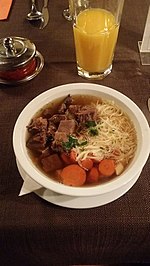
  • Rindsuppe (beef soup), a clear soup with golden colour
  • Tafelspitz,[2] beef boiled in broth (soup), often served with apple and horseradish and chives sauce
  • Gulasch (goulash),[3]: 21  a hotpot similar to Hungarian pörkölt. Austrian goulash is often eaten with rolls, bread or dumplings (Semmelknödel)
  • Beuschel, a ragout containing lungs and heart
  • Liptauer,[3]: 135  a spicy cheese spread, eaten on a slice of bread
  • Selchfleisch, meat that is smoked, then cooked, served with Sauerkraut and dumplings
  • Powidl, a thick sweet jam made from plums
  • Apfelstrudel, apple strudel
  • Topfenstrudel, cream cheese strudel
  • Millirahmstrudel, milk-cream strudel
  • Palatschinken, pancakes similar to French crêpes, filled with jam and sprinkled with sugar or other toppings. They are also served in savoury versions, such as with spinach and cheese.
  • Kaiserschmarrn, soft, fluffy pancake ripped into bites and slightly roasted in a pan, served with compote, applesauce or stewed plums.
  • Germknödel, a fluffy yeast dough dumpling filled with plum jam (Powidl), garnished with melted butter and a mix of poppy seeds and powdered sugar, sometimes served with vanilla cream
  • Marillenknödel, a dumpling stuffed with an apricot and covered with streusel and powdered sugar. The dough is made of potatoes or Topfen.
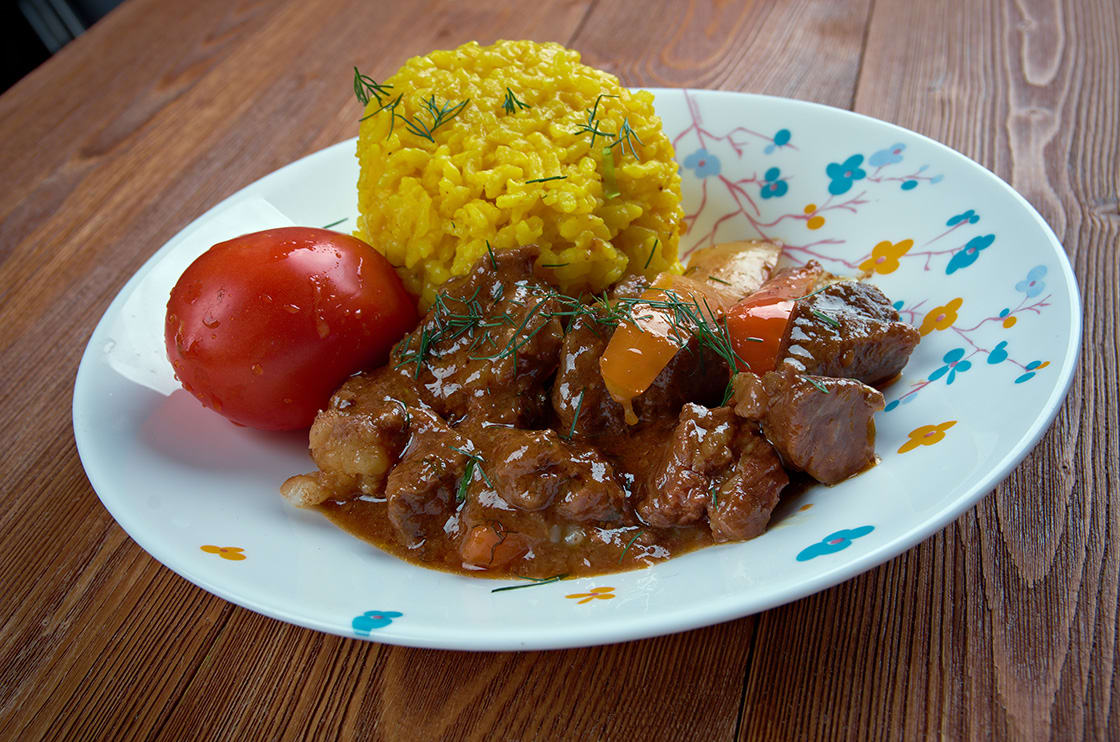
  • Saftgulasch (juicy stew), also known as Austrian or Viennese goulash, is an Austrian twist on the traditional Hungarian dish. The characteristics of the Saftgulash is that it is prepared exclusively with lean beef and a large quantity of onions, at least two thirds of the quantity of meat used. No other vegetables are added and it must be slow cooked for at least three hours. The end result is a thick dark brown sauce with very tender pieces of beef.
  • Wurstsemmel (ham rolls), basically sliced bread rolls containing a slice of ham, or sausage (Leberkäse), or also ham and cheese
  • Krautfleisch or Szegediner Krautfleisch is a ragout of Austrian cuisine - prepared from pork and Sauerkraut.
  • Krautspatzle, a dish consisting mainly of small noodles (spatzle) and cabbage.

Meat[edit]

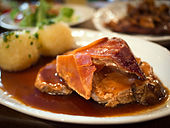
Schweinsbraten (roast pork) with Semmelknödel dumpling and cabbage salad

The most popular meats in Austria are beef, pork, chicken, turkey and goose. The prominent Wiener Schnitzel is traditionally made of veal. Pork in particular is used extensively, with many dishes using offal and parts such as the snout and trotters.

Austrian butchers use a number of special cuts of meat, including Tafelspitz (beef), and Fledermaus (pork). Fledermaus (German for "bat") is a cut of pork from the ham bone that resembles the winged animal. It is described as "very juicy, somewhat fatty, and crossed by tendons"; the latter fact makes it suitable for steaming, braising or frying after tenderization in a marinade.[4]

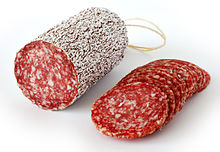
Austrian cuisine has many different sausages, like Frankfurter, Käsekrainer, Debreziner (originating from Debrecen in Hungary), or Burenwurst, Blunzn made out of pig-blood and Grüne Würstl—green sausages. Green means raw in this context—the sausages are air dried and are consumed boiled. Bacon in Austria is called Speck, bacon can be smoked, raw, salted, spiced, etc. Bacon is used in many traditional recipes as a salty spice. Leberkäse is a loaf of corned beef, pork and bacon—it contains neither liver nor cheese despite the name. Vanillerostbraten is a garlicky beef dish.

Game[edit]

Austria has an old hunting tradition since there are many woods across the country. In the autumn season many restaurants in Austria traditionally offer game on their menu along with seasonal vegetables and fruits like pumpkins from Styria. Usual game are:

  • Deer (venison): Hirsch
  • Wild boar: Wildschwein
  • Roe deer: Reh
  • Fallow deer: Damhirsch
  • Brown hare: Hase/Feldhase
  • Common pheasant: Fasan
  • Duck: Ente
  • Grey partridge: Rebhuhn

The German names of game animals followed by -braten signifies a dish of roast game: Hirschbraten is roast venison.

Sweets[edit]

Cakes[edit]

The original Sachertorte, as served at Vienna's Hotel Sacher

Austrian cakes and pastries are a well-known feature of its cuisine. Perhaps the most famous is the Sachertorte, a chocolate cake with apricot jam filling, traditionally eaten with whipped cream. Among the cakes with the longest tradition is the Linzer Torte. Other favourites include the caramel-flavoured Dobostorte and the delicately layered Esterhazy Torte, named in honour of Prince Esterházy (both originating from Hungary during the Austro-Hungarian empire), as well as a number of cakes made with fresh fruit and cream. Punschkrapfen is a classical Austrian pastry, a cake filled with cake crumbs, nougat chocolate, apricot jam and then soaked with rum. Tirolerkuchen is a hazelnut and chocolate coffee cake. Mohr im Hemd, while traditionally something closer to a chocolate custard, is now generally prepared as a steamed cake.

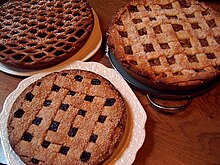
Linzer Torte

These cakes are typically complex and difficult to make. They can be eaten at a café or bought by the slice from a bakery. A "Konditorei" is a specialist cake-maker, and the designations "Café-Konditorei" and "Bäckerei-Konditorei" are common indicators that the café or bakery in question specialises in this field.

Desserts[edit]

Austrian desserts are usually slightly less complicated than the elaborate cakes described above. The most famous of these is the Apfelstrudel (apple strudel), layers of thin pastry surrounding a filling of apple, usually with cinnamon and raisins. Other strudels are also popular, such as those filled with sweetened curd cheese called Topfen, sour cherry (Weichselstrudel), sweet cherry and poppy seed strudel (Mohnstrudel).

Another favourite is Kaiserschmarr'n, a rich fluffy sweet thick pancake made with raisins and other fruits, broken into pieces and served with a fruit compote (traditionally made of plums called Zwetschkenröster (German: [ˈt͡svɛt͡ʃkn̩ˌʁœstɐ] ⓘ)) for dipping, while a speciality of Salzburg is the meringue-like "Salzburger Nocken". The Danish pastry is said to originate from Vienna and in Denmark is called wienerbrød (Viennese bread). The Danish pastry uses a dough in the classic cuisine referred to as "Viennese Dough", made of thin layers of butter and flour dough, imported to Denmark by Austrian bakers hired during a strike among the workers in Danish bakeries in 1850.[5]

Drinks[edit]

Coffee[edit]

An Einspänner is classically served in a glass.

Austria is credited in popular legend with introducing coffee to Europe after bags of coffee beans were left behind by the retreating Turkish army after the Battle of Vienna in 1683. Although the first coffeehouses had appeared in Europe some years earlier, the Viennese café tradition became an important part of the city's identity.

Coffee is served in a variety of styles, particularly in the Viennese coffee houses. An Austrian Mokka or kleiner Schwarzer is similar to espresso, but is extracted more slowly. Other styles are prepared from the Mokka:

  • großer Schwarzer – a double Mokka
  • kleiner Brauner or großer Brauner – single or double Mokka plus milk
  • Verlängerter – "lengthened" (i.e., diluted) Mokka with more water plus milk
  • Melange – half Mokka, half heated milk, often topped with foamed milk
  • Franziskaner – Melange topped with whipped cream and foamed milk
  • Kapuziner – kleiner Schwarzer plus whipped cream
  • Einspänner – großer Schwarzer topped with whipped cream
  • Wiener Eiskaffee – iced Mokka with vanilla ice cream, topped with whipped cream

Italian styles such as cappuccino, espresso and Latte are also commonly served.

Traditionally, coffee is served with a glass of still water.

Drinking coffee together is an important social activity in Austrian culture. It is quite common for Austrians to invite friends or neighbours over for coffee and cake. This routine activity can be compared to the British afternoon tea tradition. It is also very common to go to a coffeehouse while dating.

Hot chocolate[edit]

Viennese hot chocolate is very rich, containing heavy cream in addition to chocolate, and sometimes thickened further with egg yolk.

Soft drinks[edit]

Almdudler is an Austrian soft drink based on mountain herbs and with a flavour reminiscent of sambucus beverages. It is considered the "national drink of Austria", and is popularly used as a mixer with white wine or water. While Red Bull is popular all across the West, the energy drink company started in Austria. The headquarters of the Red Bull company are located at Fuschl am See near Salzburg.

Beer[edit]

Main article: Beer in Austria

Beer is generally sold in the following sizes: 0.2 litre (a Pfiff), 0.33 litre (a Seidel, kleines Bier or Glas Bier) and 0.5 litre (a Krügerl or großes Bier or Hoibe). At festivals one litre Maß and two litre Doppelmaß in the Bavarian style are also sometimes dispensed. The most popular types of beer are pale lager (known as Märzen in Austria), naturally cloudy Zwicklbier, and wheat beer. At holidays like Christmas and Easter bock beer is also available.

Austrian beers are typically in the pale lager style, with the exceptions noted above. A dark amber "Vienna Style" lager was pioneered in the city during the 19th century but is no longer common there.

Wine[edit]

The Austrian wine seal is used on all wines at Qualitätswein level.

Wine is principally cultivated in the east of Austria. The most important wine-producing areas are in Lower Austria, Burgenland, Styria, and Vienna. The Grüner Veltliner grape provides some of Austria's most notable white wines; Zweigelt is the most widely planted red wine grape. Southern Burgenland is a region that mainly grows red grapes; the "Seewinkel" area, east of the Neusiedler See in Burgenland's north, has more mixed wine cultures and is famous for its sweet wines. Wine is even grown within the city limits of Vienna – the only European capital where this is true – and some is even produced under the auspices of the city council.

Young wine (i.e., wine produced from grapes of the most recent harvest) is called Heuriger and gives its name to inns in Vienna and its surroundings, which serve Heuriger wine along with food. In Styria, Carinthia and Burgenland, the Heuriger inns are known as Buschenschanken.

Other alcoholic drinks[edit]

In Upper Austria, Burgenland, Lower Austria, Styria and Carinthia, Most, the fresh juice of grapes or apples is produced, while Sturm ("storm"), a semi-fermented grape juice is drunk after the grape harvest. Most and Sturm are pre-stages of wine.

At the close of a meal, sometimes schnapps (fruit brandy), typically of up to 60% alcohol, is drunk. In Austria schnaps is made from a variety of fruits, for example apricots, rowanberries, gentiana roots, various herbs and even flowers. The produce of small private schnaps distilleries, of which there are around 20,000 in Austria, is known as Selberbrennter or Hausbrand.

Snack food[edit]

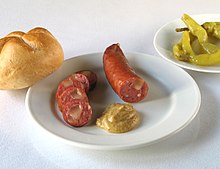
A Käsekrainer sausage with a Kaiser roll and mustard

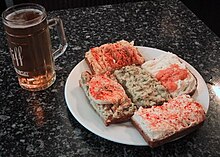
For food consumed in between meals there are many types of open sandwiches called "belegte Brote", or different kinds of sausage with mustard, ketchup and bread, as well as sliced sausage, Leberkäse rolls or Schnitzelsemmeln (rolls filled with schnitzel).

Open sandwiches in Vienna, with a Pfiff-size beer

Traditionally one can get a Wurstsemmel (a roll filled, usually, with Extrawurst, a special kind of thinly sliced sausage, often with a slice of cheese and a pickle or cornichon) at a butcher or at the delicatessen counter in a supermarket.

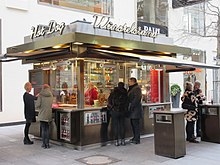
Viennese Würstelstand, Kärntner Straße

There are also other common yet informal delicacies that are typical of Austrian food. For example, the Bosna or Bosner (a spiced bratwurst in a hot dog roll), is an integral part of the menu at Austria's typical fast-food restaurant, the sausage stand (Würstelstand). Most Austrian sausages contain pork.

Regional cuisine[edit]

Lower Austria[edit]

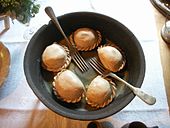
In Lower Austria, local delicacies such as Waldviertel poppies, Marchfeld asparagus and Wachau apricots are cultivated. Famous are the "Marillenknödel": small dumplings filled with apricots and warm butter-fried breadcrumbs on it. Their influence can be felt in the local cuisine, for example in poppy seed noodles "Mohnnudeln". Game dishes are very common. Lower Austria is striking for the differences within its regional cuisine due to its size and the variety of its landscape.

Burgenland[edit]

Burgenland's cuisine has been influenced by Hungarian cuisine owing to its former position within the Hungarian part of the Austro-Hungarian Empire. Dishes consist mainly of fish, chicken or pork. Potatoes are the most common side dish, for example, crushed potatoes with onions called "Greste Krumpian" (= Geröstete Kartoffeln, which comes from "geröstet", meaning "roasted", and the Hungarian term "krumpli" for potatoes). Because of Hungarian influence, Burgenlandish dishes are often spicier than elsewhere in Austria, often indicated with the terms "Zigeuner..." ("Gypsy") or "Serbisch..." ("Serbian"). Polenta is a popular side-dish within Burgenland's Croatian minority. On St Martin's Day (November 11) a Martinigans (St Martin's goose) is often prepared, and carp is a typical Christmas dish.

Styria[edit]

Styrian taverns where local winemakers serve their new wine, local cold food and homemade cakes are called Buschenschank. They are famous for their Brettljause, a cold hors d'oeuvre served on a wooden board, typical with Verhackertes (a spread made from finely chopped raw white bacon), different types of cold meat (Gselchtes: salted and smoked meat, Schweinsbraten: roast pork, air-dried sausages, Speck: ham) grated horseradish, hard-boiled eggs, meat paste, Liptauer, pumpkin seed spread, vegetables, pickles and cheese with sourdough bread, also Käferbohnensalat (runner bean salad) with pumpkin seed oil is typical.[6] Schilcher, a very dry rosé, is the regional style of wine found in Western Styria. A typically Styrian delicacy is pumpkin seed oil, which lends itself particularly to salads on account of its nutty flavour. Many kinds of pumpkin dishes are also very popular. Heidensterz, resembling a dry, almost crumbly version of grits made from buckwheat flour, is a local dish enjoyed in cold weather. Especially in autumn, game dishes are very common.[7]

  • Styrian Brettljause, a cold hors d'oeuvre

    Styrian Brettljause, a cold hors d'oeuvre

  • Käferbohnensalat, Runner bean salad with onions and pumpkin seed oil

    Käferbohnensalat, Runner bean salad with onions and pumpkin seed oil

  • Buschenschank, Kapun winery, Gamlitz, Southern Styria, Austria

    Buschenschank, Kapun winery, Gamlitz, Southern Styria, Austria

  • South Styrian vineyards

    South Styrian vineyards

  • Styrian fried chicken salad with potato- and cornsalad

    Styrian fried chicken salad with potato- and cornsalad

  • Schilchersturm

    Schilchersturm

Carinthia[edit]

Carinthia's many lakes mean that fish is a popular main course. Grain, dairy produce and meat are important ingredients in Carinthian cuisine. Carinthian Kasnudeln (noodle dough pockets filled with quark and mint) and smaller Schlickkrapfen (mainly with a meat filling) are well-known local delicacies. Klachlsuppe (pig's trotter soup) and Reindling (yeast-dough pastry/cake filled with a mix of cinnamon, sugar, walnuts and raisins) are also produced locally.

Upper Austria[edit]

Various types of dumplings are an important part of Upper Austrian cuisine, as they are in neighbouring Bavaria and Bohemia. Linzer Torte, a cake that includes ground almonds or nuts and redcurrant jam, is a popular dessert from the city of Linz, the capital of Upper Austria. Linzeraugen are fine, soft biscuits filled with redcurrant jam called Ribiselmarmelade, which has a sharp flavour.

Salzburg[edit]

Salzburger Nockerln

Kasnocken (cheese dumplings) are a popular meal, as are freshwater fish, particularly trout, served in various ways. Salzburger Nockerl (a meringue-like dish) is a well-known local dessert.

Tyrol[edit]

Tyrolean bacon and all sorts of dumplings including Speckknödel (dumplings with pieces of bacon) and Spinatknödel (made of spinach) are an important part of the local cuisine. Tyrolean cuisine is very simple because in earlier times Tyroleans were not very rich, farming on mountains and in valleys in the middle of the Alpine Region. Tyrolean food often contains milk, cheese, flour and lard.

Vorarlberg[edit]

The cuisine of Vorarlberg has been influenced by the Alemannic cuisine of neighbouring Switzerland and Swabia. Cheese and cheese products play a major role in the cuisine, with Käsknöpfle and Kässpätzle (egg noodles prepared with cheese) being popular dishes. Other delicacies include Krautspätzle (sauerkraut noodles), Käsdönnala (similar to a quiche), Schupfnudla (made from a dough mixing potato and flour), Frittatensuppe (pancake soup), Öpfelküachle (apple cake) and Funkaküachle (cake traditionally eaten on the first Sunday of Lent).

Gallery[edit]

  • Dishes
  • Bierschinken, Leberwurst and Blutwurst

    Bierschinken, Leberwurst and Blutwurst

  • Tiroler Speckknödelsuppe

    Tiroler Speckknödelsuppe

  • Erdäpfelsuppe

    Erdäpfelsuppe

  • Leberknödelsuppe

    Leberknödelsuppe

  • Frittatensuppe

    Frittatensuppe

  • Tafelspitz

    Tafelspitz

  • Bruckfleisch

    Bruckfleisch

  • Rindsgulasch

    Rindsgulasch

  • Käsnudel - Carinthian cheese noodles

    Käsnudel - Carinthian cheese noodles

  • Stelze

    Stelze

  • Krustenbraten mit Dunkelbiersoße (baked pork served with a dark beer sauce)

    Krustenbraten mit Dunkelbiersoße (baked pork served with a dark beer sauce)

  • Marillenknödel

    Marillenknödel

  • Kaiserschmarrn

    Kaiserschmarrn

  • Mohnnudeln, poppy seed noodles

    Mohnnudeln, poppy seed noodles

  • Mohnstrudel

    Mohnstrudel

  • Plum cake

    Plum cake

  • Buchteln

    Buchteln

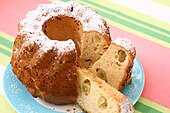
  • Bundt cake with grapes

    Bundt cake with grapes

  • Palatschinken

    Palatschinken

  • Salzburger Nockerln

    Salzburger Nockerln

  • Sachertorte

    Sachertorte

  • Saftgulasch

    Saftgulasch

  • Bratknödel

    Bratknödel

togo

Togolese cuisine is the cuisine of the Togolese Republic, a country in Western Africa. Staple foods in Togolese cuisine include maize, rice, millet, cassava, yam, plantain and beans.[1][2] Maize is the most commonly consumed food in the Togolese Republic.[1] Fish is a significant source of protein. People in Togo tend to eat at home, but there are also restaurants and food stalls.[3]

Foods and dishes[edit]

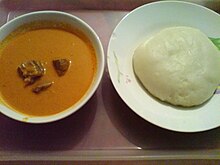
Fufu (left) and palm nut soup (right).

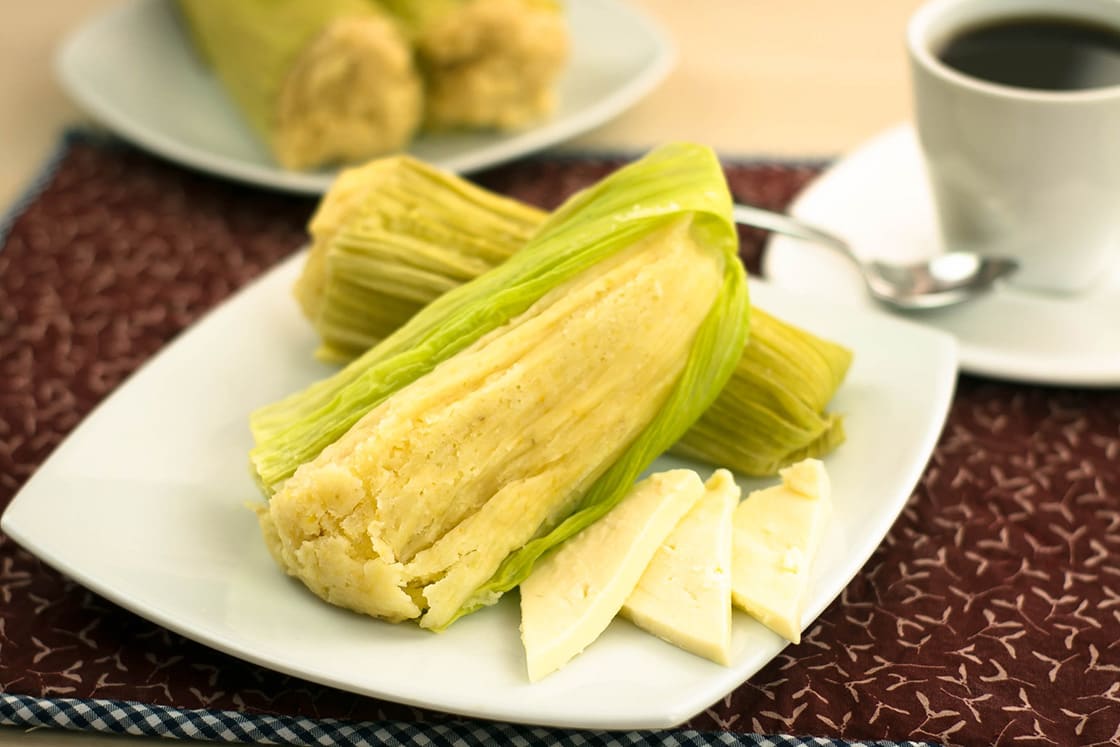
Ablo, a maize-based food

Togolese style is often a combination of African, French, and German influences.[2][4] The cuisine has many sauces and different types of pâté, many of which are made from eggplant, tomato, spinach, and fish.[2] The cuisine combines these foods with various types of meat and vegetables to create flavorful dishes.[2] Roadside food stands sell foods such as groundnuts, omelettes, brochettes, corn-on-the-cob, and cooked prawns.[3]

Additional foods and dishes include:

  • Agouti,[3] known as "grasscutters".
  • Akpan,[5] fermented maize dessert.
  • Baguette bread[3]
  • Chili peppers are often used as a spice[1]
  • Fufu is very common,[2][3] made from peeled and boiled yams which are then pounded with a pestle until reaching a dough consistency.[3] Fufu is typically accompanied with sauces.[3]
  • Goat meat.[3]
  • Koklo meme, grilled chicken with a chili sauce.[2]
  • Kokonte, a pâté made from cassava[3]
  • Pâté, a commonly consumed cornmeal cake.[4]
  • Peanuts
  • Riz sauce d’arachide, a rice dish made with groundnut sauce.[2]
  • Akume, prepared from ground maize served with a side, usually okra soup.

Beverages[edit]

  • Red wine[4]
  • American-style beer[3]
  • White wine[4]

israel

Israeli cuisine primarily comprises dishes brought from the Jewish diaspora, and has more recently been defined by the development of a notable fusion cuisine characterized by the mixing of Jewish cuisine and Arab cuisine.[1] It also blends together the culinary traditions of the various diaspora groups, namely those of Middle Eastern Jews with roots in Southwest Asia and North Africa, Sephardi Jews from Iberia, and Ashkenazi Jews from Central and Eastern Europe.[1][2]

The country's cuisine also incorporates food and drinks traditionally included in other Middle Eastern cuisines (e.g., Iranian cuisine from Persian Jews and Turkish cuisine from Turkish Jews) as well as in Mediterranean cuisines, such that spices like za'atar and foods such as falafel, hummus, msabbaha, shakshouka, and couscous are now widely popular in Israel.[3][4] However, the identification of Arab dishes as Israeli has led to accusations of cultural appropriation against Israel by Palestinians and other Arabs.[5][6]

Other influences on the cuisine are the availability of foods common to the Mediterranean, especially certain kinds of fruits and vegetables, dairy products, and fish; the tradition of observing kashrut; and food customs and traditions (minhag) specific to Shabbat and other Jewish holidays. Examples of these foods include challah, jachnun, malawach, gefilte fish, hamin, me'orav yerushalmi, and sufganiyot.

New dishes based on agricultural products such as oranges, avocados, dairy products, and fish, and others based on world trends have been introduced over the years, and chefs trained abroad have brought in elements of other international cuisines.[7]

History

Origins

See also: Ancient Israelite cuisine

Poster by the Jewish National Fund displaying the "Seven Species" of agricultural products that are documented in the Hebrew Bible as being special products of the Land of Israel (January 1945)

Israel's culinary traditions comprise foods and cooking methods that span 3000 years of history. Over that time, these traditions have been shaped by influences from Asia, Africa and Europe, and religious and ethnic influences have resulted in a culinary melting pot. Biblical and archaeological records provide insight into the culinary life of the region as far back as 1000 years BCE.[8]

Ancient Israelite cuisine was based on several products that still play important roles in modern Israeli cuisine. These were known as the seven species: olives, figs, dates, pomegranates, wheat, barley and grapes.[9] The diet, based on locally grown produce, was enhanced by imported spices, readily available due to the country's position at the crossroads of east–west trade routes.[8]

During the Second Temple period (516 BCE–70 CE), Hellenistic and Roman culture heavily influenced cuisine, particularly of the priests and aristocracy of Jerusalem. Elaborate meals were served that included piquant entrées and alcoholic drinks, fish, beef, meat, pickled and fresh vegetables, olives, and tart or sweet fruits.[8]

After the destruction of the Second Temple and the exile of the majority of Jews from the Land of Israel, Jewish cuisine continued to develop in the many countries where Jewish communities have existed since Late Antiquity, influenced by the economics, agriculture, and culinary traditions of those countries.[citation needed]

Old Yishuv

Main article: Old Yishuv § Food

The Old Yishuv was the Jewish community that lived in Ottoman Syria prior to the Zionist Aliyah from the diaspora that began in 1881. The cooking style of the community was Sephardi cuisine, which developed among the Jews of Spain before their expulsion in 1492, and in the areas to which they migrated thereafter, particularly the Balkans and Ottoman Empire. Sephardim and Ashkenazim also established communities in the Old Yishuv. Particularly in Jerusalem, they continued to develop their culinary style, influenced by Ottoman cuisine, creating a style that became known as Jerusalem Sephardi cuisine.[10] This cuisine included pies like sambousak, pastels and burekas, vegetable gratins and stuffed vegetables, and rice and bulgur pilafs, which are now considered to be Jerusalem classics.[7]

Groups of Hasidic Jews from Eastern Europe also began establishing communities in the late 18th century, and brought with them their traditional Ashkenazi cuisine, developing, however, distinct local variations, notably a peppery, caramelized noodle pudding known as kugel yerushalmi.[11]

Jewish immigration
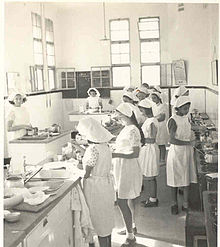
Cooking class at a Jewish girls' school in Jerusalem, c. 1936

Beginning with the First Aliyah in 1881, Jews began immigrating to the area from Yemen and Eastern Europe in larger numbers, particularly from Poland and Russia. These Zionist pioneers were motivated both ideologically and by the Mediterranean climate to reject the Ashkenazi cooking styles they grew up with, and adapt by using local produce, especially vegetables such as zucchini, peppers, eggplant, artichoke and chickpeas.[7] The first Hebrew cookbook, written by Erna Meyer, and published in the early 1930s by the Palestine Federation of the Women's International Zionist Organization, exhorted cooks to use Mediterranean herbs and Middle-Eastern spices and local vegetables in their cooking.[10] The bread, olives, cheese and raw vegetables they adopted became the basis for the kibbutz breakfast, which in more abundant forms is served in Israeli hotels, and in various forms in most Israeli homes today.[7][10]

Early years of the State

Residents of Tel Aviv standing in line to buy food rations during the austerity period, 1954

The State of Israel faced enormous military and economic challenges in its early years, and the period from 1948 to 1958 was a time of food rationing and austerity, known as tzena. In this decade, over one million Jewish immigrants, mainly from Arab countries, but also including European Holocaust survivors, inundated the new state. They arrived when only basic foods were available and ethnic dishes had to be modified with a range of mock or simulated foods, such as chopped "liver" from eggplant, and turkey as a substitute for veal schnitzel for Ashkenazim, kubbeh made from frozen fish instead of ground meat for Iraqi Jews, and turkey in place of the lamb kebabs of the Mizrahi Jews. These adaptations remain a legacy of that time.[7][10]

Substitutes, such as the wheat-based rice substitute, ptitim, were introduced, and versatile vegetables such as eggplant were used as alternatives to meat. Additional flavor and nutrition were provided from inexpensive canned tomato paste and puree, hummus, tahina, and mayonnaise in tubes. Meat was scarce, and it was not until the late 1950s that herds of beef cattle were introduced into the agricultural economy.[12]

Khubeza, a local variety of the mallow plant, became an important food source during the War of Independence. During the siege of Jerusalem, when convoys of food could not reach the city, Jerusalemites went out to the fields to pick khubeza leaves, which are high in iron and vitamins.[13] Instructions for cooking it broadcast by Jerusalem-based radio station Kol Hamagen, were picked up in Jordan, which convinced the Arabs that the Jews were dying of starvation and victory was at hand.[14] In the past decade, food writers in Israel have encouraged the population to prepare khubeza on Israel Independence Day.[15] Local chefs have begun to serve khubeza and other wild plants gathered from the fields in upscale restaurants.[16] The dish from the independence war is called ktzitzot khubeza and is still eaten by Israelis today.[citation needed]

Impact of immigration

Halva for sale at Mahane Yehuda Market in Jerusalem, 2010

Immigrants to Israel have introduced elements of the cuisines of the cultures and countries from whence they came.[1] In the nearly 50 years before 1948, there were successive waves of Jewish immigration, which brought a whole range of foods and cooking styles. Immigrants arriving from central Europe brought foods such as schnitzel and strudels, while Russian Jews brought borscht and herring dishes, such as schmaltz herring and vorschmack (gehakte herring).[7]

Ashkenazi dishes include chicken soup, schnitzel, lox, chopped liver, gefilte fish, knishes, kishka and kugel. The first Israeli patisseries were opened by Ashkenazi Jews, who popularized cakes and pastries from central and Eastern Europe, such as yeast cakes (babka), nut spirals (schnecken), chocolate rolls and layered pastries. After 1948, the greatest impact came from the large migration of Jews from Turkey, Iraq, Kurdistan and Yemen, and Mizrahi Jews from North Africa, particularly Morocco. Typically, the staff of army kitchens, schools, hospitals, hotels and restaurant kitchens has consisted of Mizrahi, Kurdish and Yemenite Jews, and this has had an influence on the cooking fashions and ingredients of the country.[7]

Mizrahi cuisine, the cuisine of Jews from North Africa, features grilled meats, sweet and savory puff pastries, rice dishes, stuffed vegetables, pita breads and salads, and shares many similarities with Arab cuisine. Other North African dishes popular in Israel include couscous, shakshouka, matbucha, carrot salad and chraime (slices of fish cooked in a spicy tomato sauce).

Sephardic dishes, with Balkan and Turkish influences incorporated in Israeli cuisine include burekas, yogurt and taramosalata. Yemenite Jewish foods include jachnun, malawach, skhug and kubane. Iraqi dishes popular in Israel include amba, various types of kubba, stuffed vegetables (mhasha), kebab, sambusac, sabich and pickled vegetables (hamutzim).

Modern trends

Assortment of pickled vegetables at a Bedouin-dominated market in Beersheba, 2007

As Israeli agriculture developed and new kinds of fruits and vegetables appeared on the market, cooks and chefs began to experiment and devise new dishes with them.[12] They also began using "biblical" ingredients such as honey, figs, and pomegranates, and indigenous foods such as prickly pears (tzabar) and chickpeas. Since the late 1970s, there has been an increased interest in international cuisine, cooking with wine and herbs, and vegetarianism.[7]

A more sophisticated food culture in Israel began to develop when cookbooks, such as From the Kitchen with Love by Ruth Sirkis, published in 1974, introduced international cooking trends, and together with the opening of restaurants serving cuisines such as Chinese, Italian and French, encouraged more dining out.[10][17]

The 1980s were a formative decade: the increased optimism after the signing of the peace treaty with Egypt in 1979, the economic recovery of the mid-1980s and the increasing travel abroad by average citizens were factors contributing to a greater interest in food and wine. In addition, high-quality, locally produced ingredients became increasingly available. For example, privately owned dairies began to produce handmade cheeses from goat, sheep and cow's milk, which quickly became very popular both among chefs and the general public. In 1983, the Golan Heights Winery was the first of many new Israeli winemakers to help transform tastes with their production of world-class, semi-dry and dry wines. New attention was paid to the making of handmade breads and the production of high quality olive oil. The successful development of aquaculture ensured a steady supply of fresh fish, and the agricultural revolution in Israel led to an overwhelming choice and quality of fresh fruit, vegetables and herbs.[10]

Ethnic heritage cooking, both Sephardic and Ashkenazi, has made a comeback with the growing acceptance of the heterogeneous society. Apart from home cooking, many ethnic foods are now available in street markets, supermarkets and restaurants, or are served at weddings and bar mitzvahs, and people increasingly eat foods from ethnic backgrounds other than their own. Overlap and combinations of foods from different ethnic groups is becoming standard as a multi-ethnic food culture develops.[7][10]

The 1990s saw an increasing interest in international cuisines. Sushi, in particular, has taken hold as a popular style for eating out and as an entrée for events. In restaurants, fusion cuisine, with the melding of classic cuisines such as French and Japanese with local ingredients has become widespread. [citation needed]

In the 2000s, the trend of "eating healthy" with an emphasis on organic and whole-grain foods has become prominent, and medical research has led many Israelis to re-embrace the Mediterranean diet, with its touted health benefits.[18]

Characteristics

Geography has a large influence on Israeli cuisine, and foods common in the Mediterranean region, such as olives, wheat, chickpeas, dairy products, fish, and vegetables such as tomatoes, eggplants, and zucchini are prominent in Israeli cuisine. Fresh fruits and vegetables are plentiful in Israel and are cooked and served in many ways.[19]

A typical Israeli mezze spread, with hummus and pita, Israeli salad, olives, and pickles

There are various climatic areas in Israel and areas it has settled that allow a variety of products to be grown. Citrus trees such as orange, lemon and grapefruit thrive on the coastal plain. Figs, pomegranates and olives also grow in the cooler hill areas.[8]

The subtropical climate near the Sea of Galilee and in the Jordan River Valley is suitable for mangoes, kiwis and bananas, while the temperate climate of the mountains of the Galilee and the Golan is suitable for grapes, apples and cherries.[20]

Cucumber-and-tomato salad with labane and za'atar

Israeli eating customs also conform to the wider Mediterranean region, with lunch, rather than dinner, being the focal meal of a regular workday.

"Kibbutz foods" have been adopted by many Israelis for their light evening meals as well as breakfasts, and may consist of various types of cheeses, both soft and hard, yogurt, labne and sour cream, vegetables and salads, olives, hard-boiled eggs or omelets, pickled and smoked herring, a variety of breads, and fresh orange juice and coffee.[7]

In addition, Jewish holidays influence the cuisine, with the preparation of traditional foods at holiday times, such as various types of challah (braided bread) for Shabbat and festivals, jelly doughnuts (sufganiyot) for Hanukah, the hamantaschen pastry (oznei haman) for Purim, charoset, a type of fruit paste, for Passover, and dairy foods for Shavuot.

The Shabbat dinner, eaten on Friday, and to a lesser extent the Shabbat lunch, is a significant meal in Israeli homes, together with holiday meals.[19]

Although many, if not most, Jews in Israel do not keep kosher, the tradition of kashrut strongly influences the availability of certain foods and their preparation in homes, public institutions and many restaurants, including the separation of milk and meat and avoiding the use of non-kosher foods, especially pork and shellfish.

During Passover, bread and other leavened foods are prohibited to observant Jews and matza and leaven-free foods are substituted.[21]

Foods

Israel does not have a universally recognized national dish; in previous years this was considered to be falafel, deep-fried balls of seasoned, ground chickpeas.[22][23] Street vendors throughout Israel used to sell falafel, it was a favorite "street food" for decades and is still popular as a mezze dish or as a top-up for hummus-in-pita, though less nowadays as a sole filling in pita due to the frying in deep oil and higher health awareness.[12]

The Israeli breakfast has always been largely healthy, by today's standards, and one book called the Israeli breakfast "the Jewish state's contribution to world cuisine".[24]

Salads and appetizers

Potato-stuffed burekas at Mahane Yehuda Market in Jerusalem, 2010

Ptitim, a type of pasta also known as "Israeli couscous"

Vegetable salads are eaten with most meals, including the traditional Israeli breakfast, which will usually include eggs, bread, and dairy products such as yogurt or cottage cheese. For lunch and dinner, salad may be served as a side dish. A light meal of salad (salat), hummus and French fries (chips) served in a pita is referred to as hummuschipsalat.[25]

Israeli salad is typically made with finely chopped tomatoes and cucumbers dressed in olive oil, lemon juice, salt and pepper. Variations include the addition of diced red or green bell peppers, grated carrot, finely shredded cabbage or lettuce, sliced radish, fennel, spring onions and chives, chopped parsley, or other herbs and spices such as mint, za'atar and sumac.[25]

Although popularized by the kibbutzim, versions of this mixed salad were brought to Israel from various places. For example, Jews from India prepare it with finely chopped ginger and green chili peppers, North African Jews may add preserved lemon peel and cayenne pepper, and Bukharan Jews chop the vegetables extremely finely and use vinegar, without oil, in the dressing.[26]

Tabbouleh is a Levantine vegan dish (sometimes considered a salad) traditionally made of tomatoes, finely chopped parsley, mint, bulgur and onion, and seasoned with olive oil, lemon juice, and salt. Some Israeli variations of the salad use pomegranate seeds instead of tomatoes.

Sabich salad is a variation of the well known Israeli dish sabich, the ingredients of the salad are eggplant, boiled eggs/hard-boiled eggs, tahini, Israeli salad, potato, parsley and amba.

Kubba is a dish made of rice/semolina/burghul (cracked wheat), minced onions and finely ground lean beef, lamb or chicken. The best-known variety is a torpedo-shaped fried croquette stuffed with minced beef, chicken or lamb. It was brought to Israel by Jews of Iraqi, Kurdish and Syrian origin.

Sambusak is a semi-circular pocket of dough filled with mashed chickpeas, fried onions and spices. There is another variety filled with meat, fried onions, parsley, spices and pine nuts, which is sometimes mixed with mashed chickpeas and breakfast version with feta or tzfat cheese and za'atar. It can be fried or otherwise cooked.

Roasted vegetables includes bell peppers, chili peppers, tomatoes, onions, eggplants and also sometimes potatoes and zucchini. Usually served with grilled meat.

Khamutzim are pickled vegetables made by soaking in water and salt (and sometimes olive oil) in a pot and withdrawing them from air. Ingredients can include cucumber, cabbage, eggplant, carrot, turnip, radish, onion, caper, lemon, olives, cauliflower, tomatoes, chili pepper, bell pepper, garlic and beans.

A large variety of eggplant salads and dips are made with roasted eggplants.[27] Baba ghanoush, called salat ḥatzilim in Israel, is made with tahina and other seasonings such as garlic, lemon juice, onions, herbs and spices. Food writer and historian Gil Marks writes in his book that: "Israelis learned to make baba ghanouj from the Arabs".[28] The eggplant is sometimes grilled over an open flame so that the pulp has a smoky taste. A particularly Israeli variation of the salad is made with mayonnaise called salat ḥatzilim b'mayonnaise.[29]

Eggplant salads are also made with yogurt, or with feta cheese, chopped onion and tomato, or in the style of Romanian Jews, with roasted red pepper.[30]

Tahina is often used as a dressing for falafel,[31] serves as a cooking sauce for meat and fish, and forms the basis of sweets such as halva.[32]

Hummus is a cornerstone of Israeli cuisine, and consumption in Israel has been compared by food critic Elena Ferretti to "peanut butter in America, Nutella in Europe or Vegemite in Australia".[33] Hummus in pita is a common lunch for schoolchildren, and is a popular addition to many meals.

Supermarkets offer a variety of commercially prepared hummus, and some Israelis will go out of their way for fresh hummus prepared at a hummusia, an establishment devoted exclusively to selling hummus.[34]

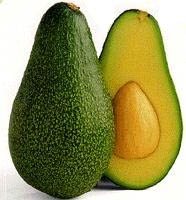
Salat avocado is an Israeli-style avocado salad, with lemon juice and chopped scallions (spring onions), was introduced by farmers who planted avocado trees on the coastal plain in the 1920s. Avocados have since become a winter delicacy and are cut into salads as well as being spread on bread.[35]

A meze of fresh and cooked vegetable salads, pickled cucumbers and other vegetables, hummus, ful, tahini and amba dips, labneh cheese with olive oil, and ikra is served at festive meals and in restaurants.

Salads include Turkish salad (a piquant salad of finely chopped onions, tomatoes, herbs and spices), tabbouleh, carrot salad, marinated roasted red and green peppers, deep fried cauliflower florets, matbucha, torshi (pickled vegetables) and various eggplant salads.[36][37]

Modern Israeli interpretations of the meze blend traditional and modern, pairing ordinary appetizers with unique combinations such as fennel and pistachio salad, beetroot and pomegranate salad, and celery and kashkaval cheese salad.[38]

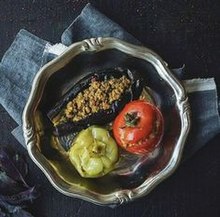
Stuffed vegetables, called memula’im, were originally designed to extend cheap ingredients into a meal. They are prepared by cooks in Israel from all ethnic backgrounds and are made with many varying flavors, such as spicy or sweet-and-sour, with ingredients such as bell peppers, chili peppers, figs, onion, artichoke bottoms, Swiss chard, beet, dried fruits, tomato, vine leaves, potatoes, mallow, eggplants and zucchini squash, and stuffing such as meat and rice in Balkan style, bulgur in Middle-Eastern fashion, or with ptitim, a type of Israeli pasta.[39]

The Ottoman Turks introduced stuffed vine leaves in the 16th century and vine leaves are commonly stuffed with a combination of meat and rice, although other fillings, such as lentils, have evolved among the various communities.[40]

Artichoke bottoms stuffed with meat are famous as one of the grand dishes of the Sephardi Jerusalem cuisine of the Old Yishuv.[41] Stuffed dates and dried fruits are served with rice and bulgur dishes. Stuffed half-zucchini has a Ladino name, medias.

Soups and dumplings

Shkedei marak (Israeli croutons)

A variety of soups are enjoyed, particularly in the winter. Chicken soup has been a mainstay of Jewish cuisine since medieval times and is popular in Israel.[42]

Classic chicken soup is prepared as a simple broth with a few vegetables, such as onion, carrot and celery, and herbs such as dill and parsley.

More elaborate versions are prepared by Sephardim with orzo or rice, or the addition of lemon juice or herbs such as mint or coriander, while Ashkenazim may add noodles.[43] An Israeli adaption of the traditional Ashkenazi soup pasta known as mandlen, called shkedei marak ("soup almonds") in Israel, are commonly served with chicken soup.

Particularly on holidays, dumplings are served with the soup, such as the kneidlach (matzah balls) of the Ashkenazim or the gondi (chickpea dumplings) of Iranian Jews, or kubba, a family of dumplings brought to Israel by Middle Eastern Jews. Especially popular are kubba prepared from bulgur and stuffed with ground lamb and pine nuts, and the soft semolina or rice kubba cooked in soup,[43] which Jews of Kurdish or Iraqi heritage habitually enjoy as a Friday lunchtime meal.[44]

Lentil soup is prepared in many ways, with additions such as cilantro or meat.[45] Other soups include the harira of the Moroccan Jews, a spicy soup of lamb (or chicken), chickpeas, lentils and rice, and a Yemenite bone-marrow soup known as ftut, served on special occasions such as weddings, seasoned with the traditional hawaij spice mix.[46][47]

White bean soup in tomato sauce is common in Jerusalem because Sephardic Jews settled in the city after being expelled from Andalusia.

Grains and pasta

Rice is prepared in numerous ways in Israel, from simple steamed white rice to festive casseroles. It is also cooked with spices and served with almonds and pine nuts.

"Green" rice, prepared with a variety of fresh chopped herbs, is favored by Persian Jews. Another rice dish is prepared with thin noodles that are first fried and then boiled with the rice.

Mujadara is a popular rice and lentil dish, adopted from Arab cuisine. Orez Shu'it is a dish invented in Jerusalem by Sephardic Jews, made of white beans cooked in a tomato stew and served on plain boiled rice; it is eaten widely in the Jerusalem region.

Couscous was brought to Israel by Jews from North Africa. It is still prepared in some restaurants or by traditional cooks by passing semolina through a sieve several times and then cooking it over an aromatic broth in a special steamer pot called a couscoussière. Generally, "instant" couscous is used for home cooking.

Couscous is used in salads, main courses and even some desserts. As a main course, chicken or lamb, or vegetables cooked in a soup flavored with saffron or turmeric are served on steamed couscous.[48][49]

Ptitim is an Israeli pasta which now comes in many shapes, including pearls, loops, stars and hearts, but was originally shaped like grains of rice. It originated in the early days of the State of Israel as a wheat-based substitute for rice, when rice, a staple of the Mizrahi Jews, was scarce.

Israel's first prime minister, David Ben-Gurion, is reputed to have asked the Osem company to devise this substitute, and so it was nicknamed "Ben-Gurion rice".

Ptitim can be boiled like pasta, prepared pilaf-style by sautéing and then boiling in water or stock, or baked in a casserole. Like other pasta, it can be flavored in many ways with spices, herbs and sauces. Once considered primarily a food for children, ptitim is now prepared in restaurants both in Israel and internationally.[50]

Bulgur is a kind of dried cracked wheat, served sometimes instead of rice.

Fish

St. Peter's fish (tilapia) at a restaurant in Tiberias, 2002

Fresh fish is readily available, caught off Israel's coastal areas of the Mediterranean and the Red Sea, or in the Sea of Galilee, or raised in ponds in the wake of advances in fish farming in Israel.

Fresh fish is served whole, in the Mediterranean style, grilled, or fried, dressed only with freshly squeezed lemon juice. Trout (forel), gilthead seabream (denisse), St. Peter's fish (musht) and other fresh fish are prepared this way.[51]

Fish are also eaten baked, with or without vegetables, or fried whole or in slices, or grilled over coals, and served with different sauces.[52]

Fish are also braised, as in a dish called hraime, in which fish such as grouper (better known in Israel by its Arabic name lokus) or halibut is prepared in a sauce with hot pepper and other spices for Rosh Hashanah, Passover and Shabbat by North-African Jews.

Everyday versions are prepared with cheaper kinds of fish and are served in market eateries, public kitchens and at home for weekday meals.[51][52]

Fish, traditionally carp, but now other firm whitefish too, are minced and shaped into loaves or balls and cooked in fish broth, such as the gefilte fish of the Ashkenazi Jews, who also brought pickled herring from Eastern Europe.

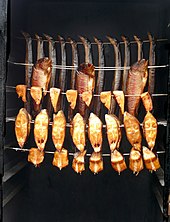
Herring is often served at the kiddush that follows synagogue services on Shabbat, especially in Ashkenazi communities. In the Russian immigrant community it may be served as a light meal with boiled potatoes, sour cream, dark breads and schnapps or vodka.[52][53]

Fish kufta is usually fried with spices, herbs and onions (sometimes also pine nuts) and served with tahini or yogurt sauce. Boiled fish kufta is cooked in a tomato, tahini or yogurt sauce.

Tilapia baked with tahini sauce and topped with olive oil, coriander, mint, basil and pine nuts (and sometimes also with fried onions) is a specialty of Tiberias.

Poultry and meat
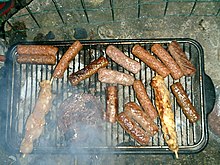
Israeli-style mangal

Breaded schnitzel with pasta

Chicken is the most widely eaten meat in Israel, followed by turkey.[54] Chicken is prepared in a multitude of ways, from simple oven-roasted chicken to elaborate casseroles with rich sauces such as date syrup, tomato sauce, etc.

Examples include chicken casserole with couscous, inspired by Moroccan Jewish cooking, chicken with olives, a Mediterranean classic, and chicken albondigas (meat balls) in tomato sauce, from Jerusalem Sephardi cuisine.[54]

Albondigas are prepared from ground meat.[55] Similar to them is the more popular kufta which is made of minced meat, herbs and spices and cooked with tomato sauce, date syrup, pomegranate syrup or tamarind syrup with vegetables or beans.

Grilled and barbecued meat are common in Israeli cuisine. The country has many small eateries specializing in beef and lamb kebab, shish taouk, merguez and shashlik. Outdoor barbecuing, known as mangal or al ha-esh (on the fire) is a beloved Israeli pastime.

In modern times, Israel Independence Day is frequently celebrated with a picnic or barbecue in parks and forests around the country.[56]

Skewered goose liver is a dish from southern Tel Aviv. It is grilled with salt and black pepper and sometimes with spices like cumin or Baharat spice mix.

Chicken or lamb baked in the oven is very common with potatoes, and sometimes fried onions as well.

Turkey schnitzel is an Israeli adaptation of veal schnitzel, and is an example of the transformations common in Israeli cooking.[57]

The schnitzel was brought to Israel by Jews from Central Europe, but before and during the early years of the State of Israel veal was unobtainable and chicken or turkey was an inexpensive and tasty substitute. Furthermore, a Wiener schnitzel is cooked in both butter and oil, but in Israel only oil is used, because of kashrut.

Today, most cooks buy schnitzel already breaded and serve it with hummus, tahina, and other salads for a quick main meal. Other immigrant groups have added variations from their own backgrounds—Yemenite Jews, for example, flavor it with hawaij.[12] In addition, vegetarian versions have become popular and the Israeli food company, Tiv′ol, was the first to produce a vegetarian schnitzel from a soya meat-substitute.

Various types of sausage are part of Sephardi and Mizrahi cuisine in Israel. Jews from Tunisia make a sausage, called osban, with a filling of ground meat or liver, rice, chopped spinach, and a blend of herbs and spices. Jews from Syria make smaller sausages, called gheh, with a different spice blend while Jews from Iraq make the sausages, called mumbar, with chopped meat and liver, rice, and their traditional mix of spices.[58]

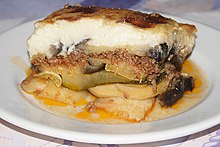
Moussaka is an oven-baked layer dish ground meat and eggplant casserole that, unlike its Levantine rivals, is served hot.

Meat stews (chicken, lamb and beef) are cooked with spices, pine nuts, herbs like parsley, mint and oregano, onion, tomato sauce or tahini or juices such as pomegranate molasses, pomegranate juice, pomegranate wine, grape wine, arak, date molasses and tamarind. Peas, chickpeas, white beans, cowpeas or green beans are sometimes also added.

Stuffed chicken in Israel is usually stuffed with rice, meat (lamb or beef), parsley, dried fruits like dates, apricots or raisins, spices like cinnamon, nutmeg or allspice; sometimes herbs like thyme and oregano (not the dried ones) are added on the top of the chicken to give it a flavor and then it is baked in the oven.

Dairy products
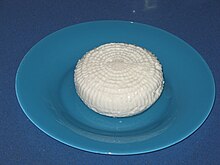
Tzfatit — semi-hardened cheese made from goat milk

Many fresh, high quality dairy products are available, such as cottage cheese, white cheeses, yogurts including leben and eshel, yellow cheeses, and salt-brined cheeses typical of the Mediterranean region.[59]

Dairy farming has been a major sector of Israeli agriculture since the founding of the state, and the yield of local milk cows is amongst the highest in the world. Initially, the moshavim (farming cooperatives) and kibbutzim produced mainly soft white cheese as it was inexpensive and nutritious. It became an important staple in the years of austerity and gained a popularity that it enjoys until today.[59]

Soft white cheese, gvina levana, is often referred to by its fat content, such as 5% or 9%. It is eaten plain, or mixed with fruit or vegetables, spread on bread or crackers and used in a variety of pies and pastries.[59]

Labneh is a yogurt-based white cheese common throughout the Balkans and the Middle East. It is sold plain, with za'atar, or in olive oil. It is often eaten for breakfast with other cheeses and bread.[60] In the north of the country, labneh balls preserved in olive oil are more common than in the central and the southern parts.

Adding spices like za'atar, dried oregano or sumac and herbs like thyme, mint or scallions is common when preserving the labneh balls. It is especially common to eat them during breakfast because meat is usually not eaten in the morning.

Tzfat cheese, a white cheese in brine, similar to feta, was first produced by the Meiri dairy in Safed in 1837 and is still produced there by descendants of the original cheese makers. The Meiri dairy also became famous for its production of the Balkan-style brinza cheese, which became known as Bulgarian cheese due to its popularity in the early 1950s among Jewish immigrants from Bulgaria.

Other dairies now also produce many varieties of these cheeses.[59] Bulgarian yogurt, introduced to Israel by Bulgarian Jewish survivors of the Holocaust, is used to make a traditional yogurt and cucumber soup.[61]

In the early 1980s, small privately owned dairies began to produce handmade cheeses from goat and sheep's milk as well as cow's milk, resembling traditional cheeses like those made in rural France, Spain and Italy. Many are made with organic milk. These are now also produced by kibbutzim and the national Tnuva dairy.[59]

Egg dishes

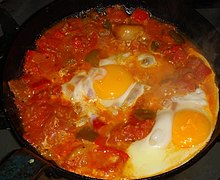
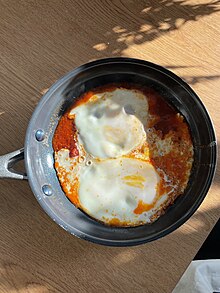
Shakshuka, a North-African dish of eggs poached in a spicy tomato sauce, is a national favorite, especially in the winter. It is traditionally served up in a cast-iron pan with bread to mop up the sauce.[62] Some variations of the dish are cooked with liberal use of ingredients such as eggplant, chili peppers, hot paprika, spinach, feta cheese or safed cheese.

Omelettes are seasoned with onions, herbs such as dill seeds (shamir), spinach, parsley, mint, coriander and mallow with spices such as turmeric, cumin, sumac, cinnamon and cloves and with cheese such as safed and feta.

Haminados are eggs that are baked after being boiled, served alongside stew or meals; in hamin they are used in the morning for breakfast, also sometimes replacing the usual egg in sabich. They are also eaten as a breakfast alongside jachnun, grated tomatoes and skhug.

Fruit

Israel is one of the world's leading fresh citrus producers and exporters,[63] and more than forty types of fruit are grown in Israel, including citrus fruits such as oranges, grapefruit, tangerines and the pomelit, a hybrid of a grapefruit and a pomelo, developed in Israel.[64] Fruits grown in Israel include avocados, bananas, apples, cherries, plums, lychees, nectarines, grapes, dates, strawberries, prickly pear (tzabbar), persimmon, loquat (shesek) and pomegranates, and are eaten on a regular basis. Israelis consume an average of nearly 160 kg (350 lb) of fruit per person a year.[65]

Many unique varieties of mango are native to the country, most having been developed during the second half of the 20th century. New and improved mango varieties are still introduced to markets every few years.

Arguably the most popular variety is the Maya type, which is small to medium in size, fragrant, colourful (featuring 3-4 colours) and usually fiberless. The Israeli mango season begins in May, and the last of the fruit ripen as October draws near. Different varieties are present on markets at different months, with the Maya type seen between July and September. Mangos are frequently used in fusion dishes and for making sorbet.

A lot of Israelis keep fruit trees in their yards, citrus (especially orange and lemon) being the most common. Mangos are also now popular as household trees. Mulberry trees are frequently seen in public gardens, and their fruit is popularly served alongside various desserts and as a juice.

Fruit is served as a snack or dessert alongside other items or by themselves. Fresh-squeezed fruit juices are prepared at street kiosks, and sold bottled in supermarkets.[65] Various fruits are added to chicken or meat dishes and fresh fruit salad and compote are often served at the end of the meal.[66]

Baked dishes, cookies, pastries, rugelach

Typical Israeli pastries, and rugelach

Knafeh served at a café in Jaffa, 2022

There is a strong tradition of home baking in Israel arising from the years when there were very few bakeries to meet demand. Many professional bakers came to Israel from Central Europe and founded local pastry shops and bakeries, often called konditoria, thus shaping local tastes and preferences.

There is now a local style with a wide selection of cakes and pastries that includes influences from other cuisines and combines traditional European ingredients with Mediterranean and Middle-Eastern ingredients, such as halva, phyllo dough, dates, and rose water.[67]

Examples include citrus-flavored semolina cakes, moistened with syrup and called basbousa, tishpishti or revani in Sephardic bakeries. The Ashkenazi babka has been adapted to include halva or chocolate spread, in addition to the old-fashioned cinnamon. There are also many varieties of apple cake. Cookies made with crushed dates (ma'amoul) are served with coffee or tea, as throughout the Middle East.[67]

Jerusalem kugel (kugel yerushalmi) is an Israeli version of the traditional noodle pudding, kugel, made with caramelized sugar and spiced with black pepper.[68] It was originally a specialty of the Ashkenazi Jews of the Old Yishuv.[11] It is typically baked in a very low oven overnight and eaten after synagogue services on Shabbat morning.[69]

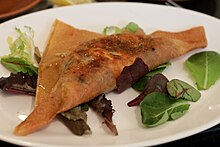
Bourekas are savory pastries brought to Israel by Jews from Turkey, the Balkans and Salonika. They are made of a flaky dough in a variety of shapes, frequently topped with sesame seeds, and are filled with meat, chickpeas, cheese, spinach, potatoes or mushrooms. Bourekas are sold at kiosks, supermarkets and cafes, and are served at functions and celebrations, as well as being prepared by home cooks.[70] They are often served as a light meal with hardboiled eggs and chopped vegetable salad.[71]

Ashkenazi Jews from Vienna and Budapest brought sophisticated pastry making traditions to Israel. Sacher torte and Linzer torte are sold at professional bakeries, but cheesecake and strudel are also baked at home.[72]

Jelly donuts (sufganiyot), traditionally filled with red jelly (jam), but also custard or dulce de leche, are eaten as Hanukkah treats.[73]

Tahini cookies are an Israeli origin cookies made of tahini, flour, butter and sugar and usually topped with pine nuts.

Rugelach is very popular in Israel, commonly found in most cafes and bakeries. It is also a popular treat among American Jews.

Breads and sandwiches

Pita for sale at Mahane Yehuda Market in Jerusalem, 2010

In the Jewish communities of the Old Yishuv, bread was baked at home. Small commercial bakeries were set up in the mid-19th century. One of the earliest, Berman's Bakery, was established in 1875, and evolved from a cottage industry making home-baked bread and cakes for Christian pilgrims.[74]

Expert bakers who arrived among the immigrants from Eastern and Central Europe in the 1920s–30s introduced handmade sourdough breads.

From the 1950s, mass-produced bread replaced these loaves and standard, government subsidized loaves known as leḥem aḥid became mostly available until the 1980s, when specialized bakeries again began producing rich sourdough breads in the European tradition, and breads in a Mediterranean style with accents such as olives, cheese, herbs or sun-dried tomatoes. A large variety of breads is now available from bakeries and cafes.[74]

Challah bread is widely purchased or prepared for Shabbat. Challah is typically an egg-enriched bread, often braided in the Ashkenazi tradition, or round for Rosh Hashana, the Jewish New Year.[75]
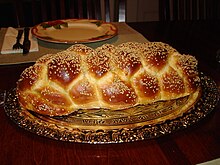
Challah — a type of braided bread made on Shabbat, originally in Ashkenazi cuisine

Shabbat and festival breads of the Yemenite Jews have become popular in Israel and can be bought frozen in supermarkets.

Jachnun is very thinly rolled dough, brushed with oil or fat and baked overnight at a very low heat, traditionally served with a crushed or grated tomato dip, hard-boiled eggs and skhug. Malawach is a thin circle of dough toasted in a frying pan. Kubaneh is a yeast dough baked overnight and traditionally served on Shabbat morning. Lahoh is a spongy, pancake-like bread made of fermented flour and water, and fried in a pan. Jews from Ethiopia make a similar bread called injera from millet flour.[76]

Pita bread is a double-layered flat or pocket bread traditional in many Middle Eastern and Mediterranean cuisines. It is baked plain, or with a topping of sesame or nigella seeds or za'atar.

Pita is used in multiple ways, such as stuffed with falafel, salads or various meats as a snack or fast food meal; packed with schnitzel, salad and French fries for lunch; filled with chocolate spread as a snack for schoolchildren; or broken into pieces for scooping up hummus, eggplant and other dips.

A lafa is larger, soft flatbread that is rolled up with a falafel or shawarma filling.[77] Various ethnic groups continue to bake traditional flat breads. Jews from the former Soviet republic of Georgia make the flatbread, lavash.[74]

Confections, sweets and snack foods
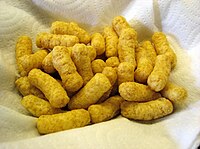
Bamba (puffed maize stuffed with peanut butter)

Milky pudding topped with whipped cream

Baklava is a nut-filled phyllo pastry sweetened with syrup served at celebrations in Jewish communities who originated in the Middle East.[78] It is also often served in restaurants as dessert, along with small cups of Turkish coffee.

Kadaif is a pastry made from long thin noodle threads filled with walnuts or pistachios and sweetened with syrup; it is served alongside baklava.

Halva is a sweet, made from tehina and sugar, and is popular in Israel. It is used to make original desserts like halva parfait.[79]

Ma'amoul are small shortbread pastries filled with dates, pistachios or walnuts (or occasionally almonds, figs, or other fillings).

Ozne Haman is a sweet yeast dough filled with crushed nuts, raisins, dried apricots, dates, halva or strawberry jam then oven baked, a specialty of Purim. The triangular shape may have been influenced by old illustrations of Haman, in which he wore a three-cornered hat

Sunflower seeds, called garinim (literally, seeds), are eaten everywhere, on outings, at stadiums and at home, usually purchased unshelled and are cracked open with the teeth. They can be bought freshly roasted from shops and market stalls that specialize in nuts and seeds as well as packaged in supermarkets, along with the also well-liked pumpkin and watermelon seeds, pistachios, and sugar-coated peanuts.[80]

Bamba is a soft, peanut-flavored snack food that is a favorite of children, and Bissli is a crunchy snack made of deep-fried dry pasta, sold in various flavors, including BBQ, pizza, falafel and onion.

Malabi is a creamy pudding originating from Turkey prepared with milk or almond milk (for a kosher version) and cornstarch.

It is sold as a street food from carts or stalls, in disposable cups with thick sweet syrup and various crunchy toppings such as chopped pistachios or coconut. Its popularity has resulted in supermarkets selling it in plastic packages and restaurants serving richer and more sophisticated versions using various toppings and garnishes such as berries and fruit.[81][82] Sahlab is a similar dessert made from the powdered tubers of orchids and milk.[81]

Watermelon with feta cheese salad is a popular dessert, sometimes mint is added to the salad.

Krembo is a chocolate-coated marshmallow treat sold only in the winter, and is a very popular alternative to ice cream. It comes wrapped in colorful aluminum foil, and consists of a round biscuit base covered with a dollop of marshmallow cream coated in chocolate.[83]

Milky is a popular dairy pudding that comes in chocolate, vanilla and mocha flavors with a layer of whipped cream on top.[84]

Sauces, spices and condiments

Malawach — a type of flatbread commonly prepared by Yemenite Jews

Chili-based hot sauces are prominent in Israeli food, and are based on green or red chili peppers. They are served with appetizers, felafel, casseroles and grilled meats, and are blended with hummus and tahina. Although originating primarily from North African and Yemenite immigrants, these hot sauces are now widely consumed.[85]

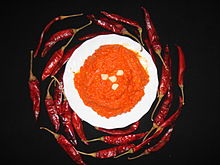
Skhug is a spicy chili pepper sauce brought to Israel by Yemenite Jews, and has become one of Israel's most popular condiments. It is added to falafel and hummus and is also spread over fish, and to white cheese, eggs, salami or avocado sandwiches for extra heat and spice.[86]

Other hot sauces made from chili peppers and garlic are the Tunisian harissa, and the filfel chuma of the Libyan Jewish community in Israel.[87]

Amba is a pickled mango sauce, introduced by Iraqi Jews, and commonly used a condiment with shawarma, kebabs, meorav yerushalmi and falafel and vegetable salads.[87]

Concentrated juices made of grape, carob, pomegranate and date are common in different regions, they are used at stews, soups or as a topping for desserts such as malabi and rice pudding.

Almond syrup flavored with rose water or orange blossom water is a common flavor for desserts and sometimes added to cocktails such as arak.

Sumac, a dark red spice is made by grinding the dried berries of the sumac bush, which is native to the Middle East, into a coarse powder. T[88]

Drinks

Assortment of Israeli beer

Turkish-style coffee in Jerusalem

There is a strong coffee-drinking culture in Israel.[89] Coffee is prepared as instant (nes), iced, latte (hafuḥ), Italian-style espresso, or Turkish coffee, which is sometimes flavored with cardamom (hel).[49] Jewish writers, artists, and musicians from Germany and Austria who immigrated to Israel before the Second World War introduced the model of the Viennese coffee house with its traditional décor, relaxed atmosphere, coffee and pastries.[90]

Cafés are found everywhere in urban areas and function as meeting places for socializing and conducting business. Almost all serve baked goods and sandwiches and many also serve light meals. There are both chains and locally owned neighborhood cafés. Most have outdoor seating to take advantage of Israel's Mediterranean climate. Tel Aviv is particularly well known for its café culture.[91]

Tea is also a widely consumed beverage and is served at cafés and drunk at home. Tea is prepared in many ways, from plain brewed Russian and Turkish-style black tea with sugar, to tea with lemon or milk, and, available as a common option in most establishments, Middle Eastern-style with mint (nana).[92] Tea with rose water is also common.

Limonana, a type of lemonade made from freshly-squeezed lemons and mint, was invented in Israel in the early 1990s and has become a summer staple throughout the Middle East.[93][94]

Rimonana is similar to limonana, made of pomegranate juice and mint.

Sahlab is a drinkable pudding once made of the powdered bulb of the orchid plant but today usually made with cornstarch. It is usually sold in markets or by street vendors, especially in the winter. It is topped with cinnamon and chopped pistachios.[95]

Malt beer, known as black beer (בִירָה שְחוֹרָה, bira shḥora), is a non-alcoholic beverage produced in Israel since pre-state times. Goldstar and Maccabi are Israeli beers. Recently, some small boutique breweries began brewing new brands of beer, such as Dancing Camel,[96] Negev,[97] and Can'an.

Arak is a Levantine alcoholic spirit (~40–63% Alc. Vol./~80–126 proof) from the anis drinks family, common in Israel and throughout the Middle East. It is a clear, colorless, unsweetened anise-flavored distilled alcoholic drink (also labeled as an apéritif).

It is often served neat or mixed with ice and water, which creates a reaction turning the liquor a milky-white colour. It is sometimes also mixed with grapefruit juice to create a cocktail known as arak eshkoliyyot.

Other spirits, brandies, liquors can be found across the country in many villages and towns.

Wine

Main article: Israeli wine

Assortment of Israeli wines from Carmel Winery, Tishbi Winery, and Golan Heights Winery

The vast majority of Israelis drink wine in moderation, and almost always at meals or social occasions. Israelis drink about 6.5 liters of wine per person per year, which is low compared to other wine-drinking Mediterranean countries, but the per capita amount has been increasing since the 1980s as Israeli production of high-quality wine grows to meet demand, especially of semi-dry and dry wines. In addition to Israeli wines, an increasing number of wines are imported from France, Italy, Australia, the United States, Chile and Argentina.[98]

Most of the wine produced and consumed from the 1880s was sweet, kosher wine when the Carmel Winery was established,[99] until the 1980s, when more dry or semi-dry wines began to be produced and consumed after the introduction of the Golan Heights Winery’s first vintage.[100] The winery was the first to focus on planting and making wines from Cabernet Sauvignon, Merlot, Sauvignon blanc, Chardonnay, Pinot noir, white Riesling and Gewürztraminer. These wines are kosher and have won silver and gold medals in international competitions.[101]

Israeli wine is now produced by hundreds of wineries, ranging in size from small boutique wineries in the villages to large companies producing over 10 million bottles per year, which are also exported worldwide.

Wine made of fruits other than grapes such as fig, cherry, pomegranate, carob and date are also common in the country.

Non-kosher foods

Foods variously prohibited in Jewish dietary laws (kashrut) and in Muslim dietary laws (halal) may also be included in pluralistic Israel's diverse cuisine. Although partly legally restricted,[102][103] pork and shellfish are available at many non-kosher restaurants (only around a third of Israeli restaurants have a kosher license[104]) and some stores all over the country which are widely spread, including by the Maadaney Mizra, Tiv Ta'am and Maadanei Mania[105] supermarket chains.[106]

A modern Hebrew euphemism for pork is "white meat".[106] Despite Jewish and Muslim religious restrictions on the consumption of pork, pigmeat consumption per capita was 2.7 kg (6.0 lb) in 2009.[107]

A 2008 survey reported that about half of Israeli Jews do not always observe kashrut.[108] Israel's anomalous equanimity toward its religious dietary restrictions may be reflected by the fact that some of the Hebrew cookbooks of Yisrael Aharoni are published in two versions: kosher and non-kosher editions.

Eating out

Street foods

In Israel, as in many other Middle Eastern countries, "street food" is a kind of fast food that is sometimes literally eaten while standing in the street, while in some cases there are places to sit down. The following are some foods that are usually eaten in this way:

Falafel in a pita with various vegetables and condiments
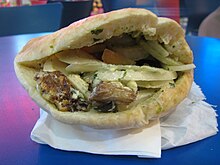
Sabich — a type of pita sandwich traditionally prepared by Iraqi Jews

Falafel are fried balls or patties of spiced, mashed chickpeas or fava beans and are a common Middle-Eastern street food that have become identified with Israeli cuisine. Falafel is most often served in a pita, with pickles, tahina, hummus, cut vegetable salad and often, harif, a hot sauce, the type used depending on the origin of the falafel maker.[12]

Variations include green falafel, which include parsley and coriander, red falafel made with filfel chuma, yellow falafel made with turmeric, and falafel coated with sesame seeds.[109]

Shawarma, (from çevirme, meaning "rotating" in Turkish) is usually made in Israel with turkey, with lamb fat added. The shawarma meat is sliced and marinated and then roasted on a huge rotating skewer.

The cooked meat is shaved off and stuffed into a pita, with hummus and tahina, or with additional trimmings such as fresh or fried onion rings, French fries, salads and pickles. More upscale restaurant versions are served on an open flat bread, a lafa, with steak strips, flame roasted eggplant and salads.[110]

Shakshouka, originally a workman's breakfast popularized by North-African Jews in Israel, is made simply of fried eggs in spicy tomato sauce, with other vegetable ingredients or sausage optional.

Shakshouka is typically served in the same frying pan in which it is cooked, with thick slices of white bread to mop up the sauce, and a side of salad. Modern variations include a milder version made with spinach and feta without tomato sauce, and hot-chili shakshouka, a version that includes both sweet and hot peppers and coriander.[111] Shakshouka in pita is called shakshouka be-pita.[112]

Jerusalem mixed grill, or me'urav Yerushalmi, consists of mixed grill of chicken giblets and lamb with onion, garlic and spices. It is one of Jerusalem's most popular and profitable street foods.[113] Although the origin of the dish is in Jerusalem, it is today common in all of the cities and towns in Israel.

Jerusalem bagels, unlike the round, boiled and baked bagels popularized by Ashkenazi Jews, are long and oblong-shaped, made from bread dough, covered in za’atar or sesame seeds, and are soft, chewy and sweet. They have become a favorite snack for football match crowds, and are also served in hotels as well as at home.[114]

Malabi is a creamy pudding originating from Turkey prepared with milk or cream and cornstarch. It is sold as a street food from carts or stalls, in disposable cups with thick sweet syrup and various crunchy toppings such as chopped pistachios or coconut. Its popularity has resulted in supermarkets selling it in plastic packages and restaurants serving richer and more sophisticated versions using various toppings and garnishes such as berries and fruit.[81][82] Sahlab is a similar dessert made from the powdered tubers of orchids and milk.[81]

Sabikh is a traditional sandwich that Mizrahi Jews introduced to Israel and is sold at kiosks throughout the country, but especially in Ramat Gan, where it was first introduced. Sabiḥ is a pita filled with fried eggplant, hardboiled egg, salad, tehina and pickles.[115]

Tunisian sandwich is usually made from a baguette with various fillings that may include tuna, egg, pickled lemon, salad, and fried hot green pepper.[115]

Places to eat

Kubbeh — a type of beet stew traditionally prepared by Iraqi Jews

There are thousands of restaurants, casual eateries, cafés and bars in Israel, offering a wide array of choices in food and culinary styles.[116][117] Places to eat out that are distinctly Israeli include the following:

Falafel stands or kiosks are common in every neighborhood. Falafel vendors compete to stand apart from their competitors and this leads to the offering of additional special extras like chips, deep-fried eggplant, salads and pickles for the price of a single portion of falafel.[109]

A hummusia is an establishment that offers mainly hummus with a limited selection of extras such as tahina, hardboiled egg, falafel, onion, pickles, lemon and garlic sauce and pita or taboon bread.[118]

Misada Mizrahit (literally "Eastern restaurant") refers to Mizrahi Jewish, Middle-Eastern or Arabic restaurants. These popular and relatively inexpensive establishments often offer a selection of meze salads followed by grilled meat with a side of french fries and a simple dessert such as chocolate mousse for dessert.[119]

Steakiyot are meat grills selling sit down and take-away chicken, turkey or lamb as steak, shishlik, kebab and even Jerusalem mixed grill, all in pita or in taboon bread.[120]

Holiday cuisine

Sabbath

Cholent (or hamin), a traditional slow-cooked stew prepared for Shabbat by Ashkenazi Jews and Sephardi Jews

Friday night (eve of Shabbat) dinners are usually family and socially oriented meals. Along with family favorites, and varying to some extent according to ethnic background, traditional dishes are served, such as challah bread, chicken soup, salads, chicken or meat dishes, and cakes or fruits for dessert.

Shabbat lunch is also an important social meal. Since antiquity, Jewish communities all over the world devised meat casseroles that begin cooking before lighting of candles that marks the commencement of Shabbat on Friday night, so as to comply with religious regulations for observing Shabbat.

In modern Israel, this filling meal, in many variations, is still eaten on the Sabbath day, not only in religiously observant households, and is also served in some restaurants during the week.[121]

The basic ingredients are meat and beans or rice simmered overnight on a hotplate or blech, or placed in a slow oven. Ashkenazi cholent usually contains meat, potatoes, barley and beans, and sometimes kishke, and seasonings such as pepper and paprika.

Sephardi hamin contains chicken or meat, rice, beans, garlic, sweet or regular potatoes, seasonings such as turmeric and cinnamon, and whole eggs in the shell known as haminados.[122][123]

Moroccan Jews prepare variations known as dafina or skhina (or s′hina) with meat, onion, marrow bones, potatoes, chickpeas, wheat berries, eggs and spices such as turmeric, cumin, paprika and pepper. Iraqi Jews prepare tebit, using chicken and rice.[121][124]

For desserts or informal gatherings on Shabbat, home bakers still bake a wide variety of cakes on Fridays to be enjoyed on the Sabbath, or purchased from bakeries or stores, cakes such as sponge cake, citrus semolina cake, cinnamon or chocolate babkas, and fruit and nut cakes.[67]

Rosh Hashanah
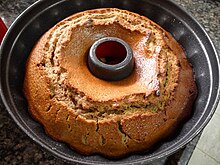
Lekach — a cake traditionally prepared in Ashkenazi cuisine for Rosh HaShanah

Rosh Hashana, the Jewish New Year, is widely celebrated with festive family meals and symbolic foods. Sweetness is the main theme and the Rosh Hashana dinners typically begin with apples dipped in honey, and end with honey cake.

The challah is usually round, often studded with raisins and drizzled with honey, and other symbolic fruits and vegetables are eaten as an entree, such as pomegranates, carrots, leeks and beets.[125]

Fish dishes, symbolizing abundance, are served; for example, gefilte fish is traditional for Ashkenazim, while Moroccan Jews prepare the spicy fish dish, chraime.

Honey cake (lekach) is often served as dessert, accompanied by tea or coffee.[125] Dishes cooked with pomegranate juice are common during this period.

Hanukkah

Sufganiyot dou— jelly-filled round doughnuts traditionally prepared in Ashkenazi cuisine during Hanukkah

The holiday of Hanukkah is marked by the consumption of traditional Hanukkah foods fried in oil in commemoration of the miracle in which a small quantity of oil sufficient for one day lasted eight days.

The two most popular Hannukah foods are potato pancakes, levivot, also known by the Yiddish latkes; and jelly doughnuts, known as sufganiyot in Hebrew, pontshkes (in Yiddish) or bimuelos (in Ladino), as these are deep-fried in oil.[126]

Hannukah pancakes are made from a variety of ingredients, from the traditional potato or cheese, to more modern innovations, among them corn, spinach, zucchini and sweet potato.[125]

Bakeries in Israel have popularized many new types of fillings for sufganiyot besides the standard strawberry jelly filling, and these include chocolate, vanilla or cappuccino cream, and others. In recent years downsized, "mini" sufganiyot have also appeared due to concerns about calories.[127]

Tu BiShvat

Dried fruits and almonds, typically eaten on Tu BiShvat

Tu BiShvat is a minor Jewish holiday, usually sometime in late January or early February, that marks the "New Year of the Trees". Customs include planting trees and eating dried fruits and nuts, especially figs, dates, raisins, carob, and almonds.[128]

Many Israelis, both religious and secular, celebrate with a kabbalistic-inspired Tu BiShvat seder that includes a feast of fruits and four cups of wine according to the ceremony presented in special haggadot modeled on the Haggadah of Passover for this purpose.[129]

Purim
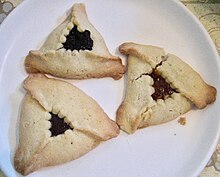
Oznei Haman — a triangular pastry prepared in Ashkenazi cuisine for the celebrations of Purim

The festival of Purim celebrates the deliverance of the Jewish people from the plot of Haman to annihilate them in the ancient Persian Achaemenid Empire, as described in the Book of Esther.

It is a day of rejoicing and merriment, on which children, and many adults, wear costumes.[130] It is customary to eat a festive meal, seudat Purim,[131] in the late afternoon, often with wine as the prominent beverage, in keeping with the atmosphere of merry-making.[130]

Many people prepare packages of food that they give to neighbors, friends, family, and colleagues on Purim. These are called mishloach manot ("sending of portions"), and often include wine and baked goods, fruit and nuts, and sweets.[130]

The food most associated with Purim is called oznei haman ("Haman's ears"). These are three-cornered pastries filled most often with poppy seeds, but also other fillings. The triangular shape may have been influenced by old illustrations of Haman, in which he wore a three-cornered hat.[132]

Passover

The week-long holiday of Passover in the spring commemorates the Exodus from Egypt, and in Israel is usually a time for visiting friends and relatives, travelling, and on the first night of Passover, the traditional ritual dinner, known as the Seder.

Foods containing ḥametz—leavening or yeast—may not be eaten during Passover. This means bread, pastries and certain fermented beverages, such as beer, cannot be consumed. Ashkenazim also do not eat legumes, known as kitniyot.

Over the centuries, Jewish cooks have developed dishes using alternative ingredients and this characterizes Passover food in Israel today.[133]

Chicken soup with matzah dumplings (kneidlach) is often a starter for the Seder meal among Israelis of all ethnic backgrounds.[133] Spring vegetables, such as asparagus and artichokes often accompany the meal.[133]

Restaurants in Israel have come up with creative alternatives to ḥametz ingredients to create pasta, hamburger buns, pizza, and other fast foods in kosher-for-Passover versions by using potato starch and other non-standard ingredients.

After Passover, the celebration of Mimouna takes place, a tradition brought to Israel by the Jewish communities of North Africa. In the evening, a feast of fruit, confectionery and pastries is set out for neighbors and visitors to enjoy. Most notably, the first leaven after Passover, a thin crepe called a mofletta, eaten with honey, syrup or jam, is served.[134] The occasion is celebrated the following day by outdoor picnics at which salads and barbecued meat feature prominently.

Shavuot

In the early summer, the Jewish harvest festival of Shavuot is celebrated. Shavuot marks the peak of the new grain harvest and the ripening of the first fruits, and is a time when milk was historically most abundant.

To celebrate this holiday, many types of dairy foods (milchig) are eaten. These include cheeses and yogurts, cheese-based pies and quiches called pashtidot, cheese blintzes, and cheesecake prepared with soft white cheese (gvina levana) or cream cheese.[135]

Allegations of cultural appropriation

The labelling of the foodstuffs originating outside of Israel as "Israeli" has led to the charge of cultural appropriation being raised by some critics.[6][failed verification] A notable example that has been lamented by Palestinians, Lebanese and other Arab populations is falafel,[6] which has been proclaimed as an Israeli national dish despite being of likely Egyptian origin.[136][137] Though never a specifically Jewish dish, it has been long been consumed by Syrian and Egyptian Jews,[138][139] and was adopted into the diet of early Jewish immigrants to the Jewish communities of Ottoman Syria.[6] As it is plant-based, Jewish dietary laws classify it as pareve and thus allow it to be eaten with both meat and dairy meals.[140] Palestinian-Jordanian academic Joseph Massad has characterized the celebration of falafel and other dishes of Arab origin in American and European restaurants as Israeli to be part of a broader trend of "colonial conquest".[141] The Lebanese Industrialists' Association has raised assertions of copyright infringement against Israel concerning falafel.[139][142] [143]

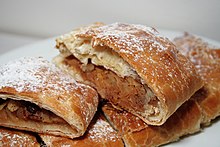
belarus

Belarusian cuisine (Belarusian: Беларуская кухня, romanized: Biełaruskaja kuchnia) refers to the culinary traditions native to Belarus. It shares many similarities with cuisines of other Eastern, Central and Northeastern European countries, based predominantly on meat and various vegetables typical for the region.

History[edit]

Belarus cuisine has predominantly Slavic roots. Along with a Ruthenian influence, it is also linked with Lithuanian and Polish because of the long intermingling of these three peoples; first within the Grand Duchy of Lithuania (11th–16th centuries) and later within the Polish–Lithuanian Commonwealth (16th–17th centuries). Though the Belarusian nobility, like the Polish elite, borrowed much from Italian, German, and French cuisines, this influence hardly made itself felt in the diet of the peasant majority.[citation needed] Still, some of the borrowed dishes spread throughout the society, such as lazanki (a mixture of flour dumplings and stewed meat, related to Italian lasagna) and, above all, various dishes made of grated potatoes, typical for German cuisine.

The political upheavals of the 20th century completely wiped out the former privileged classes and many traditional upper and middle class dishes went down the path of oblivion. The very idea of a separate Belarusian cuisine was treated with suspicion. Only after World War II did it occur to the communist authorities that the proclaimed ‘flourishing of national culture’ should also be evident in the cuisine. The only source permitted for such a culinary reconstruction was the heritage of the poorest peasants as of the 1880s, a time when primitive rural lifestyle was already on the wane. Chefs were instructed by the Party to create the new Belarusian cuisine from scratch. Dish names, recipes, "authentic" kitchenware – all were reinvented anew, as though ten centuries of history had never existed. Only the sudden advent of independence in 1991 brought an opportunity to restore these lost traditions, and a great deal still remains to be done here.

Modern Belarusian cuisine is still heavily influenced by its recent Soviet past, and many local restaurants feature Russian or Soviet dishes rather than true specialties of local cuisine. However, draniki (both plain and stuffed), boršč, chaładnik, mačanka, zrazy, cold meat rolls, eggs stuffed with mushrooms, hałubcy, fried raw pork sausage and blini are likely to be found everywhere, as well as sour rye bread.

Meals[edit]

A traditional peasant or merchant's dinner consisted of just two dishes: soup and a main course. A special kind of pot, the sparysh, with two compartments, was used by farmers' children to bring lunch to their father working in the fields. Prior to World War II, salads or other snacks were not very common, and recipes based on Russian models tended to appear in modern Belarusian postwar cookbooks. Fresh white cheese and various kinds of cold meats (usually smoked) were available, however, at least on holidays.

Cereals[edit]

Since wheat does not grow well in a cold and wet climate, Belarusians were always fond of a kind of somewhat sour rye bread, and the most traditional hard drink, the local vodka or harelka (Belarusian: гарэлка), was distilled primarily from a rye malt.

Like other Slavic peoples, Belarusians could boast of a huge variety of bliny (pancakes) of various thickness, plain and filled, made mostly of wheat or buckwheat flour, but also using oatmeal (tsadaviki).

Various kinds of cereal, especially barley, oatmeal and buckwheat, were common. Belarus was the likely centre of Europe's buckwheat culture, and dishes made with this healthy grain used to be very popular: various kinds of buns, cakes and dumplings which, except for the well-known "kasha", no longer exist today.

Vegetables[edit]

The main vegetables were cabbage (often made into sauerkraut) and beets, while turnips, swedes, parsnip and carrots both stewed and boiled (with the addition of a small amount of milk) were somewhat less popular. As elsewhere in Europe, legumes were the main source of protein, mainly in the form of kamy (puree of peas or beans with melted lard).

Soups[edit]

The word soup was not known in Belarus until the 18th century when the nobility borrowed it from German, but soup as a type of dish clearly existed centuries earlier. The old word for most traditional Belarusian soups was poliŭka (Belarusian: поліўка), except for those named after the vegetable that was the main ingredient: kapusta (cabbage soup), buraki (beet soup), gryžanka (swede soup). For a typical poliŭka the major ingredients (fish or mushrooms during fasts) were first boiled with spices; cereals such as barley or millet were boiled in the stock, and then flour blended with water, bread kvass, beet juice or buttermilk was added to the stock. Black poliŭka, made with goose or pork blood, is closely related to the Swedish "black soup" svartsoppa. Offering a matchmaker black poliŭka was the polite way for the bride's parents to decline a young man's proposal. Like the Ukrainians, Russians and Poles, Belarusians are fond of borscht, a thick and rich beet and cabbage soup made with grains, potato and meat. Soups are much more authentic, both hot (shchi, boršč, sorrel soup) and especially cold sour soups which provide cooling relief during the hot summer.

The Belarusian chaladnik (Belarusian: халаднік), a cold borscht made of beets, beet leaves or sorrel and served with sour cream, hard-boiled eggs, and boiled potatoes, has been a popular dish also in Polish and Lithuanian cuisines since the late 18th century.

Meat[edit]

Wrapped palyandvitsa

Sliced palyandvitsa

Meat was in rather scarce supply for most people, and was primarily eaten only on the main Christian holidays. Avid consumers of pork, Belarusians are less partial to mutton and beef. Most common was raw pork sausage – a pig intestine stuffed with minced or chopped meat seasoned with salt, pepper, and garlic. Its common name – "finger-stuffed sausage" (Belarusian: каўбаса, «пальцам пханая» or in short пальцоўка) – provided a graphic description of the primitive production technology.[1] Kishkа (Belarusian: кішка), or kryvyanka (Belarusian: крывянка), was a local blood sausage (Belarusian: крывяная каўбаса) made of pig's blood and buckwheat grain. Škalondza (Belarusian: шкалондза), or kindziuk (Belarusian: кіндзюк), a particular kind of round sausage made of pig stomach filled with pork minced with spices[2] – a relative of the Lithuanian skilandis – was known throughout the country. Borrowed from Italian cuisine by nobility in the 16th century, cold meat rolls, salcesons and balerons were common to all of society by the 19th century, and are still very popular. Smoked goose breast pauguski (Belarusian: паўгускі), a local Belarusian and Lithuanian delicacy, was once the pride of middle-class cuisine, but no longer exists today.

Veraščaka (Belarusian: верашчака), an 18th-century thick meat gravy with pieces of meat and sausage used as a dip or sauce for thick pancakes, is still one of the most popular specialties of Belarusian restaurants today, although it is now generally called mačanka (Belarusian: мачанка, a dip). Also popular are zrazy, chopped pieces of beef rolled into a sausage shape and filled with vegetable, mushroom, eggs, potato etc. Pork dishes are usually fried or stewed, garnished with cheese or mushrooms. Beef steaks are also quite frequent, but mutton, once very popular, is almost entirely limited to Caucasian or Central Asian restaurants, although still quite a few eat it today.

Dumplings[edit]

Kalduny, small boiled dumplings related to Russian pelmeni and Italian ravioli, were produced in endless combinations of dough, filling and sauce. Especially popular were kalduny Count Tyshkevich (filled with a mixture of fried local mushrooms and smoked ham). In the late 19th century kalduny began to be made with grated potato rather than with a flour-based dough and the former huge variety of fillings shrank considerably.[citation needed] Today, kalduny have to struggle vigorously to regain their former popularity, now overtaken by the Russian pelmeni.[citation needed]

Dairy foods[edit]

The main dairy foods include a kind of fresh white cheese (Belarusian: тварог) and sour cream (Belarusian: смятана), which is widely used both in cooking and as a garnish. Only in the mid-19th century was fermented cheese (Belarusian: сыр) borrowed from the Netherlands and Switzerland, and the local version of Edam was very popular for decades in the Russian Empire. Sour butter from the former Dzisna county was exported to Britain, where it continued to be the most expensive variety up to World War I. Today, however, these traditions have become a thing of the past.

Beverages[edit]

A mug of kvass, a fermented beverage made from black rye or rye bread

The traditional hard drink is vodka or harelka (Belarusian: гарэлка), including varieties made from birch sap (biarozavik, Belarusian: бярозавік) or flavored with forest herbs (zubrovka, Belarusian: зуброўка). Mead and similar alcoholic drinks made of honey and spices were very common up until the 19th century and then more or less disappeared until the latest revival of the national cuisine. A notable example in this group is krambambula (Belarusian: крамбамбуля), vodka diluted with water, mixed with honey, and flavored with spices (nutmeg, cinnamon, cloves, red and black pepper). In the 18th century this drink competed with French champagne in Belarus and only wealthy people could afford it. Today it is enjoying a popular revival, as is evident from the appearance of krambambula recipes and histories on the Internet.[3][4]

Kvass traditionally was and still remains the main local non-alcoholic drink, although it is increasingly made with sugars and artificial flavorings rather than with genuine rye malt and natural flavorings. Kompot is also a relatively popular beverage, normally made of dried or fresh fruit, boiled, and then cooled. Every small town boasts a local variety of mineral water. Belarusians prefer carbonated water.

Тraditional liquid desserts that accompany a meal include saladucha (Belarusian: саладуха), a thick liquid made of rye flour and honey that was popular in the 18th century, and kissel, the traditional jelly drink of Eastern Europe made from the pulp of forest berries or cooked fruits, originally thickened with oatmeal (now replaced by potato starch flour or cornstarch).

Minority cuisines[edit]

Belarusian potato babka

Belarusian cuisine owes much to Jewish cooking. In the 19th century, Jewish influence was especially noticeable in bringing in potato dishes of German origin, such as babka. This was a two-way gastronomic street, for the famous bulbe latkes, the potato pancakes of the East European Jews, may have been borrowed from the Belarusian draniki.

Another important minority ethnic group which influenced Belarusian cuisine were the Lipka Tatars, whose Tatar cuisine was especially strong in various cakes with fillings, mutton and vegetable dishes.

Potatoes[edit]

Belarus is known for farming potatoes just like Ukraine is known for farming wheat. The humble potato became so common in the 19th century that there are more than 300 potato dishes recorded in Belarus and it came to be considered the core ingredient of the national cuisine. In the Russian Empire[5] and Soviet Union, Belarusians were sometimes called bulbashi, a pejorative conjugation of the Belarusian word for potato.

Salads[edit]

Typical salads are made of a fairly short list of ingredients, combining boiled beef or chicken, potato, beet, carrot, apple, herring, diced cheese, canned peas and corn, canned fish, ‘crab fingers’, onions and mushrooms, generously seasoned with mayonnaise or sunflower oil. One of the most typical local salads is the "Belaya Vezha" salad (named after the Belaya Vezha Forest), which combines boiled chicken meat with fried mushrooms, onions, and pickled cucumbers, mixed with mayonnaise and garnished with chopped hard-boiled egg.[6] Fresh vegetable salads are also widely available: tomatoes (also mixed with cucumbers) and onions seasoned with sour cream; radishes with dill and sunflower oil (or sour cream); shredded cabbage salad seasoned with sunflower oil or mayonnaise (similar to coleslaw); and pickled cabbage with caraway seeds or cranberries with onions seasoned with sunflower oil are common.

Fish[edit]

Historically, Belarusians had little access to seafood, and this is still evident in the cuisine. The most common sea fish (after herring, which has been the most common appetizer all along the Baltic coast and its vicinity ever since the 14th century) are hake and cod and there are relatively few dishes with such fish. Much more traditional and common are lake fish, notably zander, cooked in a wide variety of ways, and carp (especially the famous stuffed carp, the gefilte fish of Jewish cuisine). Eels, smoked or stuffed, are the specialty of the lake country in the northwestern part of Belarus, adjacent to Latvia and Lithuania.

Side dishes[edit]

Side dishes are usually boiled, fried or mashed potatoes, buckwheat kasha, rice or pasta. Meat dishes are frequently served with bliny or draniki stacked in round clay pots.

united arab

Emirati cuisine is the local traditional Arabic cuisine of the United Arab Emirates. It is part of Eastern Arabian cuisine and shares similarities with cuisines from neighboring countries, such as Omani cuisine and Saudi Arabian cuisine, as well as influences from different Middle Eastern and Asian cuisines.

As a major international hub, the United Arab Emirates today has a multicultural variety of cuisines from different parts of the world.

History[edit]

Origins[edit]

See also: History of the United Arab Emirates

Cultivation of date palms in the area can be traced back to the mid-third millennium BC (commonly referred to as the Umm al-Nar period in the United Arab Emirates) from which many date seeds have been found in Umm al-Nar sites. The presence of grinding stones and fired clay ovens in archaeological sites indicate that grain processing was also performed. Studies of human dental remains dating back to the third millennium show a high level of attrition which is believed to result from the mastication of dry bread.[1]

Modern historical history[edit]

The cuisine which originated in the area that is now the United Arab Emirates and was previously the Trucial States is formed by a similar Arabic and Middle Eastern cuisine which is consumed in the wider Arabian Peninsula. The food is a mixture of a Bedouin diet, consisting of meat and camel milk, a fisherman's diet, consisting mainly of fish common in the Persian Gulf, and a farmer's diet, consisting mainly of dates. A blend of these diets as well as a mixture of spices such as cinnamon, saffron, and turmeric formed the basis of the common dishes consumed in the Trucial states region and the current traditional Emirati cuisine.[2]

The traditional food of the United Arab Emirates uses much meat, grain, and dairy. Vegetables that are easy to grow in fertile soil, such as cucumbers and tomatoes, are strongly featured in the diet. Mangos are also grown, usually in the northern emirates in villages such as Masafi. Meats traditionally used are chicken or small fowl, such as Houbara bustards, and goats. As camels are highly prized for their milk and transporting ability, the eating of camel meat is normally reserved for special occasions.

The dishes are usually like stews, as everything is often cooked in a single pot. Saffron, cardamom, turmeric, and thyme are the core flavors used in Emirati cookery. Rice was added to the diet when traders moved to the region.[when?] Leaves from indigenous trees, such as the ghaff, were also used to stuff small birds for enhanced flavor.

Traditional dishes include maq'louba, margooga, harees, machbous, frsee'ah, fireed, jisheid, and mishwy. Breakfast in the UAE usually features breads like raqaq, khameer, and chebab, served with cheese, date syrup, or eggs. These were made over a curved hot plate, resembling a stone, which would have been used by the Bedouins. Balaleat is another dish, but its advent began with the traders, who introduced pasta.

Sweet options include luqeymat, a deep-fried ball of pancake batter that is rolled in sesame seeds and then drizzled with date honey. Other desserts include khabeesa, bread crumbs blended with sugar, cardamom, and saffron, or bethitha, semolina blended with crushed dates, cardamom, and clarified butter.

At the close of the meal, it is usual to serve a red tea infused with mint as a digestive. Other mealtime traditions include a welcome with dates and gahwah (Arabic coffee), which are offered on arrival and are kept available throughout the guest's visit.

Levantine cuisine is sometimes confused with Emirati/Gulf, but shawarma, hummous, tabbouleh, and mixed grill, whilst having similar characteristics, are fairly recent additions to the Emirati diet. [citation needed]

Foods and dishes[edit]

Further information: Eastern Arabian cuisine

Kuboos (flatbread) being prepared in Abu Dhabi

Seafood has been the mainstay of the Emirati diet for centuries.[3] The United Arab Emirates cuisine is a reflection of an Arabian heritage and exposure to other civilizations over time. As the consumption of pork is forbidden under Muslim law, it is not included in most menus. Hotels frequently have pork substitutes such as beef, chicken, sausage, and veal rashers on their breakfast menus. If pork is available, it is clearly labelled as such.

Meat, fish, and rice are the staple foods of Emirati cuisine. Lamb and mutton are the more favored meats rather than goat, beef, and camel meat. Dates are usually consumed with meals.

Popular beverages are coffee and tea, which can be supplemented with cardamom, saffron, or mint to give it a distinct flavor.[4]

Alcohol is generally only served in hotel restaurants and bars (but not in Sharjah). All nightclubs and golf clubs are permitted to sell alcohol. Specific supermarkets may sell pork in a separate section of the market.[5]

Dishes forming part of the Emirati cuisine include:[6][7]

  • Asida
  • Al Jabab bread
  • Balaleet
  • Bathieth
  • Harees
  • Jami
  • Jasheed[8]
  • Kabsa
  • Khabees
  • Khanfroush
  • Khamir bread
  • Machboos[9]
  • Madroob
  • Markouka
  • Maqluba
  • Muhala bread
  • Quzi
  • Salona[8]
  • Shawarma[10]
  • Tharid
  • Waggafi bread[8]

Beverages[edit]

Traditional Arabic tea in the UAE

  • Camel milk
  • Soft drinks
  • Tea
  • Water
  • Juice
  • Laban
  • Arabic coffee
  • Arabic tea

Events[edit]

Dubai Food Festival[edit]

The inaugural Dubai Food Festival was held from 21 February to 15 March 2014.[11] According to Vision the event was aimed at enhancing and celebrating Dubai's position as the gastronomic capital of the region. The festival was designed to showcase the variety of flavours and cuisines on offer in Dubai featuring the cuisines of over 200 nationalities at the festival.[12]

tajikistan

Tajik cuisine is a traditional cuisine of Tajikistan, and has much in common with Russian, Afghan, Iranian and Uzbek cuisines. Plov (pilaf) (Tajik: палав, Uzbek: palov), also called osh (Tajik: ош), is the national dish in Tajikistan, as in other countries in the region. Green tea is the national drink.

Common foods and dishes[edit]

Eating qurutob the traditional way: with one's hands

Palav or osh, generically known as plov (pilaf), is a rice dish made with shredded yellow turnip or carrot, and pieces of meat, all fried together in vegetable oil or mutton fat in a special qazan (a wok-shaped cauldron) over an open flame. The meat is cubed, the carrots are chopped finely into long strips, and the rice is colored yellow or orange by the frying carrots and the oil. The dish is eaten communally from a single large plate placed at the center of the table, often in with one's hands in the traditional way.

Another traditional dish that is still eaten with hands from a communal plate is qurutob (Tajik: қурутоб), whose name describes the preparation method: qurut (Tajik: қурут, dried balls of salty cheese) is dissolved in water (Tajik: об, ob) and the liquid is poured over strips of а thin flaky flatbread (patyr or fatir, Tajik: фатир, or more accurately фатир равғанӣ, fatir ravghani, i.e., fatir made with butter or tallow for flakiness). Before serving the dish is topped with onions fried in oil until golden and other fried vegetables. No meat is added. Qurutob is considered the national dish.

A selection of traditional non at the market.

A Tajik man makes plov.

Meals are almost always served with non (Tajik: нон), flatbread found throughout Central Asia. If a Tajik has food but not non, he will say he is out of food. If non is dropped on the ground, people will put it up on a high ledge for beggars or birds. Legend holds that one is not supposed to put non upside down because this will bring bad luck. The same holds if anything is put on top of the non, unless it is another piece of non.[1]

Breakfast usually consists of tea, kulcha (Tajik flatbread) or non with butter, kolbasa (sausage-like meat product), smetana (sour cream), kaymak, jam, Nutella, and eggs. Fruits such as berries, grapes, apples, peaches, and apricots are eaten too during the summer. Kompot (a non-alcoholic sweet beverage that may be served hot or cold and is made with fruits) is often drunk as well.

Traditional Tajik soups include mainly meat and vegetable soups (such as shurbo and piti), and meat soups with noodles (such as laghmon and ugro). Other dishes shared regionally, either as fast food or as an appetizer, include manti (steamed meat dumplings), tushbera (pelmeni), sambusa (a triangular pastry with either a meat and onion stuffing or a pumpkin and onion stuffing, baked in a tandoor oven), and belyash (pl. belyashi, Tajik: беляши, deep-fried cakes made of yeast dough and filled with minced meat, similar to pirozhki).

Soviet cuisine both influenced and was in turn influenced by Tajik cuisine.[2]

Dairy products[edit]

Dairy dishes, usually served as part of the spread of appetizers in a Tajik meal and scooped with pieces of flatbread, include chaka (a sour milk preparation), thick yogurt, and kaymak (high-fat clotted cream). Qurut balls may be served as a snack or an accompaniment to cold beverages. Although not a traditional Tajik drink, kefir, a drinking yogurt, is often served with breakfast.

Summer produce[edit]

In the summer, Tajikistan abounds in produce and fruit; its grapes and melons were famous throughout the former Soviet Union. The bazaar also sells pomegranates, apricots, plums, peaches, apples, pears, figs, and persimmons.

Beverages[edit]

Tea generally accompanies every meal and is frequently offered between meals as a gesture of hospitality to guests and visitors. It is served hot in a china pot with a lid, and is drunk with sugar from small saucer-less cups without handles (piola). Because of the universal popularity of tea-drinking, the choykhona, or teahouse, is the most common gathering place in Tajikistan, and is similar to the Western-style coffee house.

hungary

Hungarian or Magyar cuisine (Hungarian: Magyar konyha) is the cuisine characteristic of the nation of Hungary, and its primary ethnic group, the Magyars. Hungarian cuisine has been described as being the spiciest cuisine in Europe.[1][2] This can largely be attributed to the use of their piquant native spice, Hungarian paprika, in many of their dishes. A mild version of the spice, Hungarian sweet paprika, is commonly used as an alternative.[3] Traditional Hungarian dishes are primarily based on meats, seasonal vegetables, fruits, bread, and dairy products.

General features[edit]

Hungarian cuisine is mostly continental Central European, with some elements from Eastern Europe such as the use of poppy, and the popularity of kefir and quark. Paprika is often associated with Hungary and is used prominently in several dishes. Traditional Hungarian paprika is characterised by its bright colour and distinct heat, differentiating it from milder variations of paprika popular elsewhere in the world.[4] Other herbs and spices commonly used in Hungarian cuisine include garlic, marjoram, caraway seeds, celery seeds and dill seeds.[5] Typical Hungarian food is heavy on dairy and meats, similar to that of neighboring Czech and Slovak cuisines. Chicken, pork and beef are common, while turkey, duck, lamb, fish and game meats are mostly eaten on special occasions. Hungary is also known for relatively inexpensive salamis and sausages it produces primarily from pork, but also poultry, beef and others.

Bread is perhaps the most important and basic part of the Hungarian diet. It is eaten at all meals, accompanying main dishes. Before the fall of communism in 1990, white bread was a staple food. Numerous other types of baked goods, such as buns and pastries both salty and sweet, often creatively filled, have proliferated in recent years.

Main dishes may "require" a side dish (köret) or not. It is unusual to violate this convention. The side dish is most commonly potato in various styles, but rice or steamed vegetables are also popular. Some foods have a customary side dish (e.g., csirkepaprikás 'paprika chicken' is almost always eaten with small dumplings similar to gnocchi (nokedli), while others may take any side dish (e.g., rántott sajt 'fried cheese'). Some dishes also have toppings or bread on the side considered almost mandatory, for example, the sour cream and bread with töltött káposzta 'stuffed cabbage'.

Recently, Hungarian chefs have become more creative, so Hungarian dishes prepared for tourists may seem unusual to Hungarians who are familiar with more traditional preparations.

Goulash is a famous Hungarian dish. Other famous Hungarian meat stews include paprikás, a thicker stew with meat simmered in thick, creamy, paprika-flavored gravy, and pörkölt, a stew with boneless meat (usually beef or pork), onion, and sweet paprika powder, both served with nokedli or galuska (small dumplings). In some old-fashioned dishes, fruits such as plums and apricots are cooked with meat or in piquant sauces/stuffings for game, roasts and other cuts. Various kinds of noodles, dumplings, potatoes, and rice are commonly served as a side dish. Hungarian dry sausages (kolbász) and winter salami are also widely eaten.

Other characteristics of Hungarian cuisine are the soups, casseroles, desserts, and pastries and stuffed crêpes (palacsinta), with fierce rivalries between regional variations on the same dish (such as the Hungarian hot fish soup called fisherman's soup or halászlé, cooked differently on the banks of Hungary's two main rivers: the Danube and the Tisza), palacsinta (pancakes served flambéed in dark chocolate sauce filled with ground walnuts) and Dobos Cake (layered sponge cake, with chocolate buttercream filling and topped with a thin layer of crunchy caramel).

Two elements of Hungarian cuisine that impress foreigners are the various vegetable stews called főzelék as well as cold fruit soups, such as cold sour cherry soup (Hungarian: hideg meggyleves).

Hungarian cuisine uses a large variety of cheeses, but the most common are túró (a type of crumbly quark), cream cheeses, picante ewe-cheese (juhtúró), the most common Hungarian cheeses like Karaván, Pannonia cheese [hu], Pálpusztai, Emmentaler, Edam and Trappista.

There are many smoked pork products. Many dishes get their character from the smoky taste of one or more of these ingredients. A variety of Hungarian smoked sausages, smoked ham, and smoked lard are also consumed without further preparation. These are accompanied with bread and fresh vegetables, are often called 'cold dish', and mainly consumed for breakfast or dinner, but sometimes offered as starter in restaurants.

Pickled (fermented) vegetables are often used. The most common is savanyú káposzta (lit: sour-cabbage, sauerkraut) and soured peppers, gherkins, but a mix of cauliflower, green tomatoes, baby water melon, and other vegetables is also frequent. These are traditionally consumed in the winter and often were the main source of vitamin-C throughout the cold months of winter. Some seasonal, hearty dishes such as töltött káposzta, húsos káposzta and korhelyleves are based on savanyú káposzta. Classic Hungarian restaurants often offer some variations as side dish, a refreshing complement to heavy dishes.

Seasonings[edit]

Paprika

Csaba sausage (Csabai kolbász)

Hungarian food uses selected spices judiciously to add flavor, especially paprika, a spice made of ground red pepper.

Paprika being the most important spice, there are many traditional variations and styles ranging from sweet to extremely spicy. The sweet and more mild paprika tend to be more common, but the spicy varieties are still very popular. Hot chilis are also often given as a garnish in traditional Hungarian cuisine, but when not, dried hot chilis or hot chili paste are typically given on the side.

Hungarians are known for loving spicy foods and eat everything with paprika and Piros Arany(a popular Hungarian paprika cream, meaning 'Red Gold'). They also put the Hungarian chili sauce Erős Pista, in their Fisherman's soup and paprikash.

After paprika, garlic and onion bulbs are some of the most popular aromatics, either or both being used in most every savoury dish.

Herbs are also a key component of Hungarian cuisine, with dill, bay leaf, marjoram, and parsley being the most common. Tarragon, savoury, horseradish, and lovage are also quite common, but less so than the previous. Even herbs such as thyme, patience dock, mint and chives can also be component of some dishes, although considerably less frequently than those mentioned before.

The savoury side of Hungarian cuisine makes use of many spices, most notably paprika. However, Magyar cuisine uses many other spices as well with black pepper, caraway, dill seed, and poppy seed being some of the most common for savoury dishes. Though juniper berries and coriander are also frequently used, but generally only for specific dishes. Mustard seed is uncommon as an ingredient itself, but prepared mustards are used often. Hungarian mustards are often likened to a Dijon-style mustard, though they are not typically made with wine and generally use seeds of the white mustard plant; it is also not uncommon for them to include herbs, particularly tarragon and parsley.

Sweet dishes are typically spiced with different seasonings. Cinnamon, nutmeg, anise, cloves, lemon peel, and vanilla are the most common. Allspice, while traditionally relegated to sweet dishes in western cuisines, is used in both sweet and savoury applications in Hungarian cuisine.

While not really a seasoning, the use of a thick sour cream called tejföl as a topping is another common feature in many dishes.

When products use Hungarian-style as a variation, the flavour is usually pepper, onion or bacon.

History[edit]

Goulash (gulyásleves) in a traditional cauldron (bogrács).

Stuffed cabbage (töltött káposzta) served with dill, sour cream, and sonka (ham). Töltött káposzta is frequently also served in a tomato sauce with sauerkraut and kolbász.

Bogrács[citation needed]

Hungarian cuisine has influenced the history of the Magyar people, and vice versa. The importance of livestock and the nomadic lifestyle of the Magyar people, as well as a hearkening to their steppe past, is apparent in the prominence of meat in Hungarian food and may be reflected in traditional meat dishes cooked over the fire like goulash (in Hungarian "gulyás", lit. "cattleman's (meal)"),[6] pörkölt stew and the spicy fisherman's soup called halászlé are all traditionally cooked over the open fire in a bogrács (or cauldron). In the 15th century, King Matthias Corvinus[7][8] and his Neapolitan wife Beatrice, influenced by Renaissance culture, introduced new ingredients such as sweet chestnut and spices such as garlic, ginger, mace, saffron and nutmeg,[9] onion and the use of fruits in stuffings or cooked with meat.[10] Some of these spices such as ginger and saffron are no longer used in modern Hungarian cuisine.[11] At that time and later, considerable numbers of Saxons (a German ethnic group), Armenians, Italians, Jews, Poles, Czechs and Slovaks settled in the Hungarian basin and in Transylvania, also contributing with different new dishes. Hungarian cuisine was influenced by Austrian cuisine under the Austro-Hungarian Empire; dishes and methods of food preparation have often been borrowed from Austrian cuisine, and vice versa. Some cakes and sweets in Hungary show a strong German-Austrian influence. All told, modern Hungarian cuisine is a synthesis of ancient Uralic components mixed with West Slavic, Balkan, Austrian, and German. The food of Hungary can be considered a melting pot of the continent, with a culinary base formed from its own, original Magyar cuisine.

Although Hungary is a major source of paprika,[12] and it is the spice most closely associated with Hungary,[13] peppers, the raw material in paprika production, originated from North America, where they grow in the wild in Central Mexico and have for centuries been cultivated there. The peppers were later introduced to the Old World, to Spain in the 16th century, as part of the Columbian exchange.[14][15] The spice was first used in Hungarian cuisine in the early 19th century.[13]

Hungarian meals[edit]

Hungarian lunch starts with soup. This is veal meat soup (borjúhúsleves).

Winter salami is made from cured pork and spices, smoked slowly. During the process a special noble-mold is formed on the surface.

In Hungary, people usually have a large breakfast. Hungarian breakfast generally is an open sandwich with bread or toast, butter, cheese or different cream cheeses, túró cheese or körözött (Liptauer cheese spread), cold cuts such as ham, liver pâté (called májkrém or kenőmájas), bacon, salami, mortadella, sausages such as kabanos, beerwurst or different Hungarian sausages or kolbász.[6]: 34  Traditionally fresh tomatoes and green peppers (sometimes scallion, radish and cucumber) are served with these when they are in season. Eggs (fried, scrambled or boiled) may also be part of breakfast.

Some types of meat that were commonly eaten in the past (such as beef tongue, disznósajt (head cheese) or véres hurka (similar to black pudding) are now more associated with the countryside.

Contemporary Hungarians do not always eat this typical breakfast. For many, breakfast is a cup of milk, tea or coffee with pastries, a bun, a kifli or a strudel[6] with jam or honey, or cereal, such as muesli and perhaps fruit. Children can have rice pudding (tejberizs) or semolina cream (tejbegríz) for breakfast topped with cocoa powder and sugar or with fruit syrup. Hot drinks are preferred for breakfast.

Villásreggeli or brunch (literally 'breakfast with fork') is a more luxurious big breakfast given on special occasions or holidays. Often guests are invited. Deviled eggs, cold steak, cold salads, salmon omelettes, pancakes, a spicy cheese spread made with sheep milk cheese called körözött, caviar, foie gras, fruit salads, compote, fruit yogurts, fruit juices, champagne and pastries, cakes and cookies may be served.

Lunch is the major meal of the day, traditionally with several courses, but often just one course in modern times. Cold or hot appetizers[6] may be served sometimes (for example, fish, egg or liver), then soup. Soup is followed by a main dish. The main dish is a dish including meat, side dishes and salad (or pickled vegetables - paprika, cucumber, sauerkraut, etc.), which precedes the dessert. Fruit may follow. In Hungary, pancakes (or rather, crepes) may be served as a main dish or as a dessert but not for breakfast. Salad is typically served with meat dishes, made of lettuce with tomatoes, cucumbers and onions, or some pickled variant of them.[6] A simple thin sliced cucumber or tomato salad in vinaigrette is also typical. Salads such as Salade Olivier or potato salad are made of boiled potatoes, vegetables, hard-boiled eggs, mushrooms, fried or boiled meat or fish, in vinaigrette, aspic or mayonnaise. These salads are eaten as appetizers or even as a main course.

Some people and children eat a light meal in the afternoon, called uzsonna, usually an open sandwich, pastry, slice of cake or fruit.

Dinner is typically less important than lunch, and there is no typical Hungarian dinner. It may either be a lunch-type meal, with multiple courses and the same foods one would serve for lunch, or it could be the same as a traditional Hungarian breakfast, with bread, cold cuts, cheeses, tomatoes and peppers as described above. When dinner is an important occasion it will be prepared the same way and with the same courses a full lunch would be. When it's not an important occasion, it's a good time to eat leftovers.

Hungarian meal times are somewhat flexible. Typical times are as follows: Breakfast 6-9 am; Lunch 12 noon-2 pm; Dinner 6-9 pm.

Special occasions[edit]

Pörkölt with nokedli.

For Christmas, Hungarians have a fish soup called halászlé. Other dishes may be served, such as roast goose, roast turkey or roast duck,[16] cabbage rolls (töltött káposzta). Pastry roll filled with walnut or poppy seed called (bejgli) is a usual Christmas food, and candies and sweets used to decorate the Christmas tree, such as szaloncukor are eaten during all Christmas, when everybody picks them and eats them directly from the tree. In some households, Lentil stew, also known as 'Lencse Fozelek', is consumed to bring good luck and health in the upcoming years.

Pozsonyi kifli in a baskat

Other traditional foods such as Pozsonyi kifli, a type of Bejgli is also commonly eaten in Christmas dinners (Pozsony being the original name of Bratislava), next to regular Bejglies and Strudels(rétes).

On New Year's Eve (Szilveszter), Hungarians traditionally celebrate with virsli (Vienna sausage) and lentil soup. On New Year's Day, it is common to eat either lentil soup or korhelyleves, a meaty sauerkraut soup said to cure hangovers.[17]

Hungarian pogácsa often made with pork rind or cheese sprinkled on top.

There is also a lot of superstition attached to New Year's food: on New Year's Eve, a coin is baked into the pogácsa. Whoever finds the lucky coin will have a lucky and prosperous New Year. But all the scones have to be gone before midnight, otherwise everything goes the other way.

It was tradition to bake rétes (strudels) as long as possible, because then you would be that much richer the following year.

It is also tradition for girls to put small pieces of paper with a man's name in the middle of dumplings or other raw dough. At exactly midnight, they threw them into the boiling water, the first male name that came up revealing the name of their future husband.

Easter is considered a huge event (Húsvét) and is celebrated all over Hungary. The families and their friends have the Mom and daughter prepare meals such as Smoked Ham with boiled eggs and small sandwiches and drinks quite commonly to have palinka on the table and then wait for Fathers and sons to arrive and say a poem (Husvéti Vers) and then spray on their hair with a parfum, Once the Father and son water the Mom and daughters known as Locsolkodás. They have a meal a drink then they go to the next family member until they visited all. In Szabolcs County make a special sweet yellow cheese, Sárgatúró, m ade with quark (túró) and eggs.[18][19]

Typical Hungarian dishes[edit]

Soups[edit]

NameImageDescription

GulyáslevesGoulash soup; it is possible to cook gulyás like a stew as well (e.g. Székelygulyás).

HalászléFamous hot and spicy fish soup with hot paprika. It is always made with the locally available freshwater fish selection (wider selection used, better the taste). There are some distinct recipes by which it is cooked slightly different, depending on the region of Hungary in which one makes it, and generally categorised based on the closest large body of water (river or large lake). The most famous versions are Szegedi, Bajai which are often part of the argument over this soup.

HúslevesBy the classic recipe it is made of strong beef or hen, often with bones, but many popular version use chicken or veal. Some other type meat is also possible such as wild duck, pheasant, or pigeon. This is a slow cooked broth like soup with a selection of vegetables. The cooking time depends on the type of meat, it can take up to 2–3 hours. Often served with different levesbetét (additional noodles), small pasta dumplings called csipetke, csigatészta, angel-hair noodles, but grízgombóc (semolina dumplings) or a light májgombóc (chicken liver dumplings) also popular.

GyümölcslevesA chilled, sweet soup with redcurrants, blackberries, sour cherries, apple, pear, quince or other seasonal fruit mix. It is fast cooked with cream or whole milk, some spices often accompanied with fruits, like cloves and cinnamon and sugar. This soup is often thickened with crème fraîche and flour mixture. It is served sometimes hot, but mainly cold from the refrigerator. It is very common throughout the summer with seasonal fruits, but the winter version can be made with oranges, clementines, or any sweet fruits available as either fresh or frozen.

MeggylevesA popular variant on the fruit soup, which is made only with sour cherries.

Jókai bean soupA rich bean soup, with many vegetables, smoked pork hock pieces and noodles. It is often made to be spicy or some sort of hot chili offered with it. Despite its richness it's served with and Hungarian sour cream on top and white bread, and in fact this soup is a lunch or dinner itself. Some households add some vinegar to it after serving it to the plate. This soup is named after the famous Hungarian writer Mór Jókai by Károly Gundel, the founder of one of the most known restaurants of Hungary in 1937.

CsontlevesA basic bone broth, usually served with spaghetti noodles, carrots, and turnips. It may also be served with stewed meat (usually pork), meat bones or parsley.

GombalevesA soup made from various wild mushrooms, sour cream is often added, but not necessarily the same amount as in cream of mushroom soup.

PalóclevesSimilar to goulash, except lighter in color, sourer in taste (due to the sour cream), and with dill added. It is named after Mikszáth Kálmán's nickname, and not after the palóc people in Hungary.

VadgombalevesA wild mushroom soup that originated in Southern Hungary, often without sour cream, but not necessarily the same as the cream of mushroom soup.

ZöldséglevesA soup with vegetables, such as peas, carrots, turnips, and parsley.

SóskalevesMade from sorrel leaves in a broth, often with boiled eggs as well. Similar to green borscht, but thicker.

KrumplilevesMade from potatoes in a broth, frequently with slices of sausage, carrots, turnips or sour cream.

PacallevesA tripe soup eaten primarily by Hungarians living in Transylvania, usually seasoned with vinegar, sour cream, and garlic. May be eaten with bread and hot paprika on the side. Known as ciorbă de burtă for Romanians.

BorlevesA sweet wine soup, usually with cinnamon added and raisins and whipped egg whites on top.

KöménymaglevesA soup made from caraway seeds, often with pieces of stale bread.

TojáslevesSame as köménymagleves, except with scrambled eggs added. Similar to the Slovenian national dish, prežganka.

Main courses[edit]

NameImageDescription

CsirkepaprikásA chicken stew with much sweet paprika, cream or sour cream called tejföl. Known as chicken paprikash or by some translated variant in many Central and Eastern European countries.

Paprikás krumpliA stew with potatoes, ground red pepper with spicy or mild sausage (kolbász). For children sometimes franfurter (virsli) is added, partly substituting the heavier sausage. Popular food for open fire cooking.

CsászármorzsaShredded, sweet crepe pieces with sugar sprinkled on top. Often served with jam (apricot or peach, usually) as well. Originates from Austria-Hungary, in Austria it is called Kaiserschmarrn.

FőzelékA thinner, vegetable stew (almost like a soup, but thicker), similar to pottage. It can be made with a variety of vegetable bases, such as cabbage, potatoes, kidney beans, squash, spinach, lentils, tomatoes, sorrel, peas, dill, or some combination. Meatballs (fasírozott), spicy sausage (kolbász), or a fried egg (tükörtojás) may be added. It usually eaten at home as a home-cooked meal.

  • Zöldborsó főzelék (green pea stew) has two main variants. One it with whole green peas and a Béchamel sauce, with or without ground red pepper. The other green pea variant is medium smashed, without any flour, and may contain mint.
  • Lencsefőzelék (lentils stew) is made of brown lentils. Vinegar is added as a flavoring. It can be a side dish for roasted meat.
  • Tökfőzelék (squash stew) is often made with dill and a bit of vinegar, and served cold on hot summer days.
  • Sóska (sorrel stew) is often made with a pinch of sugar. On hot summer days that is served cold by itself or as a side dish.

LecsóA mixed vegetable stew, made of primarily tomato and Hungarian wax paprika, also found throughout the Balkans and Central Europe. It is somewhat similar to ratatouille, but without squash and zucchini. A variety exists called tojásos lecsó (lecsó with eggs), which has scrambled eggs mixed in. Other popular variant is rizses lecsó (lecsó with rice), which is made with cooked rice and often a bit of potato as well. Lecsós hús is roasted meat served with lecsó stew, often served with rice or tarhonya.

SzékelykáposztaA hearty pork and sauerkraut stew, often flavored with paprika, onion, and sour cream. It is named after the Hungarian writer, József Székely (a friend and contemporary of Sándor Petőfi), who apparently asked a kocsmáros (tavernman) to mix together leftover savanyúkáposzta-főzelék (sauerkraut pottage) and sertéspörkölt (pork stew) to create it.[20]

Fasírozott or fasírtFlat, pan-fried meatballs, made from minced meat (usually pork, veal or beef) with paprika and salt added for taste. Frequently eaten with főzelék, or served with rice or french fries.

Stefánia szeletHungarian meatloaf with hard boiled eggs in the middle. Makes decorative white and yellow rings in the middle of the slices, and is often served with potatoes.

PörköltA stew similar to ragù, made with boneless meat (veal, pork, chicken, beef, lamb), sweet paprika, and some vegetables (always onions, though). Many variations exist throughout Hungary. One famous variation (pictured) is pacalpörkölt, which is often quite spicy and made with tripe. Some others are kakaspörkölt (made with rooster), kakashere pörkölt (made with rooster testicles), and ones using pork or chicken liver (sertésmáj pörkölt and csirkemáj pörkölt, respectively).

PalacsintaA stuffed crêpe, usually filled with jam. Other fillings that exist are sweet quark cheese (túró) with raisins, Nutella, vanilla pudding, or meat. Some more specific/elaborate variations on the palacsinta are listed in the next few rows.

Csúsztatott palacsintaLayered crêpes with sweet cottage cheese, raisins, jam, and walnuts, similar to the Mille crêpe. A variation of Rakott palacsinta.

Gundel palacsintaLiterally named Gundel crêpe. It was created by and named after Hungarian restaurateur Károly Gundel. They are stuffed with walnuts and served in chocolate sauce, and often flambéed (with rum). They traditionally also come with candied orange peels.

Hortobágyi palacsintaA thin savory pancake, filled and covered with a meat stew, typically made from veal, onions, and spices. Often also topped with sour cream.

Rakott palacsintaLayered crêpes with sweet cottage cheese, raisins, jam, and walnuts.

Liptai túróA spicy cheese spread with paprika, caraway, and onions.

Rántott sajtA flat cheese croquette; cheese rolled in breadcrumbs and deep-fried. It is frequently served with french fries, mashed potatoes, rice, rizi-bizi (green peas and rice mixed together, as shown in the picture), or vegetables.

Rántott húsOriginally from Austria. Meat that is tenderized, covered in eggs, flour, and breadcrumbs, then fried. Also known as Wiener schnitzel.

Rántott csirkeA chicken breast rolled in breadcrumbs and deep-fried; similar to Wiener Schnitzel. A rarer dish, rántott galamb, is made the same way, except with pigeon.

Rakott krumpliA potato casserole made with some combination of eggs, paprika, spicy sausage, thick bacon (szalonna), quark cheese (túró), onions, sour cream or breadcrumbs.

Rakott káposztaA layered cabbage dish that consists of cabbage, pörkölt, rice, sour cream, and spices. The dish comes from the Hungarians in Transylvania (Erdélyi).

Rakott zöldbabA layered oven cooked food with cooked whole green beans, fried minced meat and rice. Often covered with smetana.

SlambucSimilar to paprikás krumpli (potato stew), with added sheet pasta broken in irregular shapes. The pasta is roasted on oil or bacon's fat before adding to the stew. Often cooked on open fire in a cauldron, as cooking it in big quantity is easier.

SóletA Jewish-Hungarian stew made with kidney beans, barley, onions, paprika, and perhaps meat and eggs as well. It is similar to cholent.

SzilvásgombócSweet plum dumplings, rolled in sweet, fried, buttered breadcumbs or streusel. May also be served with nudli, which are made from the leftover dumpling dough.

TúrógombócUnlike szilvásgombóc, this sweet quark cheese (túró) dumpling has no filling, and is normally served with sour cream and icing sugar.

Töltött káposztaA cabbage roll made from pickled cabbage, filled with a light minced pork meat and rice mix. It may contain minced paprika and be served in a tomato sauce with sour cream, but this is not always the case (as in the picture). It is frequently eaten around Christmas and New Year's, but can still be eaten year-round.

Töltött tojásLiterally translates as stuffed egg or casino egg, respectively. Deviled eggs served cold (in mayonnaise) or warm (baked in the oven with sour cream), with parsley, green onions, or paprika powder added to taste.

Töltött paprikaStuffed peppers filled with pork mince and rice mixture, served in a tomato sauce with salty boiled potatoes. Also found throughout the Balkans, where it is often known as punjena paprika. The Hungarian version uses Hungarian wax pepper of the variant TV (meaning to-be-stuffed).

PecsenyeA thin pork steak served with cabbage or in the dish fatányéros (pictured), a Hungarian mixed grill on wooden platter.[6]: 83 

CigánypecsenyeA variant on pecsenye which literally translates as Gypsy roast. Consists of fried or spit-roasted pork cutlets, with thick bacon as well, which are spiced with paprika, salt or pepper. Usually served with roasted potatoes or french fries or perhaps savanyúság (pickled vegetables) (pictured).

VesepecsenyeBeef tenderloins, usually seasoned with paprika and salt.

SzűzpecsenyeLiterally means virgin roast. pork tenderloins, which are usually prepared the same as above. May also be made into szűzérme (lit. virgin medallions; pork medallions) or szűztekercs (rouladen; thinly-cut tenderloins, stuffed with minced meat, vegetables or other things).

Brassói aprópecsenyeThis dish is clearly named after Brassó, the former Hungarian name for Brașov, but it is unclear how, and various legends have arisen as explanation. It consists of diced pieces of pork and potatoes, which are pan-fried with onions, bacon, and seasoning (salt, pepper or paprika). This dish, despite the simple ingredients, needs some practice to master.

Mákos tésztaVery famous and common, an easy egg noodle dish, made with ground and sweetened poppy seeds. It has a distinct look and taste.

Diós tésztaBoiled egg noodle dish served with ground walnuts and sugar, often with lekvár (jam) or honey.

Gránátos kockaA home-cooked, simple egg noodle dish, made with potatoes and paprika powder. Often served with pickled gherkins or other pickled vegetables on the side.

Túrós csuszaAn egg noodle dish, made with quark cheese (túró) and served savory (with bacon) or sweet (with sugar).

VadasLiterally translates as with venison. Also known as vadas mártás (vadas sauce). Originally cooked with venison, such as wild boar, deer, wild duck or hare. But often made with beef, veal, rabbit and rarely with chicken. The meat (pre-cooked, in case of red meat) ready cooked in a brown or dark orange coloured vegetable ragout with carrots and other root vegetables. It is typically served with bread dumplings. In some cases the ragout is made separate and served on side of roast venison or beef slices. The venison version often accompanied with mushrooms.

PásztortarhonyaLiterally translates as shepherd egg barley. A hearty dish consisting of egg barley, potatoes, onion, kolbász, and paprika, sometimes also with bacon and other vegetables.

Tarhonyás húsEgg barley with pieces of minced meat (usually pork), but sometimes potato and kolbász as well, along with various spices.

Others[edit]

Szárnyas Brassói: a variant of the pecsenye.

Mátrai Borzaska: pork loin in a grated potato and grated potatoes with sour cream and cheese gravy.

Cibere: a fermented drink made from wheat or rye bran, popular during Lent. In Romanian it is called Borș.

Kukoricakása: Cornmeal porridge with paprika and cumin

Puliszka: a Hungarian hominy. The Csángó people make Álivánka sponge cake and Bóc out of it, a cottage cheese puliszka-dumplings, often with special blue molded cottage cheese.[21]

Csirke Paprikás Tejfölösen with nokedli.

Nyárlőrinci tutajos (raft of Nyárlőrinc): Dumplings made of tarhonya, bacon and crushed potatoes.[22]

The tripe (pacal) is a very common dish in the country, made into stews and soups and also fried.

Csirke Paprikás Tejfölösen: Chicken Paprikash with sour cream and gravy, usually eaten with fusilli or nokedli. A number of paprikashes exist, including pork- and mushroom - paprikash. Sometimes Pigeon Paprikash was also eaten.

Paradicsomos káposzta: Tomato and cabbage dish eaten with fasirt or pork ribs

Bugaci Vegyes Pörkölt: a pörkölt variant from Bugac which contains pork, beef shank and salo.

Székely lepény: "Szekler pie" a bacon, onion, sour cream and paprika flatbread, somewhat similar to the lángos, but uses a different dough (usually made from lepénykenyér).

Fatányéros: Traditional dish of Transylvanian Hungarians.

Tócsni: A Hungarian potato pancake.

Rablóhús: Hungarian skewer of roasted chicken and vegetables

Grenadírmars: potato pasta served with bell pepper and sour cream

Lebbencs leves: potato and smoked bacon soup with lebbencs tészta.

Körömpörkölt: Traditional pork nail pörkölt.

Pork strew and Pig Pörkölt: Pork is made in both stew (ragu) and pörkölt forms

Tordai Pogácsa: The Tordai pogácsa, a similar gastronomic attractions to the pecsenye of Torda(now: Turda). The pastry is much larger than the average pogácsa, with the size of a smaller baking tray. The Hungarian peasant population living there has been making it for hundreds of years, albeit with varying recipes.[23]

Pastas[edit]

Csiga pasta: small twisted pasta, made to put in soups

Csipetke or Csipötke: small pebble-shaped pasta. In Szeged it was popular to put in soup.[24]

Galuska: Eaten with paprikash or with sour cream, cheeses, eggs.

Gyufa pasta: matchstick shaped pasta, most commonly used in Baja fisherman's fish soups.

Lebbencs tészta: flat rectangular pasta, used in the dishes lebbencs leves and öreglebbencs

Nokedli: Similar to the Galuska. Used in different types of pörkölts and paprikash and in pea soup.

Orsós pasta: similar to Fusilli

Szabógallér: triangular lace-edged pasta

Tarhonya: Very small, caviar-sized pasta.

Tördelt tészta: pasta straps, used in Mácsik (poppy seed pasta variety)

Főzelék[edit]

Főzeléks are considered very important for health. It is neither a soup nor a main course. It is similar to Goulash which, although a soup, can be a substitute for a main course. Common flavours include yellow peas, beans green peas, red lentils, broccoli, spinach, onions and sometimes even cherries.

Sausages and cold cuts[edit]

Various Hungarian sausages at the Csaba Sausage Festival in Békéscsaba, Hungary.

  • Hurka (boiled sausage, three main types: liver sausage called májas hurka, made of pork liver, meat and rice; a liverless variant of the májas hurka called húsos hurka and black sausage called véres hurka, which is equivalent to the black pudding)
  • Téliszalámi (or Winter salami, salami made of spiced meat, cold smoked, and dry ripened, the most famous brand made by Pick Szeged)
  • Herz Szalámi
  • Csabai szalámi and kolbász (spicy salami and smoked sausage, made in the town of Békéscsaba)
  • Gyulai kolbász (spicy sausage, made in the town of Gyula)
  • Debreceni kolbász (Debrecener sausage)
  • Disznósajt (a special type of head cheese, made of mixed meat slices, spices, paprika, and pieces of bacon cooked in spicy stock, which is then stuffed into a pig's stomack. Disznófejsajt is also popular)
  • Szalonna (Hungarian bacon, fatback, back bacon rind, has more fat than usual breakfast bacon)
  • Virsli (a Frankfurter-like long and thin sausage, consumed boiled with bread and mustard)
  • Lókolbász (Horse sausage)

Pastry Culture[edit]

In Hungary there are a great variety of pastries and baked goods and the language even classifies them. For example, in general, a batyu is a square or pentagonal pastry (e.g. cherry or cottage cheese batyu), "párna" as the name suggests is any pillow-shaped usually puffed pastry, but the "táska" (e.g. virslis táska, cherry táska) is usually used for triangular, rolled or braided filled-pastries.

Molnárka: Along the kifli and the cipó this is another iconic breadtype. It has a shiny texture like hamburger buns, but is oval shaped. It is commonly used to make sandwiches.

Cipó: A circular loaf, smaller than normal bread (the average Hungarian bread being 3kg). According to official governmental definition (from MÉ), a bread smaller than 500g margin is classified as a cipó.

Pityókás kenyér: potato bread common in Transylvania.

Kakaós csiga

Kakaós csiga: ("Chocolate snails") traditional Hungarian pastry with chocolate filling. It was originally called csokoládés tekerge. They are often dusted with icing sugar or covered with white chocolate.

Molnárpogácsa: a large flattened pogácsa type pastry. The story goes that it was given to the miller's apprentices as payment.[25]

Stangli: Often used to describe straight (both twisted and smooth) kifli. A stangli is a rectangular bread stick, usually 30 cm long, sprinkled with cheese or seeds. Most often sold in 8-10 cm bars in boxes as snacks for gatherings.

Béles: The Béles is a pastry filled with raisin and curd or fruit jams. In Transylvania, porridge-filled Béles was often eaten on New Year's Eve.[26]

Sweets and cakes[edit]

For a more comprehensive list, see List of Hungarian desserts.

Bejgli, poppy seed roll

Dobos cake

  • Dobos Cake (sponge cake layered with chocolate paste and glazed with caramel and nuts)
  • Derelye (a type of pierogi filled with plums, cottage cheese or sour cherries. In the 17th century ones stuffed with minced meat were also common)
  • Linzer torta (a tart with crisscross design of pastry strips on top) and Isler cookies are both Austro-Hungarian sweets
  • Rigó Jancsi (Cube-shaped sponge cake with dark chocolate glaze)
  • Gesztenyepüré (cooked and mashed sweet chestnuts with sugar and rum, topped with whipped cream)
  • Barátfüle (A pierogi filled with poppy seeds, cottage cheese or plum jam. The Barátfüle is similar to derelye but the Szentesi barátfüle, like a hamantash has a hard crust.
  • Bejgli (cake roll eaten at Christmas and Easter)
  • Borzas Kata or Borzas gombóc refers to spiked dumplings, made by putting a small lump of laskadough in the middle of a vanilla cream and frying the whole thing in lard. But the Borzas Kata is more commonly used a walnut-peach jam or chocolate cake slice with a similar "spiky" top, hince the similarity.
  • Kürtőskalács Stove cake or Chimney cake, cooked over an open fire — a Transylvanian specialty, famous as Hungary's oldest pastry
  • Fonott kalács ("braided kalach")
  • Angel wings (crispy, light Hungarian Angel Wing fry cookies, a twisted thin fried cookie made of yeast dough, dusted with powdered sugar)
  • Vaníliás kifli (vanilla croissant, small, crescent shaped biscuits)
  • Piskóta (thin, light, sweet delicate, crispy cookie)
  • Krémes (Known as vanilla slice or custard slice, is a custard and chantilly cream cream cake dessert commonly associated with the former Austro-Hungarian Monarchy)
  • Rétes (layered pastry with a filling that is usually sweet)
  • Csiga (literally snail - a rolled pastry that comes in many different coatings and flavors, usually walnut, poppy seed, chocolate, and vanilla pudding)
  • Flódni (cake with four different fillings, which are poppy seed, walnut, apple, and plum jam)
  • Képviselő Fánk (Hungarian Cream Puff made from choux paste and filled with vanilla cream. Literal Translation - 'Ambassador Doughnut')
  • Kuglóf (Kuglóf cake, a traditional Austro-Hungarian coffee party cake)
  • Lekváros Bukta (a baked brick-shaped dessert filled with jam, túró or ground walnuts)
  • Lekváros tekercs (rolled up soft sponge cake filled with jam)
  • Lekvár (Thick Hungarian jam)
  • Birsalma sajt[27] (Quince cheese, or quince jelly made of quince fruits)
  • Törökméz[28] (a sweet sticky white nougat paste cooked with sugar, eggwhites, honey, bits of walnuts, spread between two wafer sheets)
  • Halva (a Transylvanian sweet confection, made with sunflower seeds, of Turkish origin)
  • Madártej (Floating island, a dessert made of milk custard with eggwhite dumplings floating on top)
  • Túró Rudi (sweet quark cheese - called túró - filled chocolate bar)
  • Szaloncukor (flavoured candies that hang on the Christmas tree, eaten at Christmas)
  • Arany galuska (dumplings, or dough balls rolled in butter, sugar, and nuts and packed together to make a pull-apart cake, with vanilla custard)
  • Vargabéles (Hungarian strudel or Noodle Pie)
  • Eszterházy torta (Consists of buttercream spiced with cognac or vanilla and walnuts)
  • Somlói galuska [hu] (Somló-style Sponge Cake)
  • Minyon / Kugler (sponge cake cubes usually flavoured with rum, chocolate, lemon, vanilla or punch)
  • Palacsinta (crêpe-like variety of pancake)
  • Győri édes and Pilóta (both are popular cookies)
  • Vargabéles (It uses rétes dough with vanilla-cottage cheese cream, with vermicelli keeping it together. It was invented by a famous Hungarian cook from Kolozsvar (now Cluj-Napoca), Marika Darvas.)
  • Mákos guba (a poppy seed-based dessert found throughout Central Europe; consists of slices of sweet(ened) kifli and poppy seeds boiled in milk with butter, often with various nuts and dried fruits as toppings)
  • Túrós lepény or túrós pite (dessert bars made from sweetened túró. A variant called kapros-túrós lepény also exists, which has dill added)
  • The Balaton, Zala, Néger, László, Kókusz, Jeges and Somogy Kocka and the Boci Szelet are all different types of small cube-shaped cakes

Others[edit]

Lángos

  • Lángos (fried bread dough)
  • Pogácsa (a type of bun, round puffed pastry with bacon, traditionally cooked on the fire)
  • Zsemle (round small breads, eaten cut in half, with butter, cold cuts or jam, often for breakfast)

    Kifli, a crescent-shaped bread

  • Fánk or Bismarck Doughnuts, typically made for Farsang
  • Kifli (crescent-shaped bread. It can be made plain, salted, with seeds or sweet; see picture)
  • Hókifli (Hungarian traditional Vanillekipferl)
  • Sajtoskifli is kifli with cheddar cheese, which usually does not have the crescent shape.
  • Dunakavics ("Danube pebbles", a popular Hungarian dragée variety.)
  • Perec (Pretzel, salty crispy pasty)
  • Sajtos tallér (popular cheese flavoured Hungarian snack, similar in shape to lukken cookies. Most people no longer make it at home, but buy it from a shop)
  • Diákcsemege (pupil's snack) a traditional mix of nuts, traditionally consisting of raisins, almonds, hazelnuts, peanuts.
  • Májgaluska (small liver dumplings used in different soups, for example, liverball soup)
  • Grízgaluska (Hungarian boiled semolina dumplings used in soup)
  • Tarhonya (a kind of large Hungarian "couscous", big pasta grain, served as a side dish; also an ingredient of Tarhonyás hús, meat with egg barley)
  • Rizi-bizi (white rice cooked with green peas, served as a side dish)
  • Vinetta or padlizsán krém (Transylvanian mashed eggplant salad made of grilled, peeled and finely chopped eggplants)
  • Körözött or Liptai túró (cheese spread with ground sweet paprika and onions)
  • Libamájpástétom (Hungarian delicacy: foie gras - goose liver pâté)
  • Málé(Sweet corn flatbreads. It does not use sweeteners. It is made using the chemical property of the corn, which gives it a sweet taste when baked in a pasta mix of flour and hot water, kept warm for a few hours. To make it work, it was often sung to, in the countryside, "Málé, Málé, just you be sweet...")
  • The Kőtes palacsinta(this palacsinta also has the size of the Crêpe, but it's also as thick as American pancakes), and the Pánkó(Szekler dougnut) are traditional foods of the Szeklers of Bukovina.
  • Poroja (flat fatty sponge cake of the Banat Hungarians)[29]

    Hungarian bread. Traditionally Hungarians buy their bread freshly made every second or third day from the local bakery, not in plastic bags or frozen.

  • French toast (literally "bread with a fur", a savoury French toast or Gypsy toast or bread fritter, a breakfast food or sometimes as a side dish)
  • Bread - (The large Hungarian bread that is baked fresh every morning in the bakeries. The traditional form called cipó is the smaller, round and has a hard thick crust. The other bread type is vekni: long loaves with crispy crust, thicker or thinner, like the baguette.)
  • Kenyérlángos (smaller piece of bread dough baked in a flat form, often topped with sour cream, bacon and onions; traditionally a snack for children on the day bread was baked at home, now sold mostly on festivals and markets)

Drinks[edit]

A cold bottle of Unicum

Hungarian wine dates back to at least Roman times, and that history reflects the country's position between the West Slavs and the Germanic peoples.

The best-known wines are the white dessert wine called Tokaji Aszú (after the North-Eastern region of Hungary, Tokaj) and the red wines from Villány (Southern part of Hungary). Famous is also the wine called Bull's Blood (Egri Bikavér), a dark, full-bodied red wine. Hungarian fruit wines, such as red-currant wine, are mild and soft in taste and texture.

Hungary's most notable liquors are Unicum, a herbal bitters, and Pálinka, a range of fruit brandies (plum and pear are popular). Also notable are the 21 brands of Hungarian mineral waters (for example, Apenta and Kékkúti).[30] Some of them have therapeutic value, such as Mira.[citation needed]

The Elderberry(bodzsa), wild strawberry (szamóca) and raspberry (málna) szörp is also common.

Traubi or Traubisoda, is a soft drink based on an Austrian license produced in Balatonvilágos since 1971. Before soft drinks became widely available, Hungarians made their own soft drinks called szörp, which is a concentrate created from sugar and fruits such as the raspberry, currant or elderberry. This concentrate is diluted in either fresh or carbonated water.

portugal

The oldest known book on Portuguese cuisine (Portuguese: Cozinha portuguesa), entitled Livro de Cozinha da Infanta D. Maria de Portugal, from the 16th century, describes many popular dishes of meat, fish, poultry and others.[1]

Culinária Portuguesa, by António-Maria De Oliveira Bello, better known as Olleboma, was published in 1936.[2] Despite being relatively restricted to an Atlantic, Celtic sustenance,[3][4] the Portuguese cuisine also has strong French[2] and Mediterranean[5] influences.

The influence of Portugal's spice trade in the East Indies, Africa, and the Americas is also notable, especially in the wide variety of spices used. These spices include piri piri (small, fiery chili peppers), white pepper, black pepper, saffron, paprika, clove, allspice, cumin, cinnamon and nutmeg are used in meat, fish or multiple savoury dishes from Continental Portugal, the Azores and Madeira islands. Cinnamon, vanilla, lemon zest, orange zest, aniseed, clove and allspice are used in many traditional desserts and some savoury dishes.

Garlic and onions are widely used, as are herbs; bay leaf, parsley, oregano, thyme, mint, marjoram, rosemary and coriander being the most prevalent.

Broa was likely introduced by the Suebi as brauþ (bread)

Olive oil is one of the bases of Portuguese cuisine, which is used both for cooking and flavouring meals. This has led to a unique classification of olive oils in Portugal, depending on their acidity: 1.5 degrees is only for cooking with (virgin olive oil), anything lower than 1 degree is good for dousing over fish, potatoes and vegetables (extra virgin). 0.7, 0.5 or even 0.3 degrees are for those who do not enjoy the taste of olive oil at all, or who wish to use it in, say, a mayonnaise or sauce where the taste is meant to be disguised.

Portuguese dishes include meats (pork, beef, poultry mainly also game and others), seafood (fish, crustaceans such as lobster, crab, shrimps, prawns, octopus, and molluscs such as scallops, clams and barnacles), vegetables and legumes and desserts (cakes being the most numerous). Portuguese often consume rice, potatoes, sprouts (known as grelos), and bread with their meals and there are numerous varieties of traditional fresh breads like broa[6][7][8] which may also have regional and national variations within the countries under Lusophone or Galician influence.[2][9] In a wider sense, Portuguese and Galician cuisine share many traditions and features.[10]

Middle Ages[edit]

During the Middle Ages, the Portuguese lived mostly from husbandry. They grew cereals, vegetables, root vegetables, legumes and chestnuts, poultry, cattle, pigs, that they used as sustenance. Fishing and hunting were also common in most regions. During this period, novel methods to conserve fish were introduced, along with plants like vines and olive trees.[11] Bread (rye, wheat, barley, oats) was widely consumed and a staple food for most of the populations.[11] Oranges were introduced in Portugal by Vasco Da Gama in the 15th century. [citation needed] Many of today's foods such as potatoes, tomatoes, chilli, bell peppers, maize, cocoa, vanilla or turkey were unknown in Europe until the post-Columbus arrival in the Americas in 1492.

Meals[edit]

See also: List of Portuguese dishes

Traditional caldo verde served in a bowl

A Portuguese breakfast often consists of fresh bread, with butter, ham, cheese or jam, accompanied by coffee, milk, tea or hot chocolate. A small espresso coffee (sometimes called a bica after the spout of the coffee machine, or Cimbalino after the Italian coffee machine La Cimbali) is a very popular beverage had during breakfast or after lunch, which is enjoyed at home or at the many cafés in towns and cities throughout Portugal. Sweet pastries are also very popular, as well as breakfast cereal, mixed with milk or yogurt and fruit. Portuguese love a fresh baked "Pastel de Nata" which is one of their unique pastries. They enjoy it together with a shot of espresso, for breakfast or even as an afternoon treat.

Lunch, often lasting over an hour, is served between noon and 2 o'clock, typically around 1 o'clock and dinner is generally served around 8 o'clock. There are three main courses, with lunch and dinner usually including a soup. A common Portuguese soup is caldo verde, which consists of a base of cooked, then pureed, potato, onion and garlic, to which shredded collard greens are then added. Slices of chouriço (a smoked or spicy Portuguese sausage) are often added as well, but may be omitted, thereby making the soup fully vegan.

Among fish recipes, salted cod (bacalhau) dishes are pervasive. The most popular desserts are caramel custard, known as pudim de ovos or flã de caramelo, chocolate mousse known as mousse de chocolate,[12] Crème brûlée known as leite-creme,[13] rice pudding known as arroz doce[14] decorated with cinnamon, and apple tart known as tarte de maçã. Also a wide variety of cheeses made from sheep, goat or cow's milk. These cheeses can also contain a mixture of different kinds of milk. The most famous are queijo da serra from the region of Serra da Estrela, Queijo São Jorge from the island of São Jorge, and Requeijão.[15] A popular pastry is the pastel de nata, a small custard tart often sprinkled with cinnamon.

Fish and seafood[edit]

Pastéis de bacalhau (literally "codfish pastries")

Amêijoas à Bulhão Pato (Bulhão Pato clams)

Portugal is a seafaring nation with a well-developed fishing industry and this is reflected in the amount of fish and seafood eaten. The country has Europe's highest fish consumption per capita, and is among the top four in the world for this indicator.[16][17] Fish is served grilled, boiled (including poached and simmered), fried or deep-fried, stewed known as caldeirada (often in clay pot cooking), roasted, or even steamed.

Foremost amongst these is bacalhau (cod), which is the type of fish most consumed in Portugal. It is said that there are more than 365 ways to cook cod,[18] meaning at least one dish for each day of the year. Cod is almost always used dried and salted, because the Portuguese fishing tradition in the North Atlantic developed before the invention of refrigeration—therefore it needs to be soaked in water or sometimes milk before cooking. The simpler fish dishes are often flavoured with virgin olive oil and white wine vinegar.

Portugal has been fishing and trading cod since the 15th century, and this cod trade accounts for its widespread use in the cuisine. Other popular seafoods includes fresh sardines (especially as sardinhas assadas),[19] sea bass, snapper, swordfish, mackerel, sole, brill, halibut, John Dory, turbot, monkfish, octopus, squid, cuttlefish, crabs, shrimp and prawns, lobster, spiny lobster, and many other crustaceans, such as barnacles, hake, horse mackerel (scad), scabbard (especially in Madeira), and a great variety of other fish and shellfish, as well as molluscs, such as clams, mussels, oysters, scallops and periwinkles.

Caldeirada is a range of different stews consisting of a variety of fish (turbot, monkfish, hake, mussels) and shellfish, resembling the Provençal bouillabaisse, or meats and games, together with multiple vegetable ingredients. These stews traditionally consist of (rapini) grelos,[20] and/or potatoes, tomatoes, peri-peri, bell peppers, parsley, garlic, onions, pennyroyal, and in some regions, coriander.

River lamprey and eels are considered fresh water delicacies. The Coimbra and Aveiro regions of central Portugal, are renowned for eel stews[21] and lamprey seasonal dishes and festivals.[22] Arganil and Penacova have popular dishes such as Arroz de Lampreia or Lampreia à Bordalesa.[23][24]

Grilled sardines in Portugal

Sardines used to be preserved in brine for sale in rural areas. Later, sardine canneries developed all along the Portuguese coast. Ray fish is dried in the sun in Northern Portugal. Canned tuna is widely available in Continental Portugal. Tuna used to be plentiful in the waters of the Algarve. They were trapped in fixed nets when they passed the Portuguese southern coast on their way to spawn in the Mediterranean, and again when they returned to the Atlantic. Portuguese writer Raul Brandão, in his book Os Pescadores, describes how the tuna was hooked from the raised net into the boats, and how the fishermen would amuse themselves riding the larger fish around the net. Fresh tuna, however, is usually eaten in Madeira and the Algarve where tuna steaks are an important item in local cuisine. Canned sardines or tuna, served with boiled potatoes, black-eyed peas, collard greens and hard-boiled eggs, constitute a convenient meal when there is no time to prepare anything more elaborate.

Meat and poultry[edit]

Cozido à portuguesa with its variety of meats

Eating meat and poultry on a daily basis was historically a privilege of the upper classes. Pork and beef are the most common meats in the country. Meat was a staple at the nobleman's table during the Middle Ages. A Portuguese Renaissance chronicler, Garcia de Resende, describes how an entrée at a royal banquet was composed of a whole roasted ox garnished with a circle of chickens. A common Portuguese dish, mainly eaten in winter, is cozido à portuguesa, which somewhat parallels the French pot-au-feu or the New England boiled dinner. Its composition depends on the cook's imagination and budget. An extensive lavish cozido may include beef, pork, salt pork, several types of charcutaria (such as cured chouriço, morcela e chouriço de sangue, linguiça, farinheira, etc.), pig's feet, cured ham, potatoes, carrots, turnips, cabbage and rice. This would originally have been a favourite food of the affluent farmer, which later reached the tables of the urban bourgeoisie and typical restaurants.

Meat[edit]

Bife com ovo a cavalo

Arroz de pato (duck rice) often includes toucinho (bacon) and chouriço as a topping

Cured meats

Tripas à moda do Porto (tripe with white beans) is said to have originated in the 14th century, when the Castilians laid siege to Lisbon and blockaded the Tagus entrance. The Portuguese chronicler Fernão Lopes dramatically recounts how starvation spread all over the city. Food prices rose astronomically, and small boys would go to the former wheat market place in search of a few grains on the ground, which they would eagerly put in their mouths when found. Old and sick people, as well as prostitutes, or in short anybody who would not be able to aid in the city's defence, were sent out to the Castilian camp, only to be returned to Lisbon by the invaders. It was at this point that the citizens of Porto decided to organize a supply fleet that managed to slip through the river blockade. Apparently, since all available meat was sent to the capital for a while, Porto residents were limited to tripe and other organs. Others claim that it was only in 1415 that Porto deprived itself of meat to supply the expedition that conquered the city of Ceuta. Whatever the truth may be, since at least the 17th century, people from Porto have been known as tripeiros or tripe eaters. Another Portuguese dish with tripe is dobrada.

Nowadays, the Porto region is equally known for the toasted sandwich known as a francesinha (meaning "Frenchie").

Many other meat dishes feature in Portuguese cuisine. In the Bairrada area, a famous dish is Leitão à Bairrada [ pt] (roasted suckling pig). Nearby, another dish, chanfana (goat slowly cooked in red wine, paprika and white pepper) is claimed by two towns, Miranda do Corvo ("Capital da Chanfana")[25] and Vila Nova de Poiares ("Capital Universal da Chanfana").[26] Carne de porco à alentejana, fried pork with clams, is a popular dish with some speculation behind its name and its origin as clams would not be as popular in Alentejo, a region with only one sizeable fishing port, Sines, and small fishing villages but would instead have a much popular usage in the Algarve and its seaside towns. One of the theories as to why the plate may belong to the Algarve is that pigs in the region used to be fed with fish derivatives, so clams were added to the fried pork to disguise the fishy taste of the meat.[27] The dish was used in the Middle Ages to test Jewish converts' new Christian faith; consisting of pork and shellfish (two non-kosher items), Cristãos-novos were expected to eat the dish in public in order to prove they had renounced the Jewish faith.[28] In Alto Alentejo (North Alentejo), there is a dish made with lungs, blood and liver, of either pork or lamb. This traditional Easter dish is eaten at other times of year as well. A regional, islander dish, alcatra, beef marinated in red wine, garlic and spices like cloves and whole allspice, then roasted in a clay pot, is a tradition of Terceira Island in the Azores.

The Portuguese steak, bife, is a slice of fried beef or pork marinated in spices and served in a wine-based sauce with fried potatoes, rice, or salad. An egg, sunny-side up, may be placed on top of the meat, in which case the dish acquires a new name, bife com ovo a cavalo (steak with an egg on horseback). This dish is sometimes referred to as bitoque, to demonstrate the idea that the meat only "touches" the grill twice, meaning that it does not grill for too long before being served, resulting in a rare to medium-rare cut of meat. Another variation of bife is bife à casa (house steak), which may resemble the bife a cavalo[29] or may feature garnishing, such as asparagus.[30]

Iscas (fried liver) was a favourite request in old Lisbon taverns. Sometimes, they were called iscas com elas, the elas referring to sautéed potatoes. Small beef or pork steaks in a roll (pregos or bifanas, respectively) are popular snacks, often served at beer halls with a large mug of beer. In modern days, a prego or bifana, eaten at a snack bar counter, may constitute lunch in itself. Espetada (meat on a skewer) is very popular in the island of Madeira.

Charcuterie[edit]

Alheiras basket display, Mirandela

Alheira,[31] a yellowish sausage from Trás-os-Montes, traditionally served with fried potatoes and a fried egg, has an interesting story. In the late 15th century, King Manuel of Portugal ordered all resident Jews to convert to Christianity or leave the country. The King did not really want to expel the Jews, who constituted the economic and professional élite of the kingdom, but was forced to do so by outside pressures. So, when the deadline arrived, he announced that no ships were available for those who refused conversion—the vast majority—and had men, women and children dragged to churches for a forced mass baptism. Others were even baptized near the ships themselves, which gave birth to a concept popular at the time: baptizados em pé, literally meaning: "baptized while standing". It is believed that some of the Jews maintained their religion secretly, but tried to show an image of being good Christians. Since avoiding pork was a tell-tale practice in the eyes of the Portuguese Inquisition, new Christians devised a type of sausage that would give the appearance of being made with pork, but only contained heavily spiced game and chicken. Over time, pork has been added to the alheiras. Alheira-sausage varieties with PGI protection status, include Alheira de Vinhais and Alheira de Barroso-Montalegre.[32][33]

Chouriço or Chouriça (the latter usually denoting a larger or thicker version) is a distinct sausage and not to be confused with chorizo. It is made (at least) with pork, fat, paprika, garlic, and salt (wine and sometimes pepper also being common ingredients in some regions). It is then stuffed into natural casings from pig or lamb and slowly dried over smoke.[34] The many different varieties differ in color, shape, spices and taste. White pepper, piri-piri, cumin and cinnamon are often an addition in Portuguese ex-colonies and islands. Traditional Portuguese cured chouriço varieties are more meaty, often use red wine and not many spices.[35] Many Portuguese dishes use chouriço, including cozido à portuguesa and feijoada.[36]

Farinheira is another Portuguese smoked sausage, which uses wheat flour as base ingredient. This sausage is one of the ingredients of traditional dishes like Cozido à Portuguesa. Borba, Estremoz and Portalegre farinheiras all have a "PGI" in the European Union.[37][38]

Presunto de Chaves, cured prosciutto

Presunto (prosciutto ham) comes in a wide variety in Portugal, the most famous presunto being from the Chaves region. Presunto is usually cut in thin slices or small pieces and consumed as aperitif, tea, or added as ingredient to different dishes.

Several varieties of presunto are protected by European law with protected designations of origin (PDO) or protected geographical indication (PGI), such as Presunto de Barrancos or Presunto Bísaro de Vinhais.[39][40]

Porco bísaro is a prized native pig breed in Portugal with PDO status.[41] Several products derived from this breed, such as «Bucho de Vinhais», «Chouriço de Ossos de Vinhais» and «Chouriça Doce de Vinhais» also have PGI status. According to the General Cattle Census on the Continent of the Kingdom of Portugal (1870), "... bísaro is the name given to the tucked-up pig, more or less leggy, with loose ears to distinguish him from the good plump and pernicious pig of the Alentejo". The name Celtic is proposed and used by Sanson to express the antiquity of the race of this type, which was the only one that existed in the regions inhabited by the Celtic people,[42] such as the north of Portugal and Galicia, the former Gaul and the British islands, before the introduction in these countries, of the Asian and Romanesque races.

In 1878, Macedo Pinto described the bísaro pig as an animal belonging to the Typo Bizaro or Celta, with the morphological characteristics mentioned above, distinguishing two varieties within the breed, according to the corpulence, color and greater or lesser amount of bristles.

Traditional Portuguese enchidos

He considered the existence of pigs from 200 to 250 kg of carcass and others between 120 and 150 kg; as for color, he says they are mostly black, also some spotted and those with white fur were called Galegos, as they come from Galicia. Molarinhos were spotted animals that had few bristles and smooth, smooth skin. The same author also mentions that they are animals of slow and late growth, difficult to fatten (only completing their growth at the age of two), producing more lean meat than fat and accumulating more in the fat than in thick blankets of bacon. In 1946, Cunha Ortigosa classifies the Bísara breed, originally from the Celtic family, as one of the three national breeds. When describing the varieties within the breed, in addition to Galega and Beirôa which encompasses the Molarinho and Cerdões subtypes.[43]

Portuguese cold cuts and sausages (charcutaria and enchidos, respectively) have long and varied traditions in meat preparation, seasoning, preservation and consumption: cured, salted, smoked, cooked, simmered, fermented, fried, wrapped, dried. Regional variations in form and flavour, specialities and names also occur. Further pork (and other meats) charcuterie products include toucinho, paio, morcela, beloura, bucho, butelo, cacholeira, maranho, pernil, salpicão and others.[44][45]

Poultry[edit]

Portuguese chicken piri-piri (Frango assado)

Chicken, duck, turkey, red-legged partridge and quail are all elements of Portuguese cuisine. Dishes include frango no churrasco (chicken on churrasco), chicken piri-piri, cabidela rice, canja de galinha, and arroz de pato (duck rice), among others.

Turkeys were only eaten for Christmas or on special occasions, such as wedding receptions or banquets. Until the 1930s, farmers from the outskirts of Lisbon would come around Christmastime to bring herds of turkeys to the city streets for sale. Nowadays, mass production in poultry farms makes these meats accessible to all classes. Bifes de peru, turkey steaks, have thus become an addition to Portuguese tables.

Vegetables and starches[edit]

Brassica oleracea var. viridis, known in Portugal as couve-galega

Vegetables that are popular in Portuguese cookery include numerous cabbage and collard varieties, sprouts[46] (traditionally collected from turnips and different cabbage shoots) tomatoes, onions and peas. There are many starchy dishes, such as feijoada, a rich black bean stew with beef and pork, and açorda, a Portuguese bread soup. Numerous ’’cozido’’ stews are prepared from kale, white beans, red beans, Catarino and Bragançano, fava beans, black eyed beans. Several pumpkins like menina and porqueira[47] varietals, are used in soups and soufflés.[48] One of numerous vegetable and starch rich soups and broths is caurdo or caldo à Lavrador, a soup made of cabbage, red beans, potatoes, prosciutto chunks and wheat flour.[49]

Many dishes are served with salads often made from tomato, lettuce, shredded carrots and onion, usually seasoned with olive oil and vinegar. Potatoes and rice are also extremely common in Portuguese cuisine. Soups made from a variety of vegetables, root vegetables, meats and beans are commonly available, one of the most popular being caldo verde, made from thinly sliced kale, potato purée, and slices of chouriço.

Fruits, nuts, and berries[edit]

Pêra Rocha (Pyrus communis L.)

Before the arrival of potatoes from the New World, chestnuts (Castanea sativa) were widely used as seasonal staple ingredients. There is a revival of chestnut dishes, desserts and compotes in Portugal and production is relevant in inland areas of central and northern Portugal.[50][51]

Other seasonal fruits, nuts and berries such as pears,[52] apples,[53] table grapes, plums, peaches, cherries, sour cherries,[54] melons, watermelons, citrus, figs,[55] pomegranates, apricots, walnuts, pine nuts, almonds, hazelnuts, strawberries, raspberries, blackberries, redcurrant and blueberries[56][57] are part of the Portuguese diet. These are consumed naturally or used as desserts, marmalades, compotes, jellies and liqueurs.[58][59]
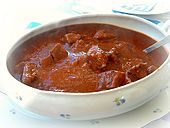
Cheese[edit]

A plate of Portuguese cheeses

See also: List of Portuguese cheeses with protected status

There are a wide variety of Portuguese cheeses, made from cow's, goat's or sheep's milk. Usually these are very strongly flavoured and fragrant. Traditional Portuguese cuisine does not include cheese in its recipes, so it is usually eaten on its own before or after the main dishes. The Queijo da Serra da Estrela, which is very strong in flavour, can be eaten soft or more matured. Serra da Estrela is handmade from fresh sheep's milk and thistle-derived rennet. In the Azores islands, there is a type of cheese made from cow's milk with a spicy taste, the Queijo São Jorge. Other well known cheeses with protected designation of origin, such as Queijo de Azeitão, Queijo de Castelo Branco. Queijo mestiço de Tolosa [ pt], is the only Portuguese cheese with protected geographical indication[60] and is made in the civil parish of Tolosa, part of the municipality of Nisa, which itself has another local variation within the Portalegre District, Queijo de Nisa.

Coffee[edit]

This section is an excerpt from Coffee in world cultures § Portugal.[edit]

As other southern European countries, and as a former colonial power, Portugal has a strong coffee culture. Coffeehouses can be found in almost every street of every city, town and village; they are simply called café, Portuguese for 'coffee'. Going to "the café" or going out to "take a coffee" are linguistic expressions, meaning "going out" or a calm encounter with someone. Like the Italian cultural trait, the Portuguese equate a café to an espresso, the default way to have the drink. Café is usually served after meals but also at any other time of the day. In Portuguese homes, coffee machines or coffee pots are a staple utility. Using mainly robusta beans, Portuguese coffee is made very strong, and the usual order is a bica (mainly in the Lisbon area), a very bitter shot of espresso. According to urban legend, this is an acronym for beba isto com açúcar, which translates to 'drink this with sugar'.[61]

Alcoholic beverages[edit]

Wines and beers[edit]

Main article: Portuguese wine

A glass of tawny Porto wine

Bunch of Alvarinho grapes

Wine (red, white and "green") is the traditional Portuguese drink, the rosé variety being popular in non-Portuguese markets and not particularly common in Portugal itself. Vinho verde, termed "green" wine, is a specific kind of wine which can be red, white or rosé, and is only produced in the northwestern (Minho province) and does not refer to the colour of the drink, but to the fact that this wine needs to be drunk "young". A "green wine" should be consumed as a new wine while a "maduro" wine usually can be consumed after a period of ageing. Green wines are usually slightly sparkling.

Traditionally grown on the schist slopes of the River Douro and immediate tributaries, Port wine is a fortified wine of distinct flavour produced in Douro, which is normally served with desserts.

Alvarinho white wines from Minho are also highly sought after.[62]

Vinho da Madeira, is a regional wine produced in Madeira, similar to sherry. From the distillation of grape wastes from wine production, this is then turned into a variety of brandies (called aguardente, literally "burning water"), which are very strong-tasting. Typical liqueurs, such as Licor Beirão and Ginjinha, are very popular alcoholic beverages in Portugal. In the south, particularly the Algarve, a distilled spirit called medronho, which is made from the fruit of the strawberry tree.

Beer was already consumed in Pre-Roman times, namely by the Lusitanians who drank beer much more than wine. The Latinised word ‘cerveja’ (from cerevisia < cervesia) derives from an older Celtic term used in Gaul.[63][64] During the Reconquista, many knights from Northern Europe preferred beer to the local wine.[65] The ‘Biergarten’ culture, called Cervejaria in Portugal, is widespread in all regions and several local brands are popular with locals and visitors alike. Lisbon has a Beer Museum focusing on Portuguese and Lusophone countries' beer traditions.[66]

Pastries and sweets[edit]

See also: Portuguese sweet bread

Pastéis de Nata and other sweets at a shop in Lisbon

Tigelada and Queijada de Requeijão

Portuguese sweets have had a large impact on the development of Western cuisines. Many words like marmalade, caramel, molasses and sugar have Portuguese origins.

The Portuguese sponge cake called pão de ló [pt] is believed to be based on the 17th century French recipe pain de lof, which in turn derived from Dutch "loef".[67] The French eventually called their cake Genoise.

Probably the most famous of the Portuguese patisseries are the pastéis de nata, originally known as Pastéis de Belém in the Lisbon district with the same name in the early nineteenth century. It is unclear when and where the recipe was first started. Monks of the military-religious Order of Christ lived in a church on the same location and provided assistance to seafarers in transit since the early fourteenth century, at least.[68]

The House of Aviz and the Jerónimos Monastery followed, the monastery lastly being occupied by the Hieronymite monks. Following the 1820 liberal revolution, events led to the closure of all monastic orders. The Pastéis de Belém were first commercialised just outside the Jerónimos monastery by people who had lost their jobs there. The original patisserie, adjacent to the monastery still operates today.[69] This pastry is now found worldwide, it is known in the UK by its original name or also as Portuguese custard tart. In 2011, the Portuguese public voted on a list of over 70 national dishes. Eventually naming the pastel de nata one of the seven wonders of Portuguese gastronomy.[70]

Many of the country's typical pastries were created in the Middle Ages monasteries by nuns and monks and sold as a means of supplementing their incomes. The names of these desserts are usually related to monastic life; barriga de freira (nun's belly), papos d’anjo (angel's double chin), and toucinho do céu (bacon from heaven). For that reason, they are often referred to as doçaria conventual or receitas monásticas (monastic recipes).[71] Their legacy dates back to the 15th century when sugar from overseas became easier to access by all classes. Nuns at the time, were often young nobles who inherited knowledge from their households and developed recipes. These recipes were passed and perfected from generation to generation, usually within the secrecy of convents. Many of today's Portuguese desserts originated in convents and monasteries.[72]

The Andalusian influence in Southern Portugal can be found in sweets that incorporate figs, almonds and honey, namely the Algarve marzipan colourful sweets,[73] or the almond tuiles, known as telhas d’amêndoa.

Most towns have a local specialty, usually egg or cream-based pastry. Some examples are leite-creme (a dessert consisting of an egg custard-base topped with a layer of hard caramel, a variant of creme brûlée) and pudim flã.

Other very popular pastries found in most cafés, bakeries and pastry shops across the country are the Bola de Berlim, the Bolo de arroz, and the Tentúgal pastries.[74]

Doce de gila (made from chilacayote squash), wafer paper, and candied egg threads called fios de ovos or angel hair.[75]

  • Pão-de-Ló

    Pão-de-Ló

  • Rabanadas and filhós, typical Christmas dessert

    Rabanadas and filhós, typical Christmas dessert

  • Leite-creme (Portuguese Crème brûlée)

    Leite-creme (Portuguese Crème brûlée)

  • Arroz Doce (Rice pudding)

    Arroz Doce (Rice pudding)

  • Bola de Berlim (a type of Berliner)

    Bola de Berlim (a type of Berliner)

  • Salame de Chocolate (Chocolate salami)

    Salame de Chocolate (Chocolate salami)

Influences on world cuisine[edit]

Goan pork vindalho served alongside other Portuguese-Goan dishes

Pão de Castela (Kasutera), a specialty of Nagasaki, Japan

Portugal formerly had a large empire and the cuisine has been influenced in both directions. Other Portuguese influences reside in the Chinese territory of Macau (Macanese cuisine) and territories who were part of the Portuguese India, such as Goa or Kerala, where vindalho (a spicy curry), shows the pairing of vinegar, chilli pepper and garlic.

The Persian orange, grown widely in southern Europe since the 11th century, was bitter. Sweet oranges were brought from India to Europe in the 15th century by Portuguese traders. Some Southeast Indo-European languages name the orange after Portugal, which was formerly its main source of imports.

Examples are Albanian portokall, Bulgarian portokal [портокал], Greek portokali [πορτοκάλι], Persian porteghal [پرتقال], and Romanian portocală. In South Italian dialects (Neapolitan), the orange is named portogallo or purtualle, literally "the Portuguese ones". Related names can also be found in other languages: Turkish Portakal, Arabic al-burtuqal [البرتقال], Amharic birtukan [ቢርቱካን], and Georgian phortokhali [ფორთოხალი].

The Portuguese imported spices, such as cinnamon (Cinnamomum verum) now liberally used in its traditional desserts and savoury dishes, from Asia.[76]

The Portuguese "canja", chicken soup made with pasta or rice, is a popular food therapy for the sick, which shares similarities with the Asian congee, used in the same way, indicating it may have come from the East.[77]

In 1543, Portuguese trade ships reached Japan and introduced refined sugar, valued there as a luxury good. Japanese lords enjoyed Portuguese confectionery so much it was remodelled in the now traditional Japanese konpeitō (candy), kasutera (sponge cake), and keiran somen (the Japanese version of Portuguese "fios de ovos", also popular in Thai cuisine under the name of "kanom foy tong"),[78] creating the Nanban-gashi, or "New-Style Wagashi". During this Nanban trade period, tempura (resembling Portuguese peixinhos da horta) was introduced to Japan by early Portuguese missionaries.

Catherine of Braganza was responsible for the introduction of tea to the English court

Tea was made fashionable in England in the 1660s after the marriage of King Charles II to the Portuguese princess Catherine of Braganza (Catarina De Bragança), who brought her liking for tea, originally from the colony of Macau, to the court.[79] When Catherine relocated up north to join King Charles, she is said to have packed loose-leaf tea as part of her personal belongings; it would also have likely been part of her dowry. Queen Catherine also introduced marmalade to the English and made the habit of eating with a fork a part of the court's table etiquette.[80]

All over the world, Portuguese immigrants influenced the cuisine of their new "homelands", such as Hawaii and parts of New England. Pão doce (Portuguese sweet bread), malassadas, sopa de feijão (bean soup), and Portuguese sausages (such as linguiça and chouriço) are eaten regularly in the Hawaiian islands by families of all ethnicities. Similarly, the "papo-seco" is a Portuguese bread roll with an open texture, which has become a staple of cafés in Jersey, where there is a substantial Portuguese community.

In Australia and Canada, variants of "Portuguese-style" chicken, sold principally in fast food outlets, have become extremely popular in the last two decades.[81][82][83] Offerings include conventional chicken dishes and a variety of chicken and beef burgers. In some cases, such as "Portuguese chicken sandwiches", the dishes offered bear only a loose connection to Portuguese cuisine, usually only the use of "piri-piri sauce" (a Portuguese sauce made with piri piri).

The Portuguese had a major influence on African cuisine and vice versa. They are responsible for introducing corn in the African continent. In turn, the South African restaurant chain Nando's, among others, have helped diffusing Portuguese cuisine worldwide, in Asia for example, where the East Timorese cuisine also received influence.[84]

Madeira wine and early American history[edit]

The indoors of a wine house in Funchal, Madeira, dedicated to the production and selling of Madeira wine

In the 18th century Madeira wine became extremely popular in British America. Barrel-aged Madeira especially was a luxury product consumed by wealthy European colonists. The price continued to rise from £5 at the start of the 18th century to £43 by the early 19th century. It was even served as a toast during the First Continental Congress in 1775.[85]

Madeira was an important wine in the history of the United States of America.[86] No wine-quality grapes could be grown among the 13 colonies, so imports were needed, with a great focus on Madeira.[87] One of the major events on the road to revolution in which Madeira played a key role was the seizure of John Hancock's sloop the Liberty on 9 May 1768 by British customs officials. Hancock's boat was seized after he had unloaded a cargo of 25 casks (3,150 gallons) of Madeira wine, and a dispute arose over import duties. The seizure of the Liberty caused riots to erupt among the people of Boston.

Madeira wine was a favorite of Thomas Jefferson after George Wythe introduced him to it.[88] It was used to toast The Declaration of Independence and George Washington, Betsy Ross,[89] Alexander Hamilton, Benjamin Franklin, and John Adams are also said to have appreciated the qualities of Madeira. The wine was mentioned in Benjamin Franklin's autobiography. On one occasion, Adams wrote to his wife, Abigail, of the great quantities of Madeira he consumed while a Massachusetts delegate to the Continental Congress. A bottle of Madeira was used by visiting Captain James Server to christen the USS Constitution in 1797. Chief Justice John Marshall was also known to appreciate Madeira, as did his fellow justices on the early U.S. Supreme Court.

papua

The cuisine of Papua New Guinea are the traditional varied foods found in the eastern part of the New Guinea island. Approximately 80% of the population is reliant on subsistence agriculture, so a large percentage of food energy and protein consumed in Papua New Guinea is produced locally, while the balance is imported. The staple foods in Papua New Guinea includes root crops, bananas, and sago.[1] Papua New Guinea's diet is largely vegetarian, especially in the Gulf and Highlands regions.

Mumu is a traditional method of cooking large quantities of food throughout Papua New Guinea, as well as other islands in the Pacific. It consists of an earth oven that is filled with hot coal or stones, that may be placed in different orientations, and subsequently cooked for a lengthy period of time. Despite the presence of advent ovens in Papua New Guinea, mumu is still prevalent at household level.[2]

Beverages[edit]

People often cool down in the hot tropical sun with a Kulau a green coconut filled with sweet, slightly tangy coconut water.Coffee is Papua New Guinea's second largest agricultural export, after oil palm, and is majorly grown in the Highlands Region. Hence, coffee is a widely consumed beverage in the country. Tea, introduced by the british is very popular in the coastal areas especially in the southern region. It is often drunk steaming hot, black and very sweet. Tea is grown locally in The highlands region. Apart from non-alcoholic drinks, beer is an alcoholic beverage that is favoured among many Papua New Guineans.

Staples[edit]

Sago is a common and essential part of Papua New Guinean cuisine,[3] as the starch ingredient is included in several traditional dishes, such as pancakes and pudding. Sago is in the form of flour usually extracted from the palm tree. Staples of the Papua New Guinean diet include karuka, sweet potato (kaukau), cassava, breadfruit (ulu), and coconuts. Coconut cream is a delicacy often found in numerous local dishes of Papua New Guinea.[4] Coastal regions traditionally use coconut milk and cream as a cooking medium, while the Highlands regions do not.[5] Coconut oil is used on special occasions in the coastal regions.

Meat proteins are occasionally consumed in Papua New Guinea. However, for people residing in coastal areas, seafood forms a substantial part of their diet.[6] Pork is regarded as a celebratory meat in Papua New Guinea, and is prepared on special occasions, including Christmas feasts.[7]

Notable dishes[edit]

  • Mumu is regarded as the national dish of Papua New Guinea. It is composed of pork or chicken, sweet potato, taro, plantains, with leafy vegetables. Mumu is an example of a balanced dish composed of the two bases, crops (including starch) and meat. The dish is named after the earth oven used traditionally. Wrapped in a parcel of banana leafs and, in modern times, aluminium foil. The composition of the mumu differs slightly from region to region with a type of fern being the preferred green in the highlands region, the NGI region uses a lot of coconut cream.

Preparing a mumu

  • Chicken pot is a dish consisting of chicken that has been stewed with mixed vegetables and coconut cream.
  • Similar to mumu is a dish called Aigir made by placing hot rocks into a pot of coconut milk to which protein, usually chicken, is added with plantains and sweet potatoes and lots of leafy greens and ginger. The dish is cooked in as little as 30 minutes owing to the hot rocks
  • Kokoda is a dish consisting of fish that is cooked in a lime-coconut sauce. The dish is similar to ceviche. Kokoda is also present in Fijian cuisine.
  • Saksak is the local name for sago flour a local staple. In the sepik region it is mixed with boiling hot water to make Nangu a gelatinous dumpling that is eaten as the basic starch in many meals. Saksak is also pressed onto a hot pan , sometimes mixed with grated coconut, to make a tortilla-like pancake.
  • Dia is a dessert composed of a sago and banana dumpling steamed in a banana leaf wrapping. It is then served with clotted coconut cream. Sweet ripe bananas are used to lend sweetness to the dish. This dish is also known as Pariwa.
  • Lamb Flaps are Lamb trimmings that are often cooked on roadside grill stands. The Lamb is marinated with ginger, garlic and chicken bullion powder. Often accompanied with a salad made with cress, sliced raw ginger and onion, and plantains or sweet potato cooked on the grill plate.

Culinary influences[edit]

The European invasion of Papua New Guinea, beginning in the 16th century, was the first foreign introduction to the local cuisine. European settlers imported livestock and crops to the region in the 19th century, which served significant commercial value.[8] The cuisine and traditions of Papua New Guinea have assimilation with Indonesian New Guinea and other Pacific nations. The dish kokoda—composed of fish cooked in a sauce of lime and coconut—is also present in Fijian cuisine.[9]

Fast food[edit]

Few fast food chains operate in Papua New Guinea. However, fast food chains operating in Papua New Guinea include Hog's Breath Cafe (an Australian steakhouse chain), Big Rooster (a locally-owned chicken shop chain) and Eagle Boys (an Australian pizzeria chain). There are no large American fast food chains in Papua New Guinea.

greece

Greek cuisine is the cuisine of Greece and the Greek diaspora.[1][2][3][4][5] In common with many other cuisines of the Mediterranean, it is founded on the triad of wheat, olive oil, and wine.[6][7][8] It uses vegetables, olive oil, grains, fish, and meat, including pork, poultry, veal and beef, lamb, rabbit, and goat. Other important ingredients include[9] pasta (for example hilopites), cheeses,[10][11] lemon juice, herbs, olives and olive oil,[12][13] and yogurt. Bread made of wheat is ubiquitous; other grains, notably barley, are also used, especially for paximathia. Common dessert ingredients include nuts, honey, fruits, sesame, and filo pastries. It continues traditions from Ancient Greek and Byzantine cuisine,[14][15] while incorporating Turkish, Balkan, and Italian influences.[16][17][18][19][20]

History[edit]

Main article: Ancient Greek cuisine

Greek cuisine is part of the culture of Greece and is recorded in images and texts from ancient times.[21][22][23] Its influence spread to ancient Rome and then throughout Europe and beyond.[24]

Ancient Greek cuisine was characterized by its frugality and was founded on the "Mediterranean triad": wheat, olive oil, and wine, with meat being rarely eaten and fish being more common.[6] This trend in Greek diet continued in Cyprus and changed only fairly recently when technological progress has made meat more available.[25] Wine and olive oil have always been a central part of it and the spread of grapes and olive trees in the Mediterranean and further afield is correlated with Greek colonization.[26][27]

The Spartan diet was also marked by its frugality. A notorious staple of the Spartan diet was melas zomos (black soup), made by boiling the pigs' legs, blood of pigs, olive oil, bay leaf, chopped onion, salt, water, and vinegar as an emulsifier to keep the blood from coagulation during the cooking process. The army of Sparta mainly ate this as part of their subsistence diet. This dish was noted by the Spartans' Greek contemporaries, particularly Athenians and Corinthians, as proof of the Spartans' different way of living.

Byzantine cuisine was similar to ancient cuisine, with the addition of new ingredients, such as caviar, nutmeg and basil. Lemons, prominent in Greek cuisine and introduced in the second century, were used medicinally before being incorporated into the diet. Fish continued to be an integral part of the diet for coastal dwellers. Culinary advice was influenced by the theory of humors, first put forth by the ancient Greek doctor Claudius Aelius Galenus.[28] Byzantine cuisine benefited from Constantinople's position as a global hub of the spice trade.[29]

Overview[edit]

A Greek salad from Thessaloniki

Traditional Greek kleftiko, consisting of lamb marinated with lemon juice, potatoes and spices and cooked slowly in a sealed container.[30]

Greek baklava

Greek gyros rolled in a pita

The most characteristic and ancient element of Greek cuisine is olive oil, which is used in most dishes. It is produced from the olive trees prominent throughout the region, and adds to the distinctive taste of Greek food. The olives themselves are also widely eaten. The basic grain in Greece is wheat, though barley is also grown. Important vegetables include tomato, aubergine (eggplant), potato, green beans, okra, green peppers (capsicum), and onions. Honey in Greece is mainly honey from the nectar of fruit trees and citrus trees: lemon, orange, bigarade (bitter orange) trees, thyme honey, and pine honey. Mastic, an aromatic, ivory-coloured plant resin, is grown on the Aegean island of Chios.

Greek cuisine uses some flavorings more often than other Mediterranean cuisines do, namely oregano, mint, garlic, onion, dill, cumin, and bay laurel leaves. Other common herbs and spices include basil, thyme and fennel seed. Parsley is also used as a garnish on some dishes. Many Greek recipes, especially in the northern parts of the country,[31][32] use "sweet" spices in combination with meat, for example cinnamon, allspice and cloves in stews.

The climate and terrain has tended to favour the breeding of goats and sheep over cattle, and thus beef dishes are uncommon. Fish dishes are common in coastal regions and on the islands. A great variety of cheese types are used in Greek cuisine, including Feta, Kasseri, Kefalotyri, Graviera, Anthotyros, Manouri, Metsovone, Ladotyri (cheese with olive oil), Kalathaki (a specialty from the island of Limnos), Katiki Domokou (creamy cheese, suitable for spreads), Mizithra and many more.[33]

Dining out is common in Greece. The taverna and estiatorio are widespread, serving home cooking at affordable prices to both locals and tourists. Locals still largely eat Greek cuisine.[34][35]

Common street foods include souvlaki, gyros, various pitas and roast corn.

Fast food became popular in the 1970s, with some chains, such as Goody's and McDonald's serving international food like hamburgers,[36] and others serving Greek foods such as souvlaki, gyros, tyropita, and spanakopita.

Origins[edit]

Greek feta cheese stuffed bifteki burger

Souvlaki

Many dishes can be traced back to ancient Greece: lentil soup, fasolada (though the modern version is made with white beans and tomatoes, both New World plants), tiganites, retsina (white or rosé wine flavored with pine resin) and pasteli (candy bar with sesame seeds baked with honey); some to the Hellenistic and Roman periods: loukaniko (dried pork sausage); and Byzantium: feta cheese, avgotaraho (cured fish roe), moustalevria and paximadi (traditional hard bread baked from wheat, barley and rye). There are also many ancient and Byzantine dishes which are no longer consumed: porridge (chilós in Greek) as the main staple, fish sauce (garos), and salt water mixed into wine.[37][38][39]

Some dishes are borrowed from Italian and adapted to Greek tastes: pastitsio (pasticcio), pastitsada (pasticciata), stifado (stufato), salami, macaronia, mandolato, and more.[40]

Some Greek dishes are inherited from Ottoman cuisine, which combined influences from Persian, Levantine-Arabic, Turkish and Byzantine cuisines: meze, kadaifi, halva, and loukoumi.

In the 20th century, French cuisine had a major influence on Greek cooking,[41][42][43] largely due to the French-trained chef Nikolaos Tselementes, who created the modern Greek pastitsio; he also created the modern Greek version of moussaka by combining an existing eggplant dish with a French-style gratin topping.

Regions[edit]

Distinct from the mainstream regional cuisines are:[3][44][45][46][47][48][49]

  • Cuisine of the Aegean islands (including Kykladítiki from Kyklades, Rhodítiki from Rhodes and other Dodecanese islands, and the Cuisine of Lesbos island)
  • Cuisine of Argolis, Cuisine of Patras, Arcadian and Maniot cuisines, parts of the Cuisine of Peloponnesean
  • Cuisine of the Ionian islands (Heptanisiakí), a lot of Italian influence
  • Ipirótiki (Epirotic cuisine)
  • Kritikí (Cretan cuisine)
  • Kypriakí (Cypriot cuisine)
  • Makedonikí (Macedonian cuisine)[50][51]
  • Mikrasiatikí, from the Greeks of Asia Minor descent, including Polítiki (from Constantinople), from the tradition of the Greeks from Constantinople, a cuisine with significant Anatolian/Ottoman influence[52][53][54]
  • Pontiakí (Pontic Greek cuisine), found anywhere there are Pontic Greeks (Greeks from the Black Sea region)
  • Thrakiótiki (Thracian cuisine)

Some ethnic minorities living in Greece also have their own cuisine. One example is the Aromanians and their Aromanian cuisine.

Typical dishes[edit]

Main article: List of Greek dishes

Greek moussaka

Typical home-cooked meals include seasonal vegetables stewed with olive oil, herbs, and tomato sauce known as lathera. Vegetables used in these dishes include green beans, peas, okra, cauliflower, spinach, leeks and others.[9][55][56]

Many food items are wrapped in filo pastry, either in bite-size triangles or in large sheets: kotopita (chicken pie), spanakopita (spinach and cheese pie), hortopita (greens pie), kreatopita (meat pie, using minced meat), kolokythopita (zucchini pie), and others. They have countless variations of pitas (savory pies).

Apart from the Greek dishes that can be found all over Greece, there are also many regional dishes.[57][58]

North-Western and Central Greece (Epirus, Thessaly and Roumeli/Central Greece) have a strong tradition of filo-based dishes, such as some special regional pitas.

Greek cuisine uses seeds and nuts in everything from pastry to main dishes.[59]

The list of Greek dishes includes dishes found in all of Greece as well as some regional ones.[60][61][62]

Appetizers[edit]

Kalamata olives

Calamari (fried squid)

  • Atzougies
  • Avgotaracho, Bottarga, flathead mullet caught in lagoons with the well-known the European and Greek Protected Designation of Origin (PDO) Avgotaracho Messolongiou from the Messolonghi-Etoliko Lagoons. The whole mature ovaries are removed from the fish, washed with water, salted with natural sea salt, dried under the sun, and sealed in melted beeswax.[63]
  • Florina peppers,[64][65] it can be roasted, sliced and served by adding olive oil and garlic.
  • Toursi (pickle),[66] with the well-known the pickled peppers and mixed pickle.
  • Feta topped with olive oil and oregano
  • Htapodi sti schara (grilled Octopus),[67][68]
  • Tirokroketes, fried cheese balls also known as tirokeftedes.[69][70]
  • Bourekakia of cheese, Börek.[71]
  • Kolokithokeftedes, zucchini fritters.[72][73]
  • Saganaki, fried kefalograviera cheese.[74][75]
  • Melitzanes tiganites,[76] fried eggplants.
  • Bouyiourdi,[77][71]
  • Lakerda
  • Loutza
  • Olives,[12][78]
  • Kolokithakia tiganita, fried cucurbita.[79][80]
  • Koxloi,[81] escargot, also is a main course.
  • Htapodi Ksidato (octopus marinated in vinegar).[82]
  • Omelette,[83][84]
  • Strapatsada (Kagianas),[85] scrambled eggs (omelette) with tomato.
  • Kalamarakia tiganita, fried squid slices served with a lemon wedge.[86][87][88]
  • Dolmades, stuffed grape leaves, also known as Dolmades or Dolmadakia.[89][90]
  • Tomatokeftedes, tomato fritters wider well-known throughout Santorini island.[91]
  • Gigantes plaki, baked beans with tomato sauce and herbs, also is a main course.
  • Marides tiganites, small-sized whitebait fish (spicara smaris) that are lightly dusted with flour, then fried.[92]
  • Skordopsomo, garlic bread made with a combination of sliced bread, olive oil, garlic, salt, pepper, oregano, and basil.[93]
  • Garides saganaki, sautéed shrimps that are deglazed with the ouzo, then doused in tomato sauce, and topped with crumbled feta cheese.[94][95][96]
  • Dakos, a traditional Cretan food features a slice of soaked dried bread or barley rusk (paximadi) topped with chopped tomatoes and crumbled feta or mizithra cheese, dried oregano and a few splashes of olive oil.[97][98]
  • Sikotakia (Livers),[99] fried lamb or chicken small liver slices with olive oil and oregano. Also it serves as main dish known as "Tigania" which refers to the shallow pan in which the meal (pork or chicken or lamp) is cooked.
  • Loukaniko (sausage),[100][101] Greek traditional sausage made from pork or lamb and typically flavored with orange peel, fennel seed, and various other dried herbs and seeds, and sometimes smoked over aromatic woods. They are also often flavored with greens, especially leeks.
  • Fava,[102] yellow split peas that are cooked with onions and various spices until they transform into a creamy purée. It uses as a dip or a main course dish, with the well-known the Protected Designation of Origin (PDO) certified Fava Santorinis (Lathyrus clymenum).
  • Spanakopita, spinach pie.[103][104][105]
  • Kolokithopita, pumpkin and feta pie filling which is placed between two layers of phyllo pastry.[106][107]
  • Tiropita, cheese pie,[108][109] also well-known is Tiropitakia which are mini cheese pies made with phyllo triangles stuffed with Greek feta cheese,[110] and Tiropitakia Kourou which has Kourou dough.[111]
  • Piroski, or Pirozhki,[112][113] fried pita has filling of feta cheese or Greek Protected Destination of Origin (PDO) certified kasseri cheese or minced meat or mashed potato or other filling or mix filling. Serving hot. Most in the past time, also less still today, piroski can be found in Greece in specialty shops selling piroski exclusively.[114][115]

Salads[edit]

In the Greek cuisine, appetizers are also the salads.

  • Horiatiki salad (village's salad), a salad with pieces of tomatoes, cucumbers, onion, feta cheese (usually served as a slice on top of the other ingredients), and olives and dressed with oregano and olive oil.[116]
  • Horta salad (leafy greens salad),[117][118][119][120][121][122][123][124] boiled Greek wild leafy greens dressed with olive oil and fresh lemon juice, greens are like antidia (endives), vlita (amaranth leaves), myronia (wild chervil), radikia (chicory), seskoula (chard), armyrithra, glistrida, styfnos.
  • Pikantiki (also known as politiki), made with white cabbage and purple cabbage finely chopped, pickled Florina peppers, carrot, celery, parsley, finely chopped garlic, lemon juice, white vinegar, olive oil, salt.
  • Lahanosalata (cabbage salad), thinly chopped cabbage with salt, olive oil and lemon or vinegar juice.[125][126][127]
  • Ampelofasoula,[128][129] salad from green beans (Vigna unguiculata) also known as cow peas.
  • Fasolia mavromatika, black-eyed pea salad.
  • Aggouro-ntomata (cucumber with tomato)
  • Patzarosalata, beet salad (beta vulgaris).[130]
  • Patatosalata, potato salad.[131]
  • Kounoupidi (cauliflower)
  • Tonosalata, tuna salad.[132]
  • Maroulosalata (lettuce)
  • Brokolo (broccoli)

Spreads and dips[edit]

In the Greek cuisine, appetizers are also the spreads and dips, belong also to Greek sauces.

  • Hummus with tahini.[133]
  • Olive paste (tapenade).[134]
  • Rosiki,[135] boiled potatoes, carrot, cucumber, mayonnaise, pea
  • Kipourou (gardener’s salad), cabbage, carrot, radish, mayonnaise
  • Kopanisti, feta cheese, grilled red sweet peppers, olive oil, fresh garlic
  • Melitzanosalata, eggplant spread and dip (eggplant salads and appetizers).[136][137]
  • Skordalia, garlic spread and dip from mashed potatoes, olive oil, vinegar, raw garlic.[138][139][140]
  • Tirokafteri, spread and dip from feta cheese, yogurt, hot peppers, olive oil, and vinegar.[141]
  • Paprika, sweet paprika,[142] concentrate tomato paste, roasted red pepper (Florina pepper), feta cheese, olive oil
  • Taramosalata, spread and dip from taramás fish roe mixed with olive oil, lemon juice, and a starchy base of bread or potatoes.[143][144]
  • Tzatziki, spread and dip, strained yogurt or diluted yogurt mixed with cucumbers, garlic, salt, olive oil, sometimes with vinegar or lemon juice, and herbs such as dill, mint, parsley and thyme.[145][146]

Soups[edit]

  • Fasolada, soup of dry white beans, olive oil, and vegetables.[147][148]
  • Fakes (lentil soup).[149]
  • Youvarlakia, soup from balls of ground meat, rice, finished with avgolemono (the creamy egg and lemon sauce), cooked in a pot.[150][151]
  • Kotosoupa,[152] chicken soup from chicken broth, tender chicken cuts, various root vegetables, and rice, using many time avgolemono sause.
  • Kremidosoupa,[153] onion soup
  • Kreatosoupa, meat soup.[154][155][156]
  • Kakavia, soup made from fishes, onions, potatoes, olive oil, and vegetables.[157][158]
  • Magiritsa, soup made from lamb offal, associated with the Easter (Pascha) tradition of the Greek Orthodox Church.[159]
  • Ntomatosoupa, tomato soup with Greek ingredients.[160]
  • Patsas, tripe soup made from lamb, sheep, or pork tripe as key ingredients, most use animal's head or feet and enrich the broth with garlic, onions, lemon juice, and vinegar.[161][162]
  • Revithosoupa, chickpea soup, also known as Revithada.[163]
  • Psarosoupa, fish soup.[164][165]
  • Trahanas, tarhana soup.[166][167]

Dishes[edit]

Selected dishes are:[168]

  • Agkinares, cardoon has various recipes.[169]
  • Fasolakia, green beans that are simmered in olive oil with other vegetable ingredients,[170][171] belongs to Ladera which literally translating to "oily", vegetable dishes cooked in olive oil.
  • Arakas (pea),[172] belongs to Ladera dishes, with the well-known the dish "Arakas me Agkinares".[173]
  • Bamies (okra),[174][175] belongs to Ladera dishes.
  • Briam,[176] also known as Tourlou, belongs to Ladera dishes, typically made from eggplants, zucchini, onions, potatoes, tomatoes, garlic, parsley.
  • Gemista (or Yemista),[177] "filled with" in Greek, baked stuffed bell peppers and tomatoes with rice or ground beef or both, onions, mint, parsley, olive oil.
  • Lahanodolmades, baked stuffed light green cabbage rolls with rice or ground beef or both, onions, mint, parsley, avgolemono sauce.[178]
  • Lahanorizo,[179] rice and cabbage, onions, fresh herbs, and the optional addition of tomato sauce.
  • Prasorizo (leek and rice),[180] made from rice, chopped sweet leeks, olive oil, garlic, dill.
  • Spanakorizo (spinach and rice),[181][182]
  • Apaki,[183] cured pork meat. Left to marinate for two or three days in vinegar, the meat is then smoked with aromatic herbs and various spices. Apaki can be cooked on its own or added to other dishes.
  • Stifado (stew),[184][185] casserole cooked with baby onions, tomatoes, wine or vinegar, olive oil, bay leaf, black pepper, meat such as pork, goat, rabbit, wild hare, beef, snails, tripe, octopus.
  • Potatoes Yachni,[186][187][188] potatoes stew, potatoes simmered in a tomato sauce with onions, garlic, herbs and spices.
  • Pastitsio, baked pasta dish with ground meat and béchamel sauce.
  • Astakomakaronada (lobster and spaghetti),[189] lobster meat that is coupled with a flavorful tomato-based sauce and served over pasta.
  • Makaronia me kima (spaghetti with ground meat),[190][191]
  • Garidomakaronada (shrimps and spaghetti),[192]
  • Melitzanes Papoutsakia, baked eggplants stuffed with ground beef and topping it with a smooth béchamel sauce. The dish is called papoutsakia (little shoes) because its shape resembles little shoes.
  • Spetsofai,[193][194] made with spicy country sausages, sweet peppers, onion, garlic, olive oil, in a rich tomato sauce.
  • Giouvetsi,[195] pieces of lamb (or beef) and small noodles such as orzo, all cooked together in a tomato sauce with garlic and oregano.
  • Gyros,[196] pork meat or chicken cooked on a vertical rotisserie, onions, tomato, lettuce, fried potatoes, sauces like tzatziki rolled in a pita bread.
  • Hilopites with chicken,[197] traditional Greek pasta made from flour, eggs, milk, and salt.
  • Pastitsada,[198]
  • Bourdeto
  • Roasted chicken with potatoes,[199][200]
  • Kleftiko,[201][202] slow-roasted leg of lamb or lamb shoulder wrapped in parchment paper with potatoes, bell peppers, onions, feta cheese, marinated with olive oil, lemon juice, garlic, fresh rosemary and herbs.
  • Keftedakia (meatballs),[203][204] fried meatballs from lean ground beef with eggs, onions, garlic, parsley, mint, it also make them using half ground beef and half ground pork.
  • Mousakas, sliced tender eggplant cut lengthwise, or potato-based, lamb ground meat, topped with a thick layer of béchamel sauce.[205][206]
  • Moshari kokkinisto,[207][208] stewed veal meat, onions, garlic, olive oil, tomato sauce, served accompanied by basmati rice, or pasta or potatoes or potato purée.
  • Biftekia,[209][210][211] Greek-version burger pattiers made with a combination of ground pork, beef, or lamb, and the meat is mixed with onions, breadcrumbs, eggs, parsley leaves finely chopped and oregano. They can grilled, baked or fried.
  • Arnaki sto fourno me patates (oven-baked lamb with potatoes),[212]
  • Katsikaki ston fourno (oven-baked goat),[213]
  • Paidakia,[214][215] grilled lamb chops.
  • Hirino me selino,[216][217] pork meat with celery.
  • Soutzoukakia Smyrneika (Smyrna meatballs),[218][219][220][221] oblong shaped beef meatballs made with cumin and cinnamon, then simmered in a rich tomato sauce.
  • Souvlaki,[222][223] with the well-known the souvlaki pita.[224]
  • Kontosouvli,[225][226]
  • Souvla
  • Kokoretsi,[227] a dish consisting of lamb or goat intestines wrapped around seasoned offal, including sweetbreads, hearts, lungs, or kidneys, and grilled.
  • Tigania,[228] pan-fried pork or chicken. The name "tigania" refers to the shallow pan in which the meal is cooked.
  • Fagri sti schara (grilled red porgy)
  • Gavros tiganitos (fried anchovy),[229]
  • Gopes tiganites, fried boops boops fishes.[230]
  • Bakaliaros (Merluccius merluccius),[231][232] cod fish, the most well-known recipe is the fried bakaliaros mainly served with skordalia dip and fried potatoes.
  • Soupies (cuttlefish),[233][234]
  • Xiphias (or Xifias),[235] a species of swordfish.

Desserts and pastries[edit]

Selected desserts and pastries are:[168]

  • Amygdalopita,[236] almond cake made with ground almonds, flour, butter, eggs and pastry cream.
  • Akanés,[237][238][239] from Serres.
  • Armenovíl/Armenonville,[240][241][242] from Thessaloniki.
  • Baklava,[243]
  • Gianniotikos Balkavas, type of Baklava from Ioannina.[244]
  • Bougatsa krema (cream),[245] from Asia Minor, filo dough wrapped around a filling of semolina custard. After it is baked, it is cut into small pieces and served hot lightly dusted with powdered icing sugar and/or cinnamon. It makes it by hand only, uses as a breakfast pastry (sweet), mid-morning snack, midday snack and dessert.
  • Crêpe,[246]
  • Fanouropita
  • Melomakarona,[247]
  • Galaktoboureko,[248] custard pie with syrup.
  • Galatopita,[249][250][251] milk pie
  • Karydopita,[252]
  • Koulourakia,[253]
  • Kourampiedes
  • Kydonopasto
  • Loukoumi,[254]
  • Muhallebi, or Mahallebi
  • Moustalevria,[255]
  • Mpezedes (Mareges)
  • Mandolato,[256] Greek version of nougat.
  • Mandola,[257] traditional almond candy from island of Corfu.
  • Pasteli,[258] sesame seed candy made from sesame seeds, sugar or honey pressed into a bar.
  • Loukoumades,[259] fried balls of dough that are often spiced with cinnamon and drizzled with honey.
  • Diples,[260] pastry sheets that are rolled, deep-fried, and doused or drizzled with a thick, honey-based syrup.
  • Pastafrola
  • Rizogalo,[261]
  • Roxakia,[262][263][264]
  • Stafidopsomo,[265]
  • Spatoula,[266][267] from Kalabaka, walnut cake with diplomat cream.
  • Poniro,[268][269] with the well-known poniro from Serres.
  • Spoon sweets,[270] with the well-known the spoon sweet Koufeto[271] from Milos island.
  • Laggites,[272] or Tiganites
  • Tsoureki,[273]
  • Vasilopita,[274] Greek New Year's cake with a coin or a trinket baked inside of it.
  • Strained yogurt with honey, walnuts often added.[275]
  • Komposta,[276] made from peach, apple, pear or other fruits.
  • Halvas with tahini,[277][278][279]
  • Halvas with semolina,[280][281][282]
  • Halvas Farsalon,[283] known as sapoune halva or jelly halva from Farsala.
  • Kariokes,[284] small sized walnut-filled chocolates and shaped like crescents.
  • Kantaifi,[285]
  • Kiounefe,[286][287][288]
  • Kazan Ntimpi,[289]
  • Revani,[290][291] with the well-known the revani from Veria.
  • Portokalopita,[292][293]
  • Milopita,[294] apple pie.
  • Melopita,[295] honey pie in Greek, traditionally associated with the island of Sifnos.
  • Saliaroi (Saliaria),[296] from Kozani.
  • Samali,[297] extra syrupy Greek semolina cake with mastic.
  • Trigona Panoramatos,[298][289][299]
  • Touloumba
  • Ypovrihio or Ypovrichio,[300] means submarine in Greek, also known as vanilia or mastiha, a white chewy sweet that is served on a spoon dipped in a tall glass of cold water.`
  • Fetoydia,[301] also known as avgofetes, made with fresh or stale bread, milk, eggs, and olive oil. The bread is cut into slices which are first soaked in milk, and then dipped in lightly beaten eggs before they are fried in olive oil. When it is served as a sweet dish, sugar, vanilla, or cinnamon are also commonly added before pan-frying, and then it may be topped with sugar (often powdered sugar).
  • Candied fruits, known as fruit glace with the well-known the marron glace.[302] Candied fruits can be found in Greece in specialty candy shops selling along with other related products exclusively, such as dried fruits,[303] nuts, jellies, koufeta, loukoumia, chocolate bars, sokolatakia (bonbon), pralines, spoon sweets, pasteli, halva, fudge, petit four, granola, granola bars, sweet spreads, breakfast cereals, energy bar, and others.

Drinks and beverages[edit]

Selected drinks and beverages are:[304][305][306][307]

  • Greek coffee,[308][309]
  • Frappé coffee,[310] invented in Thessaloniki in 1957.[311][312][313]
  • Freddo cappuccino,[314]
  • Esspreso freddo,[315][316] iced coffee combines espresso and ice merely serve coffee over ice blends the two ingredients until the coffee is slightly chilled.
  • Salepi,[317]
  • Ouzo,[318]
  • Retsina,[319]
  • Tsipouro,[320]
  • Tsikoudia,[321]
  • Gin,[322][323][324][325]
  • Beer, Beer in Greece.[326][327][328][329][330]
  • Souma,[331] from island of Chios.
  • Tentura,[332] liqueur that hails from Patras.
  • Kumquat, liqueur produced mainly on the island of Corfu.
  • Kitron, or Kitro,[333] liqueur produced on the island of Naxos.
  • Fatourada,[334] orange-flavored liqueur from the Greek island Kythira.
  • Mineral water, from several recognized water sources from Greece.[335][336][337]
  • Sparkling Mineral water, mineral carbonated water from sources from Greece.[335][336][337]
  • Mastika, or mastiha, liqueur that is made with mastiha, mostly Chios Mastiha.[338]
  • Soumada,[339] a non-alcoholic, syrupy, almond-based beverage that is produced on the island of Crete.
  • Rakomelo,[340] made by combining raki or tsipouro - two types of grape pomace brandy - with honey and several spices, such as cinnamon, cardamom, or other regional herbs. It is produced in Crete and other islands of the Aegean Sea.
  • Metaxa,[341] made from brandy, a secret combination of botanicals, and the aromatic and carefully selected Muscat wines from the island of Samos.
  • Wine,[342][343][344][345][346][347] with the well-known,[348][349][350][351][352] Agiorgitiko,[353] Anthemis,[354] Assyrtiko,[355] Athiri, Begleri Ikaria,[356] Debina,[357] Fokiano Ikaria,[358] Kidonitsa,[359] Kotsifali,[360] Lagorthi, Limnio, Liatiko, Limniona,[361] Malagousia,[362] Mandilaria, Mantinia,[363] Mavrodafni, Mavrotragano,[364] Moschofilero,[365] Muscat of Limnos,[366] Naousa,[367] Negoska, Nemea,[368] Oinomelo,[369] Patras,[370] Roditis,[371] Rodola,[372] Romeiko, Samos nectar,[373] Samos Vin Doux,[374] Savatiano,[375] Vidiano,[376] Vilana,[377] Vinsanto (Visanto),[378][379] Xinomavro.[380]

azerbaijan

Azerbaijani cuisine is the cooking styles and dishes of the Republic of Azerbaijan. The cuisine is influenced by the country's diversity of agriculture, from abundant grasslands which historically allowed for a culture of pastoralism to develop, as well as to the unique geographical location of the country, which is situated on the crossroads of Europe and Asia with access to the Caspian Sea. The location has enabled the people to develop a varied diet rich in produce, milk products, and meat, including beef, mutton, fish and game. The location, which was contested by many historical kingdoms, khanates, and empires, also meant that Azerbaijani cuisine was influenced by the culinary traditions of multiple different cultures, including Turkic, Iranian, and Eastern European.

History and features of Azerbaijani national cuisine

Azerbaijan's national cuisine is arguably closer to Middle Eastern cuisine due to the taste and preparation of the dishes, as well as adding a dark spice and flavor additives. Contemporary Azerbaijan cuisine retains the traditional methods of preparing dishes while incorporating modern cooking.[1]

Azerbaijani dishes have traditionally been cooked with copper utensils and cookware. Copper bowls and plates are still commonly used as serving dishes.[1]

Azerbaijani cuisine utilizes fruits and vegetables such as aubergine, tomato, sweet pepper, spinach, cabbage, onion, sorrel, beet, radish, cucumber, and green beans. Rice and products made from flour are widely used in national cuisine. Fresh herbs, including mint, coriander, dill, basil, parsley, tarragon, leek, chive, thyme, marjoram, green onion, and watercress often accompany main dishes. The majority of national dishes are made with lamb, beef and poultry meat. Dishes prepared of minced meat are also prevalent. The sea, lakes and rivers of Azerbaijan are abundant with different fish species, particularly the white sturgeon. Sturgeons are widely used in preparation of national dishes. Particularly, the Caspian Sea is home to many edible species of fish, including the sturgeon, Caspian salmon, kutum, sardines, grey mullet, and others. Black caviar from the Caspian Sea is one of Azerbaijan's best-known luxury foods.[1][2]

The typical Azerbaijani meal involves three courses. One of the basic dishes of Azerbaijani cuisine is plov prepared with saffron-covered rice, served with various herbs and greens, a combination distinct from those found in Uzbek plovs. Other second courses include a variety of kebabs and shashlik, including lamb, beef, chicken, duck and fish (baliq) kebabs. Sturgeon, a common fish, is normally skewered and grilled as a shashlik, served with a tart pomegranate sauce called narsharab. Dried fruits and walnuts are used in many dishes. The traditional condiments are salt, black pepper, sumac, and especially saffron, which is grown on the Absheron Peninsula domestically. The third courses include soups, of which there are more than 30 types. These include kufta bozbash, piti prepared of meat and dovga, ovdukh, dogramach, bolva prepared of greens and yoghurt.[3][4]

Black tea is the national beverage, and is drunk after food is eaten. It is also offered to guests as a gesture of welcome, often accompanied by fruit preserves.[4]

Breakfast

The Azerbaijani breakfast is heavy in dairy products such as butter, various types of white cheese, and cream, as well as honey, tandoori bread and eggs, traditionally prepared into kuku, but alternatively, also scrambled.[5] Eastern European breakfast traditions which were adopted under the Russian Empire and the Soviet Union are also occasionally seen in Azerbaijan households, with foods such as kasha, porridge, quark and crepes included on the breakfast table.

Light snacks

Azerbaijani light snacks

Azerbaijani cuisine has a number of light snacks and side dishes to open or accompany the main meals: a plate of green leaves called goy, pieces of chorek (bread), choban (a tomato and cucumber salad), white cheese or qatik (sour yogurt) and turshu (pickles).[6] This culinary tradition is comparable to Turkish meze. The richer main courses such as soups, meats and plov are served afterwards.[6]

Dishes

Dolma

Badımcan dolması

Azerbaijani dushbara

Dovga

Gürzə

Meat

Azerbaijani cuisine included large amounts of beef and game. Consumption of camel meat was also widespread, although it has become increasingly rare in modern times. In order to preserve meat, it was historically jerked, or alternatively, roasted and stuffed into jars or animal stomachs. Apart from the cuts of meat, Azerbaijani cuisine features the use of head, legs, tails and intestines of animals in numerous dishes.[7]

Azerbaijani cuisine features a wide variety of traditional meat dishes such as bozbash (parchabozbash, kuftebozbash, qovurmabozbash), piti (gence piti, sheki piti) khash, bash-ayaq (kelle-pacha), kelepir, soyutma, bozport, buglama, bozartma, and a variety of different kebabs. A variety of lamb dishes are also commonly eaten, traditionally during celebrations such as Nowruz. Meatball dishes and forms of dolma are regularly eaten as well. On particularly special occasions, local goose, turkey, duck, quail and pheasant meats are also cooked and consumed.

Azerbaijani cuisine also features a variety of seafood, especially fish which is obtained from the Caspian Sea as well as the Kura and Aras rivers. Fish is prepared in a variety of ways: stuffed, chopped, dried, grilled, fried, boiled, cooked in the oven, cooked on skewers, cooked in tandoors, cooked into plovs, and in other ways depending on the occasion and personal preferences.[7]

Pork consumption is forbidden to Muslims in Azerbaijan, in accordance with Sharia, the Islamic law.

NameDescription

BalıqFish, usually sturgeon, normally skewered and grilled as a kebab, is served with a tart sour-plum sauce.

DolmaThe traditional recipe calls for minced lamb or beef mixed with rice and flavoured with mint, fennel, and cinnamon, and wrapped in vine leaves (yarpaq dolması) or cabbage leaves (kələm dolması). There are also sour sweet cabbage dolma (turş şirin kələm dolması) and eggplant dolma (qarabadımcan dolması).

Badımcan DolmasıTomato, sweet pepper, and aubergine stuffed with minced lamb or beef mixed with chickpeas.

DushbaraSmall dumplings stuffed with minced lamb and herbs, served in broth.

Lavangistuffed chicken or fish with onions, walnuts, raisins, albukhara, and alcha seasoning. A specialty of the Talysh region in southern Azerbaijan, but very difficult to find common in restaurants.

Lula kebabA mixture of mutton, herbs, and spices squeezed around a skewer and barbecued, often served with lavash (thin sheets of unleavened bread).

QutabA sort of pancake turnover stuffed with minced lamb, cheese, or spinach.

Tika kababChunks of lamb marinated in a mixture of onion, vinegar, and pomegranate juice, impaled on a large skewer and grilled on the barbecue. In Russian, it is called shashlyk (шашлык), from Turkic shishlyk (literally, "for skewer").

QovurmaPieces of mutton or lamb on the bone (blade chops) stewed with onions, tomatoes, and saffron.[8] There is also sabzi qovurma, a lamb stew with herbs.

Sogan dolmasiThe term dolma covers a variety of stuffed vegetable dishes, widespread in the Middle East and the Mediterranean. Onion dolma are a tasty winter alternative to stuffed aubergines, tomatoes, and peppers.[9]

Tebriz kuftesiLarge meatball dish named after the town of Tabriz in northern Iran. Prepared with minced meat, onions, peas, rice, potatoes, eggs, tomatoes, turmeric, and various herbs such as parsley, coriander and dill.

BastirmaThe word "Bastir" comes from the Turkish: bastırma et ("pressed meat"), pastırma [pastɯɾˈma] in modern Turkish. It's cooked as a kebab, but before cooking it should be marinated in special sauce and herbs.

Soups

Soups in Azerbaijan tend to have a thicker consistency and a larger ratio of dry ingredients to broth.[7] A common feature of numerous Azerbaijani soups is that the soup serves the role of both the first and second courses[7] – the soup is served in a large portion and the broth is drunk first as a starter, and then the dry ingredients of the soup such as the potatoes, meat, chickpeas and large vegetable chunks are consumed as a second course together with bread.

Another characteristic featured in several Azerbaijani soups is the use of finely cut mutton tails which are added soups. Tomato paste and tomato puree are rarely used in Azerbaijani soups and instead are substituted with fresh local tomatoes during the summer.[7] During winter, local tomatoes are not widely available and so frequently substituted with dried cherries. Spices such as saffron and turmeric powder are also traditionally used in Azerbaijani soups.

NameDescription

PitiThe national soup of Azerbaijan made from pieces of mutton on the bone, cooked with vegetables in a broth; prepared and served in individual crocks.

Kufta bozbashA pea soup with lamb meatballs and boiled potatoes. The meatballs in kufta bozbash are large, hearty, and made of minced lamb or beef and rice, sometimes with a dried plum inside.

DovgaA yogurt-based soup with sorrel, spinach, rice, dried peas, and small meatballs made from ground mutton; served hot or cold depending on the season.[10]

OvdukhA cold soup based on a yogurt–water mixture poured over sliced cucumbers, chopped boiled meat, quarters of hard-boiled egg, and greens (dill, coriander, basil, tarragon, and sometimes mint).[11]

DogramachSame as ovdukh, but without the meat.[11]

Types of plov

Azerbaijani pilaf. Left: gara (lamb, halved apricots, plums, apricot seeds). Right: rice (partially colored with turmeric).

Shah pilaf[12]

Lula kebab

Plov is one of the most widespread dishes in Azerbaijan and there are over 200 types of plovs in Azerbaijani cuisine. They are usually prepared with local vegetables, meats and spices. In Azerbaijani tradition, it is customary that the household prepares a plov for guests visiting the house.[13] They are typically served in a large metal or porcelain bowl covered with a lid to keep it warm. The type of rice used to make the plov varies from one recipe to another and depends on personal preferences. Since plov is a heavy, fatty food, it is traditionally served together with sour drinks such as ayran, black tea with lemon, or verjuice. Plovs have different names depending on the main ingredients accompanying the rice:

NameIngredients

Kourma plovMutton plov with onion

Chilov plovBean plov with fish

Sabzi qovurma plovMutton plov

Toyug plovChicken plov

Shuyudli plovDill plov with beef

Shirin plovDried fruit plov

Syudli plovRice cooked in milk

Sheshryanch plovSix-color plov, eggs cooked "sunny side up" on a bed of fried green and white onions.[10]


Azerbaijani plov consists of three distinct components, served simultaneously but on separate platters: first component is rice (warm, never hot), the second component is gara, consisting of fried meat, dried fruits, eggs, or fish prepared as an accompaniment to rice, and third component being aromatic herbs. Rice is not mixed with the other components even when eating plov.[14]

Spices

Spices play an important role in Azerbaijani cuisine, especially saffron which is used in over 50 national dishes.[15] Other spices widely used in Azerbaijani cuisine include anise, cumin, cinnamon, thyme, coriander seeds, curcuma, sumac, caraway, bay leaves, mint, dill, parsley, celery, tarragon, and basil.[16]

Desserts

Pakhlavasi

Quba pakhlavasi

Shekerbura

Badambura[17]

Shorgoghal

Shorgoghal

Typical Azerbaijani desserts are sticky, syrup-saturated pastries such as pakhlava and Shaki halva. The former, a layer of chopped nuts sandwiched between mats of thread-like fried dough, is a specialty of Shaki in northwest Azerbaijan. Other traditional pastries include shekerbura (crescent-shaped and filled with nuts), peshmak (tube-shaped candy made out of rice, flour, and sugar), and girmapadam (pastry filled with chopped nuts).

Sweets are generally bought from a pastry shop and eaten at home or on special occasions such as weddings and wakes. The usual conclusion to a restaurant meal is a plate of fresh fruit that is in season, such as plums, cherries, apricots, or grapes.

In March 2009, Azerbaijani bakers achieved an entry in the CIS book of records for baking the biggest and heaviest pakhlava in the CIS, weighing about 3 tons. More than 7 thousand eggs, 350 kg of nuts, 20 kg of almonds, 350 kg of sugar, and the same amount of flour was used in the preparation of the pastry.[18]

NameDescription

PakhlavaAzerbaijani baklava consists of pastry, cardamom, and saffron are used for the preparation. Nuts (mostly hazelnuts, almonds or walnuts) and sugar are used as the filling, and syrup is used as a sweetener.[19] There are some regional variations, like Quba, Ganja, Tenbel and Sheki baklava.[20][21][22]

ShekerburaShekerbura (şəkərbura) is a popular Azerbaijani sweet pastry, filled with ground almonds, hazelnuts, or walnuts. The ancient name for this crescent-shaped pastry is Sheker Burek, a Turkic word meaning ‘sweet patty’. In Azerbaijan, it usually involves the teamwork of relatives, friends, and neighbors who congregate at someone's home to make this. Nowruz delights. What really makes these look rather spectacular is the pattern on the dough produced by the traditional tweezers called maggash.

Samani halvaSamani halva is made from malted wheat, and can be best described as a spicy, gooey, chewy treat. One samani halva tradition in Azerbaijan is to make halva communally, using flour from seven different homes.[23]

ShorgoghalAnother Novruz delicacy, Shorgoghal is a flaky pastry filled with turmeric, anise, caraway, cinnamon and black pepper. In ancient times, the yellow pastry represented the sun, while the crescent-shaped Shekerbura represented the moon. These rolls are time-consuming to prepare, but the process is not really complicated.

GuymagThis is a simple, rich dessert, traditionally offered to women who have just given birth or to patients after surgery to keep their strength up. It is high in calories and easy to prepare. It is also served as a hot breakfast when the weather is cold.

FirniFirni is a dessert made from rice flour, which has a light texture and bland flavor, making it much lighter than British and North American baked rice puddings.[24]

BadamburaBadambura is slightly less sweet than pakhlava and has no honey so it is less sticky as well. It is filled with plain ground sugar, almonds (badam in Azerbaijani language), cardamom, and vanilla.[25]

Dairy products

Qatiq

Milk and dairy products play an important role in the Azerbaijani diet. Milk, butter, cream, sour cream, yogurt, cottage cheese, buttermilk, dovga, ayran, qatiq, qurut, suzme, and other dairy products are regularly consumed in the morning, as a snack, and even incorporated into lunch and dinner. Cow's milk is most often used to produce local dairy products, however sheep's milk is also sometimes used and goats' milk is consumed for its perceived health benefits. Rural communities in Azerbaijan produce local butter, buttermilk and cheeses using traditional churning techniques.

NameDescription

AyranA savory dairy drink. It is a staple of an Azerbaijani dinner/lunch table and is served cold.

QatiqA fermented, savory milk product. It is typically eaten with Qutabs or with bread.

QurutIt is made from grain mixed with sour milk or yogurt.

DovgaA vegetarian, yoghurt-based soup cooked with a variety of herbs. Coriander, dill, mint and rice are mainstays of the soup.

ShorAzerbaijani cottage cheese.

SuzmeCreamy, fatty dairy product made from filtered and thickened qatiq.

Xinaliq pendiriKhinalug cheese, produced in the ancient village of Khinalug. It is one of the most popular cheeses in Azerbaijan.

Motal pendiriMotal cheese. Another type of cheese widely consumed in Azerbaijan.

Ayran

Breads

Salyan çörəyi (tandoor bread)

Different types of bread are baked in Azerbaijan: flat, rolling, flatbread, lavash, sengek, xamrali, thick, thin, crepes, cakes, and tandoor bread. In the Middle Ages, tandoor ovens were one of the common facilities of the population who lived in Old City (Icheri Sheher). This has been discovered during the archaeological excavations in different areas of Old City. During the meeting held in Ethiopia, the UNESCO Intergovernmental Committee for the Safeguarding of the Intangible Cultural Heritage decided to include lavash in the Representative List of the Intangible Cultural Heritage of the organization.[26][27]

Non-alcoholic beverages

Black tea in armudu stekan (pear-shaped glasses)

Black tea is a popular drink in Azerbaijan. Azerbaijani people usually prefer tea made in a samovar. Jam (Murabba) is often added to the tea as a sweetener.

Ayran is a cold yogurt beverage mixed with salt.

An Azerbaijani sherbet (Azerbaijani: şərbət) is a sweet cold drink made of fruit juice mixed or boiled with sugar, often perfumed with rose water. Sherbets (not to be confused with sorbet ices) are of Iranian origin and they may differ greatly in consistency, from very thick and jam-like (as in Tajik cuisine) to very light and liquid, as in Azerbaijan.[28] Sherbets are typically prepared in the following natural flavors:

  • Lemon[29]
  • Pomegranate
  • Strawberry
  • Cherry
  • Apricot
  • Mint[29]

Locally made brands of bottled water include the following:[30]

BrandOriginOriginating area

Aysu

BadamlıBadamli, Nakhchivan

SirabSirab, Nakhchivan

ŞollarŞollar villageNorth-east

Tamiz gazh su

QaxQakh districtNorth[31]

Kakh

Alcoholic beverages

Unlike multiple other countries with a predominantly Muslim population, alcohol consumption in Azerbaijan is entirely legal, and a variety of alcoholic drinks, both locally produced and imported can be found in shops and bars across the country. Although alcohol consumption in Azerbaijan is relatively moderate,[32] alcoholic drinks still play a part in nightlife, festivities and celebrations.

Wine

Chabiant Azerbaijani wine

Main article: Azerbaijani wine

Azerbaijan produces wine locally. In the Khanlar district of the Azerbaijan Republic, for example, archeologists have found jars buried with the remains of wine dating back to the 2nd millennium BC. One of the most ancient and notable regions known for its wine-making produce is Tovuz in northwestern Azerbaijan. Archeological findings in this region speak of ancient vessels for wine storage, stones and remains of tartaric acid used for wine-growing.[33]

The contemporary wine-making in Azerbaijan is seen in Ganja-Qazakh and Shirvan economic zones.[34] Vineyards in these regions account to about 7% of the country's cultivated land. The regions are famous for 17 vines and 16 table grape varieties, the most common of the wine cultivars being Pinot Noir.[35] In Azerbaijan, wines made from grapes are called sharab (Azerbaijani: şərab) while wines from other fruits including apples, pomegranates and mulberry are called nabiz (Azerbaijani: nəbiz). Other sorts are called chakhyr (Azerbaijani: çaxır). According to historians, there are more than 450 different categories of wild grape found in Azerbaijan which had been used for wine-making throughout the history of Azerbaijan.[36]

Beer

Main article: Beer in Azerbaijan

Beer in Azerbaijan is typified by lighter lagers. Of the domestically produced beers, the most widely distributed is Xirdalan named after the city of Xırdalan in Azerbaijan, formerly brewed by Baki-Castel (BGI) but bought by Baltika in 2008. In February 2017 company was renamed to Carlsberg Azerbaijan.[37] As a sponsor of Baku's Eurovision Song Contest, Xirdalan issued special commemorative Eurovision cans and bottles in 2012. Other widespread, locally produced brands include Novxanı, NZS, Afsana and Annenfeld. Beer popularity continues to grow in Azerbaijan as of 2018 and there are plans to fully localize malt processing for beer production, with a new malt processing plant being planned to be launched in 2024.[38] Unlike almost all CIS countries, the beer bottles in Azerbaijan are marked with excise duty sticker.

Fruit preserves

Fruit preserves of all kinds, traditionally served alongside tea, are a ubiquitous sighting at family gatherings and festivities in Azerbaijan. Jams, jellies, and especially fruit conserves are eaten in between sips of tea or sometimes placed directly into tea as a sweetener and a flavoring.

  • Peach jam

    Peach jam

  • Strawberry jam

    Strawberry jam

  • Cherry jam

    Cherry jam

  • Blackberry jam

    Blackberry jam

  • Walnut jam

    Walnut jam

czech

Czech cuisine has both influenced and been influenced by the cuisines of surrounding countries and nations. Many of the cakes and pastries that are popular in Central Europe originated within the Czech lands. Contemporary Czech cuisine is more meat-based than in previous periods; the current abundance of farmable meat has enriched its presence in regional cuisine. Traditionally, meat has been reserved for once-weekly consumption, typically on weekends.

The body of Czech meals typically consists of two or more courses; the first course is traditionally soup, the second course is the main dish, and the third course can include supplementary courses, such as dessert or compote (kompot). In the Czech cuisine, thick soups and many kinds of sauces, both based on stewed or cooked vegetables and meats, often with cream, as well as baked meats with natural sauces (gravies), are popular dishes usually accompanied with beer, especially Pilsner, that Czechs consume the most in the world. Czech cuisine is also very strong in sweet main courses and desserts, a unique feature in European cuisines.

History[edit]

The 19th-century Czech language cookbook Pražská kuchařka by Karolína Vávrová shows influences of French cuisine in the order of multi-course meals common throughout the Habsburg monarchy, beginning with soup, followed by fish entrees, meat and sweets. Vávrová deviates from this standard order for the sweets of Mehlspeisen type. These flour-based sweets, including baked puddings, strudels, doughnuts and souffles could be served either before or after the roast meats, but stewed fruits, creamy desserts, cakes, ice cream, and cookies were to always be served after the roast and for multiple dessert courses would follow this stated order.[1]

Side dishes[edit]

Dumplings (knedlíky) (steamed and sliced like bread) are one of the mainstays of Czech cuisine and are typically served with meals. They can be either wheat or potato-based and are sometimes made from a combination of wheat flour and dices made of stale bread or rolls. Puffed rice can be found in store-prepared mixtures. Smaller Czech dumplings are usually potato-based. When served as leftovers, sliced dumplings are sometimes pan-fried with eggs. Czech potato dumplings are often filled with smoked meat and served with spinach or sauerkraut. Fried onion and braised cabbage can be included as a side dish.

There are many other side dishes, including noodles and boiled rice. Potatoes are served boiled with salt, often with caraway seed and butter. Peeled and boiled potatoes are mixed into mashed potatoes. New potatoes are sometimes boiled in their skins, not peeled, from harvest time to new year. Because of the influence of foreign countries, potatoes are also fried, so French fries and croquettes are common in restaurants.

Buckwheat, pearl barley and millet grains are rarely served in restaurants. These are more commonly a home-cooked, healthier alternative. Pasta is common, either baked, boiled, cooked with other ingredients, or served as a salad. Pasta is available in different shapes and flavors. This is an influence of Italian and Asian cuisine. Rice and buckwheat noodles are not common but are becoming more popular. Gluten-free pasta is also available, made from corn flour, corn starch, or potatoes.

Breads and pastries[edit]

Bread (chléb or chleba) is traditionally sourdough baked from rye and wheat, and is flavoured with salt, caraway seeds, onion, garlic, seeds, or pork crackling. It is eaten as an accompaniment to soups and dishes. It is also the material for Czech croutons and for topinky—slices of bread fried in a pan on both sides and rubbed with garlic. Rolls (rohlík), buns (žemle), and braided buns (houska) are the most common forms of bread eaten for breakfast; these are often topped with poppy seeds and salt or other seeds. A bun or a roll baked from bread dough is called a dalamánek. A sweet roll or loupák is a crescent-shaped roll made from sweetened dough containing milk. It is smeared with egg and sprinkled with poppy seeds before baking, giving it a golden-brown colour.

Soups[edit]

Zelňačka

Soup (polévka, colloquially polívka) plays an important role in Czech cuisine. Soups commonly found in Czech restaurants are beef, chicken or vegetable broth with noodles—optionally served with liver or nutmeg dumplings; garlic soup (česnečka) with croutons—optionally served with minced sausage, raw egg, or cheese; and cabbage soup (zelňačka) made from sauerkraut—sometimes served with minced sausage. Kyselica is a Wallachian variety and contains sour cream, bacon, potatoes, eggs and sausage.

Pea (hrachovka), bean and lentil soups are commonly cooked at home. Goulash soup (gulášovka) and dršťková are made from beef or pork tripe cut into small pieces and cooked with other ingredients; the meat can be substituted with oyster mushrooms. Potato soup (bramboračka) is made from potato, onion, carrot, root parsley and celeriac, spiced with caraway seed, garlic and marjoram. Fish soup (rybí polévka) made with carp is a traditional Christmas dish.

Other common Czech soups are champignon or other mushroom soup, tomato soup, vegetable soup, onion soup (cibulačka) and bread soup (served in a hollowed-out loaf of bread). Kulajda is a traditional South Bohemian soup containing water, cream, spices, mushrooms, egg (often a quail's egg), dill and potatoes.[2] It is typical in its thickness, white colour and characteristic taste. The main ingredient is mushrooms, which gives it the dish's scent. Kyselo is a regional specialty soup made from rye sourdough, mushrooms, caraway and fried onion.

Meat dishes[edit]

Svíčková na smetaně (Marinated tenderloin), served here with dumplings and cream

A "traditional Bohemian platter" at a restaurant in central Prague, consisting of roast duck, roast pork, beer sausage, smoked meat, red and white cabbage, bread, bacon and potato dumplings.

Prague-style beef goulash

Traditional Czech dishes are made from animals, birds or fish bred in the surrounding areas.

Pork is the most common meat, making up over half of all meat consumption.[3] Beef, veal and chicken are also popular. Pigs are often a source of meat in the countryside, since pork has a relatively short production time, compared to beef.

Jitrnice is the meat and offal of pork cut into tiny pieces, filled in a casing and closed with sticks. Meat from the neck, sides, lungs, spleen, and liver are cooked with white pastry, broth, salt, spices, garlic and sometimes onions. Klobása, known as Kielbasa in the United States, is a smoked meat sausage-like product made from minced meat. It is spicy and durable. Jelito is a pork meat sausage-like product containing pork blood and pearl barley or pastry pieces. Tlačenka is a meat or poultry product consisting of little pieces of meat in jelly/aspic from connective tissue boiled into mush, served with onion, vinegar and bread. Ovar is a simple dish made from rather fatty pork meat (head or knuckle). These pieces of lower quality meat are boiled in salted water. Pork cracklings (škvarky) and bacon (slanina) are also eaten. Another popular pig slaughter (zabijačka) dish is pork blood soup (prdelačka).

In restaurants one can find:

  • Guláš is a stew usually made from beef, pork or game with onions and spices. It is usually accompanied with knedlík or sometimes bread. It is also traditionally served at home as a pot of guláš will last for several days. Czech guláš is not to be confused with Hungarian "gulyás", which is a soup more similar to Czech gulášovka (a soup). Pörkölt is the Hungarian equivalent of Czech guláš.
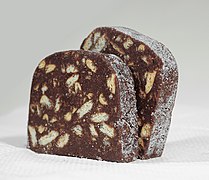
  • Roast pork with dumplings and cabbage (pečené vepřové s knedlíky a se zelím, colloquially vepřo-knedlo-zelo) is often considered the most typical Czech dish.[4] It consists of cabbage and is either cooked or served pickled. There are different varieties, from sour to sweet.
  • Marinated tenderloin (svíčková na smetaně or simply svíčková; svíčková is the name for both the sauce and the meat (beef tenderloin) traditionally used for this dish, (although cheaper beef or even pork cuts are often used instead); na smetaně means in cream, and it means that the svíčková sauce is with cream. Braised beef, usually larded, with a svíčková sauce—a thick sauce of carrot, parsley root, celeriac and sometimes cream. This dish is often served with knedlíky, chantilly cream—sweet, whipped cream—cranberry compote (kompot) and a slice of lemon.
  • Baked mincemeat (sekaná pečeně)—later only mincemeat (sekaná), is a dish made from minced pork meat (beef is also possible).
  • Ham (šunka) is made from pork or beef, braised, dried or smoked.
  • Schnitzel (řízek) is a Czech meat dish. The word means "sliced/cut (out) piece". These are usually small slices of veal, pork or chicken covered with Czech trojobal 'triplecoat', made from putting and pressing a piece pounded and sliced into smooth flour on both sides, then covered in whisked egg and breadcrumbs and fried on both sides. Řízek is served with potato side-dishes. The Czech triplecoat is used in some households at Christmas to cover carp or trout decorated with lemon slices.
  • Karbanátek is a burger usually made from pork, beef, minced fish or other meat. It is often mixed with egg and commonly crumbled with Czech triplecoat. It can be vegetable-based with pastry pieces or flour and in both versions fried on both sides or baked.
  • Smoked meat (uzené) with potato dumplings, fried onion and cooked spinach.
  • Beef with tomato sauce (rajská omáčka or rajská) is served with dumplings. Dill sauce (koprová omáčka or koprovka) is often on menus too.
  • Rabbit is commonly bred in the countryside. Hare with wild game is also served. Mutton, lamb, kid, boar, horse or deer are not as common.

Commonly-found poultry dishes are:

  • Goose, duck, turkey and chicken. Pheasant, partridge, guineafowl, pigeon and other game birds are not as common.
  • Roast duck (pečená kachna) is served with bread or potato dumplings and braised red cabbage.
  • Chicken in paprika sauce (kuře na paprice) or hen in paprika sauce (slepice na paprice) is chicken or hen stewed with onion, paprika and cream.
  • Roast turkey with bacon (krocan pečený na slanině) is turkey larded with, or wrapped in bacon, roasted with bacon and butter; it is not very common.
  • Fish—mostly trout and carp—is commonly eaten at Christmas. Otherwise many fish are imported, including sardines, fillet, salmon, tuna, and anchovy. Other types of fish are slowly becoming popular too. Crayfish used to be very common in rivers, but are nowadays rarer and are protected. Prawns or lobsters are imported instead.

Further information: Katův šleh

Other dishes[edit]

Fried cheese, served with tartar sauce and side salad

  • Mushrooms are often used in Czech cuisine as different types grow in the forests. Czechs make an average of 20 visits to the forest annually, picking up to 20,000 tonnes of mushrooms.[5] Bolete, parasol and other kinds of mushroom are often found. In the shops, you can buy common mushrooms (žampiony), oyster mushrooms (hlívy), shiitake, wood ear and dried forest mushrooms. smaženice are shallow-fried mushrooms with onion and spices. Mushroom Jacob (Houbový Kuba) is a dish prepared from cooked hulled grain (barley), then strained, mixed with cooked mushrooms, fried onion, garlic, fat and black pepper, and baked in the oven. It is served at Christmas. Mushrooms are often triple-coated and fried. Cauliflower can be fried in the Czech triplecoat.
  • Smažený sýr (colloquially smažák) is a fried cheese battered in Czech triplecoat — usually Edam (also Hermelín), about 1 cm thick coated in flour, egg and bread crumbs like Wiener schnitzel, fried and served with tartar sauce and potatoes or French fries.
  • Homemade noodles with ground poppy seeds are called nudle s mákem; these are served with powdered sugar and melted butter. A similar dish is potato buns with poppy seeds (bramborové šišky s mákem), and are called cones (šišky), because they resemble the cones of coniferous trees.
  • Omelette (omeleta) is often served with peas.
  • Pancakes (palačinky) of plate size or palm size are common.
  • The most traditional vegetables are carrots, celery, parsley, turnip, cauliflower, lettuce, onion, leek, garlic, cabbage, kale and chives. In gardens, one can also find tomatoes, bell peppers, courgettes, pumpkins, melons, sunflowers, poppies, potatoes and beet.
  • Peas and lentils are, together with bean pods, the most common. They are served as soup or as cooked mash with pickled cucumber and fried onion, occasionally with sausage or smoked meat. Šoulet (shoulet) is a mix of boiled peas with barley, fat and other ingredients.
  • Žemlovka is a baked dish made with layers of sliced rolls or buns called žemle, sliced apples and milk or eggs. It is served with cinnamon and raisins.
  • Štrúdl or závin (Strudel) can be sweet with apples, raisins, walnuts, grated coconut or cherry—or savoury with cabbage, spinach, cheese or meat.
  • Semolina porridge (krupicová kaše) is served with sugar, honey, cinnamon or cocoa with butter on the top. Optionally, sliced apples or apricots are added as toppings. Healthier versions substitute semolina for oatmeal or rice.
  • Stuffed bell peppers (plněné papriky) are stuffed with meat or rice with vegetables.
  • Lečo or lecsó is a stew made from peppers, onions, tomatoes and spices.
  • Spaghetti (špagety) is coming in as an Italian influence.
  • Eggs are often used in Czech cuisine because many families outside of cities breed hens. Scrambled eggs (míchaná vajíčka) are common. Fried eggs (volské oko, literally "ox eye") are often served with bread or potatoes and spinach. Boiled eggs are also popular. Stuffed eggs are made from halved, shelled, hard-boiled eggs. The yolk is carefully removed into a separate bowl, mixed with salt, mustard and spices and stuffed back. It can be decorated.
  • Dairy products have their place in Czech cuisine too. Edam (eidam) is a Dutch-based type of cheese and Niva is a Czech blue cheese. A common pub food, nakládaný hermelín, or pickled cheese, is a cheese similar to Camembert that is aged in olive oil and spices. Typically served with bread and an assortment of fresh vegetables. Sour cream is commonly used as part of various cream-based sauces.

Snacks[edit]

See also: List of hors d'oeuvre

Fried bramboráky (potato pancakes)

Nakládaný hermelín (marinated cheese)

  • Bramboráky (regionally called cmunda or vošouch in Pilsen and strik or striky in Czech Silesia) are fried pancakes similar to rösti made of grated raw potato, flour, carrots or sour cabbage, and rarely sausage. They are spiced with marjoram, salt, pepper, and garlic, and usually sized to fit the cooking dish. Smaller variants are often eaten as a side dish.
  • Utopenci, singular utopenec (literally "drowned men"), are piquantly pickled bratwursts (špekáčky) in sweet-sour vinegar marinaded with black pepper, bay leaf, onion and chili peppers. They are often available in Czech pubs, but are uncommon in better restaurants.
  • Nakládaný hermelín is a soft cheese, from the same family as brie and camembert, marinated with peppers and onions in oil. It is a pub-food.
  • Beer cheese (pivní sýr) is a soft cheese, usually mixed with raw onions and mustard, which is spread onto toasted bread. It is also a pub-food.
  • Open sandwiches, known as obložené chlebíčky ("garnished breads") or chlebíčky, are not made from normal Czech bread, but from roll-like, bigger pastry called veka, sliced and garnished.[6] They may be served with mayonnaise, ham, egg, fish, salads or spreads on the top.[6] They are usually decorated with fresh sliced or pickled cucumber, tomato, red or yellow bell pepper, sliced radish, or parsley. Jednohubky are similar to obložené chlebíčky, but smaller and in many varieties. All are served in a small amount—one mouthful impaled on a stick.[6]
  • Olomoucké tvarůžky or "syrečky" is an aged cheese with a strong odour. It is made in and sold from Loštice, a small town in Moravia. The tradition of making this cheese dates back to the 15th century. Tvarůžky can be prepared in a number of ways—it can be fried, marinated, or added to bramboráky.
  • Dried apple chips (křížaly) and dried banana chips.
  • Potato, beet and celery chips (crisps) are common snacks.
  • Roasted peanuts are common.
  • The "Czech hot dog" (párek v rohlíku, also called pikador in South Bohemia) is a street food consisting of boiled or steamed sausage dipped in mustard or ketchup served in a roll with a hole made inside, not in a sliced bun like the common hot dog. It is influenced by German cuisine.
  • Langoše (fried bread) are influenced by Hungarian cuisine. They are usually served with garlic, Edam cheese and ketchup, or some combination of the three.

Sweets[edit]

Apple strudel with raisins

Czech coffeehouses are known for their strong coffee, sweet pastries and famous patrons who have included Franz Kafka, Antonín Dvořák, Václav Havel and Albert Einstein. Served warm or cold, strudel (optionally topped with ice cream, whipped cream or powdered sugar), is served at almost every coffee shop, apple being the most common variety.[7]

Sweets filled with fruit, poppy seed and quark are prevalent and come in diverse forms including cakes, koláče (pies), tarts, fritters, and dumplings (ovocné knedlíky). The tradition of making pies has been preserved in American Czech communities who have settled in the Midwestern United States and Texas. They are laborious to make and usually prepared for special celebrations, births, funerals and they also have a role in Czech wedding traditions where they are distributed to friends and family in place of wedding invitations. The most common fillings are poppy seed, apricots (meruňkové knedlíky) and prunes.[7]

Dough prepared for dumplings may include potatoes, and while the combination of fruits, jams and cheeses varies among households, plums (švestkové knedlíky), apricots or strawberries (jahodové knedlíky) are common. The finished dumplings are boiled and often garnished with butter, poppy seeds or grated cheese, and a sweetener (traditionally dried and powdered pears, but sugar is used in modern adaptations). Also filled with fruit or jam (and sometimes garnished with poppy seeds) are the Czech crepes called palačinky.[7] Traditional Czech sponge cake (bublanina), served most often for breakfast, is made with cream, eggs and sugar and seasonal fruits, especially whole cherries.

  • Buchty is a yeast pastry similar to koláče; the same filling is wrapped in pieces of dough and baked, but is not visible in the final product.
  • Sweet dumplings with custard sauce (buchtičky se šodó) are small pieces of yeast pastry poured with cream made from egg yolks and wine (nowadays is šodó usually replaced with vanilla pidding). The recipe comes from Czech roots, however, the bordering countries—mainly Slovakia, Poland, and Hungary—consider buchtičky se šodó as food that came from their country.
  • Pudding is a flavoured custard combined in layers. Pudding is served in a glass topped with fruit or shaped in a mould.

Christmas cookies (vánoční cukroví)

  • Braided bread (vánočka) and buns (mazanec) are prepared for Christmas, along with many kinds of biscuits and Christmas sweets (vánoční cukroví). Vánočka and mazanec are the same type of pastry as Jewish Challah.
  • Easter Lamb (Velikonoční beránek) is prepared for Easter. The dough is from eggs, sugar and flour. Lemons can be added. It is baked in a mould in the shape of a lamb. It can be decorated.
  • Bábovka is from dough similar to that used for Easter Lamb, often with cocoa dough in the middle. It is round, 10–15 cm high, made in a mould and is often served with coffee.[8]
  • Lívance are smaller types of pancakes prepared with yeast in the batter. They are eaten with jam or warm forest fruits.
  • Vdolky and koblihy—see List of doughnut varieties.
  • Perník is made in two ways:
    • Like gingerbread, but without ginger and with added honey. Gingerbread cookies are decorated with shapes; popular themes are heart shapes, three-dimensional cottages and even whole decorated villages are made—especially in the Pardubice Region where the tradition was established in the 16th century.[9]

Frgál, a type of koláč baked in Moravian Wallachia

    • Like a cake with cinnamon and honey.
  • Trdelník is a spit cake. First adpoted in Moravia from Transleithania, it recently gained popularity in Prague and the rest of the country.
  • Roláda is a sponge cake roulade filled with jam.
  • Litá (poured) bublanina is a pancake-like batter poured onto a baking sheet. Pieces of fruit—apples, pears or cherries—measuring 1x2 cm are spread on it and it is then sprinkled with sugar.
  • Makovec is a sponge cake with ground poppy seeds.
  • Mrkvanec is a sponge cake with grated carrots and mrkvánky are small turovers filled with plum or pear jam and with grated carrot added to the dough
  • With the exception of koláče, vánoční cukroví and velikonoční beránek, sweets are consumed with tea or coffee in the late afternoon break, rather than immediately after a main meal.
  • Míša is a treat made out of frozen curd; it is popular with children and has been produced since 1961.

Beverages[edit]

Pilsner Urquell in a branded mug

The Czech Republic has the highest per-capita consumption of beer in the world. The most common style, which originated here, is Pilsner. Aside from beer, Czechs also produce wine mostly in the region of Moravia and a unique liquors— Becherovka. Czech Slivovitz and other pálenka (fruit brandies) is traditionally distilled in the country and are considered national drink. More recently new drinks became popular, among them Tuzemák, traditionally marketed as "Czech rum", is made from potatoes or sugar beets. A mixed drink consisting of Becherovka and tonic water is known under the portmanteau of Beton ("concrete"). Another popular mixed drink is Fernet Stock mixed with tonic, called "Bavorák" or "Bavorské pivo" (literally "Bavarian beer"). Kofola is a non-alcoholic Czech soft drink somewhat similar in look and taste to Coca-Cola, but not as sweet. Kofola was invented in Communist Czechoslovakia as a substitute to the Coca-Cola that they would not import, but it became so popular that production has continued well past the end of Communism in the country.[10]

honduras

Honduran cuisine is a fusion of Mesoamerican, Spanish, Caribbean and African cuisines. There are also dishes from the Garifuna people. Coconut and coconut milk are featured in both sweet and savory dishes. Regional specialties include sopa de caracol, fried fish, tamales, carne asada and baleadas. Other popular dishes include meat roasted with chismol and carne asada, chicken with rice and corn, and fried fish with pickled onions and jalapeños. In the coastal areas and the Bay Islands, seafood and some meats are prepared in many ways, including with coconut milk. Among the soups the Hondurans enjoy are bean soup, mondongo soup (tripe soup), seafood soups and beef soups. Generally all of these soups are mixed with plantains, yuca, and cabbage, and served with corn tortillas.

Pork chop with plantain chips.

Other typical dishes are montucas or corn tamales, stuffed tortillas, and tamales wrapped in plantain leaves. Typical Honduran dishes also include an abundant selection of tropical fruits such as papaya, pineapple, plum, sapote, passion fruit, and bananas, which are prepared in many ways while they are still green.

Common beverages for dinner or lunch include soft drinks. Another popular drink is agua de nance and horchata. A popular bottled soft drink is banana-flavored Tropical Banana.

Breakfast[edit]

A Honduran breakfast

Hondurans usually have a large, hearty breakfast. It typically consists of fried eggs (whole or scrambled), refried beans, Honduran salty sour cream (crema), queso fresco, avocado, sweet fried plantains, and tortillas. It is common for most households to first prepare tortillas, a staple for nearly every dish, which are used throughout the rest of the day.

Other breakfast favorites include carne asada (roasted meat) and Honduran spicy sausages (chorizo). A good breakfast will be accompanied with hot, dark—in this case Honduran-grown—coffee. Honduran coffee is renowned for its delicate qualities, being grown on the slopes of the Honduran mountains in rich soils of volcanic origin. A specific brand famous for its flavor comes from the Honduran region of Marcala; others are the Copán coffee and the coffee grown in Ocotepeque.[1]

Street vendors often sell breakfast baleadas made of flour tortillas, refried beans, and crema or queso fresco. Additional toppings include eggs, meat, and even pickled onions. Vendors sell small tamales made of sweet yellow corn dough, called tamalitos de elote, eaten with sour cream; fresh horchata and pozole is also common.

Another food that can be eaten for breakfast as a dessert is rosquillas. Rosquillas can be considered as a Honduran doughnut and are made from corn (masa, cheese and yeast).

Sopa de caracol[edit]

Sopa de caracol (conch soup)

Sopa de caracol (conch soup) is one of the most representative dishes of the Honduran cuisine. This soup was made famous throughout Latin America because of a catchy song from Banda Blanca called "Sopa de Caracol." The conch is cooked in coconut milk and the conch's broth, with spices, yuca (cassava), cilantro, and green bananas known as guineo verde. Other varieties including crab, fish or shrimp are known as sopa marinera.

Sopa de frijoles[edit]

This traditional soup is made by boiling black or red beans with garlic in water until soft. Once they are soft, the beans are blended, and added to a pot filled with water and with pork bones to serve as the base of the soup. Once the soup base has taken a chocolate color and has boiled enough, the bones are removed, and water is added to the pot, along with the rest of the ingredients, which may include yuca, green plantains, eggs, and many other ingredients. The soup is served with rice and tortillas, and may be accompanied with sour cream, smoked dry cheese, avocados and lemons.

Carneada[edit]

Carneada is considered one of Honduras' national dishes, known as plato típico when served in Honduran restaurants. While it is a type of dish, a carneada or carne asada, like its Mexican counterpart, is usually more of a social event with drinks and music centered on a feast of barbecued meat. The cuts of beef are usually marinated in sour orange juice, salt, pepper and spices, and then grilled.

The meat is usually accompanied by chimol salsa (made of chopped tomatoes, onion and cilantro with lemon and spices), roasted plátanos (sweet plantains), spicy chorizos, olanchano cheese, tortillas, and refried mashed beans.

Rice and beans[edit]

Casamiento, a rice and beans dish

Rice and beans is a popular side dish in the Honduran Caribbean coast. It is often called casamiento as in El Salvador. The most common beans used in Honduras are red beans (frijoles cheles). Typically in Honduras beans are refried and served with green fried bananas (tajadas).

Fried Yojoa fish[edit]

Fried fish from Lake Yojoa

Fried Yojoa fish often has a more savory flavor compared to other types of fish served in the region. Yojoa fish is salted, spiced, and later deep-fried. It is frequently served with pickled red cabbage, pickled onions, and deep-fried sliced plantains (tajaditas).

Baleada[edit]

Main article: Baleada

An open homemade baleada with eggs, butter, cheese and beans

The baleada is one of the most common street foods in Honduras. The basic style is a flour tortilla, folded and filled with refried beans and queso fresco or sour cream (crema). Roasted meat, avocado, plantains or scrambled eggs may be added. Honduran fast-food chains serve different kinds of baleadas.

Corn tortillas[edit]

Corn, or maíz, is a staple in Honduran cuisine. Eating corn comes to Hondurans as an inheritance from the Maya-Lenca people; the Maya believed corn to be sacred, and that the father gods created men from it.

Some tortilla-based dishes include tacos fritos, in which tortillas are filled in with ground meat or chicken and rolled into a flute. The rolled tacos are then deep-fried and served with raw cabbage, hot tomato sauce, cheese and sour cream as toppings.

Catrachitas are a common simple snack, made of deep-fried tortilla chips covered with mashed refried beans, cheese. A variant of this snack are chilindrinas, deep-fried tortilla strips with hot tomato sauce and cheese. It is common in Honduran restaurants to serve an anafre, a clay pot with melting cheese or sour cream, mashed beans and sometimes chopped chorizo heated on top of a clay container with burning charcoal, with fried tortilla chips for dipping.

Enchiladas: the whole tortilla is deep fried and served with a variety of toppings. First ground pork meat is placed, next raw chopped cabbage or lettuce, then hot tomato sauce, and a slice of boiled egg.

Tortilla con quesillo: two tortillas with quesillo (a lightly salted cheese that can easily melt), in between and then pan fried; served with a tomato sauce. Mashed beans are sometimes also added as a filling with the cheese. Chismol is sometimes on top.

Condiments[edit]

Encurtido is used as an appetizer, side dish and condiment, and is a common dish in Honduran cuisine.[2]

Tegucigalpan cuisine[edit]

This refers to the cuisine and restaurants of the city of Tegucigalpa, Honduras. Rice, beans, and tortillas are a staple of the Honduran diet, and some would argue there is little difference in quality between the streetside vendors and top restaurants.[3] The city, like in most other places in Honduras, offers a wide variety of cuisines from not only Honduras but also Asia, India, the Middle East, and other regions. Tegucigalpa offers everything from street food to gourmet food in five-star restaurants.[4][5] However, according to Frommer's, "Tegucigalpa's dining scene is considerably more varied when compared to the rest of the country, but lacks the quality and depth of other Latin American cities."[3]

sweden

Swedish cuisine (Swedish: Svenska köket) is the traditional food of Sweden. Due to Sweden's large north-to-south expanse, there are regional differences between the cuisine of North and South Sweden.[1]

Historically, in the far north, meats such as reindeer, and other game dishes were eaten, some of which have their roots in the Sami culture, while fresh vegetables have played a larger role in the South. Many traditional dishes employ simple, contrasting flavours, such as the traditional dish of meatballs and brown cream sauce with tart, pungent lingonberry jam.

General features[edit]

Swedish cuisine could be described as centered around cultured dairy products, crisp and soft (often sugared) breads, berries and stone fruits, beef, chicken, lamb, pork, eggs, and seafood. Potatoes are often served as a side dish, often boiled. Swedish cuisine has a wide variety of breads of different shapes and sizes, made of rye, wheat, oat, white, dark, sourdough, and whole grain, and including flatbreads and crispbreads. There are many sweetened bread types and some use spices. Many meat dishes, especially meatballs, are served with lingonberry jam. Fruit soups with high viscosity, like rose hip soup (nyponsoppa) and bilberry soup (blåbärssoppa) served hot or cold, are typical of Swedish cuisine. Butter and margarine are the primary fat sources, although olive oil is becoming more popular. Sweden's pastry tradition features a variety of tortes, yeast buns, cookies, biscuits and cakes; many of them are in a very sugary style and often eaten with coffee (fika).[2]

History[edit]

The importance of fish has governed Swedish population and trade patterns far back in history. For preservation, fish were salted and cured. Salt became a major trade item at the dawn of the Scandinavian Middle Ages, which began c. 1000 AD. Cabbage preserved as sauerkraut and various kinds of preserved berries, apples, and other fruit were used once as a source of vitamin C during the winter (today sauerkraut is very seldom used in Swedish cuisine). Lingonberry jam, still a favourite, may be the most traditional and typical Swedish way to add freshness to sometimes rather heavy food, such as steaks and stews. Black currant jelly is often served with wild game such as venison, elk or moose.[citation needed]

Sweden's long winters explain the lack of fresh vegetables in many traditional recipes. In older times, plants that would sustain the population through the winters were cornerstones; various turnips such as the kålrot (rutabaga) (aptly named "swede" in British English) were gradually supplanted or complemented by the potato in the 18th century. A lack of certain spices made everyday food rather mildly spiced by today's standards, although a number of local herbs and plants have been used since ancient times. This tradition is still present in today's Swedish dishes, which are still quite mild but flavourful due to the usage of such herbs.[citation needed]

Both before and after this period, some new Germanic dishes were also brought in by immigrants, such as people related to the Hanseatic League, settling in Stockholm, Visby, and Kalmar. Swedish traders and aristocrats naturally also picked up some food traditions in foreign countries; cabbage rolls (kåldolmar) being one example. An early version of kåldolmar was first published in 1765 in the fourth edition of Hjelpreda i Hushållningen för Unga Fruentimber by Cajsa Warg, though it was closer to the Turkish dolma than later dishes.

Husmanskost[edit]

Swedish husmanskost denotes traditional Swedish dishes with local ingredients, the classical everyday Swedish cuisine. The word husmanskost stems from husman, meaning 'house owner', and the term was originally used for most kinds of simple countryside food outside of towns. Genuine Swedish husmanskost used predominantly local ingredients such as pork in all forms, fish, cereals, milk, potato, root vegetables, cabbage, onions, apples, berries etc.; beef and lamb were used more sparingly. Beside berries and pears, apples are the most used traditional fruit, eaten fresh or served as apple pie, apple sauce, or apple cake. Time-consuming cooking methods such as redningar (roux) and långkok (literally 'long boil') are commonly employed and spices are sparingly used. Examples of Swedish husmanskost are pea soup (ärtsoppa), boiled and mashed carrots, potato and rutabaga served with pork (rotmos med fläsk), many varieties of salmon (such as gravlax, inkokt lax, fried, pickled), varieties of herring (most commonly pickled, but also fried, au gratin, etc.), fishballs (fiskbullar), meatballs (köttbullar), potato dumplings with meat or other ingredients (palt), potato pancake (raggmunk), varieties of porridge (gröt), a fried mix of pieces of potato, different kind of meats, sausages, bacon and onion (pytt i panna), meat stew with onion (kalops), and potato dumplings with a filling of onions and pork (kroppkakor). Many of the dishes would be considered comfort food for the nostalgic value.[citation needed]

Dishes akin to Swedish husmanskost and food traditions are found also in other Scandinavian countries; details may vary.

Sweden is part of the vodka belt and historically distilled beverages, such as brännvin and snaps, have been a traditional daily complement to food. Consumption of wine in Sweden has increased during the last fifty years, partly at the expense of beer and stronger alcoholic beverages.

Husmanskost has undergone a renaissance during the last decades as well known (or famous) Swedish chefs, such as Tore Wretman, have presented modernised variants of classical Swedish dishes. In this nouvel husman the amount of fat (which was needed to sustain hard manual labour in the old days) is reduced and some new ingredients are introduced. The cooking methods are tinkered with as well, in order to speed up the cooking process or enhance the nutritional value or flavour of the dishes. Many Swedish restaurateurs mix traditional husmanskost with a modern, gourmet approach.

Dishes[edit]

Pyttipanna

Swedish traditional dishes, some of which are many hundreds of years old, others perhaps a century or less, are still a very important part of Swedish everyday meals, in spite of the fact that modern Swedish cuisine adopts many international dishes.

Internationally, the most renowned Swedish culinary tradition is the smörgåsbord and, at Christmas, the julbord, including well-known Swedish dishes such as gravlax and meatballs. In Sweden, traditionally, Thursday has been "soup day" because the maids had half the day off and soup was easy to prepare in advance. One of the most traditional Swedish soups, ärtsoppa, is still served in many restaurants and households every Thursday,[3] a tradition since the Middle Ages. Ärtsoppa is a yellow pea soup, commonly served with pancakes as dessert. This is a simple meal, a very thick soup, basically consisting of boiled yellow peas, a little onion, salt and small pieces of pork. It is often served with mustard and followed by a dessert of thin pancakes (pannkakor). The Swedish Armed Forces also serve their conscripts pea soup and pancakes every Thursday.

Potatoes are eaten year-round as the main source of carbohydrates, and are a staple in many traditional dishes. Not until the last 50 years have pasta or rice become common on the dinner table. There are several different kinds of potatoes; the most appreciated is the "new potato", a potato which ripens in early summer and is enjoyed at the traditional midsummer feast. New potatoes at midsummer are served with pickled herring, chives, and sour cream, and the first strawberries of the year are traditionally served as dessert.

The most highly regarded mushroom in Sweden is the chanterelle, which is considered a delicacy. The chanterelle is usually served as a side dish together with steaks, or fried with onions and sauce served on an open sandwich. Second to the chanterelle, and considered almost as delicious, is the porcini mushroom, or karljohansvamp, named after Charles XIV John (Karl XIV Johan) who introduced its use as food.

In August, at the traditional feast known as kräftskiva, crayfish party, Swedes eat large amounts of crayfish, boiled and then marinated in a broth with salt, a little bit of sugar, and a large amount of dill umbels (krondill, lit. crown dill).

Meals[edit]

Meals consists of breakfast in the early morning (frukost), a light lunch before noon (lunch), and a heavy dinner (middag) around six or seven in the evening. It is also common to have a snack, often a sandwich or fruit, in between meals (mellanmål). Most Swedes also have a coffee break in the afternoon, often together with a pastry (fika). In all primary schools, and most, but not all secondary schools, a hot meal is served at lunch as part of Sweden's welfare state. According to Swedish school law, this meal has to be nutrient-dense.[4]

Breakfast[edit]

Swedish knäckebröd, or crisp bread.

Breakfast usually consists of open sandwiches (smörgås), possibly on crisp bread (knäckebröd). The sandwich is most often buttered, with toppings such as hard cheese, cold cuts, caviar, messmör (a Norwegian sweet spread made from butter and whey), ham (skinka), and tomatoes or cucumber.[5] Filmjölk (fermented milk/buttermilk), or sometimes yogurt, is also traditional breakfast food, usually served in a bowl with cereals such as cornflakes. Muesli, or porridge (gröt) is sometimes eaten at breakfast, made of oatmeal or cream of wheat, eaten with milk and jam or cinnamon with sugar.[5] Common drinks for breakfast are milk, juice, tea, or coffee. Swedes are among the most avid milk and coffee drinkers in the world.

Swedes sometimes have sweet toppings on their breads, such as jam (like the French and Americans), or chocolate (like the Danes), although many older Swedes choose not to use these sweet toppings. However, orange marmalade on white bread is common, usually with morning coffee or tea.

Many traditional kinds of Swedish bread, such as sirapslimpa (less fashionable today, but still very popular) are somewhat sweetened in themselves, baked with small amounts of syrup.[5] Like in many other European countries, there are also many non-sweetened breads, often made with sourdough (surdeg). Swedish breads may be made from wholegrain, fine grain, or anything in between, and there are white, brown, and very dark (like in Finland) varieties which are all common. Barkis or bergis is a localised version of challah usually made without eggs and at first only available in Stockholm and Göteborg where Jews first settled but now available elsewhere.

Main courses[edit]

SwedishEnglishDefinition

ÄrtsoppaPea soupYellow pea soup.

BlåbärspaltDumplings with blueberries

BlodpaltDumplings made out of blood

BlodpuddingBlack puddingThe Swedish name literally means 'blood pudding'. Sweetened and spiced, it is eaten with lingonberry jam, and sometimes bacon.

BlodkorvBlood sausageOther than pig blood, the ingredients include flour, pork, raisins and spices.

Bruna bönor och fläskBrown beans and porkA classical Swedish dish consisting of pork with stewed brown beans.

FalukorvSausage, big and thick, originating from Falun. The lifts and pumps at the Kopparberg copper mine in Falun were, during the 16th and 17th centuries before the introduction of steam engines, powered by oxen. When these oxen died from strain or old age, the skin was turned into leather ropes used in the mine, and some of the meat was turned into Falukorv sausages.

FiskbullarFishballs, made from minced white fish meat.

FläskkorvPork sausageSausages, pork.

FläskpannkakaPork pancakeA thick pancake with diced pork, baked in a form in the oven.

Flygande JacobFlying JacobCasserole based on chicken with cream, chili sauce, bananas, peanuts and bacon. Invented in the 1970s.

GravlaxSalmon cured with salt and sugar with herbs.

GrisfötterPig's trotters served with rödbetor.

Inkokt laxBoiled salmon, together with onion and carrots, in a mixture of water, vinegar, salt, sugar and some other spices. Usually eaten cold, commonly together with mayonnaise spiced with dill and lemon.

Inlagd sillPickled herring.

IsterbandSausage, from Småland, made of coarsely ground pork, barley and potatoes. It is prepared by first fermenting it and then lightly smoking it. This method of cooking creates a distinct, both acidic and slightly smoky flavour. It is traditionally eaten with dill-stewed potatoes and pickled beetroot.
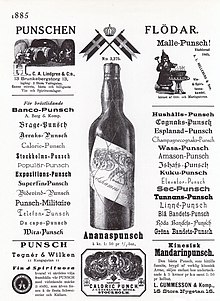
Janssons frestelseJansson's temptationPotato casserole made of grated potatoes, onion, anchovy and cream; the fish used is usually the sprat, a different species spiced with herbs.[6]

JulskinkaCured ham, boiled and breaded with mustard, bread crumbs and egg; translates as Christmas ham. The Swedish equivalent to Christmas turkey.

KåldolmarCabbage rolls. These are a Swedish variation of the Turkish dolma, and date back to when Charles XII returned to Sweden from the Ottoman Empire.[7]
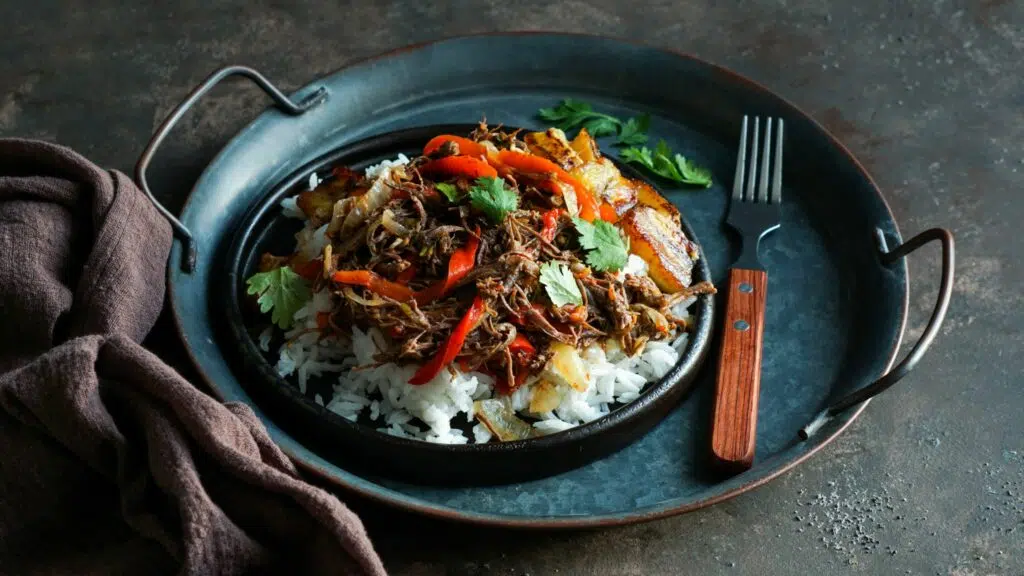
KalopsMeat stewed with onion, vegetables and spices.

KöttbullarMeatballs made from meat and herbs tightly rolled together, frequently served with mashed potatoes and pickles.

Korv StroganoffSliced sausage pieces (usually falukorv) served in a creamy tomato sauce, a cheaper Swedish variation of beef Stroganoff.

Köttsoppa med klimpSoup, made from beef and root vegetables, served with klimp, a Swedish dumpling.

KroppkakorDumplings made of pre-boiled potatoes, filled with pork.[8]

LeverpaltDumplings with liver.

LutfiskLye fish made of stockfish.

PaltDumplings made of unboiled potatoes, filled with pork.

PaltbrödA type of tunnbröd baked with blood. Traditionally served leached with white sauce and fried pork.

PannkakorA thin pancake fried in an ordinary frying pan. In some parts of Sweden, all thin pancakes are called plättar.

PitepaltDumplings from Piteå.

PlättarA plätt is a very small pancake, usually made in a plättlagg, a sort of normal size frying pan with indentations to allow for several, normally seven, smaller (usually around 10 cm in diameter) pancakes to be made at once. See Pannkakor

PölsaSimilar to hash or Scottish haggis without casing.

PrinskorvPrince's sausagesSmall sausages, hot dog-style.

PyttipannaMix of chopped and fried meat, onions, pre-boiled potatoes, often prepared from leftovers. Other ingredients are often added as well, such as sausages, beetroot, fried egg, bacon or even salmon (instead of the meat).[9]

RaggmunkPotato pancakes. Usually eaten with lingonberry jam and sometimes fried slices of pork belly.

Rotmos med fläskMashed roots with porkMashed root vegetables, usually rutabaga, carrots and sometimes potatoes, served with long-boiled salted pork loin.

RäksmörgåsShrimp sandwichOpen sandwich with shrimp, egg and mayonnaise. Lettuce, tomato or cucumber are commonly added, usually topped with lemon and dill.

SillsalladHerring saladA Russian-style chopped cold-salad side dish made with pickled herring, boiled cold potatoes, boiled cold beets, minced raw onion, fresh dill, and sour cream.

SmörgåstårtaSandwich cakeLike a very big multi-layer sandwich. Comes with many different fillings and toppings, often including shrimp, ham, mayonnaise, salad, and preserved fruits.

S.O.S. (smör, ost och sill)Butter, cheese and herringAppetizer dish made with butter, cheese, and herring.

Stekt fläsk med löksås och potatisPork with onion sauce and potatoes.

Stekt strömmingFried herringFileted fresh herring, two filets put flesh to flesh, skin out, with dill, salt and ground white pepper between and breadcrumbs on the outside, and then fried in butter until golden. Eaten with mashed potatoes and lingonberry jam. Very different from surströmming.

SurströmmingFermented Baltic herringBeing fermented, surströmming has a strong odour and unique flavour and is considered an acquired taste even among Swedes. Usually eaten with thin, hard bread.

SyltaSwedish head cheeseMade primarily from finely chopped pork pulled soft from a boiled pig head and mixed with the gelatin from the skull and various spices and pressed to form a loaf that is served chilled so that the gelatin sets.

WallenbergarePatty of ground veal, cream, and egg yolks, coated in breadcrumbs.

Seafood[edit]

Fish and other seafood are an important part of Swedish cuisine. Farmed salmon from Norway has become increasingly popular. Pickled, sweetened herring, inlagd sill, is a traditional Swedish appetizer. Shrimp and lobster are specialties of the Skagerrak coast. Surströmming is a fermented Baltic herring famous for its pungent aroma, both loved and hated.

Desserts[edit]

See also: List of Swedish desserts

Ris à la Malta (Ris à l'amande), a Christmas dessert.

Äggost

Common desserts include:

SwedishEnglishDefinition

Gotländsk saffranspannkakaRice pudding dessert with saffron originating in Gotland usually served with jam or whipped cream, or dewberry jam.

KalvdansA classic Scandinavian dessert made from unpasteurized colostrum milk, the first milk produced by a cow after giving birth.

KlappgrötSemolina pudding mixed with juice from either red currant, lingonberries, raspberries, blackberries, or comparable fruits, then stirred or blended until the texture is fluffier. Eaten cold.

OstkakaSwedish cheesecake (very different from American cheesecake).

PannkakaPancakes are almost never served for breakfast ('American-style') but either as dessert with sweet jam or whipped cream, or as a meal in itself, using fewer sweet toppings. Pancakes for dinner can be thick oven-baked pancakes with pork meat or apples inside.

SmördegspajButter dough based pie.Various kinds of pies and cookies are typical desserts, mostly served with coffee. Typical pies are apple pie, blueberry pie and rhubarb pie.

SmulpajCrumb pie

SpettekakaA sweet dry hollow Swedish cake, shaped like a cylinder, and similar to meringue, found only in a southern province of Sweden, Scania.

VåfflorWafflesOften served with jam and whipped cream or ice cream. Waffles also have their own day on 25 March.

ÄggostA dish originating from Bohuslän. In the southern parts of the county it is traditionally served as a dessert along with whipped cream, sugar and blackberry jam, but in the northern parts it is usually seen as a main dish or breakfast and often served with pickled herring.

Pastries and treats[edit]

Cinnamon roll (kanelbulle)

Kaffebröd (coffee bread)[edit]

Bakelser and other types of kaffebröd (or more colloquially fikabröd) are various forms of pastries, cake, cookies, and buns that are usually consumed with coffee (see fika). Popular kinds of kaffebröd available in a traditional Swedish konditori (coffee shop / pâtisserie) include:

SwedishEnglishDefinition

KanelbulleCinnamon roll, optionally made with cardamom dough

WienerbrödA Danish pastry; comes in several varieties and shapes; very similar to a Danish pastry in the US.

ChokladbollChocolate ball.A round chocolate-flavoured butter ball with oatmeal, cocoa and sugar, coated in coconut flakes or pearl sugar.

KringlaA small pretzel-shaped (sweet) cookie with pearl sugar on top.

PunschrullePunsch-rollA small cylindrical pastry covered with green marzipan with the ends dipped in chocolate, and inside a mix of crushed cookies, butter, and cacao, flavoured with punsch liqueur. This pastry is often called dammsugare ('vacuum cleaner'), referring to its cylindrical shape, similar to many older vacuum cleaners. Other names are arraksrulle (as arrak (arrack) is an ingredient in punsch) and '150-ohmer' (owing to the brown-green-brown colouring, resembling a 150 ohm resistor).

BiskviA small round pastry with a base: made from almonds and sugar, filled with butter cream and covered with a thin layer of chocolate. First made in France during the 19th century.

PrinsesstårtaPrincess cakeA large cake, made of sponge cake layered with whipped cream, and custard under a green marzipan coating with powdered sugar on the top; often decorated with a pink marzipan rose.

BudapestbakelseBudapest pastryBasically made from sugar, egg white, hazelnuts, whipped cream, and pieces of fruit like apricot or mandarine, decorated with a little chocolate and powdered sugar.

NapoleonbakelseNapolitainMade of pastry dough, whipped cream, custard and jam, topped with icing and currant jelly.

Napoleon pastry

KladdkakaA chocolatey and sticky flat cake.

ToscakakaLight sponge topped with caramelized almonds.

ArraksbollA ball flavoured with arrak, similar in appearance to a chokladboll but very different taste.

Treats[edit]

Saffron bun, also called St. Lucia bun (lussebulle)

During the winter holidays, traditional candy and pastries include:

TreatsDefinition

KnäckChristmas toffee. (Hard, usually to be sucked, not chewed. The soft variety is called kola, which is chewy, and may be flavoured. )

IschokladCoconut oil mixed with chocolate.

Marmelad'Marmalade candy', rectangular fruit and pectin based candy in various colours.

LussekattSaffron bun, a Swedish saffron bun eaten on the Saint Lucia celebration (13 December).

PepparkakaSimilar to a ginger snaps (has been eaten since the 14th century and baked at the monastery of Vadstena since 1444); associated with Christmas.

SemlaWith the new year, the fastlagsbulle (Lenten bun), or semla, is baked. It is a wheat bun with a cream and almond paste filling, traditionally eaten on Shrove Tuesday.[2]

Other typical Swedish candy includes:

CandyDefinition

SaltlakritsLiquorice candy flavoured with ammonium chloride.

PolkagrisTraditional peppermint stick candy from Gränna, also made in other flavours.

Ahlgrens bilarA marshmallow candy shaped like a car. Marketed as "Sweden's most purchased car" (Swedish: Sveriges mest köpta bil).

SockerbitarSimilar to square, chewy marshmallows.

GeléhallonAn early form of gelatine-based candy.

DaimFormerly called Dime in the UK.

Drinks[edit]

Sweden is in second place among the heaviest coffee-drinking countries in the world.[10] Milk consumption in Sweden is also very high, second only to Finland. Milk is bought in milk cartons; Tetra Pak, the world's largest maker of milk cartons, was founded in Sweden. Milk is considered the standard drink to have with meals during weekdays in many families, for both children and adults.

Christmas beverages[edit]

Julmust

DrinkDefinition

MummaA traditional Christmas beverage.[11] Usually a mix of porter or another dark beer, some light beer (pilsner), port wine (or some other wine), and something sweet (sockerdricka or julmust); commonly spiced with cardamom.[12]

GlöggMulled wine

Sweet drinks[edit]

A cup of blueberry soup, (blåbärssoppa) topped with cereals

SwedishEnglishDefinition

BlåbärssoppaBilberry soupSweet soup or drink made from bilberries, served either hot or cold

EnbärsdrickaJuniper berry soft drink

SockerdrickaSugar drinkSweet-sour soft drink (carbonated)

FruktsodaTraditional lemon-lime soft drink (carbonated)

ChampisSoft drink alternative to sparkling wine (carbonated)

Pommac

TrocaderoSoft drink with the taste of apple and oranges, with its roots in the north of Sweden

JulmustSweet seasonal carbonated soft drink (jul ‒ a cognate of the English yule ‒ means Christmas in Swedish)

LingondrickaLingonberry drink

NyponsoppaRose hip soupSweet soup or drink made from rose hips, served either hot or cold

Liquor[edit]

Main article: Alcoholic beverages in Sweden

Caloric punsch advertistement c. 1885

The production of liquor has a tradition dating back to the 18th century and was at a high in the 1840s.[citation needed] Since the 1880s, the state-owned Systembolaget has a monopoly on selling spirits with more than 3.5% ABV, limiting access. Hembränt (moonshine) used to be made in rural Sweden, but production has lessened in recent years due to more liberal rules for the import of alcohol as well as increased smuggling.

Punsch is a traditional liqueur in Sweden that was immensely popular during the 19th century. It was adopted as the drink of choice by university students, and many traditional songs from that time are about the consumption of punsch or are meant to be sung during the collective festivities that were part of the cultural life in the universities' student associations at the time and still is.

Beer[edit]

Main article: Beer in Sweden

Beer is also widely consumed in Sweden and the typical Swedish beer is lager of a bright and malty kind. The brands Pripps Blå and Norrlands Guld are common examples. In the last few decades, many small breweries (microbreweries) have emerged all over Sweden offering a wide range of styles and brands. Nils Oscar Brewery, Dugges Ale och Porterbryggeri and Närke Kulturbryggeri are examples of these young Swedish microbreweries. Many microbreweries in Sweden are inspired by the US craft beer movement, brewing American styles or styles commonly associated with American craft breweries, e.g. American Pale Ale and American IPA.

Food and society[edit]

Brödinstitutet ('The Bread Institute') once campaigned with a quotation from the Swedish National Board of Health and Welfare, recommending[13] eating six to eight slices of bread daily. Drinking milk[14] has also been recommended and campaigned for by the Swedish National Board of Health and Welfare;[citation needed] it is often recommended to drink two[15] to three glasses of milk per day.[16][17][18] A survey conducted on behalf of Mjölkfrämjandet, an organisation promoting consumption of Swedish milk, concluded that 52% of Swedes surveyed drink milk at least once a day, usually one glass with lunch and another glass or two in the evening or morning.[19]

Low-fat products, wholemeal bread and other alternatives are common; grocery stores usually sell milk in four or five different fat levels, from 3% to 0.1%.[20]

In Sweden, it is often considered inappropriate to feed children from another family. Visiting children may be asked to leave at dinnertime or to wait in another room, or the host family may call the visitor's parents and ask for permission.[21]

cuba

Ropa Vieja

Ropa Vieja Cuban Dish

This beloved and oh-so-aromatic mix of shredded beef and tomato sauce originated in Spain, and it’s a staple throughout Latin American countries like Venezuela and Colombia. However, ropa vieja is considered the national dish of Cuba, where residents hold a special affinity for it.

The name ropa vieja translates to “old clothes,” likely because it’s traditionally made with tough cuts of meat that break into long, thin fibers—resembling well-worn threads—when cooked. There’s even a story behind the dish’s beginnings. It’s said that a poor old man had no money to feed his family, so shredded up his clothes and boiled them instead. The man prayed over the pot while it was cooking and when he finally lifted the lid, the concoction had transformed into a mouthwatering meat stew.

Ropa Vieja most likely emerged among the Sephardic Jews of the Iberian Peninsula. As cooking on the Sabbath was off-limits, they simply prepared this slow-cooking dish the night before and enjoyed it the following day. It made its way to the Caribbean with Spanish colonists and has long been a favorite in Cuba’s paladares—in-home, family-run restaurants—where it’s served up with sides of congri (Cuban black beans and rice) and fried plantains.

TAKE ME TO CUBA

Vaca Frita

Vaca Frita Cuban Dish

Another Cuban staple, vaca frita is similar to ropa frita, but with a twist. After marinating the shredded beef (often flank steak) Cubans cook it twice: once while the meat is stewing, and then pan frying it afterwards to make it crispy. In fact, the name of the dish translates to “fried cow” in English. Vaca Frita is believed to have originated in the Canary Islands, where slaves working the local plantations were challenged with turning tough cuts of meat into deliciously edible dishes.

REQUEST A FREE CATALOG

Tostones

Tostones Cuban Dish

While plantains most likely originated in Southeast Asia, it was Spanish settlers who brought them to the Caribbean. Today, you’ll find them on menus throughout Latin America, though they’re especially prevalent in Cuba—so much so that Cubans often use the term aplatanado (being “plantain-like”) to describe non-native islanders who have adopted the country’s customs and culture.

Both cheap and nutritious, these starchy, banana-like fruits make a great snack or side-dish, especially in the form of tostones: unripe plantains that are peeled, diagonally sliced, and fried twice for extra deliciousness. They’re often served with some mojo dip: a signature Cuban sauce made up of olive oil, garlic and onion, herbs, and citrus juice.

CONTACT US ABOUT CUBA

Arroz con Pollo

Arroz con pollo Cuban Dish

Similar in many ways to Spanish paella, arroz con pollo is a mix of rice, chicken, tomato sauce, and sofrito—a traditional Cuban seasoning made with garlic, onions, and bell peppers that’s the base for many of the country’s most prominent dishes.

The origins of this recipe stem from the time of the Moors occupation of Spain, which began in the 8th century. Later, the Spanish brought it to Latin America, including Cuba, where locals put their own spin on the dish. Considered a comfort food that’s both hearty and affordable to make, arroz con pollo has long been the preferred choice of family gatherings, including birthdays.

TAKE ME TO CUBA

Moros y Cristianos

Moros y Cristianos Cuban dish

Cuban’s version of rice and beans, moros y cristianos is another dish that has its origins during the Moors’ occupation of Spain and was brought to the island country later. The name means “Moors and Christians,” with Moros being the black beans, and Cristianos the white rice. Unlike traditional rice and bean dishes, moros y cristianos cooks these two main ingredients in the same pot rather than separately, adding sofrito for a distinct Cuban flavor.

While easy to come by in Cuban homes and restaurants, moros y cristianos is also a standard dish during Noche Buena, an annual Christmas Eve family tradition with loads of good food.

LEARN MORE ABOUT CUBA

Medianoche

Medianoche Cuban sandwich

A standard food in Havana’s nightclubs, this warm pressed sandwich earned the name medianoche, or “midnight,” for the time of late night/early morning that it’s most often served. While its ingredients of roast pork, ham, mustard, Swiss cheese, and pickles are almost identical to those that make up the better-known Cuban sandwich (prevalent in Miami and Tampa), it’s the bread that differentiates the two. Rather than the crusty Cuban bread that’s a Cuban sandwich essential, medianoche utilizes a soft, sweet eggy roll. It’s the perfect “after hours” meal for replenishing following a night on the town.

TAKE ME TO HAVANA

Picadillo

Picadillo Cuban dish

Although variations of picadillo exist across Latin America and the Philippines, the origins of this aromatic hash remain a mystery. Each country prides itself on its own distinct recipe, with Cuba’s version being a comfort staple that’s both extremely flavorful and easy to prepare.

Picadillo derives from the word picar, meaning in English to “mince” or “chop” ingredients. In this case that includes ground meat and tomatoes, as well as olives, capers, and raisins for a touch of sweetness. Crispy potatoes are often added as well. It’s then served together with black beans and rice, or used as a filling in foods like empanadas.

REQUEST A FREE CATALOG

Fricase de Pollo

Fricase de Pollo Cuban Dish

Another Cuban favorite, fricase de pollo is a chicken stew that combines cuts of dark skinless meat and potatoes in a tomato sauce, adding sour orange juice and garlic for extra flavor.

Fricassee is actually a French dish of meat or vegetables browned in butter, stewed in stock, and served in a white wine sauce. It’s believed that French refugees arriving in Haiti in the 1800s brought it with them. Many of them eventually resettled in Cuba, making fricase de pollo part of the local lexicon.

READ MORE ABOUT CUBA

Cuban Coffee

Cuban coffee with Cuban flag

No Cuban dessert is complete without Cuban coffee, aka Café Cubano, a type of sweetened espresso that originated on the island. To make it, locals rigorously whip together natural brown sugar with a few early drops of brewed espresso. This creates a creamy foam that they then pour over with the remaining espresso. Cuban coffee is most commonly made with a Moka pot, sometimes called a stovetop espresso maker, and drinking it is a popular social activity. Residents linger together over cups of the strong brew everywhere from cafeterias and bars to kitchen tables.

TAKE ME TO CUBA

Flan

Flan Cuban dessert

The Cuban version of flan, a creamy custard with caramel topping that’s prevalent throughout Latin America, utilizes condensed and evaporated canned milk. That’s because in Cuba, finding fresh milk was not always an option. While this was an ingredient born of necessity, it also yields a thicker and creamier custard that’s sweeter than your average flan.

Oddly, flan originated as a savory dish in ancient Rome. Eventually, a chef created a sweetened version with honey, and the dish became hugely popular. The Spanish later adopted the recipe and added their own twist. Like most other foods, they then brought it with them to the Caribbean.

Read about our Cultural Walking Adventure in Cuba so you can enjoy these dishes and experience this trip of a lifetime for yourself.

A open air restaurant in Havana.

ENJOY CUBAN CUISINE

Related Trips

SEE ALL TOURS

Long Weekend in Cuba

Havana Cultural Walking Tour

  • 4 days
  • Starting at $4,695

View Dates & Details

Havana, Cienfuegos & Trinidad

Cuba Cultural Walking Tour

  • 7 days
  • Starting at $5,665

View Dates & Details

SHARE POST

TAGS

  • Italy
  • India
  • Traveling With Children
  • Iceland
  • Costa Rica
  • Cuisine
  • Tuscany
  • Walking Tours
  • Adventure Tour
  • Tour Guides
  • Morocco
  • Custom Travel
  • Peru
  • Bryce
  • Grand Canyon & Zion
  • Culture
  • Europe
  • United States
  • Galapagos Islands
  • Guided Tours
  • Croatia
  • Travel Tips
  • Family Vacation
  • France
  • Machu Picchu
  • Amalfi Coast
  • Group Tour
  • Cuba
  • Vietnam
  • Alaska
  • Glacier National Park
  • Yellowstone & Tetons tours
  • Uffizi Gallery
  • Piazza del Duomo
  • Truffles
  • San Miniato
  • Cortona
  • Southern Italy
  • Galapagos
  • Ecuador
  • Latin America
  • South America
  • Island Destinations
  • capri
  • Sicily
  • Florence
  • Portofino
  • Northern Lights
  • Blue Lagoon
  • Cuban dishes
  • Cuban Cuisine
  • Havana
  • Fes
  • Marrakesh
  • Atlas Mountains
  • Ouarzazate
  • Merzouga
  • walking vacation
  • family vacations
  • Venice
  • Laos
  • London
  • Rome
  • Paris
  • Cambodia
  • year-end vacations
  • Holiday Vacation
  • Year-end trips
  • Amalfi
  • Austria
  • Greece
  • Greek Isles
  • Santorini
  • portugal
  • lisbon
  • porto
  • walking tour
  • Sacsayhuaman
  • Incan Ruins
  • Mysteries of Sacsayhuaman
  • Manuel Antonio National Park
  • Costa Rican Wildlife
  • San Jose
  • Arenal Volcano
  • Chile
  • Easter Island
  • Moai
  • Poike Volcano
  • montana
  • wildlife
  • Hiking Yellowstone
  • Bryce Canyon
  • Grand Canyon
  • Zion National Park
  • Best views
  • Best walks
  • Best hikes
  • Going-to-the-sun Road
  • Yellowstone
  • National Parks
  • Wildlife in Zion National Park
  • Wildlife in Bryce Canyon
  • Wildlife in Grand Canyon
  • Wildlife spotting in National Parks
  • best views in Glacier National Park
  • Highline Trail
  • Grand Teton
  • National Park Tours
  • Alaskan Wilderness
  • Pena Palace
  • Portugese Wine
  • Maipo Valley
  • Chilean Wines
  • South Africa
  • South Africa Safari
  • Top Sites
  • Norway
  • Scandinavia
  • Stonehenge
  • England
  • Cotwolds
  • Reykjavik
  • Southern Spain
  • Andalucia
  • Alhambra Palace
  • Granada
  • Cordoba
  • Ronda
  • El Torcal
  • Naples
  • Pizza
  • Casablanca
  • Crete
  • Paros
  • Mykonos
  • Naxos
  • Rick's Cafe Casablanca
  • Port Wine
  • Palermo
  • Wine
  • Bordeaux
  • Istria
  • Chianti
  • Alentejo
  • Evora
  • Oslo
  • OsloFjord
  • Knossos
  • Delos
  • Family travel
  • multigenerational trips
  • santiago
  • Saigon
  • madrid
  • spain
  • pasta
  • best regional dishes
  • culinary tours
  • Galapagos Wildlife Encounters
  • The Cotswolds
  • Historic tours
  • cultural walking tours
  • Cornwall
  • England's Cornwall Coast
  • Provence
  • scotland
  • iberia
  • barcelona
  • gaudi
  • Italian Lakes
  • guided walking tours
  • hotels
  • heritage tours
  • Nova Scotia
  • Canada
  • Puglia

Want More Advice & Inspiration? Sign Up for Our Newsletter

  • I am a Travel Advisor

First name*

Last name*

Email*

Related Blog Posts

ALL POSTS

Italy Puglia man overlooking town

Travel Stories

Touring Puglia, On Foot At Eye Level

By Julie Gennaro

Travel Stories

Your Personal Caravan Awaits in Morocco

By Classic Journeys

Skip the Ship in the Galapagos

Travel Stories

Darwinism at work: 5 top reasons to skip the ship

By Classic Journeys

Get the Latest News and Special Offers

  • I am a Travel Advisor

First name*

Last name*

Email*

EXPLORE MORE

  • Blog
  • Gallery
  • Media Coverage
  • Gift of Travel
  • FAQs

OUR STORY

  • About Us
  • Sustainability
  • Awards
  • Terms & Conditions

CONNECT

  • Travel Advisors
  • Careers
  • Request a Catalog
  • Contact Us

Chat with our travel experts

800-200-3887

Mon-Fri 5:00AM - 5:00PM PST

Share Your Travels

© 2024 Classic Journeys llc. All rights reserved. CST-2145049-20

  • Privacy Policy
  • Terms of Service

Website by 829

We use cookies on our website to give you the most relevant experience by remembering your preferences and repeat visits. By clicking “Accept All”, you consent to the use of ALL the cookies. However, you may visit "Cookie Settings" to provide a controlled consent.

Cookie SettingsAccept All

dominican

Typical Dominican Breakfast

1. Mangú con Salami, Huevo y Queso Frito (Mashed Green Plantain, Cheese, Dominican Salami and Fried Eggs)

Mangú con Salami, Huevo y Queso Frito (Mashed Green Plantain, Cheese, Dominican Salami and Fried Eggs)

Photo Credit Buen Provecho

There is no Dominican on the face of the earth who has never heard of the traditional breakfast known as “Los Tres Golpes” (the three strikes). Once you get a taste of it, you will understand why.

This dish consists of mangu (the creamiest mashed green plantain on this side of heaven), cheese, Dominican salami, and fried eggs—a true masterpiece of texture and flavor.

Looking for the ultimate experience? Add pickled onions and avocado on the side. You won’t regret it at all.

2. Harina de Maíz (Cornmeal Porridge)

Harina de Maíz (Cornmeal Porridge)

Easy to make and affordable, this meal —which should be more like a dessert— is made with cornflour, milk, brown sugar, a pinch of salt, and a touch of cinnamon.

From generation to generation, cornmeal porridge became the go-to choice for early morning breakfast. It is now considered a symbol of a classic Dominican childhood meal.

3. Casabe (Cassava Bread)

Casabe (Cassava Bread)

Straight from the Taino diet’s culinary heritage, Casabe, also known as Cassava Bread, is an ancient food made of yucca (i.e. cassava).

This 500-year-old crispy flatbread was so crucial for the indigenous tradition that you can find a god in their pantheon called Yocahu Vagua Maorocoti (Our Great Lord of Yuca)

If you are looking to make your own Casabe, the yuca must go through a laborious process for it to be shaped into circular molds. Then you need to get yourself a burén (a stone hotplate) to bake it.

If this sounds like too much and you happen to visit the Dominican Republic, don’t worry about it. Every supermarket or convenience store has an endless amount of cassava for you to enjoy.

4. Guineo Verde con Longaniza (Green Bananas with Dominican Longanizas)

Guineo Verde con Longaniza (Green Bananas with Dominican Longanizas)

You might think that eating green bananas is outright strange, but when you boil them for a couple of minutes, get ready to do wonders in the kitchen.

Green Bananas, or Guineitos, are one of the most easily accessible foods in the Dominican Republic. You can find them at any colmado (convenience store), bus stop, cafeteria, or even in restaurants.

It’s pretty common to side it with cheese, ham, eggs, or baked chicken breasts. If we are really going to call a winner here, you have to try them with longanizas.

Made out of minced meat, Dominican longanizas have their own unique taste. They are seasoned with garlic, salt, oregano, and bitter orange.

5. Arepa (Corn Bread)

Arepa (Corn Bread)

Arepa in the Dominican Republic is bread (or cake, depending on who you ask) made of cornflour and coconut milk. Back in the day, it was traditionally prepared in a cauldron over charcoal, and thankfully, since everyone already owns an oven, it’s easier than ever to prepare it at home.

Arepas are the perfect excuse for families to gather around, make some coffee, and enjoy a great time together.

Traditional Dominican Lunch

6. La Bandera Dominicana (Rice, Kidney Beans, and Meat)

La Bandera Dominicana (Rice, Kidney Beans, and Meat)

Photo Credit: Amigo Foods

This right here is the traditional Dominican lunch. It’s so intertwined in the Dominican culture’s heart and soul that homes will prepare it at least 4 times a week.

The Dominican Flag reflects the Dominican people’s multicultural and mestizo heritage: rice from Asia, beans from South America, and European meat.

Its name comes from how similar the colors are to the tricolor banner. For this recipe, it is necessary to make each element individually. All of them are easy to prepare, and the end result is worth your time and effort.

7. Chivo Guisado Picante (Spicy Goat Meat Stew)

Chivo Guisado Picante (Spicy Goat Meat Stew)

Photo Credit: Super Pola

Considered a national delicacy, Spicy Goat Meat Stew is a recipe from the northwest of the Dominican Republic. While goat meat is not popular in the western world, it is cherished in the Caribbean, especially among older generations.

Covered in tomato sauce, the meat is seasoned with salt, garlic, oregano, rum, and bitter orange juice. To make it really spicy, cubanela and bonnet pepper are added to the sauce. Side with white rice or Tostones (Fried Plantains) and a green salad, including a slice of avocado.

8. Mondongo (Tripe)

Mondongo (Tripe)

Photo Credit: Paladar De Paseo

Mondongo is a delicious stew (or soup) made with chopped beef or pork belly. It is commonly known in other countries as tripe, and it is made mainly from cow guts.

It is popular in Spanish speaking countries, particularly the Dominican Republic, where it is considered a traditional meal.

When preparing mondongo, the ingredients must be simmered until the meat is really tender. Don’t forget the vegetables: add peppers, carrots, onions, garlic, celery, and cilantro for a full-flavored experience.

9. El Sancocho (Dominican Traditional Stew)

El Sancocho (Dominican Traditional Stew)

Among the long list of stews and soups in the Dominican cuisine, this one is the king to rule them all. Loved by every Dominican under the sun, El Sancocho is made of meat, tubers, and vegetables. A broth will unfold a culinary delight before you.

You can literally find it filled with chicken, pork, Longaniza, green plantain, squash, sweet potatoes, just to name a few of its ingredients. El Sancocho is what truly brings the Dominican celebration to life.

10. Asopao de Pollo (Chicken Rice Stew)

Asopao de Pollo (Chicken Rice Stew)

Photo Credit: My Stay at Home Adventures

Perfect for rainy days, Asopao is a thick rice stew made of tender chicken breast and vegetables.

Like a risotto, the key to achieving the best texture is to cook the rice until it’s mushy. The sofrito seasoning and veggies create a lush, light, and flavorful dish that is ready to be served and enjoyed.

ecuador

food. Many of their traditional dishes may fall outside your normal comfort zone, but you may just find one or two that introduce you to a new, favorite recipe you’ll want to eat over and over again.

Ecuadorian food dishes range as wide as the three distinct regions found in the country, which include the Amazon jungle, the Andean highlands, and the Pacific Coast (including the Galápagos Islands).

Here are the 11 traditional dishes you must try while on vacation in Ecuador.

Balls Made Of Green Banana With Cheese

Balls Made Of Green Banana With Cheese

1. Bolon de Verde

Considered a national dish of the country, the Ecuadorian cuisine of Bolon de Verde resembles a baseball-sized ball of dough on the outside. The outer layers are made of mashed green plantains, while the inside contains pork (or other meat) or cheese. Once formed, the ball is pan-fried to a golden hue and served up hot. Try this dish for breakfast or even brunch. Quite filling, one of these can sustain you for a full day of sightseeing or travel anywhere in the country.

Pescado Encocado Or Fish With Coconut Sauce

Pescado Encocado Or Fish With Coconut Sauce

2. Encocado de Pescado

This traditional dish of fish in a unique coconut sauce is not to be missed. The most common fish used in the recipe is Covina, a highly prized, wild-caught fish sought in all of South America. The coastal provinces, in particular, take great pride in this dish, serving it simply with white rice and fried plantains.

Shrimp Ceviche From Ecuador

Shrimp Ceviche From Ecuador

3. Ceviche

While ceviche is not unique to Ecuador, the way it is prepared here makes it an undeniable favorite among residents and visitors alike and an Ecuador famous food. It’s the citrus marinating juices that define its unique style. Consisting of raw shrimp or other seafood from the abundant Ecuadorian coastal waters, the citrus juice allows it to maintain the most amount of flavor. Expect to find the best ceviche in restaurants located in the seaport of Guayaquil. Ceviche carts in other areas, like Montanita, are also available.

Encebollado Fish Stew Served With Banana Chips And Lemon Typical

Encebollado Fish Stew Served With Banana Chips And Lemon Typical

4. Encebollado de Pescado

From the Ecuadorian coast to the Andes, the popular dish of Encebollado de Pescado is another must-try. This seafood soup starts with a fish-based broth, usually albacore tuna, and adds in boiled yuca, pickled red onion, tomato, a squeeze of lime juice, and cilantro. Also called chuchaqui, the soup is served with strips of fried green plantains, toasted corn (tostado), or various breads—a perfect meal by itself or paired with a side salad.

Traditional Ecuadorian Dish Grilled Guinea Pig Spread Out Onto Green

Traditional Ecuadorian Dish Grilled Guinea Pig Spread Out

5. Cuy Asado

Prepare yourself to move past your initial impressions, as Cuy Asado, or roasted Ecuador guinea pig food treat, is a highly acclaimed delicacy in Ecuador. You can enjoy a whole cuy or start out with a single or quarter sampling. It is commonly accompanied by a side of corn or potatoes and served with chile and salsa, examples of typical Ecuadorian food.

One of the best locations for ordering cuy Ecuadorian food is the city of Cuenca nestled among the Andes mountains in southern Ecuador. Here you’ll find high-end restaurants to roadside food stalls near the market serving up this dish. Another popular place for cuy is Banos, so be sure to try it while enjoying the adventurous activities in this area.

Freshly Prepared Potato Pancakes Are Served With Fresh Salad Close-up

Freshly Prepared Potato Pancakes, Served With Fresh Salad

6. Llapingachos

You’ll undoubtedly fall in love with this popular food in Ecuador, adored by both Ecuadorians and travelers. Llapingachos consists of a potato patty stuffed with cheese and cooked to perfection on a griddle, achieving a golden-brown crust.

While many consider Llapingachos as a side dish for a pork meal, including chorizo, fried egg, avocado slices, and a salad, you can enjoy one on its own also. These are particularly good choices for the vegetarians in your group. Find them anywhere in the country and in particular at the Banos Market.

Delicious

Delicious “Locro De Papa” An Ecuadorian Gastronomic Tradition

7. Locro de Papa

Ecuador is known for its traditional stew dishes, and one to try from the highland region is Locro de Papa. This gastronomical potato stew often contains cheese, onions, garlic, and cumin in addition to the potatoes. The key, however, is the annatto, a spice found in South America that adds its own unique flavor. Expect a delicious creamy consistency with a side of avocado and toasted corn.

Seco De Chivo, Ecuadorian Stew

Seco De Chivo, Ecuadorian Stew

8. Seco de Chivo

For a traditional stewed dish, try Seco de Chivo with its main ingredient of goat meat. You can also select beef or chicken versions. Whichever meat you choose, the stew consists of it along with tomatoes, onions, naranjilla (tasting similar to a lemon and pineapple combined), cane sugar, cilantro, oregano, cumin, garlic, and beer. You can find this dish in all regions of Ecuador, and it is usually served with rice, avocado, side salad, and fried plantains.

“Mote Pillo” A Variety Of Corn Cooked And Seasoned With Eggs

9. Mote Pillo

A traditional Ecuadorian food dish enjoyed in the highlands, including Cuenca, is Moto Pillo. This simple dish consists of mote, which is cooked mature corn, and added to scrambled eggs to create a delicious meal to enjoy wherever you are. This is sure to become a staple as you explore the region and enjoy the fun and scenery it offers.

10. Uchumanga

While exploring the Amazon region of Ecuador, try the traditional stew of Uchumanga. This versatile stew consists of whatever river fish is caught that day by local fishermen. With the goal of wasting nothing, the fish’s intestines are included during the stewing process.

Ecuadorian Traditional Dish Called Humitas; Made With Corn And Cheese

Ecuadorian Traditional Dish Called Humitas; Made With Corn And Cheese

11. Humita

For a truly authentic culinary experience, reach for a Humita. These simple Ecuadorian dishes resemble tamales. The steamed masa and corn are enveloped in a banana leaf and can be sweet or salty, although salty is the most common. Other ingredients may include eggs, onions, or cheese. Buy several of these from food push carts throughout the country.

There you have it then, 11 of the best traditional dishes to try while in Ecuador. While many of these dishes may fall outside your normal comfort zone, you won’t want to miss out on such a spectacular cultural experience. You might even be amazed to discover all that you’ve been missing when it comes to incredible South American meals.

jordan

Jordanian cuisine is a Levantine cuisine developed over time in Jordan. Stuffed vegetables are common, with many different techniques employed in their preparation. Meat is an important component of Jordanian cuisine, most often lamb, beef and chicken but also goat and camel meat. Rice is frequently served as a side dish but there are also one-pot rice dishes such as maqloubah.[1]

As one of the largest producers of olives in the world,[2] olive oil is the main cooking oil in Jordan. Herbs, garlic, onion, tomato sauce and lemon are typical flavors found in Jordan.

The blend of spices called za'atar[3] contains a common local herb called sumac[4] that grows wild in Jordan and is closely identified with Jordanian and other Middle Eastern countries.

Yogurt is commonly served alongside food and is a common ingredient itself; in particular, jameed, a form of dried yogurt is unique to Jordanian cuisine and a main ingredient in mansaf[5][6] the national dish of Jordan,[7][8] and a symbol in Jordanian culture for generosity.

Another famous meat dish in Jordan is zarb.[9] It is especially popular in areas inhabited by Bedouin tribes such as Petra and the desert of Wadi Rum where it is commonly served to tourists.[10] Zarb is prepared in a submerged oven called a taboon, and is considered a delicacy. It consists of a selection of meat (usually chicken and lamb), vegetables (zucchini, eggplant, carrots, potatoes) and is served with rice and various meze, such as tabbouleh salad.[11]

Internationally known foods which are common and popular everyday snacks in Jordan include hummus, which is a purée of chick peas blended with tahini, lemon, and garlic, and falafel, a deep-fried ball or patty made from ground chickpeas.

A typical mezze includes foods such as kibbeh, labaneh, baba ghanoush, tabbouleh, olives and pickles. Bread, rice, freekeh and bulgur all have a role in Jordanian cuisine.

Popular desserts include baklava, knafeh, halva and qatayef (a dish made specially for Ramadan), in addition to seasonal fruits such as watermelons, figs and cactus pear which are served in summer.[12]

Turkish coffee and tea flavored with mint or sage are almost ubiquitous in Jordan. Arabic coffee is also usually served on more formal occasions.[13]

Pork consumption is forbidden to Muslims in Jordan, in accordance with Sharia, the Islamic law.

History[edit]

Jordanian cuisine is a part of Levantine cuisine and shares many traits and similarities with the cuisine of Lebanon, Palestine and Syria, often with some local variations. More generally Jordanian cuisine is influenced by historical connections to the cuisine of Turkey and the former Ottoman Empire. Jordanian cuisine is also influenced by the cuisines of groups who have made a home for themselves in modern Jordan, including Armenians, Circassians, Iraqis, Palestinians, and Syrians.[14][15]

Food is a very important aspect of Jordanian culture. In villages, meals are a community event with immediate and extended family present. In addition, food is commonly used by Jordanians to express their hospitality and generosity. Jordanians serve family, friends, and guests with great pride in their homes, no matter how modest their means. A "Jordanian invitation" means that one is expected to bring nothing and eat everything.

Celebrations in Jordan are marked with dishes from Jordanian cuisine spread out and served to the guests. Customs such as weddings, birth of a child, funerals, birthdays and specific religious and national ceremonies such as Ramadan and Jordan's independence day all call for splendid food to be served to guests. To celebrate the birth of a child, karawiya, a caraway-flavoured pudding, is commonly served to guests.

Jordanian culinary[edit]

Main dishes[edit]

Freekeh with roasted vegetables

Mujaddara

NameDescription

Al-rashoof (الرشوف)A winter meal consisting of coarse wheat flour, lentils and yogurt, popular in northern Jordan.

Shishbarak (ششبرك)Also known as Joshpara. A sort of dumpling or jiaozi dish. After being stuffed with ground beef and spices, thin wheat dough parcels are cooked with jameed then served hot. Another name for this dish is shishbarak.

Bamia (بامية)Okra cooked with tomato sauce and onions, served with rice and lamb.

Burghul ahmar (البرغل الأحمر)Bulgur cooked in tomato sauce and served with poultry.

Burghul biz-ziet (برغل بالزيت)Bulgur cooked in olive oil and served with poultry.

Fasoulya beyda (الفاصوليا البيضاء)White beans cooked in tomato sauce and served with rice.

Fasoulya khadra (فاصوليا خضراء)Green beans cooked in tomato sauce and served with rice.

Fatteh (الفتّه )Stack of khubz (bread), topped by strained yogurt, steamed chickpeas and olive oil that are crushed and mixed together.

Freekeh (فريكة)Served with poultry or meat. Meat is fried in oil and braised with water, salt, and cinnamon bark. Then dried coriander is stirred in with freekeh and cooked.

Galayet bandora (قلاية بندورة)Tomatoes sauteed and stewed with onions, olive oil, salt, and hot peppers, it can be served with rice but is more commonly eaten with bread in Jordan.

Haneeth (stuffed baby lamb) (محشوة الضأن الرضيع)A popular dish in Jordan, which people enjoy as a big and heavy meal. It consists of roasted lamb, stuffed with rice, chopped onions, nuts and raisins.

Kabsa (الكبسة)Made from a mixture of spices, rice (usually long-grain, mostly basmati), meat and vegetables.

Kebab (كباب)Roasted or grilled, also known as mashawi. A mixed grill of barbecued meats such as kebab and shish taouk.

Kofta b'bandura (كفتة بالبندورة)Spiced, ground meat baked in tomato sauce and served with rice.

Kofta b'tahini (كفتة الطحينة)Spiced, ground meat baked in a sea of tahini, topped with thinly sliced potatoes and pine nuts and served with rice.

Kousa mahshi (كوسا محشي)Rice and minced meat stuffed in zucchinis. Usually served with chicken and wara' aynab (also called dawali).

Maftul (مفتول)Large couscous-like balls, garbanzo beans and chicken pieces cooked in chicken broth.

Malfuf (ملفوف)Rice and minced meat rolled in cabbage leaves.

Mansaf (المنسف)The national dish of Jordan and their most distinctive food. Mansaf is a traditional dish made of lamb cooked in a sauce of fermented dried yogurt called jameed and served with rice or bulgur.

Maqluba/Magluba (مقلوبة)A casserole made of layers of rice, vegetables and meat. After cooking, the pot is flipped upside-down onto the plate when served, hence the name maqluba which translates literally as "upside-down".

Mujaddara (مجدرة)Lentil and rice casserole, garnished with roasted onions.

Mulukhiyah (ملوخية)The leaves of Corchorus used as a vegetable.

Musakhan (مسخّن)Dish composed of roasted chicken baked with onions, sumac, allspice, saffron, and fried pine nuts served over taboon bread. It is also known as muhammar (Arabic: محمر).

Musaqa'h (مسقعة)Various Levantine variations of the Mediterranean dish are cooked in Jordan.

Waraq Enab (Sarma) (ورق عنب)Grape leaves filled with herbed, minced vegetables, meat and rice, cooked with olive oil. Sometimes called dawali.

Zarb (زارب)Bedouin barbecue. Meat and vegetables cooked in a large underground pit.

Mezze[edit]

A bowl of falafel

By far the most dominant style of eating in Jordan, mezze is the small plate, salad, appetizer, community-style eating, aided by dipping, dunking and otherwise scooping with bread. Mezze plates are typically rolled out before larger main dishes.[16]

A typical Jordanian mezze might include any combination of the following:

NameDescription

Arab salad (سلطة عربية)Combines many different vegetables and spices.

Baba ghanoush (بابا غنوج)Finely chopped roasted eggplant, olive oil, lemon juice, various seasonings, and tahini..

Baqdonsiyyeh (بقدونسية)Parsley blended with tahini and lemon juice, usually served with seafood.

Falafel (فلافل)Balls of fried chickpea flour and Middle Eastern spice. Dipped in every mezze, especially hummus. The Jordanian falafel balls tend to come in smaller sizes.

Fattoush (فتوش)A salad made from toasted or fried pieces of pita bread combined with mixed greens and other vegetables, such as lettuce, radish and tomato.

Ful medames (فول مدمس)Crushed fava beans served with a variety of toppings such as olive oil, lemon juice, parsley, chili pepper, sumac and more.

Halloumi (حلوم)Semi-soft white cheese. Not quite as salty, crumbly and dry as feta cheese, but similar.

Hummus (حمص)Chick peas boiled and blended to perfect smoothness with tahini paste, garlic, olive oil, and lemon juice, and perhaps topped with a little parsley.

Khobbeizeh (خبيزه)Little mallow cooked with olive oil.

Kibbeh (كبة)Herbed, minced meat covered in a crust of bulgur (crushed wheat), then fried. Shaped like an American football.

Kibbeh labaniyyeh (كبه لبنيه)A minced meat and bulgur mixture similar to ordinary kubbeh, but boiled with Jordanian jameed.

Kibbeh nayyeh (كبة نية)A minced meat and bulgur mixture similar to ordinary kubbeh, but the meat is served raw.

Labaneh Jarashiyyeh (لبنه جرشيه)Literally "labaneh from Jerash". Creamy yogurt, so thick it can be spread on flat bread to make a sandwich.

Makdous/Maqdous (مكدوس)Stuffed pickled eggplant, said to increase appetite.

Manakish (مناقيش)Flatbread dough usually topped with olive oil and za’atar spice blend. Other varieties may include cheese or ground meat and in this case it is called sfiha.

Olive oil (زيت الزيتون)One of the cornerstones of Jordanian food. For breakfast, Jordanians dip flatbread into the olive oil, then into the za'atar.

Pickled vegetables (خضروات مخللة)Jordanians enjoy pickled anything—carrots, radishes, cucumbers, cauliflower, and whatever other pickle-worthy vegetables might be around. Just about every mezze features a plate of these.

Samosa (سمبوسك)Fried dough balls stuffed with meat, pine nuts and onions.

Tabbouleh (تبولة)Vegetarian dish traditionally made of tomatoes, finely chopped parsley, mint, bulgur and onion, and seasoned with olive oil, lemon juice, and salt. Some variations add garlic or lettuce, or use couscous instead of bulgur.

Tursu or (Mokhalal) (طرشي)A certain type of alkhdharat soaked in water and salt in a pot and drawn from the air for the week such as cucumber and cabbage, eggplant flower, carrot, radish, onion, lemon, olives, chili and beans.

Yalanji (يلنجي)Plate composed of vine leaves stuffed principally with rice.

Za'atar (زعتر)A mixture of thyme and sesame seeds. Oregano, sage, or sumac can also be mixed in.

Zaitun (زيتون)Olives.

Salads[edit]

Tabbouleh

NameDescription

Arab salad (سلطة عربية)Salad with tomato, cucumber, onion, mint, olive oil and lemon juice.

Babba ghanoush (بابا غنوج)Roasted eggplant, cut into pieces and tossed with tomatoes and onions.

Fattoush (فتوش)Chopped vegetable salad (tomato, cucumber, radish, etc.) tossed with pieces of dry or fried flatbread and seasoned with olive oil, lemon juice and sumac.

Olive salad (سلطة الزيتون)Olives cut with carrots, green pepper, chili, dressed with olive oil.

Rocket salad (سلطة جرجير)Rucola (arugula, rocket) leaves in Jordan are quite large, tossed with olive oil and lemon.

Tabbouleh (تبولة)Finely chopped parsley and mint tossed with bulgur, tomatoes, onion and seasoned with olive oil and lemon juice.

Soups[edit]

In Jordan, meals are usually started with soups. Jordanian soups are usually named after their main ingredient such as:

NameDescription

Lentil soup (شوربة عدس)Served hot. Smashed brown, red or green lentils with chicken or meat broth and several varieties of spices. Other ingredients may include vegetables such as carrots, potatoes, celery, parsley, and onion.

Freekeh soup (شوربة فريكة)Served hot. Is a soup with Freekeh (green wheat), chicken or meat broth and several varieties of spices.

Sandwiches[edit]

NameDescription

Ara'yes (العرايس)Literally meaning "bride", ara’yes are spicy mincemeat-filled oven-baked flatbread sandwiches.

Falafel (فلافل)Fresh bread filled or wrapped with falafel, hummus, tomato and pickles.

Managish (مناقيش)Taboon bread topped with za'atar and olive oil.

Mo'ajanat (معجنات)Pies filled with cheese, spinach, za'atar or beef.

Sambusak (سمبوسك)Fried dough balls stuffed with cheese or meat with pine nuts and onions.

Sfiha (صفيحة)Flatbread topped with ground beef and red peppers.

Shawarma (الشاورما)Herbed and spiced chicken, lamb or beef on a spindle, sliced and then wrapped in flatbread, served with vegetables, tahini and hot sauce.

Bread[edit]

  • Abud—a dense, unleavened traditional Jordanian Bedouin flatbread baked directly in a wood fire by burying in ash and covering with hot embers.
  • Ka'ak (كعك)—a traditional Jordanian bread made mostly in a large leaf- or ring-shape and covered with sesame seeds.
  • Karadeesh—a traditional Jordanian bread made from corn.
  • Khubz (خبز, pita): Literally, "generic" bread, with a pocket.
  • Shrak—a traditional Bedouin bread, popular in Jordan and the region as a whole. It is thrown to great thinness before being tossed onto a hot iron griddle called saj that's shaped like an inverted wok. Also known as markook (خبز).[17]
  • Taboon (خبز طابون‎)—a flatbread wrap used in many cuisines. It is traditionally baked in a tabun oven and eaten with different fillings. Also known as laffa bread, it is sold as street food, stuffed with hummus, falafel or shaved meat.

Sweets[edit]

  • Baklava (بقلاوة)—a dessert made with thin layers of phyllo pastry filled with chopped nuts and soaked in honey or syrup.
  • Halva (حلوى)—a Middle-Eastern confection made from sesame flour and milk mixed with other ingredients, typically made with pistachios.
  • Knafeh (كُنافة)—a cheese pastry of shredded phyllo soaked in sugar-based syrup.
  • Qatayef (قطايف)—a sweet dumpling stuffed with cream and pistachios. Consumed during Ramadan.
  • Warbat (وربات)—a pastry of thin layers of phyllo pastry filled with custard. Often eaten during the month of Ramadan.

Beverages[edit]

  • Arabic coffee (Qahwa sada, قهوة عربية)—typically the domain of the Bedouins, consisting of ground fire-roasted beans and cardamom drawn thin and served in espresso-sized servings.
  • Lime-mint juice—consists of lemon and mint.
  • Qamar eddine (قمر الدين‎)—apricot juice, usually served in Ramadan.
  • Sahlab (سحلب)—boiled milk with starch from Orchis tubers, covered with smashed coconut and cinnamon.
  • Shaneeneh (شنينة)—a refreshing Jordanian beverage, consists of salty-sour aged goat milk yogurt, served cold.
  • Tamar hindi (تمر هندي)—a very popular sweet-and-sour Ramadan drink made with tamarind juice.
  • Tea (شاي أسود)—usually black tea, typically flavored with na'na (mint) or meramiyyeh (sage) with copious amounts of sugar. Alghazaleen and Lipton are the most popular brands of tea in Jordan.[18][19]
  • Turkish-style coffee (قهوة تركية)—significantly stronger than its Arabic brother. Water is heated in a long-handled metal cup and the grounds (and any sugar) are mixed in as the combination is brewed over a gas flame to bubbling.

belgium

Belgian cuisine is widely varied among regions, while also reflecting the cuisines of neighbouring France, Germany and the Netherlands. It is sometimes said that Belgian food is served in the quantity of German cuisine but with the quality of French food.[1][2] Outside the country, Belgium is best known for its chocolate, waffles, fries and beer.

Though Belgium has many distinctive national dishes, many internationally popular foods like hamburgers and spaghetti bolognese are also popular in Belgium, and most of what Belgians eat is also eaten in neighbouring countries. "Belgian cuisine" therefore usually refers to dishes of Belgian origin, or those considered typically Belgian.

Belgian cuisine traditionally prizes regional and seasonal ingredients. Ingredients typical in Belgian dishes include potatoes, leeks, grey shrimp, white asparagus, Belgian endive and local beer, in addition to common European staples including meat, cheese and butter. Belgians typically eat four meals a day, with a light breakfast, medium lunch, a snack, and a large dinner.

Belgium has a plethora of local dishes and products. Examples include waterzooi from Ghent, couque biscuit from the town of Dinant, and tarte au riz from Verviers. While their local origins are acknowledged, most such dishes are enjoyed throughout Belgium.

History[edit]

[icon]

This section needs expansion. You can help by adding to it. (November 2018)

This section does not cite any sources. Please help improve this section by adding citations to reliable sources. Unsourced material may be challenged and removed. (December 2021) (Learn how and when to remove this template message)

See also: History of Belgium

Belgian cuisine was influenced by that of the Roman Empire, and later that of France, Germany and the Netherlands.

Little is known about early Belgian cuisine. It can only be assumed that it was similar to that of other early European tribes. The ancient Belgians probably foraged, kept animals like sheep and cattle, grew root vegetables, hunted for animals such as the wild boar, fished, and foraged for berries and herbs. Beer was brewed as well, although not with hops (a later discovery).

Later, under the Roman Empire, many more foods were presumably introduced to Belgium, such as cabbage and other brassicas, as well as many fruits such as apples, pears and grapes. Belgium was known to be a large supplier of ham and pork for many cities in the Roman Empire.[citation needed]

Belgian cuisine[edit]

Appetizers[edit]

Chicons au gratin/Gegratineerd witloof

  • Tartines/Boterhammen: slices of rustic bread and an uncovered spread, often pâté or soft cheese, served on a cutting board. Typical spreads include Americain, pâté, and saucisson.
  • Jambon d'Ardenne/Ardeense ham: particularly smoked ham and pâté, often made of game such as wild boar. The forested Ardennes region in the south of Belgium is renowned for this type of food.
  • Salade liégeoise [fr]/Luikse salade: a potato salad with green beans, bacon, onions and vinegar. It is usually associated with Liège.
  • Croquettes aux crevettes [fr]/Garnaalkroketten: a traditional Belgian dish, these croquettes have a thick and creamy bechamel filling mixed with grey shrimp. Often served with a slice of lemon and fried parsley.
  • Tomate aux crevettes [fr]/Tomaat-garnaal: a Belgian culinary specialty, composed of a hollow, unhunted tomato stuffed with peeled grey shrimps and mixed with mayonnaise.

Savoury dishes[edit]

Varieties of coiled boudin/pens (blood sausage) on sale at a Belgian Christmas market

  • Moules-frites/Mosselen met friet: mussels cooked or steamed with onions and celery served with Belgian fries. The recipe has often been referred to as the country's national dish[3] but is also popular in the neighboring Nord region of France.
  • Carbonade flamande/Vlaamse karbonaden/stoofvlees/stoverij: a Belgian beef stew, similar to the French beef bourguignon, but made with Belgian beer instead of red wine. Served with bread or fries and mustard. Usually accompanied by a beer. This is also considered one of the national dishes, along with moules-frites.
  • Steak-frites/Biefstuk met friet: a very common and popular dish served in brasseries throughout Europe consisting of steak paired with fries.
  • Waterzooi: a rich stew and soup of chicken or fish, vegetables, cream, and eggs, usually associated with Ghent.
  • Chicons au gratin/Gegratineerd witloof: Belgian endives au gratin in béchamel sauce with cheese. Often the endives are wrapped with ham.
  • Kip met frieten en appelmoes/Poulet avec des frites et compote: dish consisting of chicken, fries, and compote, which is very common in and around Brussels.
  • Konijn in geuze/Lapin à la gueuze: rabbit in gueuze, which is a spontaneously fermented Belgian beer from the area in and around Brussels.
  • Filet américain: very finely minced ground beef eaten raw and cold. It is spread on a sandwich or bread with and sometimes topped with a sauce, usually sauce américaine, and served with fries. When served as a dinner, it is mixed with onions and capers like steak tartare, but it retains the name américain.
  • Paling in 't groen/Anguilles au vert: eel in a green sauce of mixed herbs (including chervil and parsley). Served with bread or fries. Usually accompanied by a beer or (sometimes) an Alsace wine.
  • Pêche au thon [fr]/Perzik met tonijn: halved canned or fresh peaches stuffed with a mix of tuna and mayonnaise, i.e. tuna salad.
  • Boudin/Pens: a type of sausage in which the meat, or blood, is mixed with fine breadcrumbs that is often eaten with potatoes and apple sauce, sometimes eaten raw or barbecued.
  • Stoemp: a potato that is mashed with vegetables (usually carrots or cabbages), often served with sausages.
  • Vol-au-vent: a small hollow case of puff pastry filled with chicken, mushrooms, small meatballs cooked in a white sauce, and typically served with fries.
  • Boulets à la Liégeoise/Luikse balletjes: two big meatballs in a sweet and sour sauce called sauce lapin, served with fries.
  • Lokerse paardenworst: minced horse sausages with peeled tomatoes, onion, celery, herbs, originally from Lokeren

Sweet dishes and desserts[edit]

Gaufres/Wafels

  • Gaufres/Wafels: Belgian waffles, sometimes eaten as a street snack and sold by ice-cream vans. Among the better-known styles are the Gaufre de Liège or Liège waffle, Brussels waffle, and the stroopwafel.
  • Speculoos: a shortcrust cinnamon biscuit, traditionally baked for consumption on or just before Saint Nicholas Day (Dutch: Sinterklaas, French: la Saint-Nicolas) on 6 December.
  • Croustillons/Smoutebollen: deep-fried balls of dough, eaten at fairgrounds or on special occasions like the October fair.
  • Rijstevlaai/Tarte au riz : a pie with a filling based on rice pudding, native to Verviers.
  • Sirop de Liège/Luikse siroop: a jam or jelly-like spread made of evaporated fruit juices.
  • Cuberdon: a cone-shaped purple candy made of gum arabic, originally from Ghent.
  • Lacquements: thin wafer, made from wheat, cut in two horizontally, filled and coated with sugar candy syrup flavoured with orange blossom. Generally eaten during the October fair in Liège and the Sinksenfoor in Antwerp.
  • Aalsterse vlaai: a regional pie from Aalst, with well-known variations in the area around Aalst, such as Wetteren (Wetterse vlaai)[4] and Kalken (Kalkense vlaai). A key ingredient are mastellen, a type of sandwich local to Aalst.

Belgian fries[edit]

A typical assortment of meats offered at a Belgian friterie

Frites wrapped in a traditional paper cone, served with mayonnaise and curry ketchup, with a small plastic fork on top and a frikandel on the side

Fries, deep-fried chipped potatoes, are very popular in Belgium, where they are thought to have originated. The earliest evidence of the dish comes from a book entitled Curiosités de la table dans les Pays-Bas-Belgiques written in 1781, which described how inhabitants of Namur, Dinant and Andenne around the river Meuse had eaten fried potatoes since around 1680. Though they are usually known as "French fries" in the United States, it is argued that American soldiers during the First World War called them "French fries" because the Belgian soldiers who introduced them to the dish spoke French.[5]

In Belgium, fries are sold at fast-food stands or in dedicated fast-food restaurants called friteries, frietkot, or frituur (loosely: “fry shack”). They are often served with a variety of sauces and eaten either on their own or in the company of other snacks. Traditionally, they are served in a cornet de frites (French) or puntzak [nl] (Flemish), a cone-shaped white piece of thick paper then wrapped in a piece of thin (and coloured) paper, with the sauce on the top. Larger portions are often served in cardboard trays for practicality's sake. Other street foods like frikandel, gehaktbal or kroket are sold alongside. In some cases, the fries are served in the form of a baguette sandwich along with their sauce and meat; this is known as a mitraillette. In areas with immigration, the same combination is also available in a wrap called a dürüm instead of on a baguette.

The vast majority of Belgian households have a deep fryer, allowing them to make their own fries and other deep-fried foods at home. Supermarkets sell a range of liquid and solid animal- and plant-based fats for use in home deep fryers; beef fat is particularly prized.

In June 2017 the European Commission issued a recommendation to limit the chemical acrylamide—a natural result of frying some foods at high temperatures—from reaching consumers, due to its alleged carcinogenic properties. The document proposed a change in the preparation of Belgian fries to prevent the formation of acrylamide, by blanching them before frying, as opposed to the traditional method of double frying. This led to a wave of protests from several Belgian politicians, who viewed it as an assault on the country's culture and gastronomical tradition.

Sauces[edit]

Traditionally, fries are usually served with mayonnaise in Belgium. Friteries and other fast-food establishments tend to offer a number of different sauces for the fries and meats, including aïoli and sauce américaine but also much more elaborate varieties, including béarnaise sauce. There are frequently over a dozen options, and most of them are mayonnaise-based, so the varieties include:

  • Aïoli: garlic mayonnaise.
  • Sauce andalouse: mayonnaise with tomato paste and peppers.
  • Sauce americaine: mayonnaise with tomato, chervil, onions, capers, crustacean stock, and celery.
  • Bicky sauce: a commercial brand made from mayonnaise, white cabbage, tarragon, dough, cucumber, onion, mustard, and dextrose.
  • Brazilian sauce: mayonnaise with pureed pineapple, tomato, and spices.
  • Cocktail sauce: one of several types of cold or room temperature sauces often served as part of the dish(es) referred to as a seafood cocktail or as a condiment with other seafood.
  • Curry ketchup: a spiced variant on ketchup and a common sauce in Belgium, Germany, Denmark, and the Netherlands.
  • Curry mayonnaise: mayonnaise with either turmeric, cumin, ginger, and fresh or dried hot chili peppers.
  • Joppiesaus: a commercial brand made from mayonnaise, spices, onion, and curry powder.
  • Ketchup: a sweet and tangy sauce typically made from tomatoes, sweetener, and vinegar with assorted seasonings and spices.
  • Mammoet sauce: mayonnaise with tomato, onion, glucose, garlic, and soy sauce.
  • Mayonnaise: a thick cold sauce or dressing usually used in sandwiches and composed salads.
  • Pepper sauce: mayonnaise or hot sauce with black pepper.
  • Relish—a cooked and pickled product made of chopped vegetables, fruits, or herbs, and is a food item typically used as a condiment, in particular, to enhance a staple.
  • Sauce lapin: a sauce made from sirop de Liège, cooked with raisins, onions, prunes, and cloves, typically served with boulets à la Liégeoise.
  • Sauce Riche: a pink, tartar-based sauce.
  • Samurai sauce: mayonnaise with Tunisian chili, spices, tomatoes, and bell peppers.
  • Algérienne sauce: mayonnaise with mustard, shallot, black pepper, vinegar, and chili pepper or harissa, and sometimes also tomato or tomato sauce, anchovies, or capers.
  • Tartar sauce: a mayonnaise or aïoli-based sauce of French origin, and is typical of a rough consistency due to the addition of diced gherkins or other varieties of pickles.
  • Zigeuner sauce: a "gypsy" sauce of tomatoes, paprika, and chopped bell peppers, borrowed from Germany.

Occasionally, warm sauces are offered by friteries, including Hollandaise sauce, Provençale sauce, béarnaise sauce, or even a carbonade flamande. Most of the sauces above are also readily available in supermarkets. The use of these sauces is not limited to fries; they are used on a variety of other dishes as well.

Beer[edit]

Main article: Beer in Belgium

Chimay Tripel, a Trappist beer with its own glass

For a comparatively small country, Belgium produces a very large number of beers in a range of different styles—in fact, it has more distinct types of beer per capita than anywhere else in the world. In 2011, there were 1,132 different varieties of beer being produced in the country.[6] The brewing tradition in Belgium can be traced back to the early Middle Ages and 6 Trappist Monasteries still produce beer, which was initially used to fund their upkeep.[7]

On average, Belgians drink 157 litres of beer each year, down from around 260 each year in 1900.[7] Most beers are bought or served in bottles, rather than cans, and almost every style of beer has its own particular, uniquely shaped glass or other drinking-vessel.[2] Using the correct glass is considered to improve its flavour.

The varied nature of Belgian beers makes it possible to match them against each course of a meal, for instance:

  • Wheat beer with seafood or fish.
  • Blonde or Tripel beers with eel, chicken or white meat
  • Dubbel or other dark beers with dark meat
  • Fruit Lambics with dessert

A number of traditional Belgian dishes use beer as an ingredient. One is carbonade, a stew of beef cooked in beer, similar to beef bourguignon. The beer used is typically the regional speciality: lambic in Brussels, De Koninck in Antwerp, so that the taste of the dish varies. Another is rabbit in gueuze. The Trappist monastery at Chimay also manufactures cheese that is "washed" with beer to enhance its flavour.[8]

Jenever[edit]

Bottles of jenever for sale in Hasselt, including two in traditional clay bottles

Jenever, also known as genièvre, genever, peket or Dutch gin, is the national spirit of Belgium from which gin evolved. While beer may be Belgium's most famous alcoholic beverage, jenever has been the country's traditional and national spirit for over 500 years.[9] Jenever is a "Protected Product of Origin", having received eleven different appellations or AOCs from the European Union, and can only be crafted in Belgium, the Netherlands and a few areas in France and Germany. Most of the jenever AOC's are exclusive to Belgium making Belgian jenever (Belgian genever) one of the best-kept secrets in the liquor industry.

For centuries jenever has been bottled in jugs handcrafted from clay. Its iconic shape is recognizable and unique to jenever.[10] Traditionally the Belgians serve jenever in completely full shot glasses that have just been pulled from the freezer. The first step to drinking the jenever properly is to keep the glass on the table, bend down and take the first sip without holding the glass. Once this traditional first sip is completed one can drink the rest of the drink normally.

Chocolate[edit]

Main article: Belgian chocolate

Chocolate pralines

Belgium is famed for its high quality chocolate and over 2,000[11] chocolatiers, both small and large. Belgium's association with chocolate goes back as far as 1635[11] when the country was under Spanish occupation. By the mid-18th century, chocolate had become extremely popular in upper and middle class circles, particularly in the form of hot chocolate, including with Charles-Alexander of Lorraine, the Austrian governor of the territory.[12] From the early 20th century, the country was able to import large quantities of cocoa from its African colony, the Belgian Congo. Both the chocolate bar and praline are inventions of the Belgian chocolate industry.[13] Today, chocolate is very popular in Belgium, with 172,000 tonnes produced each year, and widely exported.[11]

The composition of Belgian chocolate has been regulated by law since 1884. In order to prevent adulteration of the chocolate with low-quality fats from other sources, a minimum level of 35% pure cocoa was imposed.[14] Adherence to traditional manufacturing techniques also serves to increase the quality of Belgian chocolate. In particular, vegetable-based fats are not used.[15] Many firms produce chocolates by hand, which is laborious and explains the prevalence of small, independent chocolate outlets, which are popular with tourists. Famous chocolate companies, like Neuhaus and Guylian, strictly follow traditional (and sometimes secret) recipes for their products.

Seafood pralines (pralines shaped like sea shells or fish) are popular with tourists and are sold all over Belgium.

Famous Belgian chocolatiers are Côte d'or, Leonidas, Guylian and Neuhaus.

Gallery[edit]

Appetizers and light fare[edit]

  • A bowl of grey shrimp as a snack

    A bowl of grey shrimp as a snack

  • Jambon d'Ardenne/Ardeense ham hanging from a rack

    Jambon d'Ardenne/Ardeense ham hanging from a rack

  • Dried Ardenne sausage

    Dried Ardenne sausage

  • The usual Herve cheese

    The usual Herve cheese

  • The Trappist beer, Chimay Brewery, and Grand Cru cheese

    The Trappist beer, Chimay Brewery, and Grand Cru cheese

  • Belgian endives in a market

    Belgian endives in a market

  • Sirop de Liège/Luikse siroop on a slice of bread

    Sirop de Liège/Luikse siroop on a slice of bread

  • An assortment of sauces

    An assortment of sauces

  • Pêches au thon/Perziken met tonijn

    Pêches au thon/Perziken met tonijn

Main dishes[edit]

  • Chicken waterzooi

    Chicken waterzooi

  • Hutsepot

    Hutsepot

  • Carbonade flamande/Stoofvlees with fries and salad

    Carbonade flamande/Stoofvlees with fries and salad

  • A mitraillette

    A mitraillette

  • Stoemp with cod

    Stoemp with cod

  • Oiseau sans tête/Blinde vink [fr; nl]

    Oiseau sans tête/Blinde vink [fr; nl]

  • Paling in 't groen/Anguilles au vert

    Paling in 't groen/Anguilles au vert

  • Filet américain

    Filet américain

Sweet dishes and desserts[edit]

  • Rijstevlaai/Tarte au riz

    Rijstevlaai/Tarte au riz

  • Mattentaart [nl]

    Mattentaart [nl]

  • Smoutebollen

    Smoutebollen

  • Cuberdon candies

    Cuberdon candies

  • Kerststol

    Kerststol

  • Pain d'épices/Ontbijtkoek spiced bread

    Pain d'épices/Ontbijtkoek spiced bread

  • Speculoos cookies

    Speculoos cookies

  • Fresh Liège waffles

    Fresh Liège waffles

  • Galettes campinoises

    Galettes campinoises

  • A couque de Dinant biscuit

    A couque de Dinant biscuit

haiti

Haitian cuisine consists of cooking traditions and practices from Haiti. It is a Creole cuisine that originates from a blend of several culinary styles that populated the western portion of the island of Hispaniola, namely African, French, indigenous Taíno, Spanish and Arab influences.[1] Haitian cuisine has some similarities with "criollo" (Spanish for 'creole') cooking and similar to the rest of the Caribbean, but differs in several ways from its regional counterparts. Flavors are bold and spicy demonstrating African and French influences,[2] with notable derivatives coming from native Taíno and Spanish techniques.

Levantine influences have made their way into the mainstream culture, due to an Arab migration over the years. Years of adaptation have led to these cuisines to merge into Haitian cuisine.[1]

History[edit]

Pre-colonial cuisine[edit]

Haiti was one of many Caribbean islands inhabited by the Taíno natives, speakers of an Arawakan language called Taíno. The barbecue originated in Haiti. The word 'barbecue' derives from the word barabicu, found in the language of the Taíno people of the Caribbean[3] and entered European languages in the form barbacoa. Specifically, the Oxford English Dictionary translates the word as "framework of sticks set upon posts".[4][5]

Gonzalo Fernández de Oviedo y Valdés, a Spanish explorer, was the first to use the word "barbecoa" in print in Spain in 1526 in the Diccionario de la Lengua Española (2nd Edition) of the Real Academia Española. After Columbus landed in the Americas in 1492, the Spaniards found native Haitians roasting animal meat over a grill consisting of a wooden framework resting on sticks and a fire made underneath so that flames and smoke would rise and envelop the animal meat, giving it a certain flavor. Strangely enough, the same framework was used as a means of protection against the wild that may attack during the middle of the night while at sleep.[6][7] The barbecue not only survived in the Haitian cuisine, but was introduced to many different parts of the world and has numerous regional variations.

Colonial cuisine[edit]

Christopher Columbus landed at Môle Saint-Nicolas on 5 December 1492, and claimed the island he named La Isla Espanola (later named Hispaniola) for Spain. The Spanish established sugar plantations and made the natives work as slaves; however, the harsh conditions and infectious diseases brought over by the Spanish sailors nearly wiped out the indigenous population by 1520 as the natives lacked immunity to these new diseases, The Spaniards imported slaves from Africa to work these plantations instead.[8][9][10] The Africans introduced okra (also called gumbo; edible pods), ackee (red and yellow fruit), taro (an edible root), pigeon peas (seeds of an African shrub), and various spices to the diet. In 1659, the French had established themselves on the western portion of the islands of Hispaniola and Tortuga by the way of buccaneers. The Treaty of Ryswick of 1697 allowed the French to acquire the western portion of the island from the Spanish they had neglected. By the 1700s, the French had situated control comfortably, successfully cultivating sugarcane, coffee, cotton, and cocoa from the African slave labor. When the Haitian Revolution ended and the First Empire of Haiti was established in 1804, thousands of refugees from the revolution, both whites and free people of color (affranchis or gens de couleur libres), fled to New Orleans, often bringing African slaves with them, doubling the city's population.[11] They also introduced such Haitian specialties as red beans and rice and mirliton (or chayote; a pear-shaped vegetable) to the Louisiana Creole cuisine.[10]

Since independence from France, the French influence has remained evident in the Haitian society, not only in the usage of the language but in the contributions to the cuisine. French cheeses, breads and desserts are still common foods found at local stores and markets.[10]

Popular ingredients[edit]

A cross-section of cassava

Avocado fruit (cv. 'Fuerte'); left: whole, right: in section

Popular ingredients for preparing cuisine include: [citation needed]

  • Apricot
  • Avocado
  • Basil
  • Banana
  • Bay leaf
  • Beef
  • Beetroot
  • Bouillon cube
  • Black bean
  • Black pepper
  • Breadfruit
  • Bulgar wheat (locally known as "blé")
  • Cabbage
  • Calabaza (a squash, also called "West Indian pumpkin")
  • Carrot
  • Cashew nuts
  • Cayenne pepper
  • Cassava (locally known as 'cassave')
  • Chicken
  • Chicken broth
  • Chayote
  • Chickpeas
  • Chives
  • Cinnamon
  • Cloves
  • Coconut milk
  • Coconut
  • Cod fish
  • Conch
  • Condensed milk
  • Coriander
  • Cornmeal
  • Corn starch
  • Cow foot
  • Crab meat
  • Dewberry
  • Dried and salted cod
  • Dried black trumpet mushroom (locally called "djon-djon")
  • Eggplant
  • Eggs
  • Evaporated milk
  • Ginger
  • Goat meat
  • Grapefruit
  • Green peas
  • Grenadine
  • Ground cloves
  • Guava
  • Habanero (pepper)
  • Herring
  • Hominy
  • Jerk spice
  • Kidney bean (also called "red bean")
  • Lobster meat
  • Lamb meat
  • Lard
  • Leek
  • Lemon
  • Lima bean
  • Malanga (also called "accra")
  • Mango
  • Millet
  • Molasses
  • Mushroom
  • Mustard
  • Onion
  • Oxtail
  • Okra
  • Papaya
  • Passion fruit
  • Parsley
  • Polenta
  • Pork
  • Pigeon peas
  • Pineapple
  • Pinto bean
  • Plantain
  • Quenepe
  • Rhum
  • Rice
  • Rosemary
  • Salted beef
  • Salted fish
  • Scotch bonnet
  • Shallot
  • Shrimp
  • Soursop
  • Sour orange
  • Spinach
  • Star anise
  • Sweet potato
  • Sugarcane
  • Sugarcane juice
  • Tamarind
  • Taro root
  • Tomato sauce
  • Vanilla extract
  • Vinegar
  • Watercress
  • Yam

Popular foods[edit]

Haitian cuisine is often lumped together with other regional islands as "Caribbean cuisine", although it maintains an independently unique flavor.[10] It involves the extensive use of herbs and the liberal use of peppers. A typical dish would probably be a plate of riz collé aux pois (diri kole ak pwa), which is rice with red kidney beans (pinto beans are often used as well) glazed with a marinade as a sauce and topped off with red snapper, tomatoes and onions. It is often called the Riz National, considered to be the national rice of Haiti.

Rice is occasionally eaten with beans alone, but more often than not, some sort of meat completes the dish. Bean purée or sauce pois (sos pwa) is often poured on top of white rice. The traditional Haitian sauce pois is less thick than Cuban black bean soup. Black beans are usually the beans of choice, followed by red beans, white beans, and even peas. Chicken is frequently eaten, as are goat meat (cabrit) and beef (boeuf). Chicken is often boiled in a marinade consisting of lemon juice, sour orange, Scotch bonnet pepper, garlic and other seasonings, then subsequently fried until crispy.

Légume Haïtien (or simply "légume'" in Haiti), is a thick vegetable stew consisting of a mashed mixture of eggplant, cabbage, chayote, spinach, watercress and other vegetables depending on availability and the cook's preference. It is flavored with épice, onions, garlic, and tomato paste, and generally cooked with beef or crab. Légume is most often served with rice, but may also be served with other starches, including mais moulin (mayi moulen), a savory cornmeal porridge similar to polenta or grits), petit mil (cooked millet), or blé (wheat).

Other starches commonly eaten include yam, sweet potato, potato, and breadfruit. These are frequently eaten with a thin sauce consisting of tomato paste, onions, spices, and dried fish.

Tchaka is a hearty stew consisting of hominy, beans, joumou (squash), and meat (often pork).

Boulette are bread-bound meatballs seasoned in Haitian fashion.[12]

Spaghetti is most often served in Haiti as a breakfast dish and is cooked with hot dogs, dried herring, and spices, then served with tomato sauce and sometimes raw watercress.[citation needed]

Haitian patties

One of the country's best-known appetizers is the Haitian patty (pâté), which are made with either ground beef, chicken, salted cod, smoked herring (food), and ground turkey surrounded by a crispy or flaky crust. Other snacks include crispy, spicy fried malanga fritters called accra (akra), bananes pesées, and marinade a fried savory dough ball. For a complete meal, they may be served with griot (fried pork), tassot cabrit (fried goat meat) or other fried meat. These foods are served with a spicy slaw called pikliz which consists of cabbage, carrot, vinegar, Scotch bonnet pepper, and spices. Fried foods, collectively known as fritaille (fritay), are sold widely on the streets.[citation needed]

Regional dishes[edit]

Bowl of soup joumou and bread

Regional dishes also exist throughout Haiti. In the area around Jérémie, in the Grand'Anse department at the southwest tip of the country on the Gulf of Gonâve, a dish called tonmtonm, which is steamed breadfruit called lam veritab mashed in a pilon, is eaten. Tonmtonm is swallowed without chewing, using a slippery sauce made of okra (kalalou), cooked with meat, fish, crab, and savory spices. Tonmtonm is very similar to West African fufu. Another regional dish called poul ak nwa (poulet aux noix de cajou), which is chicken with cashew nuts), is from the north of the country, in the area around Cap-Haïtien.

Waves of migration have also influenced Haitian cuisine. For example, immigrants from Lebanon and Syria brought kibbeh, which has been adopted into Haitian cuisine.

The flavor base of much Haitian cooking is épice, a combination sauce made from cooked peppers, garlic, and herbs, particularly green onions, thyme, and parsley. It is also used as a basic condiment for rice and beans and is also used in stews and soups.

Bouillon cubes are often used by Haitian cooks, especially with the increasingly imported Maggi brand.[13]

Food by departments[edit]

DepartmentDish

ArtiboniteLalo stew and white rice

CentreGoat meat and turkey meat

Grand'AnseTonmtonm with okra stew

Nippes

NordChicken stew with cashew nuts and djondjon rice

Nord-Est

Nord-Ouest

OuestRice and peas with griot, Haitian patties, Haitian spaghetti

Sud-EstPoisson gros-de-sel

SudConch and fish

Beverages and drinks[edit]

Beer[edit]

Main article: Prestige (beer)

Beer is one of several common alcoholic beverages consumed in Haiti. The most consumed brand of beer in Haiti is Prestige, a mild lager. Prestige is brewed by Brasserie Nationale d'Haiti (owned by Heineken).[1]

Rum[edit]

Main article: Rhum agricole

Haiti is known internationally for its rum. Rhum Barbancourt is a well-known producer. Haitian rum is unique in that the distilleries use sugarcane juice directly instead of molasses like other types of rum, hence the added "h" in rhum to differentiate. The rum is marketed in approximately 20 countries and uses a process of distillation similar to the process used to produce cognac.[1]

Clairin[edit]

Clairin (Haitian Creole: kleren) is a distilled spirit, made from cane sugar, that undergoes the same distillation process as rhum, but is less refined.[14] It is sometimes referred to as a white rhum because of the similar qualities.[15][16][17] It is considered to be a cheaper option than standard rhum in Haiti. It is also used in Vodou rituals.[14][18]

Crémas[edit]

Crémas, also spelled Crémasse (Haitian Creole: kremas), is a sweet and creamy alcoholic beverage native to Haiti. The beverage is made primarily from creamed coconut, sweetened condensed or evaporated milk, and rum. The rum used is usually dark; however, white rum is used frequently as well. Various other spices are added for additional flavoring such as cinnamon, nutmeg, anise, as well as miscellaneous ingredients such as the widely used vanilla extract or raisins. Recipes vary from person to person with a few differences in ingredients here and there. However, the overall look and taste are the same. The beverage possesses a creamy consistency similar to a thick milkshake and varies from off-white to beige in color. It is a very popular drink, served regularly at social events and during the holidays. It is usually consumed along with a sweet pastry of some sort. The drink is often served cold; however, it can be served at room temperature. The beverage has become recently marketed in Haiti as well as the United States.[1]

Non-alcoholic[edit]

Main article: Soft drinks of Haiti

Due to its tropical climate, juice is a mainstay in Haiti. Juices from many fruits are commonly made and can be found everywhere. Guava juice, grapefruit juice, mango juice, along with the juices of many citrus fruits (orange, granadilla, passion fruit, etc.) are enjoyed. Juice is the de facto beverage because of its variety of flavors, easy production, and widespread accessibility.[1] Malt beverages, which are non-alcoholic drinks consisting of unfermented barley with molasses added for flavor are commonly drunk. Fruit champagne flavored Cola Couronne, is arguably the most popular soda in Haiti and its diaspora, as it is a stapled beverage since 1924.[19] Cola Lacaye is also another brand of soda that comes in a variety of flavors including fruit cola. In the more urban areas of the nation, American beverages such as Coca-Cola and PepsiCo are also enjoyed. Milkshakes (or milkchèyk) are also drunk regularly. Sweet, strong coffee is enjoyed throughout the nation. Since 1898, one of the oldest coffee brands, Café Selecto and the more recent Rebo, both offer popular blends.[1][20] Haitian coffee has a classic and rich taste of chocolatey sweet with mellow citrus highlights.[21] Jus Papaye is a Haitian papaya juice milkshake flavored with vanilla.[22] Akasan is a popular drink in Haiti made with milk, corn flour, anise stars, vanilla and cinnamon.

Desserts[edit]

Many types of desserts are eaten in Haiti ranging from the mild to sweet. Sugarcane is used frequently in the making of these desserts, although granulated sugar is also used often. A shaved ice dessert, fresco, is similar to an Italian ice, but consists primarily of fruit syrup. Pain patate (pen patat) is a soft sweet bread made using cinnamon, evaporated milk, and sweet potato. It is usually served cold from the refrigerator but it can also be eaten at room temperature. Akasan is a thick corn milkshake with a consistency similar to that of labouille (labouyi), a type of cornmeal porridge. It is made using many of the same ingredients as pain patate consisting of evaporated milk, and sugar.[1] Dous Makòs is a Haitian vanilla fudge.[23]

List of Haitian dishes[edit]

Double-fried plantain

Haitian pikliz

Griot served with fried plantains and pikliz

  • Bouillon
  • Brochette
  • Cassave or kasav (flatbread made out of dried, processed bitter cassava, sometimes flavored with sweetened coconut)[24]
  • Chocolat des Cayes or Chokola La Kaye (homemade cocoa)
  • Doukounou (cornmeal pudding; neither sweet or savory)
  • Du riz blanche a sause pois noir or diri blan ak sos pwa nwa (white rice and black bean sauce)
  • Du riz djon djon or diri ak djon djon (rice in black mushroom sauce)
  • Du riz a légume or diri ak legim (rice with legumes)
  • Du riz a pois or diri ak pwa (rice and beans)
  • Du riz a pois rouges or diri ak pwa wouj (rice and red beans)
  • Du riz a sauce pois or diri ak sos pwa (rice with bean sauce)
  • Du riz a Lalo
  • Griot (seasoned fried pork with scallions and peppers in a bitter orange sauce)[25]
  • Macaroni au Gratin (macaroni and cheese)
  • Marinade
  • Pain Haïtien (Haitian Bread)
  • Pâté Haïtien (Haitian patty) - A very popular savory snack made with a delicate puff pastry stuffed with ground beef, salted cod (bacalao), smoked herring, chicken, and ground turkey topped with spices for a bold and spicy unique flavor.[26]
  • Peanut Pralines
  • Picklese or Pikliz (a slaw-like condiment made with spicy pickled cabbage, onion, carrot, and Scotch bonnet peppers)[25]
  • Salade de Betteraves (Beet salad)
  • Sauce Ti-Malice or Sos Ti-Malice (a spicy tangy sauce usually served over Griot or Cabrit)
  • Soup joumou
  • Tassot et bananes pesées or Taso ak bannann peze (Fried Goat and fried plantains)
  • Tostones
  • Poul an Sòs (Chicken in Creole Sauce)
  • Potato gratin
  • Salad Rus (beets, potato and egg salad)

tunisia

Tunisian cuisine, the cuisine of Tunisia, consists of the cooking traditions, ingredients, recipes and techniques developed in Tunisia since antiquity. It is mainly a blend of Mediterranean and native Punics-Berber cuisine. Historically, Tunisian cuisine witnessed influence and exchanges with many cultures and nations like Italians, Andalusians, French and Arabs.[1]

Like many countries in the Mediterranean basin, the Tunisian cuisine is heavily based on olive oil, spices, tomatoes, seafood and meat. Yet, it has a distinctive spiciness that differs it from surrounding cuisines.

Origins[edit]

Tunisian cuisine developed from Berbers, ancient Carthage, Rome, the Islamic conquest of the Maghreb, and the Ottoman Empire. The cuisine has been strongly influenced by French and Italian (especially Sicilian) cooking.[2]

During its era of French colonial rule Tunisia marketed its difference to metropolitan France meaning it played on French perceptions of "difference" (Orientalism) to sell the produce of the colonies to France. The majority of restaurants that catered to international visitors did not serve authentic colonial cuisine. Exoticness and difference were emphasized instead in souks and eateries. The European settlers who traveled to and from France shared their food experiences with the metropolitan French, but authentic Tunisian cuisine did not become integrated into the popular cuisine coloniale category of French cuisine.[3]

Ingredients[edit]

The North African dish asida is a lump of cooked wheat dough, sometimes with added butter or honey

Merguez is a red, spicy mutton or beef-based fresh sausage

Egg shakshouka made in Tunisia

Unlike other North African cuisines, Tunisian food is quite spicy. A popular condiment and ingredient which is used extensively in Tunisian cooking, harissa, is a mix of ground chili peppers, garlic, and caraway[4] or spices commonly sold together as a paste. It is usually the most important ingredient in different sauces and gravies. Westernised harissa mostly contains red chilies to replace black cumin, which is different from standard cumin. Other common spices include cumin or cumin seeds, garlic, caraway seeds, coriander seeds and paprika. A recipe for the sauce includes red chili peppers and garlic, flavored with coriander, cumin, olive oil and often tomatoes.[citation needed]

Like harissa or chili peppers, tomato paste is also an ingredient integral to the cuisine of Tunisia. Tuna, eggs, olives and various varieties of pasta, cereals, herbs and spices are also ingredients which are prominently used in Tunisian cooking.[5]

Potatoes were introduced by European settlers in the early 20th century and have become a common ingredient in traditional salads, sauces and couscous. By 1990 one of the most common homemade foods with potatoes was French fries.[6]

Tunisian culinary ingredients include the following typical elements:[7]

  • Condiments and flavorings: harissa, rose water, orange blossom water, jasmine water and geranium water.
  • Eggs.
  • Farm animals: lamb, veal, beef, camel and chicken.
  • Fish and seafood: tuna, squid (calamari), octopus, anchovies, eel, sardines, mackerel, red snapper, sea bream, sea snails and sea bass.
  • Fruits: lemon, oranges, figs, dates, olives, apricots, pomegranates and quince.
  • Herbs: parsley, coriander, mint, basil, rosemary, oregano, bay leaves and thyme.
  • Nuts: hazelnuts, almonds, chestnuts, pine nuts and peanuts.
  • Spices: garlic, anise, saffron, cinnamon, caraway, coriander, cumin, fennel, fenugreek, ginger, white pepper, black pepper, red pepper and cloves.
  • Vegetables: onions, bell peppers, carrots, chickpeas, tomatoes, capers, celery, turnips, potatoes, chili peppers (Baklouti peppers), cucumbers and eggplants.
  • Other popular ingredients: honey.

Ojja is a dish with a base of eggs, harissa, and tomato paste

Tunisians also produce grapes, wheat, barley and orchard fruits. Once fermented they become wines, as in Chateau Mornag which is a staple Tunisian wine, beers (Celtia, Berber or the Stella brand—now owned by Heineken of the Netherlands), brandy (Boukha—fig liqueur, Thibarine—herbal date liqueur, or other liqueurs made from pomegranates, dates, lotos (jujube), carobs or prickly pears and apple ciders. Scented waters with dark rose or blossom petals, similar to aguas frescas with flowers, have been called "scents from heaven".

Tabil, pronounced "tebel," is a word in Tunisian Arabic meaning "seasoning" (similar to adobo in Spanish) and now refers to a particular Tunisian spice mix, although earlier it only meant ground coriander. Paula Wolfert makes the plausible claim that tabil is one of the spice mixes brought to Tunisia by Muslims coming from Andalusia in 1492 after the fall of Granada. Today, tabil, closely associated with the cooking of Tunisia, features garlic, cayenne pepper, caraway seeds and coriander pounded in a mortar, then dried in the sun. It is often used in cooking beef, veal and game. Organs are traditionally staples of Tunisian cooking, such as tripe, lamb brains, beef liver and fish heads.

Due to the long coastline and numerous fishing ports, seafood has a prominent place in Tunisian cuisine. Fish can also be grilled, baked, fried, or stuffed and seasoned with cumin (kamoun). Squid, cuttlefish and octopus are served in hot crispy batter with slices of lemon, in a cooked salad, or stuffed and served with couscous.

Snails have been eaten in Tunisia since prehistoric times, as excavated mounds of shells, mixed with stone tools and artifacts from the Caspian civilization in the region of Gafsa have proven.[8] Today, snails are still enjoyed in several regions, such as Hammamet, the central coast (Sahel) and Kairouan, but shunned in others.[9]

Regional cuisines[edit]

Tunisia has different regional aspects. Tunisian cuisine varies from north to south, from the coast to the Atlas Mountains, from urban areas to the countryside, and along religious affiliations.

For instance, the original inhabitants of Tunis (the Beldiya), do not use harissa much; they prefer milder food, and have also developed their own breads and desserts.

Closer to the Atlas mountain range, game is favoured. A diet may be composed of quail, pigeons, squabs, partridge, rabbits and hare. In the Cap Bon, people enjoy tuna, anchovies, sardines, sea bass and mackerels. On the island of Djerba, where there is a dense Jewish presence, kosher food is consumed.

Despite the strong presence of fast food and restaurants in Sfax, people from the city enjoy their traditional dishes more than anything else. Sfaxians tend to add their own touch to the Tunisian cuisine. They have staple regional dishes such as marka which is a fish soup to which Sfaxians usually add vermicelli or couscous. The soup can also be eaten with barley bread or croutons. Charmoula is a dish made of baked raisins, onions and spices, traditionally eaten with salted fish on the first day of Eid al-Fitr. Sfax is also famed for its pastries. There are two kinds of Sfaxian pastries: daily pastry (locally called hlou Arbi) like makrouth, doria, and ghraiba, and high-range pastry for weddings and special ceremonies (like baklawa, mlabbes and ka'ak warka').[10]

The region of Gabes is famous for using hrous seasoning instead of harissa (hrous Gabsi is a paste whose main ingredients are 50% salt pickled onions, 50% dried red chili, unlike harissa which does not contain onions).[5]

In Djerba, kosher cuisine is available as well as a myriad of restaurants[11] offering a wide range of regional dishes like rouz djerbi and mainly seafood-based meals.

Main dishes[edit]

couscous

Couscous with meat Osban

Couscous[edit]

Couscous, called kosksi, is the national dish of Tunisia, and can be prepared in many ways. It is cooked in a special kind of double boiler called a kiska:s in Arabic or couscoussière in French. The couscous used is typically fine-grained. Called kosksi in the Tunisian dialect, it is a tiny granule made from steamed and dried durum wheat. It is the most popular national dish. Couscous is a dish for all events. It is frequently served in an enormous traditional bowl with bits of meat and vegetables. It is served mostly on festive occasions and large gatherings, from weddings to funerals.

Meats, vegetables and spices are cooked in the lower pot. Cooking steam rises through vents into the container above. It is layered with whole herbs such as bay leaves and covered with a fine-grain couscous. The couscous pasta is therefore cooked with aromatic steam. During the cooking process, the couscous needs to be regularly stirred with a fork to prevent lumping, much as risotto is cooked.

The word couscous (alternately cuscus or kuskus) was first noted in early 17th century French, from Arabic kuskus, from kaskasa 'to pound', and is probably of Berber origin.[12][13][14] The exact formation of the word presents some obscurities.[12] The Berber root *KS means "well formed, well rolled, rounded".[12][13] Numerous names and pronunciations for couscous exist around the world.[15]: 919 

Couscous has been recognized on UNESCO's list of Intangible Cultural Heritage in 2018. This new designation by UNESCO is due to the worth of couscous and the tradition, practices, and ability that encompass it.

Meats[edit]

Preferred meats include lamb (kosksi bil ghalmi) or chicken (kosksi bil djaj), but regional substitutes include red snapper, grouper (kousksi bil mannani), sea bass (kosksi bil warqua), hare (kosksi bil arnab) or quail (kosksi bil hjall).

Pork consumption is forbidden to Muslims in Tunisia, in accordance with Islamic dietary laws.

Tajine[edit]

Tunisian tajines or tajine refers to a kind of quiche, without a crust, made with beaten eggs, grated cheese, meat and various vegetable fillings, and baked like a large cake. The Tunisian tagine is very different from the Algerian or Moroccan dish but similar to the Italian frittata or the Egyptian eggah.

Seafood[edit]

A popular seafood specialty is poisson complet or the whole fish. The entire fish, excluding internal organs, is prepared and fire-grilled, but it can also be fried, grilled or sautéed. It is accompanied with potato chips and either mild or spicy tastira, made by frying green peppers, tomatoes, onion and a little garlic, all of which is finely chopped and served with an egg poached or sunny side up. Finely chopped fresh parsley is sprinkled on top; a drizzle of lemon juice and a pinch of sea salt complete the recipe.

Sauces[edit]

Tunisian sauces, which are closer to spicy broths, are an integral part of dishes. Otherwise olive oils are often used as sauces.

Harissa or hrissa is often said to be a Tunisian sauce, but it is better described as an ingredient of Tunisian cooking or a seasoning. Harissa is made of red chili, garlic, salt, cumin, coriander, olive oil, and sometimes also caraway or mint.

Kerkennaise and mloukhia are other frequently used sauces. Kerkennaise is made of capers, olive oil, tomato, scallions, coriander, caraway, cumin, parsley, garlic, white vinegar and paprika. Mloukhia is a dark green sauce served with shredded lamb or beef.

Dishes[edit]

Brik, a Tunisian version of börek, is stuffed thin warka pastry, commonly deep fried.

Traditional Tunisian bread being made

Tunisian pastries

  • Asida—a sweet gruel pudding.
  • Assidat zgougou—an Aleppo pine pudding.
  • Baklawa—layers of thin pastry interspersed with ground pine nuts, almonds, hazelnuts and pistachios, brushed in golden butter, baked and dipped in a honey syrup.
  • Bambalouni—fried sweet donut-like cake served with sugar.
  • Berber-style lamb stew—A simple stew of lamb cooked with vegetables, such as potatoes and carrots, in a traditional clay pot.
  • Borzgane–A sweet and savory couscous that mixes crunchy dried fruits and tender meat. It is a festive couscous prepared to welcome spring.
  • Bouza—rich and sticky sorghum puree.
  • Brik—tiny parcels of minced lamb, beef, or vegetables and an egg wrapped in thin pastry and deep fried.
  • Caponata- a sweet and sour stew of eggplant and other vegetables
  • Chakchouka—a vegetarian ragout similar to ratatouille with chickpeas, tomatoes, peppers, garlic and onions, served with a poached egg.
  • Chorba—a seasoned broth, with pasta, meatballs, fish, etc.
  • Felfel mahchi—sweet peppers stuffed with meat, usually lamb, and served with harissa sauce.
  • Fricasse—tiny sandwich with tuna, harissa, olives and olive oil, bearing no similarity to the classic continental European casserole of the same name.
  • Guenaoia—lamb or beef stew with chillies, okra, and spices.

Harissa

  • Houria—cooked carrot salad.
  • Kamounia—a beef and cumin stew
  • Khobz mbesses—Tunisian semolina bread
  • Khobz tabouna—traditional oven-baked bread, not a flat or pita-like bread.
  • Koucha—shoulder of lamb cooked with turmeric and cayenne pepper.
  • Lablabi—rich garlicky soup made with chickpeas.
  • Langues d'oiseaux or "birds' tongues"—a type of soup with pasta shaped like rice grains.
  • Makroudh—semolina cake stuffed with dates or almonds, cinnamon and grated orange peel.
  • Masfouf—sweetened couscous, the Tunisian version of the Moroccan seffa.
  • Makboubeh—tomato and pepper stew.
  • Makloub—a folded-pizza sandwich, similar to a shawarma, made from pizza dough and filled with minced chicken, cheese, salad, harissa, mayonnaise and other sauces.[16][17]
  • Makoud—potato and meat casserole (similar to a quiche).

Makroudh

  • Marqa—slow-cooked stews of meat with tomatoes and olives, somewhat similar in concept to the Moroccan tajine stews.
  • Mechouia salad—an hors d'oeuvre of grilled sweet peppers, tomatoes and onions mixed with oil, lemon, tuna and hard–boiled eggs.

Mechouia salad

  • Merguez—small spicy sausages.
  • Mhalbiya—cake made with rice, nuts and geranium water.
  • Mloukhia—a beef or lamb stew with bay leaves. The name is from the green herb used, which produces a thick gravy that has a mucilaginous (somewhat "slimy") texture, similar to cooked okra.
  • Nwasser (or nouasser, noicer) pasta —very thin, small squares of pasta made with semolina and all-purpose flour, flavoured with Tunisian bharat, a blend of ground cinnamon and dried rosebuds.
  • Ojja—scrambled egg dish made of tomatoes and mild green chillies supplemented with various meats and harissa.
  • Osbane—pieces of animal gut stuffed with meat, offal and chards, spinach, parsley and a small amount of bulgur or rice.
  • Stuffed squid - The squid's pocket can be stuffed with a mix similar to the osbane stuffing (a majority of greens such as chards, spinach, parsley, a small quantity of sheep liver, cooked chickpeas, rice or bulgur and some onion and garlic, dry mint and harissa gathered together with raw egg) or have a stuffing exclusively made of greens, hard boiled eggs and the finely chopped calamari tentacles. There stuffed calamari can be eaten with couscous or directly in a spicy tomato sauce. They are a specialty from the Central coast region, particularly Sousse and Monastir.[18]
  • Tunisian salad—diced cucumber, peppers, tomatoes, and onions seasoned with olive oil and may be garnished with olives, eggs and tuna. It is analogous to the French Niçoise salad and Greek salad.
  • Samsa—layers of thin pastry alternated with layers of ground roast almonds, and sesame seeds, baked in lemon and rosewater syrup.
  • Shakshouka—a dish of eggs poached in a sauce of tomatoes, chili peppers, and onions, often spiced with cumin.
  • Zitounia—ragout of veal or other meats simmered in a tomato sauce with onions, flavoured with olives.
  • Torshi—pickled turnips, marinated with lime juice.
  • Yo-yo—donuts made with orange juice, deep fried, then dipped in honey syrup.

burundi

Beninese cuisine involves many fresh meals served with a variety of sauces. Meat is usually quite expensive, and meals are generally light on meat and generous on vegetable fat.

In southern Benin cuisine, the most common ingredient is corn, often used to prepare dough which is mainly served with peanut- or tomato-based sauces. Fish and chicken are the most common meats used in southern Beninese cuisine, but beef, pork, goat and bush rat are also consumed. Meats are often fried in palm or peanut oil. Rice, beans, tomatoes and couscous are also significant staple foods. Fruits are common in this region, including mangoes, mandarin oranges, oranges, bananas, kiwifruit, avocados, pineapples and peanuts.

Yams are the main staple in northern Benin, and are also often served with peanut- or tomato-based sauces. The population in the northern provinces uses beef and pork meat which is also fried in palm or peanut oil or cooked in sauces. Cheese is also frequently used in some dishes.

Food preparation[edit]

Chicken

Smoked fish in smoker

Acarajé is peeled black-eyed peas formed into a ball and then deep-fried

Aloko (fried plantain)

A plate of fufu (right) accompanied with peanut soup

Frying in palm or peanut oil is the most common meat preparation, and smoked fish is also commonly prepared in Benin. Grinders are used to prepare corn flour, which is made into a dough and served with sauces. "Chicken on the spit" is a traditional recipe in which chicken is roasted over fire on wooden sticks. Palm roots are sometimes tenderized by soaking in a jar with saltwater and sliced garlic, then used in various dishes.[citation needed]

Many people have mud stoves for cooking and also mud pots which are used to preserve the meal, and mud pots are used to store water; these pots are usually kept outside the home.[citation needed]

Specialty foods[edit]

Wagasi cheese[edit]

Wagasi is a specialty cows'-milk cheese of northern Benin made by the Fulani people, and is abundantly available in cities such as Parakou.[1] It is a soft cheese with a mild flavor and a red rind, and used often in Beninese cooking.

Àkàrà[edit]

Àkàrà is a dish made from peeled black-eyed peas formed into a ball and then deep-fried in red palm oil. It is found in most parts of the Republic of Benin, Nigeria and Ghana.

Other specialty foods[edit]

The following summarizes some other Beninese specialty dishes and foods:[1]

  • Akassa—fermented corn dough served with a sauce
  • Akpan—corn dumplings, dipped in a sauce
  • Aloko—fried plantain
  • Amiwo: red corn dough, often made with tomato puree, onion and peppers and served with a sauce
  • Beignets—cake made of roasted peanuts, cooked in oil
  • Dough—corn dough, usually soaked in sauces
  • Fufu: mashed yams formed into a paste
  • Garri—a popular West African food made from cassava tubers
  • Moyo: a sauce usually served with fried fish, consisting of tomato sauce, onion and peppers
  • Igname pilée—pounded yams with tambo chili, tomatoes, onion, chicken consome and peanuts with beef

Beverages[edit]

Choukoutou or "chouk" is a Beninese millet beer[1] commonly consumed in northern Benin, and shipped to southern Benin by railway and roadways. Sodabi is a liquor made from wine palm, and often consumed at events and ceremonies.[1]

See also[edit]

  • mapAfrica portal
  • iconFood portal
  • African cuisine

References

benin

Beninese cuisine involves many fresh meals served with a variety of sauces. Meat is usually quite expensive, and meals are generally light on meat and generous on vegetable fat.

In southern Benin cuisine, the most common ingredient is corn, often used to prepare dough which is mainly served with peanut- or tomato-based sauces. Fish and chicken are the most common meats used in southern Beninese cuisine, but beef, pork, goat and bush rat are also consumed. Meats are often fried in palm or peanut oil. Rice, beans, tomatoes and couscous are also significant staple foods. Fruits are common in this region, including mangoes, mandarin oranges, oranges, bananas, kiwifruit, avocados, pineapples and peanuts.

Yams are the main staple in northern Benin, and are also often served with peanut- or tomato-based sauces. The population in the northern provinces uses beef and pork meat which is also fried in palm or peanut oil or cooked in sauces. Cheese is also frequently used in some dishes.

Food preparation[edit]

Chicken

Smoked fish in smoker

Acarajé is peeled black-eyed peas formed into a ball and then deep-fried

Aloko (fried plantain)

A plate of fufu (right) accompanied with peanut soup

Frying in palm or peanut oil is the most common meat preparation, and smoked fish is also commonly prepared in Benin. Grinders are used to prepare corn flour, which is made into a dough and served with sauces. "Chicken on the spit" is a traditional recipe in which chicken is roasted over fire on wooden sticks. Palm roots are sometimes tenderized by soaking in a jar with saltwater and sliced garlic, then used in various dishes.[citation needed]

Many people have mud stoves for cooking and also mud pots which are used to preserve the meal, and mud pots are used to store water; these pots are usually kept outside the home.[citation needed]

Specialty foods[edit]

Wagasi cheese[edit]

Wagasi is a specialty cows'-milk cheese of northern Benin made by the Fulani people, and is abundantly available in cities such as Parakou.[1] It is a soft cheese with a mild flavor and a red rind, and used often in Beninese cooking.

Àkàrà[edit]

Àkàrà is a dish made from peeled black-eyed peas formed into a ball and then deep-fried in red palm oil. It is found in most parts of the Republic of Benin, Nigeria and Ghana.

Other specialty foods[edit]

The following summarizes some other Beninese specialty dishes and foods:[1]

  • Akassa—fermented corn dough served with a sauce
  • Akpan—corn dumplings, dipped in a sauce
  • Aloko—fried plantain
  • Amiwo: red corn dough, often made with tomato puree, onion and peppers and served with a sauce
  • Beignets—cake made of roasted peanuts, cooked in oil
  • Dough—corn dough, usually soaked in sauces
  • Fufu: mashed yams formed into a paste
  • Garri—a popular West African food made from cassava tubers
  • Moyo: a sauce usually served with fried fish, consisting of tomato sauce, onion and peppers
  • Igname pilée—pounded yams with tambo chili, tomatoes, onion, chicken consome and peanuts with beef

Beverages[edit]

Choukoutou or "chouk" is a Beninese millet beer[1] commonly consumed in northern Benin, and shipped to southern Benin by railway and roadways. Sodabi is a liquor made from wine palm, and often consumed at events and ceremonies.[1]

See also[edit]

  • mapAfrica portal
  • iconFood portal
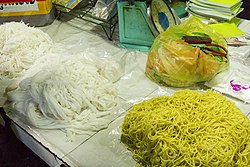
  • African cuisine

References

rwanda

The cuisine of Rwanda is based on local staple foods produced by the traditional subsistence-level agriculture and has historically varied across different areas.[1]

Background[edit]

Rwandan staples include bananas, plantains, pulses, sweet potatoes, beans, and cassava (manioc). Historically this is particularly true of the Twa and the Hutus who hunted and farmed. Their diet was high in vegetables and lacked in animal protein due to the small amount of animal products consumed. The Tutsis were traditionally pastoralists and consumed a higher amount of milk and dairy products.[1] A majority of Rwandan people depend on farming, and a majority of those people who are farmers do not sell what they produce due to challenges accessing markets.[2]

Many Rwandans eat a lot of meat nowadays.[1] For those that live near lakes and have access to fish, tilapia is popular.[1] The potato, thought to have been introduced to Rwanda by German and Belgian colonists, is now very popular and is cultivated in the towns of Gitarama and Butare.[3]

National dishes[edit]

Ugali with stew

A plate of ugali and cabbage

Igikoma

Various dishes have evolved from the range of basic foods consumed. Ugali (or bugali), eaten throughout sub-Saharan Africa, is a paste made from maize and water to form a porridge-like consistency.[4] Isombe is made from mashed cassava leaves and served with meat or fish.[3]

Matoke is a dish made from baked or steamed bananas.[4] Ibihaza is made from pumpkins cut into pieces, mixed with beans and boiled without peeling them. The groundnut paste ikinyiga and millet flour paste umutsima w’uburo are made from boiling water and flour, mixed to a porridge-like consistency.[5] In the restaurants in the capital city of Kigali, locals and expatriates eat a variety of international cuisine, including Indian, Chinese, Italian, and African.[6] In other cities and towns, the cuisine is simpler, often consisting of chicken, fish, goat or steak served with rice or French fries.[6]

Beverages[edit]

Milk is a common drink among Rwandans.[7] Igikoma, also known as porridge, is a common breakfast drink consumed by athletes and breastfeeding mothers.[8].Other popular drinks in Rwanda include fruit juice, wine, beer and soda (Fanta) for those who do not drink alcohol.[9] Commercial beers drunk in Rwanda include Primus, Mützig and Amstel.[4] In rural areas, urwagwa is a beer made from the fermented juice of bananas that has been mixed with roasted sorghum flour.[10]

Beers feature in traditional rituals and ceremonies and are generally consumed only by men.[3] Ikigage is an alcoholic beverage made from dry sorghum that is thought to have medicinal powers.[11] Ubuki is made from fermented honey with 12 percent alcohol content.[12]

See also[edit]

  • Ugandan cuisine

guena

Major ingredients[edit]

Corn is a staple with preparations and ingredients varying by region: Mid Guinea, Upper Guinea, Coastal Guinea, Forested Guinea, and the area of the capital (Conakry).[2] It is part of West African cuisine and includes fufu, jollof corn, maafe, and tapalapa bread. Ingredients include boiled cassava leaves.

In rural areas, food is eaten from a large serving dish and eaten by hand outside.[2] Desserts are uncommon. Guinean cuisine has achieved some popularity overseas and there are Guinean restaurants in New York City, United States.[2]

Notable dishes[edit]

Traditional preparation of fou fou in a mortar and pestle.

Traditional Guinean dishes include:

  • Fou fou, also known as Tôreuy, is a savory pastry with okra sauce[2]
  • Bwayry[1]
  • Cooked mango[1]
  • Fried plantain is a sweet like banana[1]
  • Patates, fried sweet potatoes[1]
  • Fouti is okra with (rice)
  • Gateau farine,[1] is a variety of round cake
  • Tamarind drink[1]
  • Thiacri, a sweet Senegalese couscous and milk dish[1]
  • Poule[1][clarification needed]
  • Konkoé, smoked catfish and vegetable stew[2]
  • Bissap, a hibiscus drink that is purple coloured with sometimes mint
  • Attieke,a dish with fish or tilapia sauce topped with cucumbers and tomatoes
  • Katun,

Sauces[edit]

Traditional Guinean sauces include:

  • Footi sauce—thick, with eggplants, onions, kidney beans, water, tomato sauce, and a bouillon cube
  • Maffe tiga—Guinean/Senegalese-style peanut sauce
  • Maffi gombo—okra sauce
  • Maffi hakko Bantura—leafy sauce with sweet potato
  • Maffi supu[clarification needed]
  • Sauce d'arrachide ou Kansiyé—consists of peanut butter, water, hot chili peppers, tomatoes, garlic, and onions[2]
  • Maafe Taku- made with okra

Beverages[edit]

Traditional Guinean beverages include:

  • Ginger drink, beverage (bitter sweet ginger drink)
  • Hibiscus drink, beverage (jus de bissap)
  • In non-Muslim areas, palm wine is consumed

zimbabwe

Zimbabwe is a small country by African standards (i.e. it’s larger than Germany), but home to many ethnic groups and cultures. As in many ethnically diverse countries, popular foods in Zimbabwe vary based on ethnicity and region.

As a land-locked country, most of Zimbabwe’s top dishes are based on local agricultural products. Since climatic conditions differ across the country’s regions, so do the agricultural products and locally sourced ingredients. Therefore, many different dishes and recipe variations can be found across the country’s ten major provinces.

MY LATEST VIDEOS

This is China's Most Expensive Restaurant

Ultraviolet by Paul Pairet is China's most expensive restaurant and the second most expensive Michelin-starred restaurant in the world. The top-priced menu costs well over $1,400 USD.

0 seconds of 1 minute, 11 secondsVolume 0%

Let’s take a look at some of the most popular foods in Zimbabwe, though note that some may be more popular in certain regions than others.

1. Madora | Macimbi (Mopane Worms)

Madora/ Macimbi/ Mopane Worms

Photo Credit: avaresekitchen

The mopane is a worm considered a delicacy in Zimbabwe and other African countries. It is found in mopane trees that grow in the Matabeleland region and parts of the Midlands.

It is a green or black and whitish-stained worm with spikes on its body. The worm is squeezed clean of all its internal fluid so that only a yellowish fleshy part remains. Boiling them or simply salting and drying them out in the sun are some of the ways that mopane worms can be prepared for the pot.

The actual preparation takes only 20 minutes in which the worms are boiled, drained of water, and then left to simmer in a bit of oil with tomato, onion, and a mixture of spices. They go down quite well with sadza, a porridge made of ground maize.

2. Sadza

Sadza/ Pap/ Hard Corn-

Photo Credit: african_basket

This is the richly scrumptious product of Zimbabwe’s staple crop, maize.

First, corn is ground into a powdery cornmeal. Then Sadza is made from boiling water and mixing it with a paste of cornmeal, letting it simmer for a while before finally adding more of the meal to make it thicker. The end result is a hot steaming mountain that can be accompanied by beef or chicken stew and a side of any leafy vegetable. It can also be combined with mopane worms. The result is utter satisfaction when washed down with a glass of ice-cold water.

A variation of Sadza can be made with millet or Rapoko meal. The final result is a dark brownish porridge known as Pap, which can be molded and eaten with tripe, roasted pork, or any of the stews popular in Zimbabwe, such as beef or chicken.

3. Derere (Zimbabwean Okra)

Derere/ Okra

The name itself is some kind of onomatopoeia in the Shona language. Derere is a special meal made from okra that is highly recommended in medical circles. Both rich in protein and acting as an appetizer, it is a great meal for those who are not feeling well.

It can come in a leafy form or cut up into tiny rings from the okra pod. When cooked, okra will be very appealing to the eye and richly delicious to the palate.

4. Mutakura/ Grains Mixture

Mutakura/ Grains Mixture

Ever wondered how it would be to combine two fine wines in one bottle? Can you imagine the explosiveness in your mouth? That is how this combination of a meal goes down.

cambodia

Cambodian cuisine combines the culinary traditions of many different ethnic groups in Cambodia, an important subset of which is Khmer cuisine, the nearly-two-thousand-year-old culinary tradition of the majority Khmer people.[1][2] Over centuries, Cambodian cuisine has incorporated elements of Indian, Chinese (in particular Teochew), Portuguese and French cuisine, and due to some of these shared influences and mutual interaction, it has many similarities with the cuisines of Central Thailand, and Southern Vietnam and to a lesser extent also Central Vietnam, Northeastern Thailand and Laos.

Khmer cuisine can be classified into rural, elite and royal cuisine,[3] although the difference between the royal and popular cuisine is not as pronounced as in the case of Thailand and Laos.[4] The Khmer royal dishes use more varied and higher quality ingredients, and contain more meat.[3]

Historical influences[edit]

2nd–9th century[edit]

Many spices in Khmer cuisine were introduced by Indian merchants around 2nd century. The Indian influence on cuisine among other aspects of Khmer culture was already noted by a Chinese visitor around 400 AD.[5] From South India through Java, Khmer royal cuisine adopted the preparation of curry pastes, adding lemongrass and galangal to the recipe.[6] According to Cambodian anthropologist Ang Choulean, the influence of Indian cuisine on rural Cambodian cuisine has been limited or even non-existent.[7]

A passage in the Book of Sui mentions that the food eaten by inhabitants of 7th century Chenla "includes a lot of butter, milk-curds, powdered sugar, rice, and also millet, from which they make a sort of cake which is soaked in meat juices and eaten at the beginning of the meal."[8]

9th–15th century[edit]

A bas-relief of the 12th/13th century Bayon temple depicting a Khmer outdoor kitchen cooks grilling sang vak and cooking rice and a wild boar and servers carrying away trays of food.

Between 9th and 15th century the culinary influence of the growing Khmer Empire spread beyond the borders of modern-day Cambodia into what is now Thailand, Laos, Vietnam, and Indonesia.[9] According to Chinese diplomat Zhou Daguan's account, onions, mustard, chives, eggplants, watermelons, winter gourds, snake gourds, amaranth and many other vegetables,[10] as well pomegranates, sugarcane, lotus flowers, lotus roots, Chinese gooseberries, bananas, lychees, oranges, and many other fruits were available in the Khmer Empire in late 13th century.[11]

Food crops and other plants were actively cultivated and harvested in tropical gardens both in and around cities and temples of the Khmer Empire. Archaeobotanical investigations at Angkor Wat and Ta Prohm have identified macroremains of rice, sesame, mung beans, crepe ginger, black peppers, long peppers, and either citron or kaffir lime rind, as well as phytoliths from plants of Cucurbitaceae, Mus, Arecaceae, and Canarium families,[12] while archaeobotanical investigations at 14th–15th century Angkor Thom have identified macroremains of rice, sesame, mung beans, pigeon peas, hyacinth beans, and yardlong beans.[13]

For centuries, Khmer Empire was the dominant Indianized civilization in the region and its influence also reached culinary arts. Khmer Empire played a mediating role in transferring the Indian culinary influence now fundamental to Central Thai cuisine.[14] The close affinity between Cambodian and Central Thai cuisine has been attributed to the extensive, centuries-long contact between the Khmer Empire and Ayutthaya Kingdom. The flavour principles of many Cambodian dishes, such as sour fish soups, stews and coconut-based curries, including steamed curries, are very similar to Central Thai cuisine, although Cambodian dishes contain much less chilli and sugar,[15] and more aromatic spices such as cardamom, star anise, cloves, and nutmeg, along with lemongrass, ginger, galangal, coriander, and wild lime leaves.[9]

Khmer cuisine has also influenced Thailand's Isan cuisine[16] and Khmer cuisine is very popular in the region's lower southern provinces of Surin, Sisaket and Buriram that have a large Northern Khmer population.[17] Khmer-influenced dishes of the Surin province include sanlo chek, salot rao or kaeng phueak, ang kaep bop, and som jruk.[18] As Thai tribes migrated southwards they were influenced by the Khmer practice of fermenting fish and adopted local ingredients, including prahok, which became imbedded in the Isan (as pla ra) and Lao cuisine (as padaek) from the time both Isan and Laos were part of the Khmer Empire.[19]

Lao cuisine has influenced the cuisine of Cambodia through Lao migration into the country.[20] Khmer cuisine has much less in common with Isan and Lao cuisines than with Central Thai cuisine.[15]

16th–18th century[edit]

In beginning of 16th century, Portuguese merchants and explorers arrived in Cambodia and started introducing various fruits and vegetables, such as papayas, tomatoes, pineapples, peanuts, cashews, avocados, vanilla, apples, passion fruit and sweet potatoes from South America, Europe and other parts of Asia, however, Portuguese influence on Cambodian cuisine was not just limited to ingredients. Traditional Khmer dessert krob knor (គ្រាប់ខ្នុរ) is a direct descendant of Portuguese fios de ovos, and Cambodian egg cakes num barang (នំបារាំង) are also believed to be of Portuguese origin.[21]

Khmer-influenced Vietnamese dishes: bún nước lèo [vi]'; bún mắm; bánh cống; cà ri[22][23] (clockwise from top left)

From 18th century onwards, the ingredients and dishes of Mekong Delta's indigenous Khmer Krom, most notably spices (cardamom, cinnamon, star anise, clove, ginger, turmeric and ground coriander), curries and fermented food have influenced the cuisine of modern-day Southern Vietnam as large numbers of Vietnamese began settling in the area.[23] Khmer Krom dishes, such as bún nước lèo [vi], bún mắm and canh xiêm lo have also been adopted by the region's Vietnamese and Chinese people, while Khmer Krom have adopted the Vietnamese lẩu mắm and canh chua and Chinese Yang Chow fried rice into their cuisine.[24] Sóc Trăng province's Khmer specialties cốm dẹp[25] and nom kapong[26] (នំកំប៉ុង) have become popular across Mekong Delta as well as some other localities in Vietnam, while Khmer-style crepes ọm chiếl are sold in food stalls around Mekong Delta, especially Trà Vinh province.[27] Conversely, the Vietnamese influence on Cambodian cuisine intensified during two centuries of Vietnamese rule in Cambodia.[5] A dish that Cambodian cuisine is believed to have been borrowed from the Vietnamese is beef lok lak.[28][29]

19th–20th century[edit]

Toasted baguettes for sale in Kampot

From 1863 to 1953, Cambodia was a French protectorate, which led to the adoption of French culinary elements into Cambodian cuisine. Baguettes (or more often demi-baguettes) became common in Cambodia and were made into sandwiches, often with butter, sardines in oil or with pâté, or were eaten with curries, instead of fresh rice noodles or rice. Slices of baguettes with melted cheese, pork liver pâté or sardines in oil are also sometimes served with fried eggs or omelette for breakfast. The French also introduced ingredients, such as potatoes, onions, butter, margarine, and carrots. Fried potatoes are served in the so-called "English" version of lok lak, carrots are added to soups, lettuce leaves or sliced onions are included in other Cambodian dishes, while butter and margarine is the preferred fat in Cambodian cooking. Other Khmer adoptions from the French cuisine include coffee, condensed milk, chocolate, beer and wine.[30] Cambodian cuisine shares the French influence with Vietnamese and Lao cuisine as Vietnam, Laos and Cambodia were all part of French Indochina.[31]

Fried spiders at a market in Skuon

In the decades after World War II, many Cambodian urban middle-class and elite families employed cooks trained to prepare French dishes, and the children of these households often did not learn cooking themselves. The transmission of Cambodian culinary knowledge was even further disrupted by the Cambodian Civil War and Cambodian genocide in the 1970s and 1980s.[9] During the rule of Khmer Rouge, Cambodian cuisine was reduced to a plain rice gruel and Cambodians were forced to start catching and eating insects, frogs, snakes, snails and other small animals to avoid starvation. One remnant of the Khmer Rouge era in Cambodian cuisine are fried spiders (a-ping) that are sold as street food to tourists and still eaten by some locals, especially in Skuon, for which it has earned the nickname Spiderville.[32]

21st century[edit]

Nowadays, more and more Asian fast food chains (such as The Pizza Company, Lotteria, Pepper Lunch, Yoshinoya and Bonchon)[33] and Western fast food chains (such as Burger King, KFC, Krispy Kreme and Carl's Jr.) have entered the Cambodian market, especially in Phnom Penh, and fast food has become increasingly integrated into the Cambodian food scene, particularly among the younger generation.[34]

Since the early 2010s there has been an emerging grassroots culinary movement in Siem Reap termed "New Cambodian Cuisine" loosely consisting of six Cambodian chefs and restaurateurs (Pola Siv, Sothea Seng, Pol Kimsan and Sok Kimsan, Mengly Mork and Pheak Tim) experimenting with and modernizing traditional Cambodian dishes.[35] More recently, mobile applications dedicated to Khmer traditional recipes have also been developed, such as "Khmer Cooking Recipe" downloaded more than 100,000 times on Google Play and "Khmer Cooking".[36]

In the United States (20th–21st century)[edit]

Since the late 1970s, approximately 200,000 Cambodians have settled in the United States of America, nearly half in Southern California, fleeing the Khmer Rouge and the following economic and political turmoil in Cambodia. Cambodian Americans own about 9,000 businesses, predominantly restaurants and grocery stores catering to the local Cambodian American community. Cambodian Americans own around 90% of the 5,000 independently owned doughnut shops in California.[37] The most successful of them was Ted Ngoy who at the peak of his success owned about 70 doughnut shops in California and was nicknamed "The Donut King".[38]

Phnom Penh Noodle House in Seattle.

Grilled trout (trey ang) with a coconut-ginger sauce served at the Elephant Walk restaurant in Cambridge, Massachusetts.

Over time the food cooked by Cambodians in the United States developed into a distinct Cambodian American variety. Meat, especially beef and chicken, plays a much more central role in Cambodian American meals, which also make much more extensive use of tomatoes and corn.[39] Unhealthy eating habits, such as consumption of fatty meat, and obesity rates are higher for the Cambodian Americans who experienced more severe food deprivation and insecurity in the past.[40] The food of second- and third-generation Cambodian Americans has become more Americanized. Cambodian cuisine is not well known within the United States and is usually compared to Thai food by many Americans. Most Cambodian restaurants are located in cities with a significant Cambodian population, such as Lowell, Massachusetts, Long Beach, California and Seattle, Washington. Some of the Cambodian-owned restaurants, however, served other Asian cuisines, especially Thai and Chinese,[39] whereas in the ones that serve Cambodian cuisine Chinese, Thai and Vietnamese-influenced dishes usually dominate over Khmer dishes.[41]

Long Beach, California has the most Cambodian restaurants in the U.S.: twenty-two, including Phnom Penh Noodle Shack and Sophy's. Some Cambodian-owned restaurants in the city, such as Little La Lune Cuisine and Crystal Thai Cambodian, serve Thai food, while others, such as Hak Heang or Golden Chinese Express, serve Chinese food.[39] Lowell, Massachusetts, has at least twenty Cambodian restaurants, among them Tepthida Khmer and Simply Khmer. Other notable Cambodian restaurants include Sok Sab Bai in Portland, as well as Phnom Penh Noodle House and Queen's Deli in Seattle. The most famous Cambodian restaurant in the U.S. is the Elephant Walk, serving French-inspired Khmer cuisine.[39] It was opened in 1991 in Cambridge, Massachusetts by Longteine de Monteiro. The restaurant also created a cookbook of the same name, which is the first Cambodian American cookbook.[41]

In 2000, a part of Central Long Beach was officially designated as Cambodia Town, where since 2005 an annual parade and culture festival takes place that also features Cambodian cuisine.[42] Since the late 2010s there has been an emerging wave of second-generation Cambodian American chefs and restaurants in the U.S. focusing on Cambodian cuisine.[43][44][45] Among them is the award-winning restaurant Nyum Bai, opened in Fruitvale, Oakland, California in 2018 by chef Nite Yun.[46]

Cambodian Chinese cuisine[edit]

Phnom Penh-style kuyteav

Over time, Chinese Cambodians have developed a food tradition that's distinct from both Khmer and Chinese cuisine.[47] The foodways of the Chinese Cambodians have not only been influenced by the Khmer but also by the Vietnamese and Chinese Vietnamese foodways.[48]

The Chinese began migrating to Khmer Empire in 13th century, bringing their cuisine with them, from which the Khmer cuisine adopted noodles, soy sauce, different vegetables, stir frying, steaming and the custom of eating soup for breakfast.[49] Until the mid-20th century, the Chinese that mostly migrated to Cambodia were Teochews and to a lesser extent also Hainans, Hakkas, and Cantonese.[50] Nowadays, the Teochew kway teow has become a popular dish in Cambodia, where it is eaten for breakfast, lunch and dinner or as a snack and often flavoured with lime, chili, fish sauce, and palm sugar.[51]

Geographic variations[edit]

Khmer royal dishes served at the Raffles Hotel Le Royal in Phnom Penh

In Cambodia's coastal regions, dishes with saltwater fish are more common. Kampot used to be famous for its deep-fried pomfret with garlic, sugar, lime juice and chilies. The colonial resort Kep historically used to host numerous fine dining seafood restaurants along the promenade that after the city's complete destruction by Khmer Rouge in 1970s have been replaced by individual vendors offering simpler seafood, such as crabs sauteed with onions and black pepper, or pieces of dried squid, pounded or grilled over a wood fire served with pickled papaya and cucumbers.[52]

In northern part of the country, along the Cambodia–Thailand border, dishes have been influenced by Thai cuisine and use an increased amount of coconut milk, chillies and sugar. Cambodian dishes in the north also use deer, wild bird and other types of game. Bamboo shoots, popular in Lao cuisine, are also included in dishes more frequently. In northwest Cambodia, remnants of the Khmer imperial cuisine are more visible, most notably by its steamed curries.[52]

Kitchen and eating utensils[edit]

The interior of a traditional Khmer kitchen

A rural Khmer house kitchen

In Khmer Empire, kitchens earthenware pots were used to cook rice, and sometimes an earthenware stove was used to make sauces. Hearths were formed by burying three stones in the ground and ladles were made from coconuts. Pottery dishes imported from China or copperware were used for serving rice, while sauce containers were made from leaves. Chiao leaves were also used to make single use spoons for carrying liquid to the mouth.[53]

The south wall of 12th/13th century Bayon temple depicts a Khmer kitchen, including its utensils, many of which are still used throughout modern Cambodia. According to local villager stories passed down by generations, the 12th century Wat Athvea once housed an Angkorean-era royal open-air kitchen. They describe the temple's loose fallen stones as kraya cham-en meaning "the preparation of the royal meal" and talk about once-standing brick stoves and a wall where meat, baskets of ingredients, and utenstils were hung. However, French archaeologist Claude Jacques argues that there is no archaeological evidence that a kitchen from the Khmer Empire had survived in the following centuries and believes that Daguan's writings and the Bayon temple's bas-relief are the only surviving documentation of ancient Khmer kitchens.[53]

Nowadays, Khmer rural kitchens are usually placed in a airy location, close, but separate from the main house to avoid smoke from burning firewood and undesirable odours from disturbing the main household. The most important Khmer kitchen utensils are:

  • A mortar and pestle for making kroeung;
  • A bamboo sieve for filtering prahok and ripe tamarind juice;
  • Earthen stoves with varying heat intensity for cooking different dishes;
  • A coconut grater;
  • Earthen pots for cooking rice and soup, as well as storing water;
  • Jars for storing prahok, kapi and other ingredients.
  • Loose bamboo baskets for storing vegetables.[53]

In many kitchens, aluminium pots have replaced earthenware. Utensils are usually hung on the walls of the kitchen for easier access. With frying adopted from the Chinese, frying pans are also often found in modern Khmer kitchens. Although usually not considered part of the kitchen utensils, some houses may also have a larger mortar for grinding rice, and flat round bamboo trays for separating husk from the grain.[53]

Ingredients[edit]

Rice[edit]

Cambodian aromatic long-grain (សែនក្រអូប, sên krâ’ob) rice, one of the best paddy rice varieties of Cambodia[54]

Because of Cambodia's geographic location, rice together with fish, especially freshwater fish, are the two most important sources of nutrients in the Cambodian diet. Rice is a staple food generally eaten at every meal.[55]

Rice is believed to have been cultivated by the ancestors of the Khmers in the territory of Cambodia since 5,000 to 2,000 B.C.[56] The advanced hydraulic engineering developed during the Khmer Empire allowed the Khmer to harvest rice and other crops three to four times a year.[57] According to the International Rice Research Institute, there are approximately 2,000 rice varieties indigenous to Cambodia bred over the centuries by the Cambodian rice farmers.[58] One of them – "Malys Angkor" (ម្លិះអង្គរ, Mlih Ángkô) – has been regarded the world's best rice.[59]

Fermented sauces[edit]

Metal containers with fermented seafood (mam) at the Prahok market (Psah Prahok) in Battambang.

Prahok fried in banana leaves with steamed rice, yardlong beans, cucumbers, spring onions and Thai eggplants.

In Khmer, a distinction is made between fermented seafood depending on its consistency and the ingredient. Mam (មាំ) is the general term for seafood fermented with a special technique and usually includes more solid pieces of the fermented ingredient, whereas prahok (ប្រហុក, prâhŏk) and kapi (កាពិ, kapĭ) have more homogeneous consistency than mam.

Mam is prepared by adding a mixture of salt, roasted red sticky rice and palm sugar to snakehead fillets and fermenting them for more than a year. The palm sugar and rice give mam an earthier and sweeter flavour and a reddish tone.[60][61] Prahok, on the other hand, can either be made from small fish with all the bones and less salt (called prahok chhoeung) or large deboned fish and more salt (called prahok sach (ប្រហុកសាច់, prâhŏk săch)),[19] which in turn can be made from larger fish (such as the striped snakehead (ត្រីរ៉ស់)) or smaller fish (such as trei kamplienh), with or without roe. Roe can be removed from the fish, cleaned, drained, and fermented separately.[60] Kapi is made by pounding cleaned, dried and salted shrimp into a homogeneous paste, sun-drying it for one day, pounding the paste again, sun-drying it for two more days and pounding the paste for the final time to attain a viscous consistency.[62]

Prahok is used as flavouring for almost every Khmer dish, mixed with rice or served as a dipping sauce (ទឹកជ្រលក់, tœ̆k chrôluŏk).[19] It can also be prepared into dishes of its own, such as prahok k'tis (ប្រហុកខ្ទិះ, prâhŏk khtih), prahok kap (ប្រហុកកប់, prâhŏk káp), teuk khreung, teuk prahok[60] prahok ang (ប្រហុកអាំង, prâhŏk ăng), and prahok chien (ប្រហុកចៀន, prâhŏk chiĕn). Fermented roe (ពងត្រី, pông trei) is primarily eaten with steamed eggs, omelettes and other hen or duck egg dishes.[60] Kapi is often mixed with sugar, garlic, lime juice, chilli and crushed peanuts and used as a dipping sauce for vegetables, fruit, meat and fish.[63]

Other sauces used in the Cambodian cuisine include fish sauce (ទឹកត្រី, tœ̆k trei), oyster sauce (ទឹកប្រេងខ្យង, tœ̆k préng khyâng), soy sauce (ទឹកស៊ីអ៊ីវ, tœ̆k si-iv; តៅអ៊ីវ, tau iv; សាអ៊ីវ, sa-iv or ស៊ីអ៊ីវ, si-iv), tamarind sauce (ទឹកអម្ពិល, tœ̆k âmpĭl) and hoisin sauce (ទឹកសៀង). Fish sauce is an important ingredient in Khmer cooking, used to add saltiness to soups and noodle dishes, marinating meats or as a dipping sauce for fish. Mixed with ingredients, such as garlic, ginger and lime juice, it is used a sauce for spring rolls, salads and noodles. [64] Oyster sauce was introduced by Chinese immigrants[65] and has become a common ingredient in Cambodian cooking used to add a tangy-sweet flavour to meats and stir-fried vegetables. Oyster sauce, along with fish sauce, and soy sauce, is commonly used together when seasoning foods. Soy sauce is also a common ingredient and condiment, mixed with garlic or aged radish to be eaten with primarily high protein dishes, as well as used to add saltiness when fish sauce is not used. Tamarind sauce is made from tamarind paste mixed with fish sauce, garlic, chilli peppers, lime juice, palm sugar, and vinegar.[66]

Herbs and spices[edit]

Black, white, red and green Kampot peppercorns for sale at the Kep Crab Market

The most common herbs and spices in Cambodian cuisine are sweet basil (ជីរនាងវង, chi néangvông), coriander (ជីរវ៉ាន់ស៊ុយ, chivănsŭy), hot mint (ជីរពងទាកូន, chi pông téa kon), turmeric (រមៀត, rômiĕt), garlic, ginger (ខ្ញី, khnhei), galangal (រំដេង, romdeng), kaffir lime leaves (ស្លឹកក្រូចសើច, slœ̆k kroch saeuch), neem leaves (ស្លឹកស្ដៅ, slœ̆k sdau), peppermint (ជីរអង្កាម, chi ángkam), lemongrass (ស្លឹកគ្រៃ, slœ̆k krey), chives (គូឆាយ, kuchhay), scallions, saw leaf herb (ជីរបន្លា, chi bánla), fingerroot (ខ្ខ្ជាយ, khchéay) and rice paddy herb.[5][67]

Certain regions in Cambodia are known for their spices. Kampot pepper[68] and Kampong Speu palm sugar[69] (ស្ករត្នោតកំពង់ស្ពឺ, Skor Thnaot Kompong Speu) have been granted Geographical Indications in Cambodia and protected geographical indication in the European Union. Cardamom Mountains in Southwest Cambodia are famous for their large population of wild cardamon plants.[70]

The cultivation of peppercorns in Cambodia dates back to at least the 13th century, and because of its "uniquely strong yet delicate aroma" and "slightly sweet eucalyptus taste," Kampot pepper is often regarded as the world's best pepper.[71][72][73]

Kroeung[edit]

Green kroeung.

Main article: Kroeung

Kroeung (គ្រឿង, krœăng [krɨəŋ] – 'ingredients') is a Khmer fresh flavouring paste commonly used in curries, soups and stir-fries, one of the essential ingredients of Cambodian cuisine. The base of the paste consists of pounded lemongrass, galangal, garlic, shallots, kaffir lime leaves and turmeric. There are five common types of kroeung: yellow kroeung (kroeung samlor m’chu), green kroeung (kroeung samlar kako) and red kroeung (kroeung samlor kari), as well as k’tis kroeung (kroeung samlor k’tis), and saraman kroeung (kroeung samlor saraman) each with different uses.[74]

Vegetables[edit]

The Cambodian diet consists heavily of leaf vegetables, such as water morning glory (ត្រកួន, trâkuŏn), cabbage (ស្ពៃក្តោប, spey kdaôp), Chinese kale (ខាត់ណាចិន, khăt-na chĕn), betel (ស្លឹកម្លូ, mlu), vine spinach (វល្លិ៍ជន្លង់, voă chónlóng), and watercress (ច្រាច់, crac), which are used in soups, stir-fries (ឆា, chá) and salads.[5]

Cambodian cuisine also uses different squashes, such as bitter melon (ម្រះ, mreăh), winter melon (ផ្លែត្រឡាច, phlê trâlach), kabocha, and luffa (ននោង, nong), root vegetables, such as carrots (ការ៉ុត, karŏt), cassava (ក្ដួច, kduŏch), lotus rhizomes (ឫសឈូក, rœ̆h chhuk), potatoes (ដំឡូង, dámlong), radish (រ៉ាឌី, radi), sweet potatoes (ដំឡូងជ្វា, dámlong chvéa) and jicama (ដំឡូងរលួស, dâmlong rôluŏh or ប៉ិកួៈ, pĕkuŏk) and other vegetables, such as cucumbers (ត្រសក់, trâsák), eggplants (ត្រប់, tráp), tomatoes (ប៉េងប៉ោះ, péngpaôh), cauliflower (ផ្កាខាត់ណា, phka khăt-na), chayote (ផ្លែស៊ូ, phlê su), shallots (ខ្ទឹមក្រហម, khtœ̆m krâhâm), yardlong beans (សណ្ដែកកួរ, sándêk kuŏ) and maize (ពោត, pot). Many unripe fruits, such as papaya, green banana, and mango, are also used as vegetables.[5][67]

Fruits[edit]

A Cambodian fruit vendor at the Central Market selling pomelos, oranges, apples, kiwifruit and sugar bananas

A Cambodian fruit vendor at the Central Market selling dragon fruit, persimmons, apples, winter melons, snake fruit and pomelos

Fruits in Cambodia are so popular that they have their own royal court. Durian (ទុរេន, tŭrén) is considered the "king", mangosteen the "queen", sapodilla (សាប៉ូឌីឡា) the "prince" and milk fruit (ផ្លែទឹកដោះគោ, phlê tœ̆k daôh ko) the "princess". Other popular fruit include kuy fruit (ផ្លែគុយ, phlê kŭy), romduol, pineapple (ម្នាស់, mnoăh), rose apple, jackfruit (ផ្លែខ្នុរ; phlê khnŏl), papaya (ល្ហុង, lhŏng), watermelon (ឪឡឹក, âulœ̆k), banana (ចេក, chék), mango (ស្វាយ, svay), rambutan (សាវម៉ាវ, sav mav),[75] guava (ត្របែក, trɑbaek), longan (មៀន, miĕn) and tamarind (អម្ពិល, âmpĭl).[5]

Although fruits are usually considered desserts,[5] some such as ripe mangoes, watermelon, and pineapples are commonly eaten with heavily salted fish with plain rice. Fruits are also made into smoothies (ទឹកក្រឡុក, tœ̆k krâlŏk). Popular fruits for smoothies are durian, mangoes and bananas. Sun-dried limes boiled in sugar and salt water are used in chicken and duck soups, sauces with fish, as well as beverages.[76]

Since 2018, Koh Trong pomelos (ក្រូចថ្លុងកោះទ្រង, kroch thlŏng Kaôh Trông) are recognized as one of the geographical indications in Cambodia. Pomelos grown in the Kratié Province's Koh Trong commune are known for their sweeter taste and the absence of seeds after ripening.[77]

Fish and meat[edit]

Sun-dried shark minnows and snakehead fish at the Prahok market (Psah Prahok) in Battambang

Dried fish and pork sausages for sale at Psah Chas in Siem Reap

There are more than 900 different freshwater and saltwater fish species found in Cambodia. Approximately 475,000 tons of fish (ត្រី, trei) are caught in Cambodia every year and a Cambodian annually consumes 63 kg of fish on average. They are fried, dried, smoked and fermented into prahok and fish sauce. Fish and fish products are eaten two to three times a day.[55] Popular fish are snakeheads, snappers, catfishes (ត្រី, trei chleang), and mackerels.[9] Cambodian chef Luu Meng has estimated that approximately 40–50% of Cambodian dishes are made with fish.[78]

In the late-13th-century Khmer Empire, cows were not used for riding, meat or hide, and geese had been recently introduced by the Chinese sailors.[79] Since the 1980s, the role of meat in the Cambodian diet has increased significantly and nowadays the consumption of meat, such as beef (សាច់គោ, săch koo), pork (សាច់ជ្រូក, săch chruk) and poultry, has become common, especially in the capital region.[80] In Siem Reap, ground pork or beef is made into spicy or sweet and savoury sausages (សាច់ក្រក, săch krɑɑk (pork); ខ្វាគោ, kwa koo (beef)) that are eaten with steamed white rice, congee or baguettes.[81]

Other seafood includes an array of shellfish such as crabs (ក្ដាម, kdaam), clams, cockles (ងាវ, ngiəw), crayfish (បង្កង, bang kang), shrimp and squid (ត្រីមឹក, trei mik). Boiled or fried cockles seasoned with salt, chili, and garlic are sold as a popular street food.[82] Giant freshwater prawns are usually only eaten by middle- and upper-class Cambodians because of their price. More unusual varieties of meat include frogs (កង្កែប, kɑngkaep; most commonly eaten are East Asian bullfrogs, rice field frogs, balloon frogs, banded bullfrogs, yellow frogs and Asian common toads),[83] turtles[84] (អណ្ដើក, ɑndaək) and arthropods (such as tarantulas (សត្វអាពីង, sata ping), fire ants, grasshoppers (កណ្ដូប, kandoup), giant water bugs and crickets (ចង្រិត, cɑngrət)).[85] Crickets, water bugs, and tarantulas are seasoned with salt, sugar and oil, deep-fried and sold as street food.[82]

Noodles[edit]

Cambodian rice and wheat noodles

Cambodian noodles are made out of rice, wheat and tapioca flour (បាញ់កាញ់, bañ kañ)) in varying thickness. Wheat noodles, such as hand-pulled noodles (មី, mii) and the thinner wheat vermicelli (មីសួ, mii suə), have been adopted from the Chinese cuisine, but incorporated into distinct Cambodian noodle soups and stir-fries. Rice noodles include the indigenous lightly-fermented num banhchok (នំបញ្ចុក), as well as rice vermicelli (គុយទាវ, kŭytéav), banh sung (បាញ់ស៊ុង, bɑɲ song), silver needle noodles (លត, lat) and banh hoi (បាញ់ហយ).

Dishes[edit]

Cambodian street food skewers

In Khmer, haan bai (ហាងបាយ lit. 'rice stall') is a generic term for food stalls serving both made-to-order and pre-prepared food (usually from large aluminum pots). In Phnom Penh, haan bai account for nearly four fifths of all meals eaten outside the house, with pre-prepared food venues or soup-pot restaurants accounting for nearly three-quarters of meals eaten at a haan bai. Soup-pot restaurants are the most popular dining format among Cambodians and their popularity is inversely correlated with socioeconomic status.[86]

The Khmer word haan (ហាង) is a borrowing from Chinese háng ("store", "business"). More specifically the stalls are referred to by the main food served, for example, rice noodle stalls (ហាងគុយទាវ, hang kŭytéav) or coffee stalls (ហាងកាហ្វេ, hang kafe).

Stews and curries[edit]

Cambodian curries: fish amok; saraman curry; kari sach moan; num banhchok samlor cari (clockwise from top left)

The Khmer term samlor (សម្ល) has a broad range of meanings and can be used to refer to a wide variety of stews and curries. Curries are a staple food in Cambodian cuisine and are usually eaten with rice, fresh noodles, or a baguette. They usually include seafood, chicken, beef, and pork, and vegetarian Cambodian curries are uncommon. Popular Cambodian curries are fish amok, num banhchok, kari sach moan, sour beef curry and curry leaf chicken.[87] The word kari (ការី, kari) is used to designate an Indian type of curry and is believed to be a loanword from Tamil.[88] Curries are served on all important ceremonial occasions. Cambodian curries are distinct from the rest of Asia by their use of sweet potatoes.[89]

netherlands

Dutch cuisine is formed from the cooking traditions and practices of the Netherlands. The country's cuisine is shaped by its location on the fertile Rhine–Meuse–Scheldt delta on the European Plain bordering the North Sea, giving rise to fishing, farming, and overseas trade. Due to the availability of water and flat grassland, the Dutch diet contains many dairy products such as cheese and butter, and is relatively high in carbohydrates and fat.

The Burgundian court enriched the cuisine of the elite in the Low Countries in the 15th and 16th century,[1] so did in the 17th and 18th century the colonial trade, when the Dutch ruled the spice trade, played a pivotal role in the global spread of coffee, and started the modern era of chocolate, by developing the Dutch process chocolate,[2] which was instrumental in the transformation of chocolate to its solid form (which was up till then drunk as a liquid).

In the late 19th and early 20th centuries, frugality became fashionable. Dutch food became designed to be efficient rather than pleasing,[3] which was the result of the rise of housekeeping schools, where girls learned to cook in such manner.[4] The focus on efficiency in the food production became so successful that, despite its size, the Netherlands became the world's second-largest exporter of agricultural products by value behind the United States.[5] It gave both the Dutch the reputation of being the feeders of the world, and Dutch food of having a bland taste.[3] During the 20th century, Dutch cuisine and diet changed significantly. Initially influenced by the eating culture of its colonies (particularly the Dutch East Indies), and later by globalization, it became cosmopolitan. Most international cuisines are represented in the major cities and there is a renewed interest in taste, which is also reflected in the 123 Michelin star restaurants in the country.[6]

History[edit]

14th–16th centuries[edit]

Early cookbooks from Germany (1350), Norway (mid-14th century), England, France and Italy picture a homogeneous food culture in Europe, because these surviving cookbooks were written for and by the elite, who travelled with their cooks throughout Europe, and exchanged dishes among themselves.[7] Differences were mainly in the use of what was locally available and in season. Milk and butter—coming from the low-lying grasslands of Holland and Friesland—were used extensively in the Netherlands, in comparison to German countries and England, where bacon fat was extensively used, or Southern Europe, where predominantly oil was used. Moreover, Dutch butter and cheese became famous products at an early stage and continued to be so for centuries.[8]

The common people ate a lot of dough and grain products, although it was often in the form of a half-liquid brij or porridge. Potages were also popular: one-pan dishes with various (root) vegetables, peas, possibly herbs, meat and fish. Soppes were also eaten: a kind of thick vegetable/meat/fish paste that was thickened with bread or poured over bread.[8] Beer was in medieval times the common drink as water was of poor quality.[9] It was flavoured with gruit and produced until the 14th century at the monasteries. Gruit was replaced with hop, a tradition introduced from the German city of Bremen, which extended the shelf life and turned the Low Counties into a major exporter of beer that remained until today, as the Netherlands is still the largest beer exporter of Europe.[10] Brand, established in 1349, is the country's oldest beer brand.

How Hollandse Nieuwe is eaten

The sea provided an abundance of fish. The process of gibbing was invented by Willem Beukelszoon,[11] a 14th-century Zealand fisherman. The invention extended the shelf life of herring, which made it possible to sail further and catch more. It created an booming export industry for soused herring (Dutch: maatjesharing) that was monopolized by the Dutch. They began to build bigger ships and eventually moved from trading in herring to a multitude of exclusive products like exotic spices, ultimately leading to the Dutch becoming a seafaring and colonial power.[12] Herring is still very important to the Dutch who celebrate Vlaggetjesdag (Flag Day) each spring, as a tradition that dates back to the 14th century when fishermen went out to sea in their small boats to capture the annual catch: Hollandse Nieuwe.[13]

Gardening was initially practiced by monasteries, but castles and country houses began also to develop gardens with herbs and vegetables and hunting grounds. The famous tourist attraction and flower park Keukenhof (literally kitchen garden) is an example of a former 15th-century hunting ground and herbs garden for Jacqueline, Countess of Hainaut's castle kitchen. Orchards for pears and apples connected to castles were later used for export and set off a Dutch horticulture tradition that remains to this day.[8]

During the 15th century haute cuisine began to emerge, largely limited to the aristocracy. Cookery books from this period are aimed at the upper class. The first Dutch-language cook book printed in Brussels is called Een notabel boecxken van cokeryen (A notable book of cookery) from ca. 1510.[14] It offers medieval recipes for festivities, such as sauces, game, jellies, fish, meat, pies, eggs, dairy products, candied quinces and ginger and contains one of the oldest known recipes for appeltaerten, apple pie. The recipes come from various sources, 61 of them are translations of the French recipe book Le Viandier.[14] Historically, Dutch cuisine was closely related to northern French cuisine, since the two countries have nearby borders and the Low Countries and Northern France have been historically ruled by the Dukes of Burgundy, who established in the Burgundian Netherlands a glamorous court life with lavish feasts. This is still visible in traditional Dutch restaurants and particularly the Southern regional cuisine, that is colloquially referred to as Bourgondisch.[8]

17th century[edit]

Still life with turkey pie, oysters, lemon and grapes by Pieter Claesz (1627).

As the Dutch Republic entered its Golden Age in the 17th century, dishes of this kind became available to the wealthy middle class as well, often consisting of a rich variety of fruits, cheeses, meat, wine, and nuts.[15][16] The Dutch Empire enabled spices, sugar, and exotic fruits to be imported to the country. By 1662, the Dutch provided more than half of the refined sugar consumed in Europe[17] and monopolised the trade in spices such as nutmeg, clove, mace and cinnamon.[18] The large supply of spices made them affordable for the Dutch middle class. In the Middle Ages, spices were largely used to indicate social status. This disappeared with this new development in Dutch society and it was the elite who were the first to ban the frequent use of spices. The cookbook De Verstandige Kok (or The Reasonable Chef) published in 1667, reflects this and shows the great interest the elite had in what was on the plates.[3][19] The Dutch East India Company pioneered in establishing gardens for coffee cultivation in their colonies and was the first to import coffee on a large scale to Europe and popularised the concept of coffee houses for the masses.[20] The Dutch later grew the crop in Java and Ceylon.[21] The first exports of Indonesian coffee from Java to the Netherlands occurred in 1711.[22] By the late 18th century, tea and coffee consumption were increasing and becoming part of everyday life. Tea was served with sweets, candy or marzipan and cookies. The availability of relatively cheaper spices resulted in a tradition of spiced cookies called speculaas, the exact recipes of which were kept secret by bakers.[23]

Vegetables, meat, poultry and salted, smoked or fresh fish and eggs were prepared in the Dutch kitchens of the time.[24] The meal started with green salads and cold or warm cooked vegetables with dressing, vegetable dishes with butter, herbs or edible flowers and continued with numerous fish and meat dishes. Exotic ingredients such as dates, rice, cinnamon, ginger and saffron were used. Savoury tarts and pastries followed. The meal ended with jellies, cheese, nuts and sweet pastries, washed down with hippocras, a sweet spiced wine.[25] Of course, even in the Golden Age, not everyone could afford such luxuries and the everyday meal of the ordinary Dutchman was still a humble affair of grain or legume pottage served with rye.[26]

18th–20th centuries[edit]

In the late 18th century the potato was introduced from South America and became a staple food by 1800.[27] In the early 19th century, while the rich could eat what they desired, the working population ate bread (rye bread in some areas) and potatoes (often eaten at every meal of the day[27]), pancakes in some areas, occasionally herring and other fish, fruit and vegetables, but usually little meat. Throughout the 19th century working class people suffered from some form of malnutrition.[27]

Vincent van Gogh, The Potato Eaters (1885): peasants from his home village Nuenen having dinner.

During the 19th century, the poor people drank little else but water of poor quality, sometimes watery coffee (or chicory) or tea. In some areas hot chocolate was consumed, but the most popular drinks (beside water) were beer and jenever. For most of the century beer was drunk in the southern part, where Catholicism dominated, and in Catholic enclaves in the other areas. Jenever consumption early in the 19th century was twice that of the equivalent consumption of distilled spirits in neighbouring countries.[27]

The modest and plain look of what is nowadays considered the traditional Dutch cuisine, appears to be the result of a fairly recent development. In the twentieth century, the new availability of mass education meant that a great number of girls could be sent to a new school type, the Huishoudschool (housekeeping school), where young women were trained to become housewives and where lessons in cooking cheap and simple meals were a major part of the curriculum, often based on more traditional Dutch dishes, and leading to increased uniformity in the Dutch diet. Values taught in that school system included frugality, proper table manners, and healthy eating.

Origins[edit]

Dutch agriculture roughly consists of five sectors: greenhouse-based, tillage-based, fruit agriculture, animal husbandry and fishery.

  • In Westland region, greenhouse capital of the world, a million tons of tomatoes per year are grown on only 18 square kilometers of area, making it number one globally in efficiency.[28]

    Greenhouses are used to produce tomatoes, lettuce, cucumbers, and sweet peppers. The Netherlands has shown itself to be the standard-bearer of high-tech greenhouse technology. Wageningen University and Research are the primary architects of this technology, working 80 kilometers southeast of Amsterdam. The university is considered the top agricultural research institution in the world.[29]
  • Tillage-based crops include potatoes, kale, beetroot, green beans, carrots, celeriac, onions, all the common kinds of cabbages, Brussels sprouts, cauliflower, endive, spinach, Belgian endive, asparagus and lettuce. Recently some initiatives have been started to encourage interest in such "forgotten" vegetables as common purslane, medlars, parsnips, and black salsify.
  • Fruits include apples, pears, cherries, berries, and plums.
  • The Dutch keep cattle for milk, butter, cheese, and for their meat, chickens for their eggs and for meat, pigs for their meat and a variety of non-edible products, and sheep for their wool and meat. Goats are increasingly kept for cheese production. Traditionally, horse meat was a common dish (steak, sausage, and thinly-sliced smoked meat), but it is less popular today.
  • The fishery sector lands cod, herring, European plaice, sole, mackerel, eels, tuna, salmon, trout, oysters, mussels, shrimp, and sardines. The Dutch are famous for their smoked eel and soused herring, which is eaten raw.

Regional[edit]

Many food origins can be traced back to one of the three general regional forms of Dutch cuisine.[30] Some agricultural products and foodstuffs from these regions are protected by EU law as Protected designation of origin, like jenever, Noord-Hollandse Gouda, and kanterkaas (cumin cheese and clove cheese), Traditional speciality guaranteed, like boerenkaas (farmhouse cheese) and Hollandse nieuwe (soused herring), and the less strict variant of Protected geographical indication, like Edam Holland and Limburgse vlaai.

Western cuisine[edit]

A small Edam cheese with the traditional red wax coating

A Zeeuwse bolus with butter

Ossenworst with Amsterdam onions.

Hollandse graanjenever

Western Dutch cuisine is found in the provinces of North Holland, South Holland, Zeeland, Utrecht and the Gelderlandic region of Betuwe. Due to the abundance of surface water and flat grassland in this region, necessary to sustain dairy cattle, the area is known for its many dairy products, like cheese and butter. While the direct border to the sea made fish readily accessible, as well as spices, coffee, chocolate and sugar from the overseas colonies.

Zeeland and South Holland produce a lot of butter, which contains a larger amount of milkfat than most other European butter varieties. This resulted in a wide variety of rich, buttery flavoured pasty. Cookies of all sorts are produced in great number and tend to contain a lot of butter and sugar, of which the stroopwafel is well known, just as cookies with a filling of some kind, mostly almond, like gevulde koek. Pastries in this area tend to be also quite doughy, and often contain large amounts of sugar; either caramelised, powdered or crystallised. The oliebol (in its modern form) and Zeeuwse bolus are good examples. A moist doughy white bread from the Zaanstreek in North Holland is duivekater, of which the recipe goes back hundreds of years and is eaten with butter.

A by-product of the butter-making process, buttermilk (karnemelk), is also considered typical for this region. Also Leyden cheese, spiced with cumin and traditionally produced with skimmed milk, can be considered as a byproduct in the same way. Traditional farm-made Leyden cheese from this region is a Protected designation of origin. For centuries this region provide prominent Dutch cheeses, named after cities in Holland where these cheeses were sold. Recorded history of Gouda cheese arguably starts in 1184,[31] making it one of the oldest cheese that is still in production using its original recipe, while Edam cheese (traditionally in small waxed spheres), is made since the 14th century.[32] These cheeses are made with full fat milk - thus are not a by product of butter production - and the young varieties have a milky flavour. Cheeses sold as Gouda or Edam are now produced everywhere in the world. The European Commission has designated the specific names "Gouda Holland" and "Edam Holland" cheeses as Protected Geographical Indications. These cheeses must be produced in Holland using traditional methods with milk from Dutch cows and to have undergone a natural aging process. Trademarked cheeses such as Leerdammer, Beemster and Rotterdamsche Oude are also home to this region.

Seafood such as soused herring, mussels (called Zeeuwse Mosselen, since all Dutch mussels for consumption are cleaned in Zeeland's Oosterschelde), eels, oysters and shrimps are widely available and typical for the region. Kibbeling, once a local delicacy consisting of small chunks of battered white fish, has become a national fast food, just as Lekkerbekje.

Indirectly a product of the sea is Ossenworst (ox sausage), a raw beef sausage originating in Amsterdam, which used to be made of ox meat. This specialty has its origins in the seventeenth century, when oxen were imported large-scale from Denmark and Germany. The spices in the sausage, such as pepper, cloves, mace and nutmeg, came from the Dutch East Indies. Traditionally, aged beef was used for this sausage, that was then smoked at a low temperature such that the meat remained raw. Present-day Amsterdam ossenworst is made with lean beef, and the sausage is now often neither smoked nor aged. It is often eaten with Amsterdamse uitjes, a kind of pickled onion. The tradition of pickling onions and augurk or zure bom (pickled cucumbers) is typical for Amsterdam, that got this Middle eastern tradition via its Jewish population. Traditionally, soused herring is only eaten in Amsterdam with pickled cucumber.

The region harbours the largest cocoa cluster in the world,[33] making the Netherlands one of the leading exporters of chocolate.[34] Why the chocolate industry is located in this region, is due to its colonial past, and the development of the Dutch process chocolate in 1828 by Coenraad van Houten, that started the modern era of chocolate as it was instrumental in the transformation of chocolate to its solid form which was up till then drunk as a liquid. Van Houten produced chocolate in Amsterdam, later in Leiden and Weesp, while Droste started in Haarlem. The popular chocomel started the production in Zoetermeer, and is a trademarked chocolate-flavoured milk, often the choice of drink as Koek-en-zopie, the food and drink sold on the ice during periods of ice skating. Verkade has its chocolate production in Zaandam. The same city is home to the headquarters of a relatively new Dutch fair trade chocolate brand that took the market by storm: Tony's Chocoloney. De Zaanstreek is, since the 16th century, also known for its mayonnaise (for the Dutch a popular condiment to eat with French fries), and typical whole-grain mustards (popular to eat with bitterballen).The traditional alcoholic beverages of this region are beer (pale lager) and jenever, a high proof juniper-flavored spirit, that came to be known in England as gin. The region is home to the majority of the jeneversteden, or 'jenever cities'. Lucas Bols in Amsterdam and Nolet (Ketel One) in Schiedam are the oldest and third oldest distillery of the world respectively. The third jenever city s Delft. The Bols family established the liquor distillery in Amsterdam in 1575. By the turn of the 18th century, Bols created 300 liquor recipes and started worldwide distribution. It has since introduced many other flavours, such as the Blue Curaçao and Pisang Ambon.[35] The Nolet Distillery in Schiedam was founded in 1691, and has remained in the Nolet family ever since.[36] A noted exception within the traditional Dutch alcoholic landscape is also native to this region: advocaat, a rich and creamy liqueur made from eggs, sugar and brandy.

Northeastern cuisine[edit]

Gelderse rookworst

The regions in the north and east of the Netherlands, roughly the provinces of Groningen, Friesland, Drenthe, Overijssel and Gelderland north of the great rivers make up north eastern Dutch cuisine.

Groninger metworst

The region is the least populated area of the Netherlands. The late (18th century) introduction of large scale agriculture means that the cuisine is generally known for its many kinds of meats. The relative lack of farms allowed for an abundance of game and husbandry, though dishes near the coastal regions of Friesland, Groningen and the parts of Overijssel bordering the IJsselmeer also include a large amount of fish.

Fries roggebrood with oude kaas

The various dried sausages, belonging to the metworst-family of Dutch sausages, are found throughout this region and are highly prized for their often very strong taste. Most towns and various villages have their own variety of this sausage.

The most famous sausage from this region is Gelderse rookworst (smoked sausage of Gelderland). The Dutch eat 60 million rookworst a year.[37] These sausages traditionally have been smoked over oak and beechwood chips, and are served after they have been boiled in water. The sausage contains a lot of fat and is very juicy. The large sausage are often eaten alongside stamppot, like zuurkoolstamppot (mashed potatoes and sauerkraut). Cut in half they are sometimes eaten as a street food. Also in Gelderland (in and around the Veluwe) and Overijssel (in Salland) kruudmoes is a traditional food with buttermilk, pearl barley, bacon and herbs in which rookworst is processed.

The provinces are also home to more heavy and solid varieties of Dutch pastries, cookies and (rye) breads. Each of the provinces of Gelderland, Overijssel and Groningen has a long-standing rye bread tradition, but rye bread from Friesland (Fries roggebrood, a kind of Pumpernickel) became well known because of its taste. Notable characteristics of Frisian rye bread is its long baking time (up to 20 hours), resulting in a sweet taste and a deep dark color. In contrast to southern Dutch cuisine, which tends to be soft and moist, the northeastern rye bread and pastries generally are of a hard texture, and the pasties are heavily spiced with ginger or succade or contain small bits of meat. Examples of these that are considered typical for the region are Kruidkoek (such as Groninger koek), Frisian suikerbrood (with chunks of sugar), Fryske dúmkes (cookies with anais, ginger, and hazelnuts) and spekdik (small pancakes with metworst and bacon).

In terms of alcoholic beverages, the region is renowned for its many bitters (such as Beerenburg) and other high-proof liquors rather than beer, which is, apart from Jenever, typical for the rest of the country. The city of Groningen (the capital of the eponymous province) is one of the 'jenever cities', and the residence of Hooghoudt distillery. The other jenever cities all are located in the western region of the Netherlands.

Also Friesland has a feature in common with the Western cuisine, that of cheese production. Friesland is as a coastal region home to low-lying grasslands, that yield an abundance of milk. Friese Nagelkaas (Friesian Clove cheese) is a notable example, and the variant made with skimmed milk known as kanterkaas, is a protected designation of origin.

Southern cuisine[edit]

Limburgish vlaai

Southern Dutch cuisine constitutes the cuisine of the Dutch provinces of North Brabant and Limburg and the Flemish Region in Belgium. It is renowned for its many rich pastries, soups, stews and vegetable dishes and is often called Bourgondisch (Burgundian) which is a Dutch idiom invoking the Burgundian dukes who ruled the Low Countries in the Middle Ages. In this region the dukes had their court, which was renowned for its great feasts. The culinary tradition in this region overlaps with that of neighbouring Flanders.

Hachee met rodekool

It is the Dutch culinary region which developed an haute cuisine and it forms the base of most traditional Dutch restaurants including typical main courses served such as Biefstuk, Varkenshaas, Ossenhaas, these are premium cuts of meat, generally pork or beef, accompanied by a wide variety of sauces and potatoes which have been double fried in the traditional Dutch (or Belgian) manner.

Trappist beer from Tilburg

Stews, such as hachee, a stew of onions, beef and a thick gravy, contain a lot of flavour and require hours to prepare. Vegetable soups are made from richly flavored stock or bouillon and typically contain small meatballs alongside a wide variety of different vegetables. Asparagus and witloof are highly prized and traditionally eaten with cheese or ham.

Pastries are abundant, often with rich fillings of cream, custard or fruits. Cakes, such as the Limburgse vlaai from Limburg and the Moorkop and Bossche Bol from Brabant, are typical pastries. Savoury pastries also occur, with the Brabantian worstenbroodje (a roll with a sausage of ground beef, literally translates into sausage bread) being the most popular. It even has been included in the national inventory of intangible cultural heritage.[38]

The traditional alcoholic beverage of the region is beer. There are many local brands, ranging from Trappist beer to Kriek lambic. 5 of the 11 International Trappist Association-recognised breweries in the world, are located in the Southern Dutch cultural area. Beer, like wine in French cuisine, is also used in cooking; often in stews.

Colonial[edit]

Indonesian[edit]

Further information: Indonesian cuisine

Rijsttafel

Indonesian and Indo dishes became popular due to the arrival of former Dutch colonials and people of Eurasian descent into the Netherlands, especially after the independence of Indonesia from Dutch colonial rule in 1945. Countess Cornelia van Limburg Stirum writes in her book The Art of Dutch Cooking (1962): "There exist countless Indonesian dishes, some of which take hours to prepare; but a few easy ones have become so popular that they can be regarded as 'national dishes'". She then provides recipes for nasi goreng (fried rice), pisang goreng (fried bananas), lumpia goreng (fried spring rolls), bami (fried noodles), saté (satay or grilled skewered meat), satésaus (satay sauce or peanut sauce), and sambal oelek (chilli paste).[39] Of the Dutch-Indonesian fusion dishes the best known is the rijsttafel ("rice table"), which is an elaborate meal consisting of many (up to several dozen) small dishes filling an entire table. While still popular in the Netherlands, rijsttafel is now rare in Indonesia itself. Popular Indonesian-Dutch fusion dishes sold at snackbars are patatje oorlog (French fries with mayonaise, onions and peanut sauce), patatje pinda (French fries with peanut sauce),[40] bamischijf (or bamiblok) and nasischijf (or nasiblok). Another Indonesian-inspired food popular in the Netherlands and non-existent in Indonesia is long sheets of krupuk.

Outside the big cities, Indonesian food is served in Chinese restaurants, and almost every town in the Netherlands has a Chinese-Indonesian (Chinees-Indische) restaurant. This typical Dutch restaurant fusion is now in decline. In February 2021, this Chinese-Indonesian restaurant culture - where three cultures come together (Chinese, Indonesian and Dutch) - was acknowledged as Dutch intangible cultural heritage that needs to be preserved.[41]

Surinamese and Caribbean[edit]

Broodje bakkeljauw

Surinamese cuisine is also popular in the Netherlands, especially in the bigger cities. Surinamese establishments commonly offer roti, a staple of the Hindustani community in Suriname, various Surinamese interpretations of Chinese Indonesian cuisine, and Surinamese sandwiches (Surinaamse broodjes) such as broodje bakkeljauw (with a type of dried and salted cod) and broodje pom.

International[edit]

Italian and American style pizzerias have become widespread, as have American fast food restaurant chains. In recent decades, Arab and Turkish dishes have become increasingly popular as well, especially as a snack food. In larger towns and cities, small restaurants selling kebabs, shawarma, and falafel can be found on virtually any street corner. In the bigger cities foods from all corners of the globe are sold in shops and restaurants.

Structure of meals[edit]

Breakfast[edit]

Alongside yoghurt, fruit and muesli, ontbijt (breakfast) consists of bread, usually with butter and sweet toppings, such as hagelslag, vlokken, muisjes, vruchtenhagel, gestampte muisjes, treacle, apple butter, kokosbrood, jam, chocolate spread, and speculaas.

Dutch bread tends to be very airy, as it is made from yeast dough. From the 1970s onward Dutch bread became predominantly whole-grain, with additional seeds such as sunflower or pumpkin seeds often mixed with the dough for taste. Rye bread is one of the few dense breads of the Netherlands. White bread used to be the luxury bread, often made with milk as well as water. A typical Dutch white bread is tiger bread. Ontbijtkoek may be eaten as a substitute for a full breakfast, or simply as a snack. It is served as a thick slice, usually with butter. This popular 'cake' has been around for centuries, since it can be stored for weeks at room temperatures, without it spoiling, due to the pH, sugar content and used spices.[42] Ontbijtkoek resembles somewhat a soft gingerbread cake, but then with much less ginger, hardly any fat and more sugar. The sugar used is the typical Dutch basterdsuiker, an aromatic, moist and fine sugar, which gives a baking product its typical brown color and smooth texture. Basterdsuiker is protected by the EU and acknowledged as a Traditional speciality guaranteed.[43]

Beschuit (Dutch crisp bakes) is also eaten as a breakfast food, with the same variety of sweet toppings, or cheese. A longtime Dutch (romantic) favourite is to serve strawberries on beschuit, which is usually topped with some sugar or whipped cream.

  • Kruidkoek

    Kruidkoek

  • Bread with butter and hagelslag

    Bread with butter and hagelslag

A popular breakfast in the weekend are pannenkoeken, large and thin pancakes, but not as thin as French crêpes. The batter consists of eggs, milk, a mixture of wheat and buckwheat flour, salt, and vanilla extract. The pancakes are cooked in butter, but a bit of vegetable oil is added to the batter to prevent it from burning. Typical fillings that are cooked with the batter are apples, cheese, raisins, chocolate and banana's. Sometimes pannenkoeken are eaten as dinner in a pannenkoekenhuis (restaurant), and the variety of toppings can include bacon, ragout, salmon and many other things. On the plate pannenkoeken can be topped off with powdered sugar, cinnamon or stroop (Dutch syrup).[44]

Wentelteefjes (French toast) is another breakfast treat, that has a long history, which goes back to Roman times. A recipe was found in Apicius, a Latin cookbook from 4th and 5th century.

Lunch[edit]

Uitsmijter spek en kaas

Middageten or lunch is somewhat similar to breakfast, but is usually heavier, less sweet, and more savory. However, lunch is not to be a warm meal, and eating leftovers for lunch is not very common. In bars and restaurants, however, uitsmijter is a popular dish: two eggs fried with bacon or Gouda cheese, rosbief (rare roast beef, thinly cut), ham.

Dutch consumers are fond of pindakaas (peanut butter) as a bread topping. The Netherlands is not only the number one importer of peanuts, it is also the biggest exporter of peanut butter, and despite its size, the third largest consumer in Europe.[45] Other popular toppings are filet americain (a finely ground raw lean beef with the addition of mayonnaise, mustard, paprika and other spices).

Cheese[edit]

One of the most popular toppings for bread is cheese. The vast majority of Dutch cheeses are semi-hard or hard cheeses. Famous Dutch cheeses, include Gouda and Edam. A typically Dutch way of making cheese is to blend in herbs or spices during the first stages of the production process. Famous examples of this are cheeses with cloves (usually the Friesian Clove), cumin (most famously Leyden cheese), or nettles.

Dutch hard cheeses generally can be divided by maturity:

Dutch nameEnglishMaturityFlavourTexture

Jonge kaasyoung4 weekscreamysoft

Jong belegenyoung matured8–10 weeksmildsoft

Belegenmatured16–18 weeksfullsemi hard

Extra Belegenextra matured7–8 monthssavourysemi hard

Oude kaasold10–12 monthsrich and savouryhard

Overjarigvery old (literally "Crossing years")1–2 yearsrich, savoury and saltycrumble with salt crystals

The terms 'jong', 'belegen', 'oud', etc. have not been legally protected with regard to the period of ripening.[46] Cheeses sold in supermarkets may have been produced with a fast-ripening starter. This results in faster formation of crystals, and the fast-ripening starter gives a sweeter flavour to the cheese. Fast ripened cheeses lack the complex terroir of cheeses with a longer ripening process. Names implying a level of ripening while avoiding Dutch words could also be used. For example, Old Amsterdam which is ripened - according to the company - only for 8 months, uses "Old" instead of "Oud".[47]

The designation boerenkaas is legally protected for cheese made on a farm from raw milk. Due to the use of raw (not pasteurised) milk, the enzymes and bacteria present in the cheese remain active during ripening. Boerenkaas is therefore spicier and more complex than factory cheese where pasteurised milk is used. Moreover, the taste of boerenkaas varies from farm to farm because of the diverse dairy cattle breeds, different feed, the season and the craft of the cheese maker.[46]

Fat content on the cheese packaging is also legally protected. For example, '35+' cheese must contain between 35-40% fat, '48+' must contain 48-52%. These percentages are calculated based on the dry matter of the cheese. Thus, a 48+ cheese generally contains 29% vet accounting for water contentse.[48]

Coffee break and sweets[edit]

Dutch people invite friends over for koffietijd (coffee time), which consists of coffee and cake or biscuits, served between 10:00 and 11:00 am (before lunch), 4:00 pm (between lunch and dinner) or between 7:00 pm and 8:00 pm (after dinner). Dutch thrift of the 1940s and 1950s, when the country was rebuilding the destruction of World War II, led to the famous standard rule of only one cookie with each cup of coffee. Presumably in the late 1940s even the then-Prime Minister, Willem Drees, served coffee and one biscuit to a visiting American diplomat, who then became convinced that the money from the Marshall Plan was being well spent. It has been suggested that the reasons for this can also be found in the Protestant mentality in the northern Netherlands. The Roman Catholic south does not share this tradition as for instance in Limburg, where serving a large vlaai (sweet pie or pastry with filling), cut into eight pieces, is tradition when visitors are expected.

Koffie verkeerd (literally "wrong coffee"), or Café au lait, consists of equal parts black coffee and hot milk. The Dutch drink tea without milk and the tea is weaker than typical English or Irish types of tea which are stronger and are usually taken with milk. In Dutch bars, tea with freshly chopped ginger (verse gemberthee) or with fresh mint leaves (verse muntthee) has become popular in the 21st century. In the autumn and winter hot chocolate or chocomel is drunk. Two traditional Dutch drinks, anijsmelk (hot milk with aniseed) and kwast (hot water with lemon juice)[49] are hardly drunk any more.

Drinks are served with a wide variety of pastry (gebak), cookies (koekjes) and candies (snoep).

Gebak[edit]

Appeltaart (Dutch style apple pie), comes in two main varieties, crumble crust (appelkruimeltaart) and lattice (appeltaart) style pie. The main difference is the texture and design rather than the flavours. The recipe of both doughs is based on flour, sugar and full-cream butter, and sometimes additional ingredients such as lemon zest. The filling typically uses sour hard appels such as the soft and sweet sour Goudreinet or the crisp and sweet Elstar. Sometimes a small pear is added to the mixture. Fillings are usually flavoured with cinnamon, nutmeg and lemon juice. Dutch apple pie filling sometimes includes additional ingredients such as raisins and nuts. Almond paste is sometimes added as a layer between the apples and the crust, so the moisture of the apple filling does not soften the crust. Apple pie can be served warm or cold, plain, with a dash of whipped cream or vanilla ice cream. In the US, "Dutch apple pie" refers specifically to the apple pie style with a crumb topping.

  • gevulde koek

    gevulde koek

  • stroopwafel

    stroopwafel

  • tompouce

    tompouce

  • boterkoek

    boterkoek

  • speculaas

    speculaas

  • appeltaart

    appeltaart

Boterkoek, or "butter cake" is a rich, buttery pastry that is somewhere between a cake and a cookie. It has a crust to the outside and has a soft dense inside. The treat has Dutch Jewish origins, with the Jewish original often including candied ginger.[50]

Vlaai is typical for the province of Limburg, but is eaten everywhere in the Netherlands. They are made with a yeast dough and filled with fruit such as apple, apricot, pineapple, plum, cherry or berry filling. Other ingredients include custard and rhubarb. Rijstevlaai has stuffed with a rich rice-and-cream filling, and kruimelvlaai, has a custard filling with a crumb crust. Vlaai can be topped with fruits, whipped cream or chocolate.

Tompouce or tompoes, is iconic, and the Dutch market shows little variation in form, size, and colour. A tompouce is a rectangular bar of about 15 cm x 5cm x 4cm. It consist of two layers of puff pastry sandwiching crème patisserie. The top pastry has a smooth and pink icing. During Koningsdag a variant is made with orange instead of pink icing.

Mergpijp is an elongated pastry consisting of cake, cream and jam or purée, covered with a white layer of marzipan which are dipped in chocolate on both ends. They are a variation of a Swedish pastry.

Moorkop and the similar Bossche bol are large chocolate glazed choux pastry spheres filled with whipped cream.

Koek[edit]

Spekkoek, naturel en pandan

Sprits

The Netherlands is famous for its cookies, and one of the three top exporters of cookies in the world.[51] The (American-) English word cookie, derives from Dutch koekje[52] (or in the Hollandic dialect koekie which has a similar pronunciation as English cookie).

  • Stroopwafel, this iconic Dutch cookie is a thin waffle, made in a pizelle pan, is sliced horizontally and filled with a layer of syrup. It originates in the city of Gouda.
  • Speculaas, has a centuries old history, and is a spiced cookie with an intense fragrance of cinnamon, cloves, nutmeg, and ginger. The cookies traditionally show a person or windmill in relief. The cookies are traditionally served around St Nicholas Day, celebrated on December 5 and December 6. There are a few theories on the origin of its name - one says it derives from the Latin word speculum, meaning a mirror, referring to the mirrored images that the cookies are decorated with.
  • Gevulde koek, a very popular round cookie made from butter dough and with a moist almond paste filling. It has a diameter of about 10 centimeters and is decorated with an almond. Almond paste was first seen in a Dutch recipe book in 1510.[53] Cheaper, mass produced variants often contain a filling of persipan. Similar cookies with different shapes are called kano and rondo.
  • Bitterkoekje, is a small round, semi-hard cookie based on the bitter kernels of almonds (or today often apricot pips). It dates back to before the Middle Ages. It was traditionally served when a couple got married. The sweet (sugar) and the bitter (bitter almonds) symbolized marriage, with its highs and lows.
  • Krakeling (kind of kringle)
  • Kletskop
  • Bokkenpootjes
  • Spekkoek cake with many layers (originally from Indonesia)
  • Sprits
  • Fryske dúmkes
  • Roze koek cake with pink fondant
  • Groninger koek
  • Janhagel
  • Jan in de zak
  • Ketelkoek
  • Krentenwegge (kind of raisin bread)
  • Kruidkoek similar to a soft gingerbread
  • Kokoskoek
  • Oudewijvenkoek
  • Gemberkoek
  • Ontbijtkoek
  • Rijstekoekje
  • Dikke koek
  • Zeeuwse bolus

Snoep[edit]

Griotten, a Dutch liquorice

The Netherlands is one of the world's leading exporters of candy[54] and chocolate.[55] The Dutch favor drop: liquorice. The Dutch are the highest consumers of liquorice in the world,[56] and the largest producer of the liquorice candy in the European Union, making up one-third of all EU liquorice production.[57] There are over 80 kinds of drop sold in shops over the country.[57] The four types of drop are soft sweet (including fruitdrop), soft salt, hard sweet (katjesdrop), and hard salty (zoute snippers). Zoute drop, or salty liquorice comes in regular and double salty. When they are flavoured with coconut fondant they are called Engelse drop (liquorice allsorts). Other varieties are made with honey (honingdrop), salmiac (salmiakdrop), or bay laurel (laurierdrop). Typical shapes of Dutch drop are diamonds, ovals, oblongs, and coins (known as munten in Dutch, leading to the name muntdrop). Some manufacturers have introduced speciality ranges where the drop is made in thematic shapes, the most notable are shapes of cars (autodrop), and shapes of farm animals and farm machinery (boerderijdrop).

Well known local Dutch candies are hopje from the city of the Hague and babbelaars from the province of Zeeland. Well known also world wide are mentos and fruittella, both inventions of Isaak van Melle who started the production of candies and toffees at Breskens in 1900.

Borreltijd and savouries[edit]

Bitterballen

Borrelnootjes

Between 5:00 pm and 9:00 pm alcoholic beverage drinks (borrel), beer, wine or other drinks with savoury snacks are served in bars, at home or at the work space (cafetaria). Borrels are most frequently served at weekends or Friday afternoon. At more formal borrels bitterballen are served, a miniature variant of the kroket (croquette), deep-fried ragout-filled balls with a crunchy layer of bread crumbs. Bitterballen are served with mustard. Another hot borrel snack isvlammetje (deep-fried mini spring rolls with a very spicy minced meat filling). Borrelnootje (peanuts in a spiced crusty coating), cheese cubes and kaasstengels (crusty cheese sticks) are other typical borrel snacks.

In Dutch drinks, beer in particular lager plays a central role while wine plays only a modest role. Traditionally the spirit jenever was frequently consumed during drinks. Dutch beer market is dominated by three main producers (with main and subsidiary brands) with a regional preference. Heineken is most common in the west, Grolsch (owned by Asahi Breweries) in the east, and Bavaria in the south. Other common Dutch lager brands are Hertog Jan and Dommelsch (owned by AB InBev) and the independently brewed Gulpener and Budels.[58] Imported Belgian Jupiler is also very common in the Netherlands.

Dutch cities had long brewing tradition. In the 20th century, the market consolidated when big brewers took over smaller breweries merging production in few production plants, and sometimes discontinuing brands. Since 1990 craft brewers have proliferated in the Netherlands, especially in North Brabant and Limburg which maintained a stronger beer tradition, with many different types of beer (not unlike beer in Belgium). In the 21st century, many new microbreweries were founded, brewing top fermenting beers in many different styles. In September 2013, there were 184 active breweries in the Netherlands. Popular styles include bock, trappist ale, stout, and wheat beer, while in the 2010s IPA varieties became very popular. Some of the most popular craft breweries in the Netherlands are Brouwerij 't IJ, Jopen, and Two Chefs brewing.

Common spirits include Jenever (originally distilled malt wine and the precursor to Gin, nowadays frequently made with industrially produced alcohol), Brandewijn (brandy) and Vieux an imitation Cognac. Of the bitters, Frisian spiced Beerenburg is the most famous, but also Kandeel (made from white wine), kraamanijs (anisette), oranjebitter (orange-flavored brandy, served on festivities surrounding the royal family), Advocaat, Boerenjongens (raisins in brandy), and Boerenmeisjes (apricots in brandy) are consumed.

Dinner[edit]

A traditional Dutch meal: meat, potatoes, and boiled vegetable

Dinner, traditionally served early by international standards, starts around or even before 6 p.m. The old-fashioned Dutch dinner for the lower class consists of one simple course: potatoes, meat and vegetables—known under the acronym "AVG" (aardappelen, vlees, groente). AVG consists traditionally of potatoes with a large portion of vegetables and a small portion of meat with gravy, or a potato and vegetable stew. Vegetable stews served as side dishes are for example rodekool met appeltjes (red cabbage with apples), or rode bieten (beetroot). Regular spices used in stews of this kind may be bay leaves, juniper berries, cloves, and vinegar, although strong spices are generally used sparingly. Stews are often served with pickles, including gherkins or cocktail onions (zilveruitjes). Due to the influx of other countries, traditional meals have lost some popularity. Stamppot, mashed potatoes with different options for vegetables, is traditionally eaten in winter. If there is a starter, it is usually soup.

Boerenkoolstamppot with rookworst

The below-listed meals have historic origins as meals for common labourers. From the 17th to the 19th century workers worked 10 to 16 hours on farms or in factories in unheated rooms, hence these meals are very heavy on calories and fat and were meant to replenish a laborer's energy.

  • Stamppot, boiled potatoes mashed with vegetables and served with meat and/or gravy, coming in a number of varieties:
    • Boerenkoolstamppot, curly kale (boerenkool) mixed with potatoes, served with bacon, gravy, mustard, and rookworst (smoked sausage). It is one of more popular Dutch dishes. It is the classic stamppot, and thus when people only say 'stamppot' they mean the curly kale variant. Boerenkoolstamppot was mentioned in cookbooks from the year 1661. Mashed potatoes were not used in this dish at that time, although the sausage was already served with the cabbage in this dish. The dish became popular after a few bad corn seasons, when potatoes became popular as food. Boerenkoolstamppot is high in carbohydrates, which makes it a popular meal for cold winter days.
    • Hutspot with karbonade

      Hutspot, made with potatoes, carrots, and onions served with slow-cooked karbonade (meat chop) and sometimes bacon or sausage. The gravy from the slow cooked meat is served in a dimple or kuiltje, made within the hutspot after it has been served on a plate. Before potatoes were introduced in Europe hutspot was made from parsnips, carrots, and onions. The dish plays a central role during 3 October Festival in the city of Leiden.
    • Andijviestamppot, raw endive mashed with hot potatoes, served with diced fried spek (a kind of bacon).
    • Hete bliksem ("hot lightning"), boiled potatoes and apples, served with stroop (treacle) or diced speck.
    • Zuurkool, sauerkraut mashed with potatoes. Served with fried bacon or a sausage. Sometimes curry powder, raisins or slices of pineapple or banana are used to give a stamppot an exotic touch.
  • Snert, also called erwtensoep, is a very thick pea soup that can be served either as a main dish or as an appetizer and is traditionally eaten during the winter. Snert includes pieces of pork and rookworst and is almost a stew rather than a soup. It is often said that "you should be able to stand a spoon upright in a good pea soup".[59] It is customarily served with roggebrood (rye bread) spread with butter and topped with katenspek, a variety of bacon which is first cooked and then smoked. The meat from the soup may also be put on the rye bread and eaten with mustard.

    Snert with rye bread

Meat dishes[edit]

  • Gehaktballen (meatballs, usually half pork, half beef).
  • Slavink, minced meat wrapped in bacon.

    Slavink

  • Balkenbrij, a type of liverwurst and meatloaf. The butter-based gravy (boterjus) in which the meat has been fried or cooked is also served. A variant of this, eaten around the IJsselmeer, is butter en eek, where vinegar is added to the gravy.

Flour and dairy dishes[edit]

  • Pannenkoeken (large and thin pancakes) with bacon, apples, cheese, or raisins
  • Poffertjes, miniature sized pancakes, but made with a batter that contains yeast. They are made in a special poffertjespan, and served with butter and powdered sugar.

    Poffertjes

  • Spekdik (a variant of the pancake made with bacon)
  • Wentelteefjes (French toast)

Seafood[edit]

  • Mosselen met friet

    Zeeuwse mosselen (a mussel dish, so called because mussels are cleaned and sold in Yerseke, in the province of Zeeland) are popular and commonly served with friet (French fries).
  • Kibbeling, chunks of cod (but often replaced by cheaper white sea fish) that are battered and fried. It is a popular street food.

Side dishes[edit]

  • Stoofperen. Served with formal winter meals. Hard pears usually of the Gieser Wildeman [nl] or Saint Remy (pear) [nl] cultivars. The pears are stewed with sugar, wine and spices (usually cinnamon and cloves) for relatively long time (more than 30 minutes up to several hours) until soft and colouring brownish red throughout.

Toetje[edit]

Toetje, or the final course is a sweet dessert, traditionally yogurt with some sugar or vla, a thin milk pudding (cooked milk with custard). Vla comes in a variety of flavours, the most common ones are chocolate and vanilla.

  • Vla-flip, vanilla vla mixed with yogurt
  • Hopjesvla, this dessert comes from the Hague. It is inspired by Haagse Hopjes and has a caramel and coffee flavor.
  • Vanillevla
  • Chocoladevla
  • Stoofpeertjes

    Stoofperen, poached pears in spiced and sweetened red wine. Eaten with yoghurt as breakfast, with vanilla or cinnamon ice cream as dessert, or warm with the main course as vegetable, particularly around Christmas.
  • Broodpap, a bread porridge made from old bread, milk, butter, and sugar
  • Griesmeelpudding met rodebessensaus (semolina pudding served with currant coulis) has been so popular in the Netherlands, that it is thought of as typical Dutch. But other varieties of semolina pudding are popular in the hole of Northern and Eastern Europe. 'Gries' comes from German, where the pudding may have originated from.
  • Grutten (Groat)
  • Haagse bluf, consists of stiffly beaten egg whites with sugar and berry juice without sugar. The name is a reference to the air that people of the Hague would adopt: it seems like a lot, but in fact it is largely air.
  • Hangop, strained yogurt, garnished with rhubarb, other fruit or jam
  • Karnemelkse bloempap
  • Karnemelkse gortepap
  • Rijstebrij (rice pudding)
  • Krentjebrij (also called watergruwel)
  • Broeder, a type of boiled pudding usually containing buckwheat, is a traditional dinner mainly in West Friesland

Special occasions[edit]

Birth and death[edit]

The birth of a child is an occasion for serving beschuit met muisjes (Dutch rusk covered with sugared aniseed). The aniseeds are blue when the child is a boy and pink if it is a girl. It is common to serve them to all visitors of mother and child and bring them to announcing birth at e.g. workplace. Traditionally, Dutch funerals are sober, and food provided is a simple piece of cake with a cup of coffee or tea.

Beschuit met muisjes

Sinterklaas[edit]

Gevulde Speculaas

Chocoladekruidnoten

Boterletter shaped in the 'S' of Sinterklaas.

The Dutch festival of Sinterklaas is held on 5 December. Saint Nicholas leaves gifts in the children's shoes. On this occasion, the Dutch drink hot chocolate milk and eat luxury variants of speculaas: speculaasbrokken (thick speculaas chunks) and gevulde speculaas (almond paste filled speculaas). Spices in speculaas include cinnamon, cloves, nutmeg, cardemon and ginger. Also boterletter (a baked pastry crust with an almond paste filling and shaped into a letter S of Sinterklaas), marsepein (marzipan, in the shape of animals or other topical items), borstplaat (discs of fondant); and taaitaai are eaten. And everyone receives a chocoladeletter (chocolate letter), corresponding with the first letter of the name of the receiver. Special treats distributed by Saint Nicholas' aide Zwarte Piet include pepernoten (irregularly shaped small cookies made of rye, honey and anise) and kruidnoten (gingernut-shaped biscuit but made with speculaas spices). The traditional kruidnoot has a specific flavor and texture, but over the years, various variants have also entered the market. Some examples of variants that have appeared in Dutch stores:

  • Chocoladekruidnoten: These are kruidnoten covered with a layer of milk chocolate, dark chocolate, or white chocolate.
  • Truffelkruidnoten: These have a rich chocolate flavor and are covered with a thin layer of cocoa powder.
  • Gevulde kruidnoten: This variant has a filling in the center. Popular fillings include chocolate, caramel or marzipan.
  • Yoghurtkruidnoten: These kruidnoten are coated with a layer of yogurt. They have a fresh and creamy taste.
  • Koffiekruidnoten: These are kruidnoten with a subtle coffee flavor. They are often coated with a layer of coffee glaze.

Christmas[edit]

Christmas (Kerst) in the Netherlands is a typical family holiday. Traditionally there is family brunch with kerststol, a fruited raisin bread, often filled with almond paste and covered in powdered sugar. The bread and its name stol originate from Germany, and the name appeared for the first time in print in a Dutch newspaper in 1871.[60] A popular sweet is kerstkransje. Christmas dinner is also a family occasion where rollade (a kind of roulade but without the filling, consisting of spiced pork), roast pork, game, or other luxury meat may be served. Another popular Christmas dinner tradition is gourmetten, where people cook on the dinner table their own food on a special gourmetset, although this is not limited to Christmas.

New year[edit]

Oliebollen, a Dutch fried pastry, eaten on New Year's Eve

On New Year's Eve (Oud en Nieuw), Dutch houses smell of the piping hot oil of deep-fat fryers used to prepare oliebollen and appelbeignets (a kind of apple fritter) – not to be mistaken for the appelflap which are made of puff pastry. Also ananasbeignets (pineapple fritter) are considered a treat. Oliebollen are yeast dough balls, either plain or filled with glacé fruits, apple pieces, raisins, and sultanas are served with powdered sugar. They are sold by street vendors and bakeries, and the quality can vary by a land slide and every year an oliebollen contest is held.[61] Freshly made they are the most tasty. In the 17th century, Dutch settlers also took their oliebollen to the American colonies, where they are now known in a different form and recipie as doughnuts.

In Limburg, nonnevotten are sometimes served during New Year's Eve, although it is mostly eaten during Carnival. Around New Years knieperties are popular, in particular in the northern provinces.

Easter[edit]

Months before Easter (Pasen) shops are flooded with chocolate eggs. On average, the Dutch eat 47 chocolate easter eggs a year.[62] Another popular dish eaten during Easter is Paasstol, which is the same kind of bread as the Kerststol.

Fast food[edit]

Snackbars[edit]

The Dutch have their own types of fast food, sold at snackbars that mainly serve deepfried fastfood. French fries (called patat or friet) are served with one or a combination of sauces, most commonly:

Kapsalon

  • patatje met (mayonaise or fritessaus)
  • patatje pinda (peanut sauce)
  • patatje ketchup (or curry ketchup)
  • patatje speciaal (mayonnaise, (spiced) ketchup, chopped raw onions)
  • patatje oorlog (peanut sauce, mayonnaise, chopped raw onions)
  • patatje joppie (pickle relish of chopped vegetables and mild spices)
  • patatje kapsalon (fries, topped with either shawarma, kebab, or döner kebab, finished with salad, cheese, and various sauces such as sambal and garlic sauce).

Snacks made with meat are usually deep fried. These include:

Broodje kroket and Uitsmijter (ham cheese egg sandwich)

  • frikandel, deep-fried skinless minced meat sausage, most popular fast food snack in the Netherlands
  • kroket, deep-fried ragout roll covered in a thick crust, eaten with mustard, also available in bread rolls (broodje kroket). The two main varieties are rundvleeskroket (with beef) and kalfsvleeskroket (with veal). Vegan, cheese and satay versions are also available. The thick, crispy crust, the bigger size and the filling sets the Dutch kroket apart from the French croquette (where it originates from) and Spanish croquetas. An estimated 75% of all Dutch people eat them, resulting in 29 kroketten per person per year on average, being the 2nd most popular Dutch snack after the frikandel.[63] In some municipalities, members of the municipal council have the right to a kroket if a council meeting lasts until after 23:00.[64] A bun with kroket (broodje kroket) is often eaten as lunch.

    Bamiblok

  • bamiblok and nasischijf, deep-fried disk or square shaped mie goreng or nasi goreng patties covered with breadcrumbs.
  • kaassoufflé, deep fried puff pastry envelope with a small amount of Gouda cheese in the center
  • Berenklauw, sliced meatball and fried onion rings on a wooden skewer, smothered in peanut sauce
  • Kipcorn, deep fried rod-shaped chicken or turkey meat slurry, breaded with a crust of corn or breadcrumbs, served with ketchup, mayonnaise or curry sauce
  • Saucijzenbroodje

    eierbal, regional (in the north and east of the country), a deep-fried egg in ragout

On the road[edit]

  • Saucijzenbroodje (kind of sausage roll), with nutmeg spiced minced meat baked in puff pastry, are sold in supermarkets and kiosks.
  • Brabants worstenbroodje, regional (Brabant), slightly spiced sausage baked in bread dough.

Fish stalls[edit]

  • Kibbeling

    rauwe haring or zoute haring (soused herring), optionally served with chopped raw onions, which is eaten by lifting the herring high up into the air by its tail and then biting into it upwards (except for Amsterdam, where the herring is cut into pieces). Raw herring is also commonly sold in a soft white bun.
  • kibbeling, deep-fried, nugget-sized chunks of (originally) Atlantic cod, but now often replaced by cheaper other kinds of whitefish. It is often served with remoulade, garlic sauce or tartar sauce, and seasoned with a mix of grounded herbs, such as coriander, pepper, paprika, garlic, onion chilli etc.
  • lekkerbekje, deep-fried cod (or other whitefish), similar to the fish served with British fish and chips, but delicately spiced and with a more tempura-like batter
  • gerookte paling (smoked European eel) has a long standing tradition in the Netherlands, particularly around IJsselmeer.

Gallery[edit]

  • Krentenbollen are eaten with butter or cheese

    Krentenbollen are eaten with butter or cheese

  • Sudderlapjes is slowly simmered beef

    Sudderlapjes is slowly simmered beef

  • Gebakken mosselen (fried mussels)

    Gebakken mosselen (fried mussels)

  • Raw oysters, which are

    Raw oysters, which are "platte zeeuwse oester".

  • Broodje bal, a slice of bread with a meatball and gravy

    Broodje bal, a slice of bread with a meatball and gravy

  • Slices of meat with hard-boiled eggs in the middle.

    Slices of meat with hard-boiled eggs in the middle.

senegal

The cuisine of Senegal is a West African cuisine that derives from the nation's many ethnic groups, the largest being the Wolof. Islam, which first embraced the region in the 11th century, also plays a role in the cuisine. Senegal was a colony of France until 1960. From the time of its colonization, emigrants have brought Senegalese cuisine to many other regions.

Because Senegal borders the Atlantic Ocean, fish is very important in Senegalese cooking. Chicken, lamb, peas, eggs, and beef are also used, but pork is not due to the nation's largely Muslim population.

Peanuts, the primary crop of Senegal, as well as couscous, white rice, sweet potatoes, lentils, black-eyed peas and various vegetables, are also incorporated into many recipes.

Meats and vegetables are typically stewed or marinated in herbs and spices, and then poured over rice or couscous, or eaten with bread.

Popular fresh juices are made from bissap, ginger, bouye (pronounced 'buoy', which is the fruit of the baobab tree, also known as "monkey bread fruit"), mango, or other fruit or wild trees (most famously soursop, which is called corossol in French).

Desserts are very rich and sweet, combining native ingredients with the extravagance and style characteristic of the French impact on Senegal's culinary methods. They are often served with fresh fruit and are traditionally followed by coffee or tea. Tea, known as attaya, is served in a ritualistic fashion.

Meals[edit]

  • Thieboudienne or chebu jën (among other names)—"The Rice of Fish." Dubbed as the national dish of Senegal, it consists of flavoursome fish that has been marinated with parsley, lemon, garlic, onions (and other herbs), then later cooked with tomato paste and a variety of vegetables such as lettuce, cabbage, and carrots. Rice is later added to the mix giving it a reddish look.
  • Thiébou yapp or chebu yap—"The Rice of Meat." It is very popular with the Senegalese and is usually cooked with beef (or lamb) that is first fried and garnished with onions, garlic, black pepper, red pepper, and salt (and other ingredients). Mustard and water are later added to the mix for the meat to tenderize and soak up all the flavours. As with chebu jën, rice is then added to the mix and tends to be garnished with either green olives or cooked black-eyed peas.[citation needed]
  • Thiébou guinar or chebu ginaar—"The Rice of Chicken." The preparation and procedures are similar to that of chebu yap: the chicken is first fried with herbs and spices, and later soaked in water and mustard. When the rice is to be added, it is usually garnished with carrots.[1]
  • Thiébou guerté or chebu gerte—"The Rice of Peanut." Peanuts are known to be Senegal's cash crop. It too follows the same preparations and procedures as chebu yap and chebu ginaar, where the meat is first fried with herbs and spices. However, peanut butter is added to the dish, replacing mustard, which is added with water to allow the meat to soak up all the flavour. Creating a thick paste, rice is then added to the mix. This dish is not very well known and is rarely cooked by the Senegalese, but if so, only on special occasions.[citation needed]
  • Yassa—Now popular with other West African countries, yassa is chicken or fish first marinated with spices, then simmered with onion, garlic, mustard, and lemon juice. This creates a chicken and onion sauce side-dish that is served with plain white rice.
  • Chere—a millet couscous found in Senegal, Gambia and Mauritania.[2]
  • Maafe—seasoned fish, chicken, lamb, or beef cooked with vegetables in a tomato and peanut butter sauce.
  • Bassi-salté— A traditional stew,[3] seasoned meat cooked with tomato paste and vegetables over the local couscous called chere.
  • Sombi—sweet milk-rice soup.[4]
  • Capitaine à la Saint-Louisienne—perch stuffed with spices.[5]
  • Footi—a vegetable sauce[6]
  • Ndambé[7] or ndambe—beans cooked in a spiced tomato paste, typically served on bread as a breakfast sandwich.
  • Fattaya—most often a street food, fried dough filled with French fries, a thick yassa onion sauce, a fried egg, and a bit of ketchup and hot sauce.[8]

Desserts[edit]

  • Thiakry—a couscous usually eaten with yogurt.
  • Lakh - a pudding made with Thiakry grains and a more liquid yogurt (called "lait caillé" or soured milk).
  • Cinq centimes—the "five-cent cookie", a peanut cookie popular in marketplaces.[9]

Drinks[edit]

  • Powdered milk—which is imported—is preferred over other local milks. Curdled milk is very popular.
  • The consumption of fresh fruit juice is not very common.
  • Bissap is the most popular beverage. It is a purplish-red juice made from hibiscus flowers, water and sugar. Fresh mint leaves and orange blossom are sometimes added.
  • Other juices are also drunk: dakhar (tamarind juice), gingembre (ginger brew), bouye (brew made from baobab fruit, also known as "monkey bread").
  • Attaya (made from Chinese gunpowder tea, sugar and mint) is also highly popular.
  • Local beers (Gazelle and Flag brands) are available; however, alcohol consumption within the population is not very popular given that the majority of the population is Muslim (95%).

Bibliography[edit]

  • Tevi L. Adambounou: Application du principe de la déshydratation partielle par Osmose A: La conservation post-récolte de légumes tropicaux et tentatives d'introduction du produit fini dans les habitudes alimentaires sénégalaises, Université de Laval (Québec), 1983.
  • Amadou Sarra Ba: Les goûts et les usages culinaires dans l’espace sénégambien VIII-XIX, Dakar, Université Cheikh Anta Diop, 2001.
  • Monique Biarnès: La Cuisine sénégalaise, Paris, Société africaine d'édition, 1972.
  • Tadeusz Lewicki: West African Food in the Middle Ages: According to Arabic Sources, Cambridge University Press, 2009, ISBN 978-0521102025
  • Joséphine N'Diaye Haas: Cuisine Sénégalaise, L'Harmattan.
  • Saurelle Diop: Cuisine sénégalaise d’hier et d’aujourd’hui
  • Youssou N'Dour: La Cuisine de ma mère, Minerva, 2004 ISBN 2830707486
  • Aminata Sow Fall: Un grain de vie et d'espérance, Éditions Françoise Truffaut, 2002 ISBN 2951661452
  • Pierre Thiam: Yolele! Recipes from the Heart of Senegal, Lake Isle Press Inc., 2008 ISBN 978-1891105388 (the cookbook was finalist of the IACP Julia Child Cookbook Award and a Special Jury Award Winner at The Gourmand World Cookbook in Paris).
  • Pierre Thiam: Senegal - Modern Senegalese Recipes from the Source to the Bowl, Lake Isle Press Inc., 2015.

guetmala

Most traditional foods in Guatemalan cuisine are based on Maya cuisine, with Spanish influence, and prominently feature corn, chilies and beans as key ingredients. Guatemala is famously home to the Hass avocado.[1]

There are also foods that are commonly eaten on certain days of the week. For example, it is a popular custom to eat paches (a kind of tamale made from potatoes) on Thursday. Certain dishes are also associated with special occasions, such as fiambre for All Saints Day on November 1 and tamales, which are common around Christmas.

History[edit]

Regional Guatemalan cuisine is relatively obscure, due in part to its geographic isolation in volcanic highlands, and also due to the civil war in the second half of the 20th century which discouraged international visitors. Guatemalan cuisine is heavily influenced by Mayan cuisine, with some Spanish influences as well. Many dishes are hyper-regional and are not available outside specific towns.[2]

Maize is an important staple food in Guatemalan cuisine, and has been cultivated in the region since ancient times. Hot chocolate also has a long history in Guatemala. Before the modern era, chocolate was seen as a luxury, and cocoa beans were also used as currency by ancient Mayans. Pork and beef were later introduced by Spanish colonization in the 16th century, supplementing the local meat sources of turkey, other poultry, and fish.[2]

Style[edit]

Many Guatemalan dishes are cooked without the use of cooking oil, with ingredients placed directly on the comal or wrapped in leaves. Many Guatemalan dishes have the suffix '-ik' as part of their name; -ik means chili in several Mayan languages spoken in the country.[2]

Varieties of Guatemalan tamales[edit]

Black and red tamales in Guatemala

There are reportedly hundreds of varieties of tamales throughout Guatemala. The key variations include the ingredients in the masa or dough (corn, potatoes, rice), in the filling (meat, fruits, nuts), and what it is wrapped with (leaves, husks). Tamales in Guatemala tend to be wrapped in green 'maxan' leaves (Calathea lutea), while chuchitos — which resemble Mexican tamales — are wrapped in corn husks.

The masa is made out of corn that is not sweet, such as what is known as feed corn in the United States. In Guatemala, this non-sweet corn is called maize and the corn that Americans are used to eating on the cob (sweet corn), Guatemalans call elote. Tamales in Guatemala are more typically wrapped in plantain or banana leaves and maxan leaves than corn husks. Additionally Guatemalan tamales use cooked masa, which is prepared in a time-consuming process that requires a significant amount of work.

  • Tamales colorados ("red tamales") owe their name to the tomato and achiote (annatto seed) that give them their color, wrapped with corn masa and are stuffed with tomato recado (a flavorful thick sauce), roasted red bell pepper strips, capers, green olives, and chicken, beef or pork.
  • Tamales negros ("black tamales") are darker and sweeter than their red counterparts due to the chocolate, raisins, prunes and almonds which are added to them. Other black tamales are not sweet but are simply made out of blue/black corn.
  • Tamales de elote ("sweet corn tamales") do not use the typical masa but instead are made out of sweet corn. These may contain whole kernels of corn in the masa and do not generally contain meat.
  • Chuchitos ("small dogs") are a very typical kind of Guatemalan tamale made using the same corn masa as a regular tamale but they are smaller, have a much firmer consistency and are wrapped in a tuzas (dried corn husks) instead of plantain leaves. Chuchitos are often accompanied by a simple tomato salsa and sprinkled with a hard, salty white cheese traditional from the Zacapa region. Chuchitos are a very common and are commonly served at luncheons, dinners and celebrations. The masa can be mixed with tomato recado or with a meat broth.
  • Tamalitos de masa ("small dough tamales") are smaller than the typical tamales because they are usually plain in taste, with no filling and are used to dip in other foods such as soup, salsa or beans, rather than eaten alone. These tamales are a staple of western Guatemalan cuisine which are favored over the typical tortilla.
  • Tamalitos de chipilín and tamales de loroco are other variants of the aforementioned tamales de masa, that have said ingredients added to the mix.
  • Paches are a kind of tamal made from potatoes instead of corn.
  • "Bollito" are similar to tamales, the difference is they are filled with beans instead of meat.

List of typical foods[edit]

Main dishes[edit]

  • Tapado, seafood soup with green plantain and coconut milk
  • Chiles rellenos, a blend of shredded meats and peppers, covered in egg batter and fried
  • Gallo en perro, spicy stew ("perro" being slang for "hot/spicy")
  • Gallo en chicha, hen/chicken stew
  • Garnachas
  • Pepián (19th century recipe), meat and vegetable stew in a thick recado sauce
  • Subanik, meat and vegetable stew in spicy sauce[3]
  • Kak'ik, turkey soup with chili
  • Caldo de res or cocido, beef and vegetable soup
  • Caldo de gallina, hen soup
  • Jocón, chicken stewed in a green sauce
  • Hilachas, shredded beef meat in a red sauce
  • Güicoyitos rellenos, stuffed zucchini
  • Pollo a la cerveza, chicken in a beer sauce
  • Pollo guisado, Spanish chicken stew
  • Carne guisada, meat stew
  • Chuletas fascinante, "fascinating chops", a breaded pan-fried pork chop
  • Ensalada en escabeche, pickled vegetable salad
  • Pollo encebollado, chicken in an onion-based sauce
  • Estofado, beef, potato and carrot stew
  • Revolcado (or "chanfaina"), tomato-based stew with spices and cow's underbelly
  • Pollo en crema, chicken in cream-based sauce
  • Carne adobada, adobo marinated preserved beef or pork
  • Pulique, yet another kind of meat and vegetable stew
  • Suban-ik, chicken and pork stewed in a red sauce inside mashan leaves, often prepared for special occasions
  • Enchiladas, tostadas (fried tortillas) stacked with ground beef and vegetables, typically including beets

Rice dishes[edit]

There are a variety of rice dishes made in Guatemala. Some include:

  • Arroz frito, fried rice
  • Arroz amarillo, plain yellow rice
  • Arroz con vegetales, rice made with different vegetables like corn, carrots and peas
  • Arroz con frijoles, called simply that or in other parts called "casamiento" or "casado", rice with beans (typically black beans)
  • Rice and beans, made with coconut milk
  • Arroz con pollo, chicken and rice, similar to paella

Desserts[edit]

  • Pastel de banano, a type of banana cake
  • Tortitas de yuca, yuca latke
  • Chancletas de güisquil, sweet chayote covered in whipped egg whites and then fried
  • Arroz con leche, the Spanish version of rice pudding
  • Atol de elote, sweet corn atole
  • Buñuelos, torrejas y molletes, different kinds of sweet bread soaked in syrup, which may or may not have a filling
  • Rellenitos de plátano, small balls of mashed plantains filled with sweetened black beans, fried and sprinkled with sugar
  • Garbanzos en dulce, chickpeas in sweet thick and mayonnaise like syrup
  • Repollitos con dulce de leche
  • Mole de platano, fried plantain slices in a chocolate-based sauce made with several chilies (dessert)

Snacks[edit]

Chicharrones in Guatemala

  • Tamales de frijol con chiltepe
  • Shucos ("dirties"), the Guatemalan version of a hot dog, which often includes guacamole, cabbage, and mayonnaise. This type of hot dog is a native snack only from Guatemala City where it was created.
  • Chicharrones y carnitas, fried pork skins and fried pork meat chunks, respectively
  • Tostadas de guacamol, frijol, o salsa, fried corn tortilla with guacamole, fried black beans or tomato sauce
  • Tacos de carne o pollo, fried rolled-up corn tortillas filled with meat or chicken
  • Yuca con chicharrón, boiled cassava served with fried pork chunks

Traditional food for Día de todos los Santos (November 1)[edit]

  • Fiambre, which can be "white" or "red", depending on whether the pickled vegetable salad in it contains beets
  • Ayote en dulce, a type of squash boiled in a special sweet syrup
  • Jocotes en miel, a variety of Spondias purpurea fruit boiled in syrup
  • Empanadas de ayote, a type of squash pastry

Other[edit]

  • Atol maatz, thick corn-based drink flavored with fire ash[2]
  • Caldo de huevos, an egg-based Consomme typically eaten as a remedy for hangovers
  • Chirmol Chapín
  • Chojín, a version of salpicón made with fried pork skins
  • Guatemalan ceviche of fish, shrimp, snail, clams or a mixture of all
  • Macuy, a green-colored soup[2]
  • Puchon-ik, chili-spiced dried fish popular in the city of San Juan[2]
  • Salpicón, chopped meat, radish and mint leaves served with lemon juice
  • Tukun-ik, a corn, egg, and chili soup popular in San Juan[2]